2027 Classifying Fictional Community Benefit Activities for a Class Project

Co-Founder and Chief Data Scientist
A fictional hospital may offer free screenings, train nursing students, support a food pantry, and advertise a new clinic. Those activities do not all belong in the same community benefit category. If you are classifying them for a healthcare administration class project, the deciding details are who benefits, why the hospital provides the activity, and how its costs are documented. This guide gives you a repeatable classification method, worked examples, and a way to explain uncertain cases. It also shows which education paths build the skills used in real community benefit work.
Key Things You Should Know
- Classify the activity by its primary purpose and documented costs - not by whether it sounds helpful. Under IRS Schedule H, financial assistance, Medicaid shortfalls, health improvement, professional education, research, and other qualifying activities have distinct reporting categories.
- A fictional example needs enough facts to support a defensible answer: eligible population, community need, services provided, funding, and whether the activity primarily benefits patients or markets the hospital.
- A community health needs assessment generally occurs at least once every three years for a hospital subject to federal tax-exempt hospital requirements; it helps justify priorities but does not make every related expense reportable as community benefit.
What Are Fictional Community Benefit Activities in Healthcare Administration?
Fictional community benefit activities are invented hospital programs used to practice a real administrative task: deciding whether spending serves an identified community need and where it belongs in community benefit reporting. A class might describe a hospital-funded diabetes workshop or transportation assistance without using confidential patient records or actual accounting data.
The distinction matters because a community benefit is not simply any good deed by a hospital. For a US tax-exempt hospital, IRS Schedule H provides reporting categories, while federal requirements for applicable charitable hospitals also address community health needs assessments (CHNAs) and implementation strategies. An assignment may use a simplified rubric, so identify whether your instructor wants Schedule H classifications, a broader discussion of social impact, or both.
This exercise fits healthcare administration because it combines mission, budgeting, population health, and accountability. Students entering through an associate degree can also consider planning a healthcare administration bachelor's transfer if they want further preparation in those areas.
How Do You Classify Fictional Community Benefit Activities Correctly?
Start with the facts in the scenario rather than its program name. "Community wellness fair," for example, could describe free education for an underserved population, a promotional event for a new service line, or a mixture of both.
Use this sequence to make your conclusion reproducible:
- Identify the population served, the health need addressed, and whether the hospital or an outside organization provides the service.
- Determine the activity's primary purpose: community health improvement, patient financial assistance, professional education, research, another qualifying purpose, or marketing and routine operations.
- Match qualifying activity and cost information to the appropriate Schedule H category; separate distinct components rather than assigning an entire mixed-purpose event to one category.
- State what evidence supports the classification, such as the CHNA priority, eligibility rules, program description, or cost records, and flag missing facts.
Do not confuse this judgment with health information management (HIM), which focuses on health data and records. For students choosing a career path, it helps to compare degree routes in healthcare administration and HIM: community benefit planning is usually an administration or population health responsibility, even when HIM staff supply useful data.
Which Community Benefit Activities Qualify Under Healthcare Standards?
IRS Schedule H distinguishes financial assistance and certain government-program shortfalls from other community benefit activities. The examples below show why the details of a fictional case matter; they are classifications to test against the facts, not automatic approvals.
| Fictional activity | Likely treatment | Deciding detail |
| Hospital reduces an eligible patient's bill under its financial assistance policy | Financial assistance at cost | Documented eligibility and applicable policy |
| Hospital incurs costs exceeding Medicaid reimbursement for covered care | Medicaid shortfall | Cost and reimbursement calculation |
| Free blood-pressure education responds to an identified community need | Community health improvement services | Community-focused purpose, rather than patient acquisition |
| Hospital provides qualifying clinical training for health professionals | Health professions education | Nature and documented cost of the educational activity |
| Hospital funds a qualifying clinical study | Research | Research purpose and applicable cost records |
| Hospital pays a community partner to deliver a qualifying health program | Cash or in-kind contribution | Recipient, purpose, and value of the contribution |
| Hospital advertises its new outpatient clinic | Generally not community benefit | Primary promotional purpose |
Bad debt and Medicare shortfalls should not be relabeled as financial assistance or Medicaid shortfalls. Community-building activities, such as some housing or economic-development initiatives, also require separate analysis rather than automatic placement in a community health improvement category.
Good data records can support that analysis, but a HIM qualification serves a different function. Students drawn primarily to data governance can explore evaluating CAHIIM-accredited health information management schools instead of assuming a healthcare administration degree provides the same preparation.
Choose a degree according to the work you want to do, not just the label "healthcare." A bachelor's in healthcare administration can build a foundation for program coordination, budgeting, and healthcare operations. A master of health administration (MHA) typically offers more focused preparation for managing healthcare organizations and community-facing programs. An MBA with relevant healthcare coursework emphasizes broader business management; it may be useful for leadership, but it is not automatically a substitute for population health or nonprofit-hospital policy training.
If you are changing careers, prior experience in public health, social services, finance, or project management may transfer well. The harder gap may be understanding hospital reimbursement, CHNAs, and community partnerships - not merely obtaining another degree. Some health administration master's options without prior healthcare employment may suit career changers, but verify each program's admissions policy and applied-learning opportunities.
Look beyond a course title for assignments that resemble the classification task. Relevant study may appear in population health, healthcare finance, health policy, nonprofit management, program evaluation, epidemiology, or strategic planning. A course might ask students to interpret a CHNA, design an implementation strategy, estimate program costs, or assess whether an intervention reaches its intended population.
For direct preparation, compare syllabi or ask whether students work with community health data and explain their decisions in a written project. Health administration master's degrees offered online can be a starting point for comparing curricula, but an online MHA should not be assumed to include a dedicated community benefit course.
Some do, but online delivery alone says nothing about the depth of community benefit instruction. A useful program should let you apply finance, policy, and population health concepts to a realistic case - ideally one that requires both a program recommendation and a defensible cost classification. Ask whether projects use public CHNA reports, whether group work or live sessions are required, and whether an internship or employer-based project can address community benefit.
Working students comparing an MHA with online healthcare MBA options with compressed terms should examine the actual course sequence and scheduling commitments. Faster terms may reduce calendar time without reducing the work needed to master healthcare-specific reporting.
First, confirm that the institution holds recognized institutional accreditation. Then consider whether specialized accreditation fits the degree: CAHME accredits eligible healthcare management graduate programs, while AACSB, ACBSP, or IACBE accreditation may be relevant to a business-school MBA. CAHIIM pertains to health informatics and information management programs, not healthcare administration programs generally. No accreditation label alone establishes that a course teaches IRS Schedule H classification.
For advanced study, check the specific degree and institution rather than carrying assumptions from an MHA or MBA into a doctorate. An online doctoral degree comparison for healthcare leaders is most useful after you have confirmed that doctoral research or senior-level leadership work - not an immediate need to learn community benefit basics - is your goal.
Requirements vary by school and degree. Bachelor's programs generally evaluate prior education and transfer credit; graduate programs commonly require a bachelor's degree and may request a résumé, statement, recommendations, or professional experience. Tests, prerequisites, and healthcare-experience expectations are program-specific. Completion time depends on transfer credit, course availability, enrollment pace, and any internship or capstone.
Compare total expected cost, not an advertised per-credit figure alone: account for required credits, mandatory fees, materials, and any travel for fieldwork or residencies. Ask whether an employer will fund relevant coursework before borrowing. If you are considering a doctorate after a master's, use an online healthcare administration doctoral degree cost guide as a separate comparison; doctoral pricing should not be treated as the cost of preparing for an entry-level community benefit role.
Community benefit coordinators may organize partner activities and documentation; population health managers may oversee interventions and evaluate results; hospital community health leaders may set priorities, budgets, and reporting processes. The path into these roles depends heavily on relevant experience. A class project can demonstrate analytical skill, but it does not replace experience with healthcare operations, community organizations, or program evaluation.
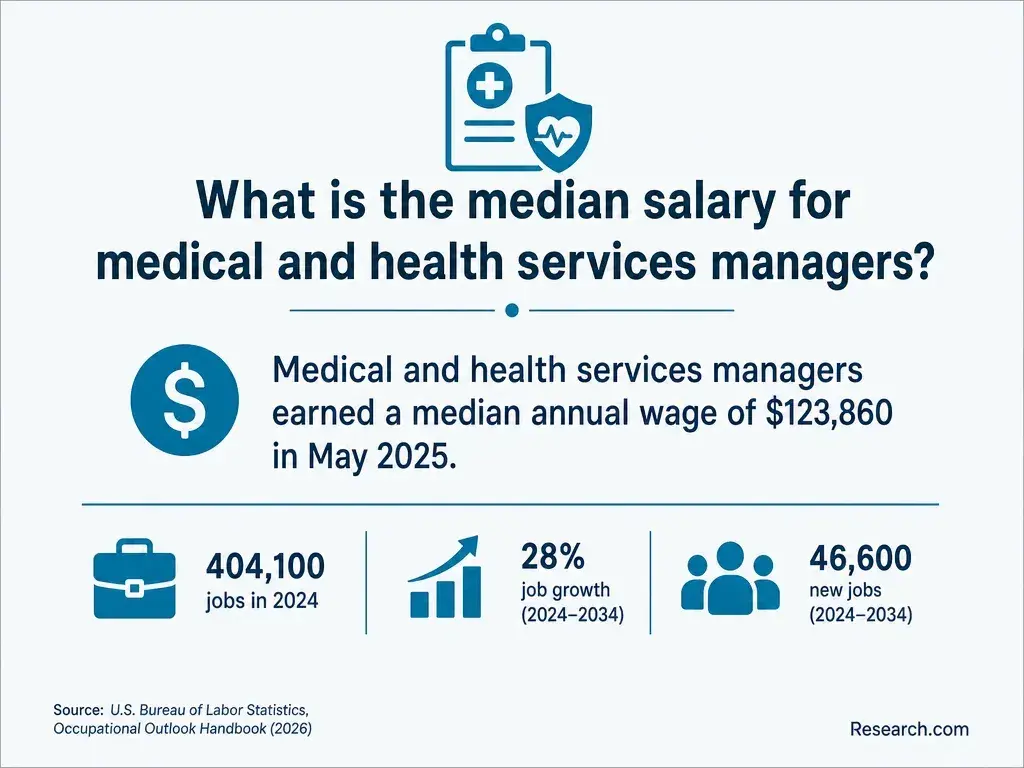
For salary context, the US Bureau of Labor Statistics reports a May 2025 median annual wage of $126,520 across all management occupations. That broad figure is not a community benefit salary or an expected wage for a new graduate; compare job postings for the specific role and location instead. Experienced leaders considering research-intensive or executive roles might examine faster doctoral completion pathways in healthcare leadership, but a doctorate is not the usual first step into community benefit work.
Do Healthcare Administrators Need Licenses or Professional Certifications?
Community benefit and population health administration roles generally do not require a universal healthcare administrator license. Requirements change if a job includes a separately regulated function, such as clinical practice or certain facility-administrator positions; check the state and the job description. An optional professional credential may strengthen a particular skill set, but it does not replace experience or confer permission to practice a licensed profession.
The same distinction applies to advanced degrees. Short-format doctoral healthcare administration study considerations may matter later in a leadership career, but neither a doctorate nor an MBA turns a community benefit classification exercise into a clinical credential.
Other Things You Should Know About Healthcare Administration
Yes, if your assignment allows it. Label every invented amount as an assumption and keep it separate from published hospital figures. Do not present a hypothetical calculation as an actual tax filing.
Check the assignment rules. If you use a real organization, clearly distinguish its published facts from the programs and decisions you invented.
Follow the assigned rubric and explain the difference when it affects your answer. A classroom framework may be designed to teach concepts rather than reproduce a federal reporting form.
Give a conditional classification: state the most plausible category, identify the fact that would confirm it, and explain how a different answer to that fact would change your conclusion.
- Rubrics: Tools for Making Learning Goals and Evaluation Criteria Explicit for Both Teachers and Learners - PMC https://pmc.ncbi.nlm.nih.gov/articles/PMC1618692/
- Community benefit activities of private, nonprofit hospitals | nih.gov https://pubmed.ncbi.nlm.nih.gov/21451160/
- Chapter 1., Section 8. Some Lessons Learned on Community Organization and Change - Main Section | Community Tool Box https://ctb.ku.edu/en/table-of-contents/overview/model-for-community-change-and-improvement/lessons-learned/main
- Learning Outcomes | Center for Teaching & Learning | Student Support & Advising Services https://www.colorado.edu/center/teaching-learning/teaching-resources/course-design-development/learning-objectives
- Course Assessment Plan Development | osu.edu https://drakeinstitute.osu.edu/institute-articles/course-assessment-plan-development
- Creating Learning Outcomes - Stanford Teaching Commons https://teachingcommons.stanford.edu/teaching-guides/foundations-course-design/course-planning/creating-learning-outcomes
- 7.2 Defining Activities - Project Management | MSL Academic Endeavors https://pressbooks.ulib.csuohio.edu/project-management-navigating-the-complexity/chapter/7-2-defining-activities/
- Build Your Impact Narrative - Assess Your Research Impact | Research Guides at Virginia Commonwealth University https://guides.library.vcu.edu/research_impact/narrative
- Course Objectives & Learning Outcomes | DePaul University, Chicago https://resources.depaul.edu/teaching-commons/teaching-guides/course-design/Pages/course-objectives-learning-outcomes.aspx
- Research Guides: Organizing Your Social Sciences Research Assignments: Writing a Case Analysis Paper | usc.edu https://libguides.usc.edu/writingguide/assignments/caseanalysis