2027 Choosing an Online Data Science Master's for a Career in Food Production

Co-Founder and Chief Data Scientist
Choosing an online data science master's for a food production career means looking beyond a program's degree title. A food scientist moving into analytics, a plant operations professional, and a prospective supply chain analyst may need different technical depth and project opportunities.
The strongest choice will teach sound statistical and computing methods while giving you a way to apply them to production, quality, or distribution problems. This guide shows what to compare, what to verify with schools, and when a different credential may be a better fit.
Key Things You Should Know
- Prioritize statistical modeling, data engineering, and a substantial project you can connect to production, quality, or supply chain data - not a program that merely mentions the food industry.
- Verify institutional accreditation, online availability where you live, project flexibility, and the full cost before applying; these details vary by school.
- The U.S. Bureau of Labor Statistics projects 35% growth in data scientist employment from 2025 to 2035, but that national forecast does not measure hiring specifically in food production.
What is an online data science master's degree for food production careers?
It is typically a general data science graduate degree applied to food-industry problems, not a separate qualification in food production. Students learn to manage data, build and evaluate models, and communicate results; they bring food-domain knowledge through electives, projects, prior work, or collaboration with industry partners.
Match the degree to the decisions you want to influence. A prospective process analyst may need time-series analysis and experimental design to study yield or downtime. Someone targeting demand planning may benefit more from forecasting and optimization. If interpreting business performance is the main goal and advanced modeling matters less, compare master's in data analytics study options before committing to a data science curriculum.
Which online data science master's programs are accredited?
Accreditation generally attaches to the institution, not specifically to its online data science master's. Without checking a current accreditor record for each school, a list of supposedly accredited programs would be unreliable. Verify the institution and its accreditor through the U.S. Department of Education's accreditation database or the accreditor's own directory, then confirm that the degree appears in the school's current academic catalog.
Accreditation alone does not establish that the program fits food production. Also ask whether the school can enroll students residing in your state, whether any required activities involve travel, and whether a proposed food-industry project would be permitted. Treat an unclear accreditation claim or an inability to provide a current catalog and tuition schedule as a reason to pause - not as proof that the program is invalid.
How can data science support modern food production?
Food producers can use data science to improve decisions across processing, quality, maintenance, and distribution. The useful method depends on the data and the consequence of an error: predicting a short stoppage is different from assessing a potential food safety concern.
The table connects common production questions to the evidence a student might encounter. It is a way to judge whether a program's projects resemble the work you want to do.
| Production question | Relevant data | Possible analytical approach | Important limitation |
| Why is yield changing? | Batch records, ingredient properties, equipment settings | Regression, experimental design, process monitoring | Correlation alone does not establish the cause. |
| When might equipment fail? | Sensor readings, maintenance logs, operating conditions | Time-series modeling, anomaly detection | Rare failures can make models hard to validate. |
| How much product will be needed? | Orders, promotions, seasonality, inventory | Forecasting, optimization | Changing demand can quickly weaken forecasts. |
| Which lots need investigation? | Inspection results, lot records, process measurements | Risk scoring, statistical process control | A model must not replace required human review or controls. |
AI-based inspection or prediction can be worth studying, but a promising model is not automatically safe to deploy. In a regulated production setting, data quality, traceability, validation, and the ability to explain decisions can matter as much as predictive accuracy.
What coursework should an online data science master's include?
Look for a foundation in statistics, programming, databases, machine learning, and model evaluation. For food production, especially useful depth includes experimental design, time-series analysis, optimization, data pipelines, and communication with nontechnical stakeholders. Course titles are only a starting point: a brief forecasting unit is not equivalent to a course with substantial forecasting projects.
A strong project opportunity lets you define an operational question, document data quality, compare a model against a sensible baseline, and explain the cost of false alarms or missed problems. For example, a downtime project should evaluate how early a warning arrives and whether operators could act on it - not just report model accuracy. If you cannot use workplace data, ask whether the program accepts appropriately sourced public or simulated data for an industry-relevant project.
Check course descriptions and sample capstone requirements for evidence of this work. A program with excellent general machine learning instruction may still be a poor fit if its project rules prevent you from exploring your target production problem.
What are the admission requirements for online data science master's programs?
Requirements vary. Programs may expect prior coursework or demonstrated ability in programming, calculus, linear algebra, and statistics, while others provide preparatory study. A background in food science, engineering, agriculture, or operations can supply valuable domain context, but it does not automatically fulfill a formal math or coding prerequisite.
Before applying, compare your transcript and work samples with each program's published requirements. Ask admissions staff whether specific prior courses meet any prerequisites and whether missing preparation can be completed before enrollment. If your primary interest is AI rather than broader data science, artificial intelligence master's routes from other disciplines may help you compare entry paths; do not assume their requirements match those of a data science program.
How do online and campus-based data science master's programs compare?
Neither format is inherently better for food production. Online study may let you keep a plant, quality, or supply chain job and turn familiar problems into course projects. Campus study may be preferable if you need frequent in-person collaboration, access to particular facilities, or a local research group.
Compare the actual delivery rules rather than the format label. Ask whether online classes are live or self-paced, when group work occurs, how projects are supervised, and whether any exams or residencies require travel. For an employed student, the decisive question is often whether the program accommodates production shifts and permits an applied project - not whether the diploma says "online."
How long does an online data science master's take and cost?
Time to completion depends on required credits, course availability, prerequisite work, and whether you study full-time or part-time. Total cost depends on more than advertised tuition: account for mandatory fees, software or equipment requirements, any travel, and the income you might forgo if you reduce work hours. Request a written estimate based on your expected course load and residency status.
A faster pathway can lower the time spent studying but may leave less room for prerequisite preparation or a food-focused project. If you are also considering an AI degree, AI master's programs with sub-two-year pathways offer a separate pace comparison; check whether their curriculum serves your intended role before comparing completion times. Employer tuition support may change your out-of-pocket cost, but confirm eligibility, reimbursement timing, and any continued-employment conditions.
What careers can a data science master's lead to in food production?
Potential destinations include production or process analytics, quality analytics, demand forecasting, supply chain analytics, and data science roles at food manufacturers or their technology suppliers. Job titles differ across employers. A degree can strengthen your qualifications, but relevant experience, project evidence, and the ability to work with operations teams also affect hiring.
Choose a target role before choosing electives. Someone who wants to improve line performance should seek projects involving process data and measurable operational decisions; someone aiming for computer-vision inspection may need deeper imaging and machine learning work. If AI development is the main objective, assessing artificial intelligence degree options by career path can help clarify whether a specialized degree better matches that goal.
How much can food production data science professionals earn?
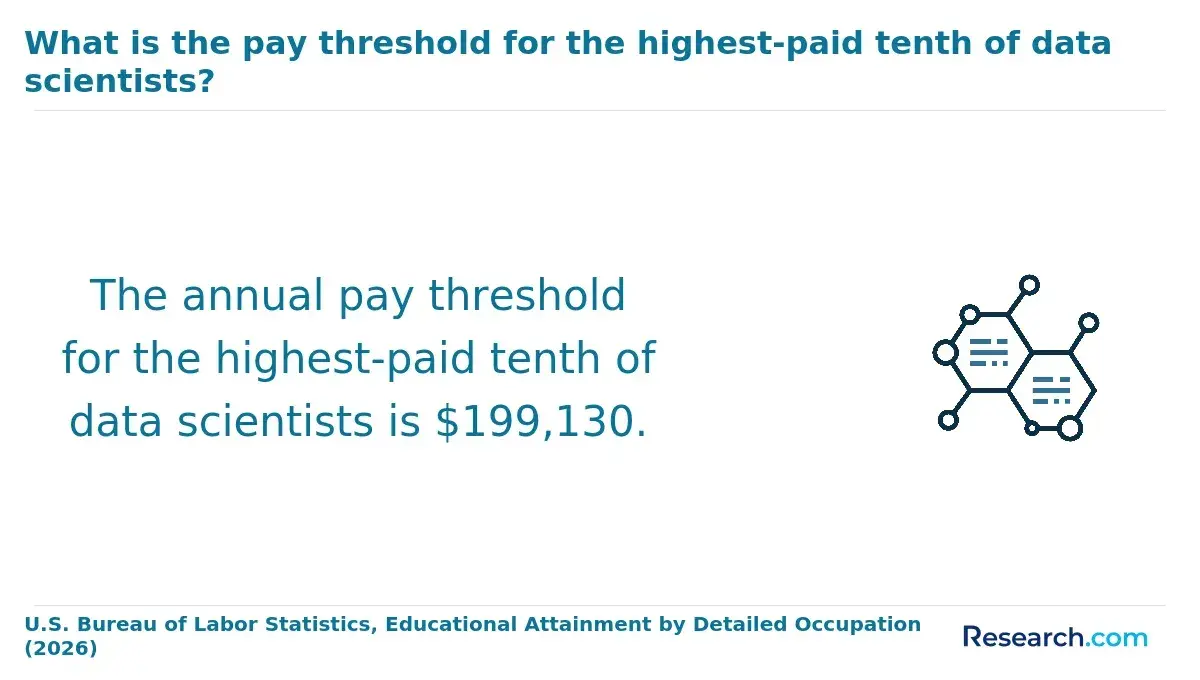
The U.S. Bureau of Labor Statistics reports a $120,230 median annual wage for data scientists in May 2025. That is a national figure for the occupation, not a food-production-specific salary or a predicted salary for graduates of an online master's program.
Use the figure as context, then examine postings for the roles, locations, and employers you are considering. A quality analyst and a data scientist may have different responsibilities and pay even within the same company. When weighing tuition against potential earnings, compare opportunities available with your current experience against those the degree could plausibly help you pursue; do not attribute an entire future salary to the degree.
What skills and certifications strengthen a food production data science career?
Technical credibility comes from showing that you can clean imperfect operational data, use SQL and a programming language, evaluate models appropriately, and explain results to people responsible for production decisions. Food-domain knowledge - such as understanding batch records, process variation, traceability, and quality workflows - helps you ask better questions and recognize when a model's output needs investigation.
Certifications can complement these skills, but their value depends on the job. A food safety or quality credential may matter more for a quality-focused position; a cloud or data-platform credential may be more relevant to a data engineering role. Neither substitutes for evidence that you can solve a production problem responsibly. If you expect to design AI systems used in consequential decisions, choosing an AI ethics and governance track is worth considering alongside technical training.
Before enrolling, identify a few target job postings and note their recurring tools, domain requirements, and responsibilities. Then ask each program how its coursework and project supervision would help you produce evidence for those requirements. A common mistake is choosing the most advanced-sounding curriculum without checking whether it supports the work you actually want to do.
Other Things You Should Know About Data Science
Not necessarily. Agricultural projects often focus on growing and harvesting; food production analytics may focus on processing, packaging, quality, and distribution. Some data and methods overlap, so judge a project by the decisions it addresses rather than its industry label.
Only with appropriate permission and safeguards. Ask your employer and program about data ownership, confidentiality, access, and publication rules before proposing the project. A de-identified, public, or simulated dataset may be a workable alternative.
Not by itself. Auditor positions may require food safety knowledge, specific training, and experience set by the employer or relevant audit scheme. Check the qualifications for the particular positions you want.
Not always. If you can develop the needed programming and statistical skills through targeted study and projects, that may be sufficient for some analytics roles. A master's is more compelling when the roles you want require deeper technical preparation than you can demonstrate otherwise.
References
- The Application of Artificial Intelligence and Big Data in... - PMC https://pmc.ncbi.nlm.nih.gov/articles/PMC10742996/
- Cost of Attendance (Budget) | 2025-2026 Federal Student Aid Handbook https://fsapartners.ed.gov/knowledge-center/fsa-handbook/2025-2026/vol3/ch2-cost-attendance-budget
- DAPIP | Homepage - Office of Postsecondary Education (OPE) https://ope.ed.gov/dapip/
- HACCP Principles & Application Guidelines | fda.gov https://www.fda.gov/food/hazard-analysis-critical-control-point-haccp/haccp-principles-application-guidelines
- Types of Financial Aid: Grants, Work-Study, and Loans | studentaid.gov https://studentaid.gov/understand-aid/types
- Syracuse Online Master's in Applied Data Science https://onlinegrad.syracuse.edu/information-science/applied-data-science/
- Data Science and Analytics, MS Online | New England College https://www.nec.edu/programs/data-science-and-analytics-ms-online
- MS in Data Science | Online | $9900 | Eastern University https://www.eastern.edu/academics/graduate-programs/ms-data-science
- Cost of Attendance - Financial Aid and Scholarships | The University of Utah https://financialaid.utah.edu/tuition-and-fees/cost-of-attendance.php
- Understanding FSMA: HACCP, HARPC and the Preventive Controls for Human Food Rule | psu.edu https://extension.psu.edu/understanding-fsma-haccp-harpc-and-the-preventive-controls-for-human-food-rule/