Careers After an Online MBA in Nonprofit Management for Small Business Owners

Co-Founder and Chief Data Scientist
Small business ownership builds skills that nonprofits value: managing cash, serving customers, hiring people, and making difficult trade-offs. Moving into nonprofit leadership, however, also means working with boards, donors, restricted funding, and a mission that shapes every decision. This guide explains which careers may be realistic after an online MBA in nonprofit management, where your ownership experience transfers, and where it may not.
It also covers the degree's cost, time commitment, and alternatives so you can decide whether it is the right investment.
Key Things You Should Know
- Owners can pursue nonprofit operations, program, finance, or social-enterprise roles; executive positions generally require relevant sector experience as well as management ability.
- An online MBA combines a broad business core with nonprofit-focused study, but a short course or targeted volunteer leadership role may be a better first step if you need only sector-specific knowledge.
- The Bureau of Labor Statistics reports a $126,520 median annual wage for all management occupations in May 2025 - not for nonprofit managers or MBA graduates specifically. Do not use it as a personal salary forecast.
What careers can you pursue after an online MBA in nonprofit management?
For an owner, the most realistic transition depends on what you already run. Experience supervising staff and improving service delivery may translate to nonprofit operations. Managing budgets can support a move toward finance or administration, while building partnerships may help in community programs or fundraising. An MBA can strengthen your candidacy, but employers will still assess your knowledge of their mission, funding model, and stakeholders.
The following paths differ in how directly ownership experience transfers and what you may need to learn before applying.
| Career path | Transferable owner experience | Likely gap to address |
| Operations or administrative manager | Staffing, vendors, budgets, and process improvement | Grant restrictions, board reporting, and nonprofit accountability |
| Program manager or director | Service delivery, team leadership, and measuring results | Experience with the population served and program outcomes |
| Development or fundraising manager | Relationship-building and persuasive communication | Donor stewardship, grant writing, and fundraising practice |
| Social-enterprise leader | Revenue generation and commercial operations | Balancing earned income with charitable mission and governance |
| Executive director | Organization-wide decisions and financial responsibility | Demonstrated nonprofit leadership, board partnership, and fundraising |
An owner moving into a similar-size organization's operations role may have a more direct path than one seeking to lead a large charity immediately. To test a substantial career change, take on a defined nonprofit project - such as improving a program budget or service workflow - and use its results to show how your experience applies.
How can an online nonprofit management MBA help small business owners?
The strongest case for the degree is that it develops capabilities you can use in both settings. Managerial finance can sharpen cash-flow and resource-allocation decisions in your business. Marketing and operations courses can help you reach customers and improve service delivery. Nonprofit-focused work adds a different lens: how to pursue a mission when donors, grants, clients, and boards may each define success differently.
That overlap is valuable if you plan to keep operating your business while serving on a nonprofit board, launch a social enterprise, or eventually move into nonprofit management. It is less compelling if your immediate need is narrow - for example, learning to write grants. A focused course, mentor, or supervised nonprofit project could address that need with less expense and time away from the business.
Before enrolling, identify a business problem and a nonprofit career goal that the MBA's actual courses or projects would help you tackle.
What does an online MBA in nonprofit management teach?
An MBA typically has a general management core covering subjects such as accounting, finance, marketing, operations, strategy, and organizational behavior. A nonprofit management concentration, when formally offered, adds courses or projects focused on topics such as fundraising, governance, mission-driven strategy, and measuring program results. An MBA with one nonprofit elective is not necessarily a designated concentration.
Look closely at the sector emphasis before choosing a program. A healthcare business owner aiming specifically at hospital or health-service administration, for example, may find that fast online MBA programs in healthcare management cover more relevant operating issues than a general nonprofit concentration.
Conversely, an owner planning to lead a community charity should prioritize board governance, funding, and accountability over industry-specific healthcare courses. Compare course descriptions and applied projects, not just concentration names.
Online delivery does not by itself determine whether an MBA is credible. Verify that the university holds recognized institutional accreditation, then check whether its business school has specialized accreditation, if that matters to your target employers. These are different forms of recognition; neither establishes that a particular nonprofit concentration is offered online.
For a career transition, respect also depends on evidence beyond accreditation: relevant coursework, substantive projects, access to nonprofit professionals, and your own record of results.
Admissions selectivity is a separate consideration. If you are exploring online MBA programs with accessible admissions, do not treat acceptance rates alone as a measure of instructional quality or career value. Ask whether online students can use career services and whether any nonprofit projects involve real organizations.
Requirements vary by university. Applicants commonly need a bachelor's degree and may be asked for a résumé, statement of purpose, recommendations, or an interview. Some schools require a GMAT or GRE score; others waive testing or do not require it. A business bachelor's degree is not universally required, though an owner without recent accounting or quantitative coursework may benefit from preparation before classes begin.
Compare each school's published rules rather than assuming your ownership experience replaces an academic requirement. An online MBA programs business prerequisites comparison can help you identify programs worth investigating, but confirm current prerequisites and testing policies directly with each school.
In your application, describe concrete decisions you made - such as managing cash shortages, hiring, or improving operations - and explain how they connect to your nonprofit goal.
Completion time depends on required credits, course sequencing, and whether you study full-time or part-time. A faster schedule can reduce the time spent in school but may draw attention away from customers and staff. A slower one may protect business continuity while extending tuition payments and delaying a career move. Ask schools for a term-by-term plan based on the course load you can actually sustain.
Online does not always mean self-paced. Check live-class times, group meetings, residencies, and policies for pausing enrollment during a busy season. If your operating hours change unpredictably, online MBA programs with asynchronous classes may be easier to evaluate than programs with frequent required live sessions. Confirm which parts of a specific program are asynchronous; group work can still require coordinated time.
There is no single price for this degree. Compare total required tuition and mandatory fees, not only an advertised per-credit rate. Include books and software, any required travel, financing costs, and income you might forgo if coursework reduces the time you can spend running your business. Verify whether a nonprofit concentration adds credits or fees to the standard MBA.
If you are comparing formats, online executive MBA programs with manageable tuition may be relevant to an experienced owner, but an executive format is not automatically cheaper or better suited to nonprofit work. Request a written total-cost estimate and a realistic course schedule from each school. Then compare that commitment with the cost of a targeted course or executive-education program that addresses your immediate skills gap.
There is no reliable single salary for graduates of this concentration. Pay varies by occupation, location, organization size, funding, and prior experience. As a broad reference point, the Bureau of Labor Statistics reports that the median annual wage across all management occupations was $126,520 in May 2025. That figure includes many industries and managers without this MBA; it does not describe nonprofit management pay or predict what an owner would earn after changing careers.
For a useful comparison, look at current postings for the specific role and region you want. Compare their compensation and required experience with what you earn from your business, including benefits you would gain or give up. A mission-driven move can be worthwhile without increasing pay, but it should be a deliberate financial choice rather than an assumed MBA return.
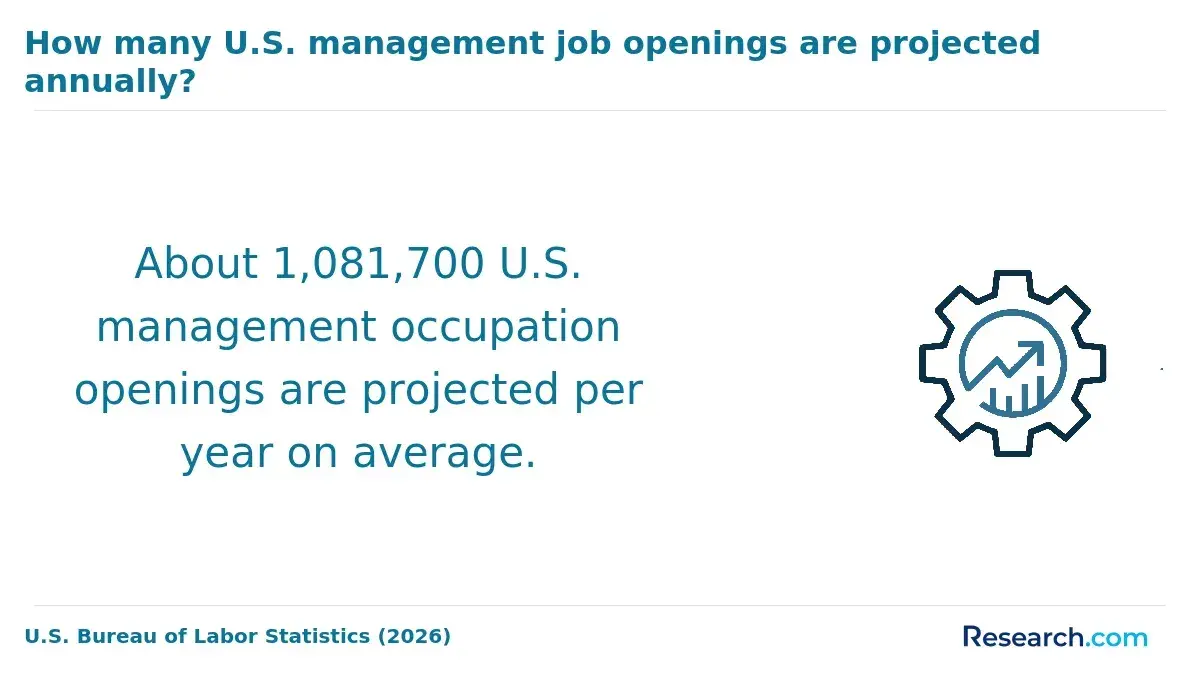
The Bureau of Labor Statistics projects about 1.1 million management-occupation openings each year, on average, from 2025 to 2035, reflecting growth and replacement needs across the economy. This is not a forecast of nonprofit vacancies. It indicates broad demand for managers while leaving the prospects for any particular nonprofit role dependent on local organizations, budgets, and experience requirements.
Research the market at the level you hope to enter. Review postings from nonprofits in your area for recurring requirements, then speak with leaders about how they fill operations, program, and development roles. If nearly every target position calls for direct fundraising or program experience, build that experience alongside - or before - an MBA rather than expecting the degree to close the gap by itself.
Do nonprofit management MBA graduates need licenses or certifications?
Nonprofit management itself generally does not require a professional license, and an MBA does not confer one. Requirements can change when a role includes regulated work, such as clinical services, legal practice, or licensed accounting activities. Check the duties of the job, not just the organization's nonprofit status.
Optional fundraising, project-management, or accounting credentials may help with particular functions, but they are not substitutes for demonstrated results. For most owners entering nonprofit management, a stronger first move is to identify the function they want, gain relevant experience, and pursue a credential only when target employers value it.
Other Things You Should Know About MBA
Often, but review the nonprofit's conflict-of-interest and outside-employment policies. Disclose any vendor, client, or financial relationship between the two organizations before accepting a role.
It can demonstrate governance and mission commitment, especially if you contribute to substantive decisions. Board service is not the same as managing staff or programs, so describe your responsibilities accurately.
Start with the mission and operating model, not the organizational label. If an existing nonprofit can deliver the work effectively, joining or partnering with it may be more practical than creating a new organization.
Possibly, if the instructor permits it and confidentiality rules allow it. Ask whether applied assignments can address your business, a nonprofit partner, or both before counting on them as a benefit.
- Nonprofit Executive Director Job Description | Southeast Missouri State University https://semo.edu/blog/blog-posts/nonprofit-executive-director-job-description
- MBA Opportunities That Combine Salary and Social Impact | CSUMB https://mba.csumb.edu/blog/nonprofit-mba-careers-with-salary-and-social-impact
- Fundraising and Development Certificate | UC San Diego Division of Extended Studies https://extendedstudies.ucsd.edu/certificates/fundraising-and-development
- Nonprofit Manager + Professional Grant Writing Course | Loyola Marymount University https://academics.lmu.edu/extension/programs/business-programs/grantwriting-and-nonprofit/
- Social Entrepreneurship and Nonprofit Management | Mount saint vincent https://online.mountsaintvincent.edu/degrees/business/mba/nonprofit-management/social-entrepreneurship/
- Is an Online MBA Worth It? Costs, Salary, ROI | University of the People https://www.uopeople.edu/blog/is-an-online-mba-worth-it/
- Top 18 essential nonprofit management skills and development tips | cmich.edu https://www.cmich.edu/blog/all-things-higher-ed/top-18-essential-nonprofit-management-skills-and-development-tips
- 18 Nonprofit Job Titles & 6 Career Paths to Follow | University of San Diego Online Degrees https://onlinedegrees.sandiego.edu/nonprofit-jobs/
- 18 Careers You Can Pursue with an MBA (Aside from Business) | umn.edu https://online.umn.edu/story/18-careers-you-can-pursue-mba-aside-business
- How an MBA Degree Can Help You in Your Nonprofit Career | BGSU Online https://onlinedegree.bgsu.edu/programs/business/mba/general/help-your-nonprofit-career/