Careers after an online MBA in Healthcare Management for public sector professionals

Co-Founder and Chief Data Scientist
If you manage programs, budgets, or operations in a public health agency or government hospital, an online MBA in healthcare management may help you pursue broader leadership work. It will not, however, replace the experience or qualifications a specific position requires.
This guide maps realistic career paths, explains where business training fits public-sector rules, and puts cost, salary, and job-outlook information in context so you can decide whether the degree—or a more targeted option—supports your next move.
Key Things You Should Know
- The strongest near-term paths usually build on work you already do: healthcare operations, program management, budgeting, procurement, or organizational improvement.
- An MBA does not confer a clinical license, meet every government job qualification, or automatically raise a public employee's grade or pay.
- The Bureau of Labor Statistics projects about 1.1 million annual openings across all management occupations from 2025 to 2035; that broad figure is not a forecast of healthcare management vacancies.
What Careers Can You Pursue After an Online MBA in Healthcare Management?
For an established public sector professional, the most realistic outcome is often a move into greater responsibility within a familiar system. A healthcare management MBA combines general business training with healthcare-focused study; it can strengthen a candidacy for management work, but it is not itself a job qualification that overrides experience requirements.
The paths below differ in how much of your existing experience you can carry into the next role. Titles vary across agencies, health systems, and contractors.
| Career path | Typical work | Most relevant prior experience |
| Healthcare operations manager | Coordinate staffing resources, service delivery, budgets, and process improvements | Clinic, hospital, or agency operations |
| Health program manager | Oversee implementation, contracts, performance measures, and reporting | Public health programs or grants |
| Healthcare finance or procurement manager | Support financial planning, purchasing, vendor oversight, and compliance | Government budgeting, finance, or acquisition |
| Health system strategy or improvement manager | Evaluate service changes and coordinate teams across departments | Quality improvement, analytics, or organizational change |
A shift from a public agency to a private or nonprofit health system is possible, but employers may expect direct provider-side experience. Clinical leadership is a different path: licensed nurses exploring online MBA career paths should distinguish business-management positions from roles that require nursing credentials and practice experience.
How Can Public Sector Professionals Use an Online Healthcare Management MBA?
Use the degree to solve a defined management problem, not merely to add letters after your name. An agency analyst might apply managerial finance to a service-expansion proposal; a hospital operations employee might use process analysis to reduce delays; a program supervisor might evaluate contractor performance. These examples are useful because they produce evidence of responsibility and results that a hiring panel can assess.
Public institutions operate under appropriations, procurement rules, transparency duties, and mission-based measures of success. Private-sector tools such as cost analysis and strategy can help, but they must be adapted to those constraints rather than treated as substitutes for them.
If your goal is internal advancement, compare the degree with your agency's position requirements and ask about education assistance before enrolling. If your goal is senior leadership and you already have substantial management experience, compare a conventional MBA with online executive MBA programs; their schedules, peers, and costs may fit differently.
An MBA is less compelling when the target position chiefly requires a clinical credential, specialized policy expertise, or experience you have not yet gained. In those cases, a relevant assignment, employer training, or a specialized graduate degree may be a more direct step.
What Healthcare Management Jobs Are Available in Government Agencies?
Potential employers include federal healthcare organizations such as the Department of Veterans Affairs, health agencies within the Department of Health and Human Services, and state or local health departments. Opportunities may involve facility administration, program operations, grants, contracts, finance, or performance improvement. A job's official title and classification may not include "healthcare manager," so search by function as well as title.
Read the actual vacancy announcement before choosing a degree around a desired role. Check its required experience, education, occupational series or classification, grade, location, and any specialized conditions. A current employee can also ask a supervisor or human resources office which assignments demonstrate readiness for the next level. An MBA may strengthen management skills while leaving a posting's mandatory experience or professional qualification unchanged.
The MBA core generally develops management skills in accounting, finance, operations, strategy, analytics, and organizational leadership. Healthcare-focused courses may apply those skills to health system finance, quality, policy, reimbursement, or healthcare operations. The exact mix varies: a formally designated concentration is not the same as taking one healthcare elective.
For public sector work, examine assignments as closely as course titles. A useful program may let you analyze a public budget, improve an agency process, or assess a healthcare contract while addressing ethics and governance. Ask whether projects require access to workplace data and whether the school offers an alternative when an agency cannot share it. Also check live meetings and collaborative requirements rather than assuming online study is entirely self-paced; online MBA programs with limited group work may be worth comparing if unpredictable public-service duties make team scheduling difficult.
Many nonclinical healthcare management jobs do not require a professional license solely because they involve healthcare. Requirements attach to the position, however, not to the MBA: nursing leadership may require an active nursing license, and some long-term care administrator roles are subject to state licensure. Clinical practice requires its own professional qualifications.
Optional certifications can demonstrate expertise in areas such as project management, healthcare quality, or finance, but an MBA concentration is not equivalent to a certification. Before paying for either, review several target postings and the relevant state licensing board's rules. That comparison will show whether the missing qualification is management education, a specific credential, or hands-on experience.
Completion time depends on the program's required credits, course sequence, available terms, and your enrollment pace. Accelerated study can shorten the calendar, while part-time study can leave more room for full-time agency work. A healthcare concentration may also have courses offered on a limited schedule, so ask for a term-by-term plan rather than relying on a headline completion time.
For employees who may be assigned emergency response, travel, or irregular shifts, the more important question is whether deadlines and required meetings are workable. Compare online MBA programs with asynchronous classes with programs that require scheduled sessions, and confirm rules for missed work, course breaks, group projects, and any campus visits. Asynchronous delivery can ease scheduling without reducing the work required.
There is no single price for this degree. Compare the total amount you would pay: tuition for every required credit or course, mandatory fees, materials, any travel, and financing costs. Check whether healthcare concentration courses carry different charges and whether published tuition assumes a particular enrollment pace. A tuition-only figure is not a complete budget.
Public sector employees should ask their employer what education assistance is available, whether approval must come before enrollment, and whether reimbursement depends on grades, job relevance, or continued service. Then compare your likely out-of-pocket cost with a concrete career objective. If your target posting mainly calls for procurement experience or a specific credential, a full MBA may be a costly way to address a narrower gap.
An online MBA can be a credible qualification, but "accredited" needs a precise meaning. Verify that the university holds recognized institutional accreditation, then check whether its business school or MBA also has specialized business accreditation if that matters to you. Do not assume institutional accreditation and specialized business-school accreditation are interchangeable—or that a healthcare-themed course establishes a formal concentration.
Employer value also depends on curriculum, relevant experience, and whether the program supports your intended move. When comparing online MBA programs with accessible admissions, assess accreditation, healthcare course depth, project opportunities, and total cost as well as entry requirements. For government roles, the vacancy announcement—not a school's marketing language—remains the authority on minimum qualifications.
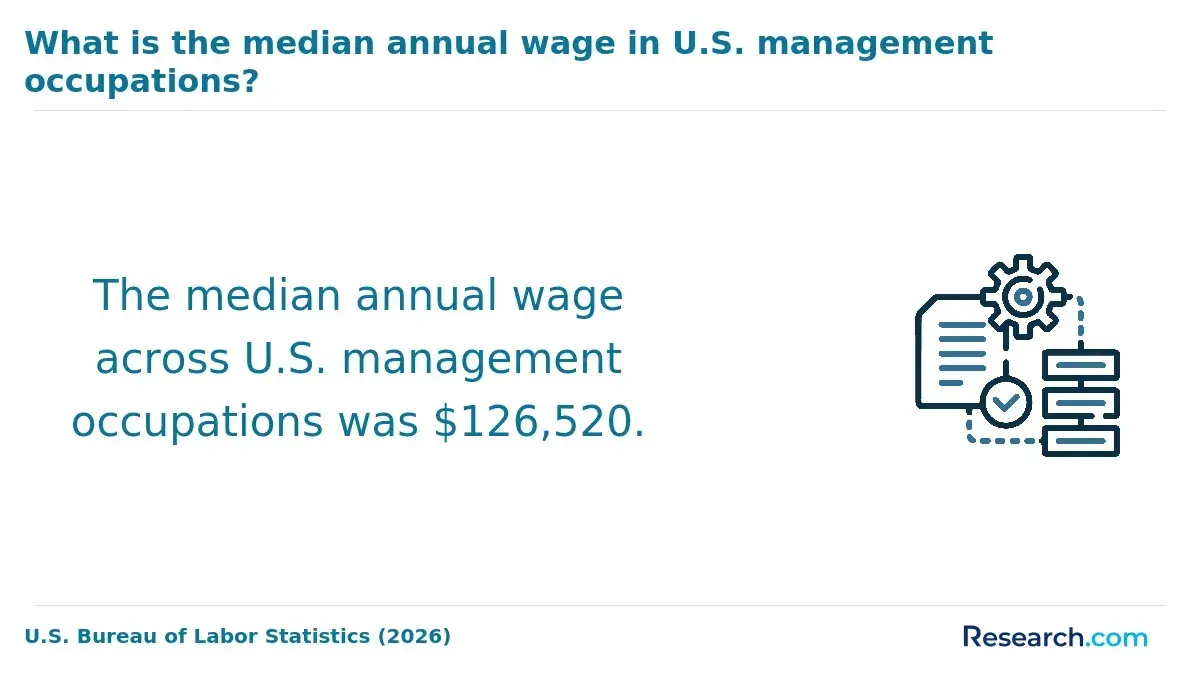
There is no reliable salary that applies to every healthcare management MBA graduate. As broad context, the Bureau of Labor Statistics reports a $126,520 median annual wage for management occupations in May 2025. That figure covers management jobs across industries and experience levels; it is neither a healthcare-management-specific wage nor an MBA graduate starting salary.
For a useful personal estimate, look at posted pay ranges for positions you could realistically qualify for in your location. Government grades, steps, and locality rules can constrain an internal pay increase, while a move to a hospital, contractor, or nonprofit brings a different compensation structure. Compare those ranges with your current pay and expected education cost; do not assume the degree itself will cause the difference.
How Strong Is the Job Outlook for Healthcare Management Careers?
The broader management labor market offers opportunities: the Bureau of Labor Statistics projects management-occupation employment to grow faster than average from 2025 to 2035. That projection includes many fields beyond healthcare and does not predict hiring by a particular health department, hospital, or federal agency.
For public sector professionals, the practical outlook is local and role-specific. Funding, approved vacancies, classification rules, and competition from applicants with direct healthcare experience can matter more than a broad growth forecast. Track postings for your target function, note recurring qualifications, and seek assignments that close those gaps while studying. That evidence will tell you more about your prospects than the MBA title alone.
Other Things You Should Know About MBA
Only with the necessary employer approval and safeguards. Ask the program whether it accepts public, de-identified, or simulated data when confidential agency information cannot be used.
Yes. Public hospitals can use different hiring and employment arrangements. Check the employer and vacancy terms rather than assuming every public hospital position follows the same civil-service rules.
Yes, if the school formally awarded the concentration and your academic record supports it. If you took healthcare electives without a designated concentration, list the relevant coursework instead.
Not necessarily. First identify the roles you want and their qualifications. If your main gap is supervisory experience, seeking a stretch assignment now may do more for your candidacy than starting the degree immediately.
- Monetary and Nonmonetary Costs and Benefits of a Public Health Master's Degree in the 21st Century | nih.gov https://pmc.ncbi.nlm.nih.gov/articles/PMC7287566/
- Health Workforce Projections | hrsa.gov https://bhw.hrsa.gov/data-research/projecting-health-workforce-supply-demand
- HHS Office of Human Resources Guidance, Hiring Assessment Strategies | HHS.gov https://www.hhs.gov/about/agencies/asa/ohr/hr-library/hiring-assessment-strategies.html
- Summary of the Public Health System in the United States | nih.gov https://www.ncbi.nlm.nih.gov/books/NBK218212/
- Health workforce | who.int https://www.who.int/health-topics/health-workforce
- MPH vs. MHA vs. MBA: Choosing the Right Path for Your Career in Healthcare - Purdue Online https://www.purdue.edu/online/mph-vs-mha-vs-mba-choosing-the-right-path-for-your-career-in-healthcare/
- Healthcare Executive Jobs: How to Build a Leadership Career | USC Price https://priceschool.usc.edu/price-blog/healthcare-executive-jobs-how-to-build-a-leadership-career-in-healthcare/
- Careers in Healthcare Management | charlotte.edu https://hmp.charlotte.edu/degrees-and-programs/phs-graduate-programs/master-health-administration-mha/careers-healthcare/
- Healthcare Administrators in Public Health: Career Guide [2026] | SUU https://online.suu.edu/degrees/business/mba/healthcare-administration/healthcare-administrators-in-public-health/
- Public vs. Private Sector Careers: What's the Difference? | Online Master of Public Administration https://onlinempa.uic.edu/news-stories/public-vs-private-sector-careers/