Is an Online MBA in Healthcare Management Worth It for Career Changers?

Co-Founder and Chief Data Scientist
Moving into healthcare management can mean building on experience you already have - or starting over in an unfamiliar industry. An online MBA in Healthcare Management may help you learn the business side of healthcare while keeping your job, but its value depends on the role you want and the experience employers expect.
This guide helps career changers assess realistic entry points, compare the MBA with more direct alternatives, and weigh costs against potential benefits before choosing a program.
Key Things You Should Know
- An online healthcare MBA is most promising when your existing operations, finance, technology, or management experience maps to a specific healthcare role; the degree alone is unlikely to secure a senior position.
- Compare the full cost with a realistic transition path, not a management salary headline: the median annual wage across all US management occupations was $126,520 in May 2025, not the expected pay for new healthcare MBA graduates.
- Prioritize programs with relevant healthcare projects, usable career support, and access to employers; if you need clinical qualifications or an entry-level foothold, a different credential or direct work experience may be more useful.
Is an online MBA in Healthcare Management worth it for career changers?
It can be worth it if you can connect your current skills to a defined healthcare business role and obtain the industry exposure needed to compete for it. The MBA provides broad management training; a healthcare management concentration applies some of that training to healthcare organizations. Neither is a substitute for clinical credentials or a record of managing healthcare operations.
The size of your career change matters. A finance manager moving into a hospital finance team can build on a familiar function while learning healthcare reimbursement and budgeting. Someone with no management or healthcare experience seeking to run a hospital department faces a much larger gap. For that person, a coordinator, analyst, or project role may be a more credible first step than an MBA alone.
Use your target job - not the degree title - as the test of value. Review actual postings for the roles and locations you want, then compare their experience requirements with your background. Ask each school whether online students can complete healthcare-focused projects, use career services for an industry change, and connect with relevant employers. A program is harder to justify if those opportunities are limited and you would need substantial loans to attend.
Career changers who plan to keep working can explore MBA degree options for working adults programs online, then verify that each program offers meaningful healthcare coursework rather than only a broadly named elective. When the immediate goal is to enter healthcare, targeted courses plus relevant work experience may offer a more direct route.
What careers can career changers pursue with an online healthcare MBA?
Your strongest entry point is often a healthcare version of work you already do. These examples distinguish plausible transitions from roles that generally require a longer track record.
| Existing experience | Possible healthcare direction | Gap to address |
| Operations or project management | Clinic operations, process improvement, or healthcare project coordination | Patient-flow, compliance, and healthcare-system experience |
| Finance or accounting | Provider finance, budgeting, or revenue-cycle analysis | Healthcare payment and reimbursement knowledge |
| Technology or data | Health IT implementation or healthcare business analysis | Clinical workflows, privacy rules, and relevant systems |
| Sales, service, or people management | Patient access, service-line support, or team operations | Healthcare terminology and employer-specific operating requirements |
Job titles vary widely. An "administrator" position at a small practice may have very different responsibilities from an executive role at a hospital. Seek projects that demonstrate the missing knowledge - for example, analyzing a care-delivery process or working with a healthcare employer - while you study. If postings consistently require prior healthcare experience, consider an adjacent position first rather than treating the MBA as a shortcut past that requirement.
How much does an online MBA in Healthcare Management cost?
There is no single price: schools set tuition by credit, course, term, or program, and a concentration may add coursework. Request a written estimate based on your expected course load. Include mandatory fees, materials, technology, any required travel, and interest if you will borrow. Check whether a quoted price covers the full degree or tuition only.
For a career changer, affordability also depends on what happens before the target job arrives. Compare your total out-of-pocket and borrowing costs with a conservative earnings scenario that includes any time spent in an entry-level or adjacent healthcare role. A simple payback check divides your net education cost by a plausible annual increase in earnings - but only if that increase follows from an attainable job move, not from an occupational median. If you cannot identify a credible path to that move, a precise return-on-investment estimate would be misleading.
Ask about employer tuition assistance, scholarships, payment schedules, and whether changing your enrollment pace affects fees or aid. You can compare affordable MBA schools MBA USA as a starting point, but compare each school's total cost for the curriculum you would actually take.
The MBA core typically covers accounting, finance, operations, strategy, analytics, and organizational leadership. Healthcare-focused study may address reimbursement, healthcare policy, quality improvement, health systems, or the management of patient-facing organizations. Course names and depth differ by school: a healthcare elective does not necessarily mean the school offers a formal healthcare management concentration.
For career changers, applied coursework is especially valuable when it produces evidence of relevant skills. A project involving a clinic's staffing process, for example, may help an operations professional explain how familiar management methods translate to care delivery. Before enrolling, inspect the required course sequence and ask whether online students can undertake healthcare projects with real organizations. An MBA teaches managerial decision-making; it does not train you to provide clinical care.
Some are, but accreditation must be checked for each school and program. Institutional accreditation concerns the university as a whole; business-school or programmatic accreditation is a separate distinction. AACSB, ACBSP, and IACBE are business-education accreditors, but their scopes and standards differ. A healthcare concentration does not automatically carry its own separate accreditation.
Confirm the institution's current accreditation through the accreditor or the US Department of Education's recognized-accreditor resources. Then check any claimed business accreditation directly with that accreditor and verify that it covers the relevant business unit or program. Accreditation is an important screening step, not evidence that a particular online program has strong healthcare recruiting access.
Requirements vary by school. Applicants generally need a bachelor's degree and may be asked for transcripts, a résumé, a statement of purpose, recommendations, or an interview. Schools differ on work-experience expectations and GMAT or GRE policies; some require tests, some offer waivers, and others do not require them. Do not assume a nonbusiness degree or a lack of healthcare experience rules you out.
Preparation should match your gap. An experienced manager new to healthcare may benefit from learning basic healthcare terminology and payment models. An applicant with deep healthcare experience but limited business coursework may need a refresher in accounting or quantitative analysis. Ask whether foundation courses are required, included in the degree, or charged separately - and use your application to explain the specific role you intend to pursue.
Completion time depends on required credits, course sequencing, transfer or waiver policies, and whether you study full-time or part-time. A healthcare concentration can extend the timeline if its courses are offered infrequently. Request a term-by-term plan based on your intended pace rather than relying on a school's fastest advertised completion time.
Online delivery does not necessarily mean control over your schedule. Ask about live classes, group meetings, exam windows, residencies, and whether taking a break delays access to required courses. If unpredictable work hours are a concern, business degrees for students needing schedule flexibility online MBA programs with asynchronous classes can provide comparison points; confirm each program's actual live-session and team-project expectations before applying.
An online MBA can let you retain your job and income while testing a move into healthcare. A campus program may be more practical if your transition depends on intensive in-person recruiting, internships, or local employer connections. Neither format is automatically better: the decisive issue is whether its students can access the experiences and contacts your target role requires.
Ask schools how career advising, employer events, alumni introductions, and experiential projects work for online students specifically. Confirm whether internships are feasible for employed students and whether campus visits are required. Established managers considering a different kind of leadership program may also compare executive MBA options by total cost, though an executive MBA is generally a less direct fit for someone seeking an initial healthcare foothold.
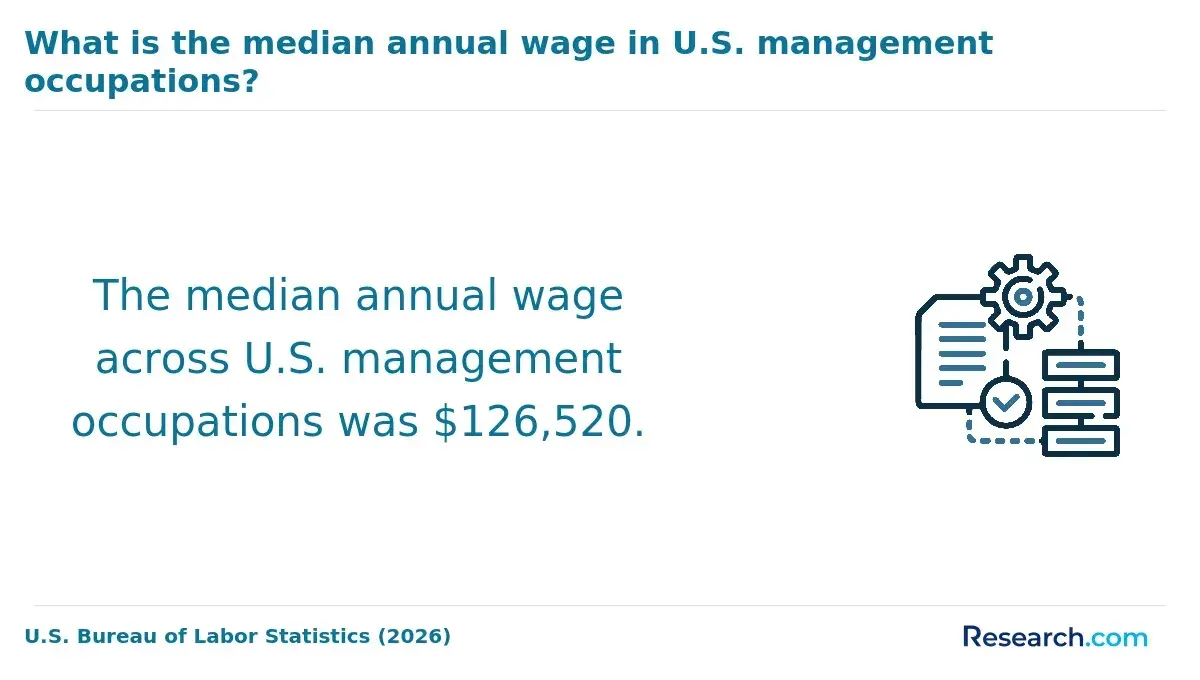
There is no dependable single salary for online healthcare MBA graduates. Pay depends on occupation, employer, location, scope of responsibility, and prior experience. The US Bureau of Labor Statistics reports a $126,520 median annual wage for all management occupations in May 2025. That broad figure includes established managers across industries; it is not a starting salary, a healthcare-specific estimate, or evidence that an MBA caused higher earnings.
For a useful personal estimate, compare compensation in local postings for the first role you could realistically obtain, then examine the experience needed for the next role. The BLS projects management occupations overall to grow faster than the average for all occupations from 2025 to 2035, but that outlook does not predict hiring for a particular healthcare job or new graduate.
Do healthcare management careers require licenses or certifications?
Many business and administrative roles do not require a clinical license, but requirements depend on the job and state. An MBA does not qualify someone to practice nursing, medicine, or another licensed health profession. Nursing home administrator roles, for example, can have state-specific licensing requirements; check the relevant state board before choosing a degree path.
Optional credentials in areas such as project management or healthcare quality may help demonstrate particular skills, but employers can still require relevant experience. Licensed nurses seeking both advanced nursing education and management training can use tuition-focused MBA program search degree programs to explore combined MSN/MBA options. They should verify each program's nursing prerequisites and whether it supports their intended clinical role.
Other Things You Should Know About MBA
Yes. Ask hiring managers or professionals in your target function which experience they value and whether an MBA would strengthen your candidacy. Their answers can help you choose a program - or decide to gain experience first.
Often, yes. Look for healthcare clients, projects, volunteer responsibilities, or internal transfers that let you build relevant experience while employed. Confirm that these opportunities are realistic alongside your study schedule.
A Master of Healthcare Administration may fit someone focused specifically on leading healthcare organizations. An MBA may fit someone who wants broader business training or the option to work across industries. Compare actual courses and employer expectations, not degree labels alone.
Explore roles and speak with people doing the work before committing to a full degree. A targeted course or project can help you test your interest at lower cost.
- Accreditation and Certification: Do They Improve Hospital Financial and Quality Performance? | nih.gov https://pmc.ncbi.nlm.nih.gov/articles/PMC8305524/
- Accreditation in the U.S. | ed.gov http://www.ed.gov/laws-and-policy/higher-education-laws-and-policy/college-accreditation/accreditation-in-the-us
- MPH vs. MHA vs. MBA: Choosing the Right Path for Your Career in Healthcare - Purdue Online https://www.purdue.edu/online/mph-vs-mha-vs-mba-choosing-the-right-path-for-your-career-in-healthcare/
- Online MBA in Healthcare Management | 5 Public Administration Careers for MPA Graduates https://www.augusta.edu/online/mba-healthcare-management.php
- FAQ: Earning Your MBA in Healthcare Management Online | Fitchburg State University Online https://online.fitchburgstate.edu/degrees/business/mba/healthcare-management/faq/
- Online MBA in Healthcare Management | AACSB-Accredited | The University of Scranton https://gradadmissions.scranton.edu/programs/masters-business-administration/healthcare-management-specialization.shtml
- MBA Healthcare Management | CU Online https://online.campbellsville.edu/online-degrees/mba-healthcare-management/
- Online MBA Healthcare Management Concentration | SNHU https://www.snhu.edu/online-degrees/masters/mba-online/mba-in-healthcare-management
- Healthcare Management Careers with an M.B.A. - MTSU https://mba.mtsu.edu/articles/health-care-management-careers-with-mba/
- MBA vs. MHA: Which Degree Is Right for You? | SIUE https://online.siue.edu/degrees/business/mba/healthcare-administration/administrator-salary/