Is an Online MBA in Information Systems Worth It for Working Parents?

Co-Founder and Chief Data Scientist
An online MBA can remove a commute, but it cannot remove deadlines, group meetings, or the need for childcare during focused study. For working parents considering an Information Systems concentration, the decision is whether its management training can advance a realistic career goal without overextending the household. This guide explains what the degree teaches, where it may help professionally, and how to assess its cost and scheduling demands. You can use those factors to decide whether a full MBA - or a narrower credential - is the better next step.
Key Things You Should Know
- It is most likely worth it if you already work near technology or business operations, want greater responsibility for technology decisions, and can manage the program's actual weekly commitments.
- Check the full household cost: tuition is only part of the expense; fees, childcare, lost work time, and borrowing can change the return on investment.
- Do not treat salary figures as a promise: the $126,520 median annual wage reported by the U.S. Bureau of Labor Statistics for management occupations in May 2025 describes workers in those occupations, not online MBA graduates.
Is an online MBA in Information Systems worth it for working parents?
Yes, potentially - but only when the degree serves a defined career move and the family can sustain its cost and schedule. An Information Systems MBA combines general business management with study of how organizations select, govern, and use technology. It is usually a better fit for someone aiming to lead technology-related work than for someone seeking deep software engineering or cybersecurity training.
The strongest case is often an adjacent move: an analyst, IT professional, project lead, or operations employee seeking responsibility for budgets, teams, vendors, or digital initiatives. The case is less certain if the hoped-for promotion has no clear requirements, the program requires frequent evening meetings, or substantial borrowing would strain household finances. A parent considering a major career change should also examine whether employers expect technical experience the MBA will not provide.
Evaluate value against your current pay and opportunities, not a published post-MBA salary. Compare the total amount you would pay with a conservative estimate of additional earnings you could realistically obtain; divide the former by the latter for a rough payback period. That calculation excludes uncertainty, financing costs, and nonfinancial benefits such as better management skills. If the advancement case is weak, a targeted course, certification, or employer-sponsored project may deliver more relevant learning at lower cost. If admission barriers are part of the decision, compare top online MBA programs with accessible admissions without letting ease of entry outweigh career fit or scheduling requirements.
What can you do with an online MBA in Information Systems?
The degree may support advancement toward IT project or program management, business systems management, technology consulting, or leadership of digital operations. In these roles, the work can include setting priorities with business leaders, assessing technology investments, coordinating teams, and managing implementation risk. Your prior experience determines which path is realistic: an experienced IT professional may be positioned to supervise a function, while a business analyst might first move into a cross-functional project lead role.
An MBA does not by itself qualify someone to administer complex systems, architect software, or immediately become a senior technology executive. Parents with limited professional experience may find that an entry-level business technology role builds the foundation employers want before graduate study. They can compare MBA admission pathways for working adults online MBA programs without work experience requirements, but admission without experience should not be confused with access to management jobs after graduation.
How much does an online MBA in Information Systems cost?
There is no dependable single price for this degree: schools charge differently by credit, course, or program, and an Information Systems concentration may affect the courses or credits required. The table separates costs that families should include when comparing actual offers.
| Cost component | What it may include |
| Published academic charges | Tuition for all required credits and mandatory program or university fees |
| Study-related expenses | Books, software, equipment, and any required campus travel |
| Household and financing costs | Additional childcare, reduced paid work, and interest if borrowing is necessary |
Ask each school for a total-cost estimate at your intended pace and confirm whether tuition or fees can change during enrollment. Then subtract only funding you can reasonably expect, such as confirmed employer assistance. Reimbursement may arrive after you pay tuition, creating a cash-flow problem even if the eventual net cost is manageable. An affordable online MBA programs option 2 10 000 comparison can help identify lower-priced possibilities, but verify current charges and the availability of relevant Information Systems coursework before applying.
The MBA core generally covers management subjects such as accounting, finance, strategy, operations, and leadership. Information Systems coursework may address technology strategy, business analytics, enterprise systems, data governance, or managing technology projects. The emphasis is typically on making and implementing business decisions about technology - not training as a software developer or advanced data scientist.
Schools use concentration labels differently. Check whether "Information Systems" is a formal online concentration, a set of electives, or simply a related course within a general MBA. Compare the required courses and any capstone or team project with the decisions you want to make at work. For a parent, a useful project can connect study to current responsibilities, but a team-based capstone can also create fixed meeting obligations.
Completion time depends on required credits, course sequencing, and how many classes you take at once. Part-time study can make weekly demands more manageable but extends the period during which tuition payments and family scheduling must be coordinated. Accelerated study shortens the calendar only if you can reliably protect enough study time alongside work and caregiving.
Ask for a term-by-term plan showing when Information Systems courses are offered, whether they must be taken in sequence, and what happens if you skip a term. Also request the policies on leave, reentry, and maximum time to finish. A program advertised as "self-paced" may still have weekly deadlines or group meetings; the course schedule matters more than the marketing label.
Accreditation belongs to the institution or business school, not automatically to every concentration. Verify that the university holds recognized institutional accreditation, which is relevant to degree recognition and federal student aid eligibility. Separately, check whether its business school holds specialized accreditation, such as AACSB, ACBSP, or IACBE; these are distinct forms of review and should not be described as interchangeable.
Confirm that the MBA and its Information Systems courses are actually offered online by the accredited institution. Accreditation can help establish academic legitimacy, but it does not prove that a program's timetable, career services, or price will suit your family.
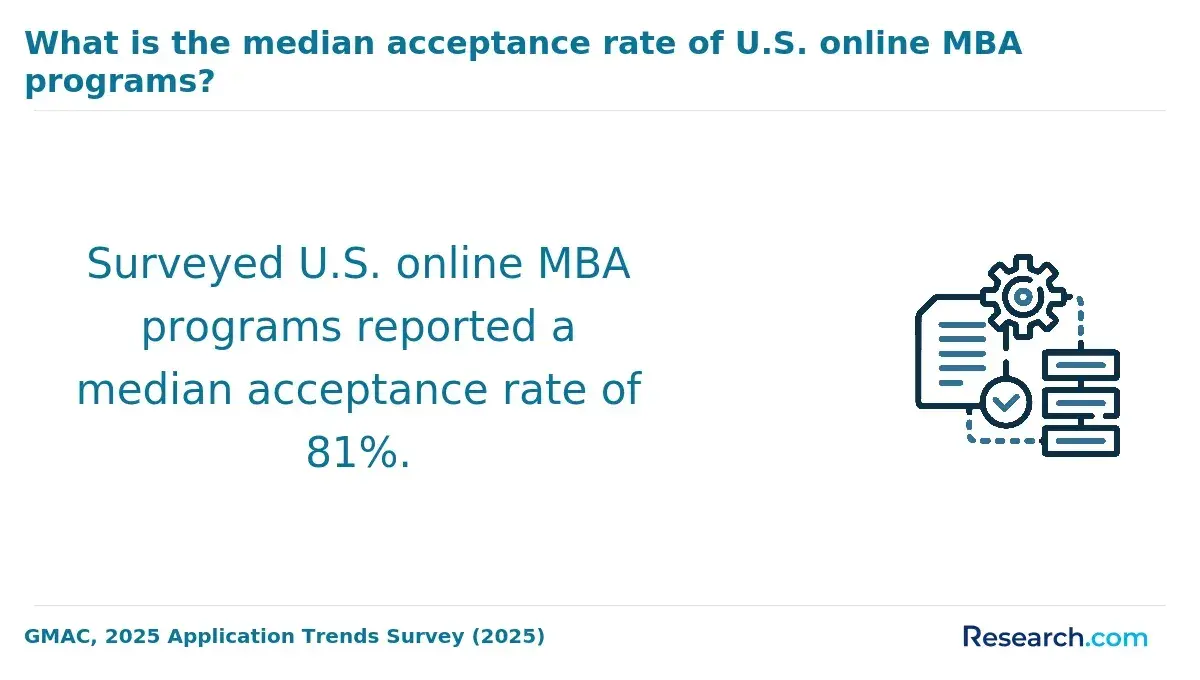
Requirements vary by school. Applications commonly ask for a bachelor's degree, academic records, a résumé, and a statement of purpose; some also request recommendations, an interview, or GMAT or GRE scores. Professional-experience expectations, test waivers, and any foundation coursework must be checked against the specific program's current policy. An Information Systems concentration does not universally require a computing bachelor's degree.
If your undergraduate record is a concern, review the school's stated minimums and waiver or provisional-admission policies rather than assuming you are ineligible. Guidance on online MBA application criteria can help frame that search. In an application, connect your work accomplishments and career goal to management-level technology study; do not rely on the concentration name alone to explain your fit.
An online MBA can be the better logistical choice when it eliminates commuting and lets you study around established childcare coverage. It is not necessarily the more flexible choice. Live classes, fixed exams, residencies, and group projects can still occupy evenings or weekends. A nearby campus program with predictable meeting times may be easier to plan around than an online program whose team meetings change each week.
Before choosing, request a sample course schedule and ask when classmates typically collaborate. If variable childcare coverage makes team coordination especially difficult, explore business-school options for online MBA programs with limited group work; confirm the requirements of the specific MBA rather than assuming an entire program has no collaborative assignments. Compare career services and employer access as well, because an online student should not assume they receive the same recruiting experience as a full-time campus cohort.
There is no single reliable salary for graduates of this concentration. Pay depends on the occupation, location, employer, prior experience, and scope of responsibility. The U.S. Bureau of Labor Statistics reports a $126,520 median annual wage for management occupations in May 2025. That broad occupational figure includes people with many educational backgrounds; it is not an MBA salary estimate or evidence that the degree caused an increase in pay.
For a useful personal comparison, look at compensation for the specific roles you could plausibly seek next, and compare their requirements with your résumé. Someone advancing within technology management may have a different earnings path from someone entering the field. Treat a potential raise as uncertain until you have evidence from relevant job postings, employer conversations, or an internal promotion pathway.
Do you need certifications or licenses after an MBA in Information Systems?
There is generally no occupational license required merely because you earned an Information Systems MBA. A particular job may value a project-management, cloud, cybersecurity, or vendor-specific certification, depending on its responsibilities. Those credentials demonstrate narrower knowledge; they do not replace an MBA's broad management curriculum, and the MBA does not replace hands-on technical experience.
Let the target role determine whether another credential is worthwhile. If job descriptions repeatedly require a specific platform skill that you lack, targeted training may be more direct than an MBA. If you already have technical credibility but need to manage budgets and organizational change, the MBA may address the more consequential gap.
Other Things You Should Know About MBA
That depends on the university's document and transcript policies. Ask the registrar what the diploma and transcript will show before enrolling.
Yes. Some employers require repayment if you leave within a specified period or fail to meet their eligibility rules. Read the written policy before counting assistance as guaranteed savings.
Possibly, but obtain employer approval and follow confidentiality and data-use rules. A realistic project can be valuable without disclosing sensitive company information.
Possibly, but check your leave terms, benefits rules, and the program's deadlines. Being permitted to enroll is separate from having predictable time to complete coursework while caring for a child.
- Overview of Accreditation in the United States | ed.gov http://www.ed.gov/laws-and-policy/higher-education-laws-and-policy/college-accreditation/overview-of-accreditation-united-states
- Employer-offered educational assistance programs can help pay for college | Internal Revenue Service https://www.irs.gov/newsroom/employer-offered-educational-assistance-programs-can-help-pay-for-college
- Is Online MBA Worth It? In a Word, Yes. | Babson College https://www.babson.edu/graduate/admissions/graduate-school-advice/is-online-mba-worth-it/
- FLEX MBA Career Outcomes - Lehigh College of Business https://business.lehigh.edu/academics/graduate/masters-programs/mba/flex-mba/career-outcomes
- MIS Careers: Salary Ranges and Growth Potential | SIUE https://online.siue.edu/degrees/business/mba/management-information-systems/mis-jobs-salary-guide/
- Getting an MBA While Working Full Time: How to Make It Work | Pace University New York https://www.pace.edu/news/getting-an-mba-while-working-full-time
- Why Is Accreditation Important? | ACE Blog https://ace.edu/blog/why-is-accreditation-important/
- Employer Tuition Assistance Plans May Help Pay for College | Campus https://campus.edu/blog/financial-aid/employer-tuition-assistance-programs-can-help-pay-for-college
- 4 Flexible Ways to Earn a College Degree on Your Schedule | St. John's University https://www.stjohns.edu/news-media/johnnies-blog/4-flexible-ways-earn-college-degree-your-schedule-0
- MBA Time Commitment: What to Expect from Full-Time and Part-Time Programs - Gary W. Rollins College of Business https://blog.utc.edu/business/2022/12/05/how-long-does-it-take-to-get-an-mba/