2027 BS in Business Administration and Supply Chain Management and Logistics: Evaluating Career Claims Before Requesting Information
Audited and Verified:
Our Editorial and Data Verification Process
Research.com uses government datasets, official education statistics and primary institutional information to support its career and degree guides. Our review process checks factual accuracy, occupational definitions, source dates and the requirements associated with the credentials discussed.
How This Article Was Fact-Checked
Our editorial team verifies salary estimates, employment projections, education requirements and program information against original data providers and official organizations. Salary figures are checked against the relevant occupational definitions and reporting periods. Information about licensure, accreditation and required in-person training is reviewed separately.
Fact-checked and verified on:

Co-Founder and Chief Data Scientist
A supply chain degree page may pair a promising job title with a salary figure, but neither tells you whether its graduates qualify for that job or earn that pay. If you are considering a BS in Business Administration with a supply chain management and logistics concentration, the useful question is what the program can help you learn and demonstrate.
This guide separates entry-level opportunities from experience-dependent roles, puts labor market figures in context, and shows what to verify about coursework, cost, accreditation, and outcomes before requesting information.
Key Things You Should Know
- A supply chain concentration can prepare you for analyst, purchasing, inventory, and logistics work, but a degree alone does not qualify you for management.
- The U.S. Bureau of Labor Statistics projects 18% employment growth for logisticians from 2025 to 2035; that occupation-wide projection is not a placement rate for graduates.
- The May 2025 median annual wage for logisticians was $82,320. Compare it with the program's actual graduate outcomes and your likely first role, not with an advertised earnings promise.
What is a BS in Business Administration with Supply Chain Management and Logistics?
It is a business bachelor's degree that combines a general business core with study of how organizations source materials, manage inventory, move goods, and coordinate suppliers and customers. Supply chain management covers decisions across that network; logistics focuses more closely on transportation, storage, and delivery. The distinction matters when comparing courses with the work you want to do.
Check the award's exact name. "Supply chain management and logistics" may be a formally recorded concentration, an elective group, or simply a description of available courses. A BS in Business Administration may offer broader preparation than a specialized supply chain bachelor's, while the specialized degree may devote more required study to the function. Neither structure is automatically better for hiring.
For someone already working in operations, the broader degree may help connect purchasing decisions to finance and management. If your goal is advancement without leaving work, compare its required schedule and projects with other career advancement study options in business administration. Ask the school which credential appears on the transcript and which courses are required, rather than relying on the program page's label.
What careers can you pursue with a supply chain management and logistics degree?
Potential starting points include logistics coordination, inventory analysis, purchasing support, and operations analysis. Employers define titles differently, so compare job duties and required experience—not just the title—with what you have done in coursework, internships, or employment.
The table distinguishes plausible early-career work from responsibilities that commonly require a stronger track record. It can help you test whether a program's career list describes realistic first jobs or longer-term possibilities.
| Role or path | Typical work | Evidence to develop |
| Logistics or transportation coordinator | Track shipments, resolve delivery exceptions, communicate with carriers | Spreadsheet reporting, clear communication, documented problem-solving |
| Inventory or supply chain analyst | Review demand, stock levels, and process data to support decisions | Data cleaning, forecasting basics, explanation of assumptions |
| Purchasing assistant or procurement specialist | Support supplier comparisons, orders, records, and compliance with purchasing rules | Cost analysis, supplier communication, attention to contractual details |
| Supply chain or operations manager | Own budgets, performance, supplier relationships, or staff supervision | Relevant results and judgment developed through substantial work responsibility |
Career changers can often make the strongest case for an adjacent role: for example, a warehouse employee who documents inventory improvements or a customer-service employee who has resolved delivery problems. If your target is coordinating projects rather than sourcing and distribution, compare the duties and affordable pathways to study project management before committing to this concentration.
How much can supply chain and logistics graduates earn?
There is no single reliable salary for graduates of this concentration. The U.S. Bureau of Labor Statistics reports a May 2025 median annual wage of $82,320 for logisticians, an occupation involving analysis and coordination of supply chains. That is the midpoint for workers across the occupation, not a starting salary or a measured outcome for people with this particular degree.
Your likely pay depends on the job's duties, location, industry, and your experience. A coordinator position and an experienced logistician position should not be treated as interchangeable merely because both appear on a school's careers page. Ask for outcomes specific to the program, including which graduates responded, when pay was measured, and whether the figures separate new entrants from experienced workers.
Judge an earnings claim against what you would pay and the role you could realistically seek after graduation. Comparing inexpensive online business administration colleges can help establish alternatives, but request each school's remaining-credit estimate before drawing a cost-versus-earnings conclusion.
Expect a business core that may cover accounting, finance, economics, statistics, management, and information systems. Supply chain coursework may address procurement, operations, inventory, transportation, forecasting, and supplier relationships. Schools differ in which topics are required, how deeply they are taught, and whether students use data in assessed projects.
To evaluate a career claim, connect a required course to a job task. Inventory analysis is more credible preparation when students build and explain a forecast than when the topic receives only a brief introduction. A supplier-selection exercise should require attention to cost, reliability, and risk—not price alone. Ask to see course descriptions and examples of permitted assignments, and confirm whether relevant electives are offered often enough to fit your graduation plan.
For transfer students, an accepted course may count only as a general elective rather than satisfy the business core or concentration. That distinction also matters if you are comparing functions: guidance on applying previous coursework to a project management degree is not evidence that the same credits will fill supply chain requirements. Request a program-specific degree audit.
A full-time student entering without college credit may plan around the school's standard bachelor's sequence; a transfer or part-time student needs an individual completion estimate. Accepted credits, prerequisites, course availability, and required credits completed at the awarding school can change that timeline. An accelerated calendar does not remove required work.
For a meaningful cost comparison, ask for a written estimate of remaining tuition and mandatory fees based on your evaluated credits. Include books or software, any travel or proctoring costs, and the effect of taking fewer courses per term. Check financial-aid eligibility and employer reimbursement rules separately: reimbursement may arrive only after you pay and complete a course.
If you are comparing this BS with a different business pathway, keep funding assumptions separate. An online project management undergraduate funding guide can identify aid questions to raise, but it cannot establish your award or this supply chain program's net price. Do not request information based on an advertised tuition figure alone.
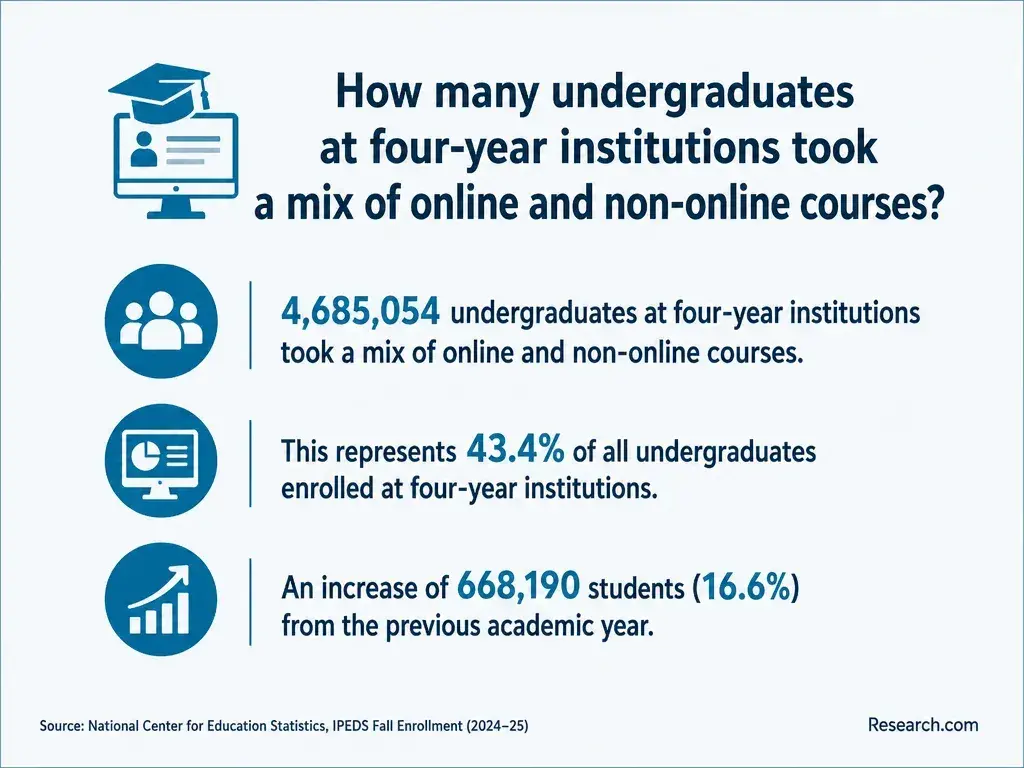
Delivery format alone does not establish a degree's quality or an employer's assessment of your skills. Compare the same essentials in either format: the awarding institution, required curriculum, faculty access, assessed work, career support, and opportunities to gain relevant experience. An online simulation can support learning, but it is not the same as an employer-supervised internship.
Online also does not necessarily mean self-paced. Ask about live sessions, group assignments, exam arrangements, software access, internship expectations, and required visits. If speed is the attraction, use lists of online colleges with accelerated supply chain bachelor's study to identify candidates, then confirm which courses you would actually need and when they run. A shorter advertised timeline may not fit a working student's schedule.
Requirements depend on the school and whether you apply as a first-year or transfer student. Schools commonly review prior academic records; some business majors have separate entry standards or require preparatory mathematics, statistics, accounting, or economics. Do not assume that admission to the university means immediate entry to the concentration.
Send admissions and the business adviser your transcripts, then request answers to two distinct questions: whether you qualify to enter and how previous courses apply to the degree. If you are considering another business function, material on HR bachelor's transfer credit evaluation may suggest useful questions, but only this school can decide how credits apply to its supply chain curriculum. Ask when any missing prerequisites must be completed and whether they delay required courses.
Start with the institution's current accreditation status and confirm it through the accreditor's directory and the U.S. Department of Education's accreditation information. Then check the school's own program record for the exact degree, campus or online delivery, and awarding unit. Accreditation of an institution does not, by itself, establish that a particular business program has separate business-school accreditation.
If a school cites AACSB, ACBSP, or IACBE, check that accreditor's directory and the scope of the listing; ask the school whether the specific degree is covered. Accreditation is an important quality and eligibility check, not proof that graduates obtain particular jobs. You can use national online business program rankings to make a shortlist, but verify accreditation directly rather than treating inclusion on a list as confirmation.
Many supply chain coordination and analysis jobs do not require a general occupational license. Requirements can change with the activity and employer: work involving regulated transportation, customs transactions, or other specialized duties may have separate rules. Read the target job posting and check the relevant regulator before assuming the degree supplies legal authority to perform a task.
Employers may value voluntary supply chain or procurement certifications, but each issuing organization controls its eligibility, exams, and experience requirements. A concentration is not a certification, and a course does not automatically satisfy a certifier's rules. If your goal is staff leadership rather than a supply chain credential, compare the job's experience requirements with undergraduate leadership programs with shorter timelines; neither degree substitutes for demonstrated supervisory responsibility.
How do you choose a reputable supply chain management degree program?
Choose against a specific target role, not the longest list of possible careers. Before requesting information, identify two or three relevant job postings and note their recurring tasks, tools, education preferences, and experience requirements. Then use the program's answers to test its claims.
These questions produce information you can compare across schools rather than another general brochure:
- What is the exact degree and transcripted concentration, and which supply chain courses are required?
- Can I see an official transfer evaluation and degree audit showing remaining requirements and course availability?
- What assessed projects, internships, or employer connections are available, and which are guaranteed versus optional?
- What will my remaining tuition and fees be, and what schedule can I realistically follow?
- Do you publish outcomes for this specific program, with cohort definitions and response rates?
If fast completion is important, explore US business bachelor's fast-track rankings for additional schools to question. Give greater weight to a credible individual degree audit, relevant coursework, and transparent outcomes than to an advertised completion time or an occupation-wide salary. If a school cannot substantiate its career claims, you can request clearer evidence—or consider a more direct route through relevant employment and targeted training.
Other Things You Should Know About Business Administration
No. Both are bachelor's degrees in business, but their official titles and required curricula vary by institution. Compare the actual courses and degree requirements rather than assuming one label carries a uniform advantage.
Yes, if you can describe relevant work such as tracking inventory, resolving delivery issues, coordinating vendors, or improving a process. Document the task and your contribution without disclosing confidential employer information.
Not automatically. Check whether your target employers require another degree or whether specific courses, supervised experience, or targeted training would address the gap more directly. Ask schools about second-bachelor's rules before applying.
Only if your employer permits it and you protect confidential information and intellectual property. When permission is unavailable, create a clearly labeled project using public or hypothetical data and explain your methods and assumptions.
- Understanding College Costs | studentaid.gov https://studentaid.gov/resources/prepare-for-college/students/choosing-schools/consider-costs
- Price of Attending an Undergraduate Institution - COE https://nces.ed.gov/programs/coe/indicator/cua/price-of-attending-an-undergraduate-institution
- Graduate Placement Rates - SC State Library Digital Collections https://dc.statelibrary.sc.gov/server/api/core/bitstreams/05ba701d-dd76-41db-8fef-f135f41a34b9/content
- Internship, Co-Op & Work Based Learning - UF Career Hub | Career Connections Center University of Florida https://careerhub.ufl.edu/channels/internship-co-op-work-based-learning/
- For Employers - Career Center - Georgia Tech https://career.gatech.edu/coops-internships/for-employers/
- Jobs and Career Paths in Supply Chain Management and Logistics - Global Supply Chain Institute https://haslam.utk.edu/gsci/news/supply-chain-management-career-path/
- Supply Chain Management Graduate Certificate | wsc.edu https://www.wsc.edu/supply-chain-management-graduate-certificate
- A project-based learning approach to supply chain mapping education - ScienceDirect https://www.sciencedirect.com/science/article/pii/S147281172400199X
- Online vs On-Campus College: Choose the Right Format | Bay Path University https://www.baypath.edu/news/bay-path-university-blogs/post/online-vs-on-campus-college-choose-the-right-format/
- What Can You Do with a Supply Chain Management Degree? | American Public University https://www.apu.apus.edu/area-of-study/business-and-management/resources/exploring-what-you-can-do-with-a-supply-chain-management-degree/