2027 Comparing Online BS in Business Administration Options for Part-Time Students Using Employer Benefits
Audited and Verified:
Our Editorial and Data Verification Process
Research.com uses government datasets, official education statistics and primary institutional information to support its career and degree guides. Our review process checks factual accuracy, occupational definitions, source dates and the requirements associated with the credentials discussed.
How This Article Was Fact-Checked
Our editorial team verifies salary estimates, employment projections, education requirements and program information against original data providers and official organizations. Salary figures are checked against the relevant occupational definitions and reporting periods. Information about licensure, accreditation and required in-person training is reviewed separately.
Fact-checked and verified on:

Co-Founder and Chief Data Scientist
An employer tuition benefit can make an online business degree affordable - or leave you paying bills long before reimbursement arrives. For working adults comparing part-time BS in Business Administration programs, the best fit depends on more than advertised tuition: course schedules, benefit rules, transfer credits, and the cash needed each term all matter.
This guide shows how to compare those factors, identify costs your employer may not cover, and choose a program you can realistically finish while keeping your job.
Key Things You Should Know
- Compare programs by the cost of courses that actually satisfy your degree requirements, not by advertised tuition or the number of credits a school says it accepts.
- Confirm whether your employer pays the school directly or reimburses you later; grade rules, annual limits, and job-change repayment terms can change your cash needs. Part-time online study is not necessarily self-paced.
- Check live sessions, group work, exam windows, and required-course availability before committing to an enrollment schedule.
What is an online BS in Business Administration for part-time students?
An online BS in Business Administration is an undergraduate degree covering several business functions rather than a single occupation. Part-time students take a reduced course load while continuing to work. That can make study more manageable, but it extends the calendar time needed to finish.
"Online" describes where instruction is delivered, not when work is due. Some programs use recorded lessons with weekly deadlines; others require live meetings, scheduled exams, or group presentations. Before treating a program as compatible with your job, request a recent syllabus for a required course and check its attendance and assessment rules.
A BS in Business Administration, BBA, and BA in Business may cover similar subjects, but their quantitative requirements, electives, and degree-completion policies can differ. If your aim is advancement at your current employer, compare the curriculum against the responsibilities you want next, not the degree title alone. Broader online business administration pathways alongside an existing career can provide a starting set of options to investigate.
How can employer tuition benefits help pay for an online business degree?
Employer assistance may be direct tuition payment, reimbursement after a passing grade, or access to a designated school network. These arrangements have different consequences even when the advertised benefit sounds identical. A network discount matters only if that school accepts your applicable credits and offers the courses you need.
Ask human resources or your benefits administrator for the written policy before enrolling. These questions expose the conditions most likely to affect your decision:
- Which schools, degree levels, courses, and fees qualify, and must your program relate to your current job?
- Is approval required before registration, and does the employer pay the school or reimburse you after grades post?
- What benefit limits, minimum grades, employment-status rules, and repayment obligations apply?
- Can you combine the benefit with grants or scholarships, and how does payroll handle any taxable amount?
Get the financial-aid office's explanation of how employer assistance interacts with other aid; do not assume two awards can pay the same charge twice. Even aid opportunities in a related field, such as grants for project management undergraduates, require their own eligibility checks rather than automatically applying to a BSBA.
How do online BSBA programs compare with campus-based business degrees?
Online and campus programs can lead to the same type of degree, but their schedules and access to learning opportunities differ. The comparison below focuses on constraints that matter when you must remain employed; confirm each feature with the school rather than assuming it follows from the delivery label.
| Factor | Online option | Campus-based option |
| Attendance | May allow remote participation, but live sessions and timed exams can still apply. | Requires travel and attendance at set locations and times. |
| Collaboration | Group projects may require meetings outside your work hours. | In-person meetings may be easier to arrange around scheduled classes. |
| Work-based projects | May let you propose a current-workplace project, subject to approval and data permissions. | May offer local employer activities, also subject to program requirements. |
| Costs beyond tuition | Check technology, proctoring, and any travel charges. | Check commuting, parking, and time away from work. |
Choose the format whose required activities fit your work schedule. A campus evening course may be more predictable than an online course with mandatory daytime meetings. When reviewing leading US colleges for online business study, use their listings to find candidates, then verify the current requirements for your specific program and term.
Start with the institution's accreditation status and confirm that its accreditor is recognized by the U.S. Department of Education or the Council for Higher Education Accreditation. Then check whether any advertised business accreditation - such as AACSB, ACBSP, or IACBE - actually covers the business school or program you intend to enter. Institution-level and business-specific accreditation are different claims; neither establishes that a program fits your employer's benefit policy.
Ask the school and your employer to confirm eligibility in writing, particularly if reimbursement requires an "accredited program" without defining the term. Also verify that online students receive the same advising, required-course access, and degree credential described for the offering you are considering.
An application-fee waiver can lower the cost of exploring a school, but it is not evidence of program quality. Lists of ways to apply to accredited online colleges for free are useful for finding candidates; the accreditation scope and benefit eligibility still need separate checks.
Most BSBA curricula combine general education with accounting, economics, finance, marketing, management, operations, business law, and quantitative or information-systems work. Requirements and course order vary. For a part-time employee, the decisive issue is whether prerequisites and infrequently offered courses allow a steady path to graduation.
Compare an official concentration with a few related electives. A formal concentration has defined requirements; an elective in supply chain or analytics does not, by itself, award that designation. Ask whether the classes you want are offered online at a part-time pace and whether choosing them adds credits or delays a required capstone.
If your target is a specialized logistics role rather than broad business preparation, compare the BSBA's supply chain content with supply chain bachelor's programs with compressed schedules. A shorter advertised timeline is useful only if your transferred credits, course sequence, workload, and employer benefit rules support it.
Schools commonly request evidence of prior education, such as a high school credential or college transcripts. Transfer applicants may face separate standards for admission to the institution and entry into the business major. Mathematics, accounting, or other prerequisites depend on the program; a gap in preparation does not necessarily prevent admission, but it may add courses to your plan.
Before applying, send unofficial transcripts for an initial review and ask when an official evaluation becomes available. Then request a degree audit showing which credits fulfill general education, business-core, concentration, elective, and residency requirements. Accepted credit is not the same as a requirement satisfied. Only the school can determine the final applicability of prior coursework.
Review credit and eligibility rules for business administration admission as preparation for questions to ask admissions and advising; the current catalog and your individual evaluation control your actual path.
There is no reliable completion price or date until a school evaluates your credits and maps your remaining requirements. Build a term-by-term estimate using the courses you still need, their tuition and mandatory fees, books and software, and any proctoring or travel costs. Add likely costs from course sequencing: a required class unavailable next term can delay completion even when you can afford to enroll.
The comparison below separates three figures that are often mistakenly treated as the same price. Request each from the school or employer for your own circumstances.
| Measure | What it includes | Why it matters |
| Program charges | Tuition and required fees for courses remaining after the official degree audit. | Shows what the school will bill, not what you will ultimately pay. |
| Cash needed during a term | Charges due before employer reimbursement and aid are received, plus uncovered materials. | Reveals whether you can manage the payment schedule without costly borrowing. |
| Expected personal cost | Eligible charges after confirmed benefits and aid, plus uncovered expenses and financing costs. | Supports a comparison of affordable completion paths. |
Ask whether tuition is charged per credit, course, or term and whether taking fewer courses changes fees or aid eligibility. Accelerated online bachelor's programs may shorten the calendar, but faster terms do not automatically reduce total charges or fit a full-time job. Have an adviser check your proposed course sequence before treating any timeline as dependable.
A BSBA can support applications for business operations, project coordination, sales operations, marketing support, procurement, or human resources positions. The realistic next role depends on your existing responsibilities and the evidence you can show - not simply on graduating. An employee who already tracks budgets or improves workflows may be better positioned for a related internal role than for an unfamiliar specialty.
Match courses and approved projects to a target job description. For example, operations roles may call for spreadsheet analysis and process documentation, while HR work may require familiarity with employment practices and careful handling of employee information. Ask whether your current job can supply a suitable academic project; employer permission and faculty approval are separate requirements.
If HR is your specific goal and you have substantial prior college work, compare the BSBA with colleges accepting credits toward human resources study. A specialized curriculum may be more direct, but only an official audit can show which route uses more of your credits. Neither degree alone guarantees an HR position or promotion.
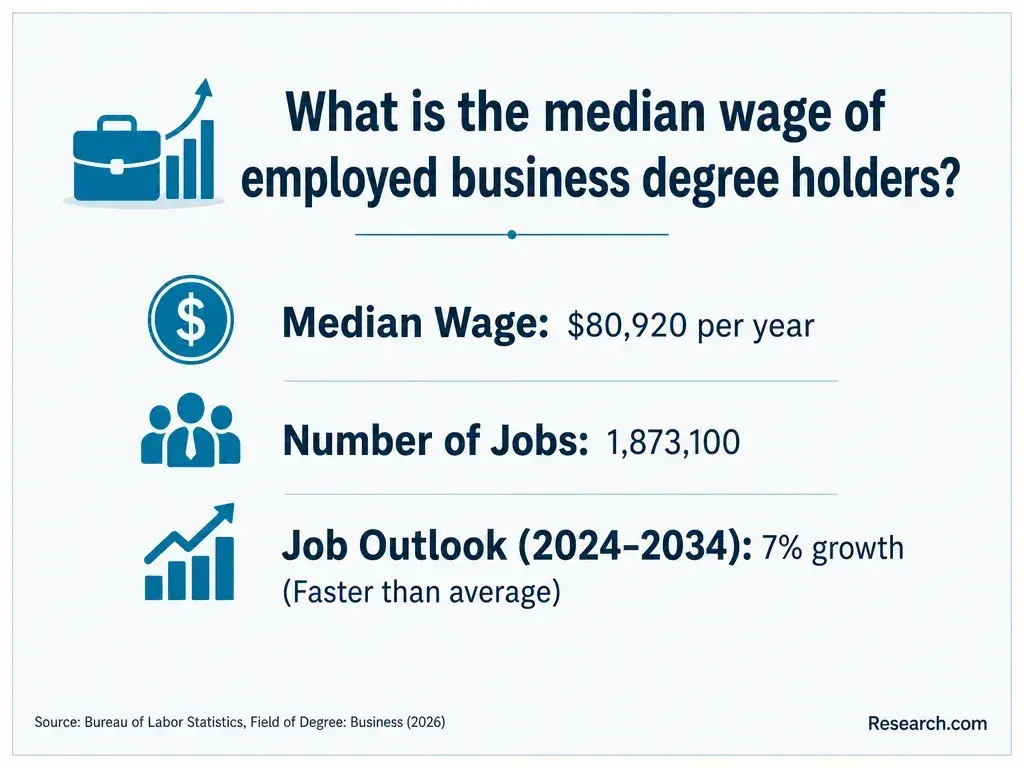
There is no single salary or employment projection for BSBA graduates: employers hire into occupations, and pay varies with responsibilities, experience, location, and industry. For one relevant occupation, the U.S. Bureau of Labor Statistics reports a $75,940 median annual wage for human resources specialists in May 2025 and projects 6% employment growth from 2025 to 2035. Those figures describe the occupation as a whole, not the starting pay or job prospects of someone newly completing a business degree.
Use occupation data to assess a role you could plausibly pursue, then compare local postings with your experience and skills. Do not use a manager's median wage to justify the cost of a degree if your likely next step is a coordinator or specialist role.
For a supply chain target, evaluating supply chain degree cost and duration comparisons alongside role requirements is more useful than assuming a broadly titled business degree will produce a particular salary.
Which certifications and standards matter for business administration careers?
A BSBA is an academic degree, not a professional license or a substitute for job experience. Employers may value separate credentials in human resources, project management, accounting, or another function, but eligibility can depend on documented experience, specific coursework, examinations, or licensing-board rules. Check the issuing organization's current requirements before assuming a concentration qualifies you.
For an employee using tuition benefits, the practical choice is whether the next role requires a bachelor's degree, a function-specific credential, or stronger evidence of work performance. If your employer mainly seeks demonstrated supervisory or organizational skills, compare the BSBA with organizational leadership bachelor's routes of three years or less and with employer training. Confirm which option your employer recognizes and funds before committing to a full degree.
Other Things You Should Know About Business Administration
Possibly, but benefits usually depend on continued eligibility under your employer's written policy. Check when coverage ends, whether already paid assistance must be repaid, and how you would fund the next term before changing jobs.
It can. Ask the school how a break affects reentry, catalog requirements, course availability, and financial aid. Check your employer's policy separately for any effect on benefit eligibility.
Only if the school offers an applicable prior-learning or work-based-credit process and approves your evidence. Holding a job does not automatically replace an internship, required course, or capstone.
Compare the remaining degree requirements and your personal cost at both schools. A preferred-school discount may be outweighed by additional required courses, uncovered fees, or a longer completion path.
- Employer-offered educational assistance programs can help pay for college | Internal Revenue Service https://www.irs.gov/newsroom/employer-offered-educational-assistance-programs-can-help-pay-for-college
- Asynchronous Online Instruction Leads to Learning Gaps When Compared to a Flipped Classroom - PMC https://pmc.ncbi.nlm.nih.gov/articles/PMC9366838/
- Tuition and Fees Data - Texas Higher Education Coordinating Board https://www.highered.texas.gov/legislative-appropriations-overviews/tuition-and-fees-data/
- Academic Years, Academic Calendars, Payment Periods, and Disbursements | 2025-2026 Federal Student Aid Handbook https://fsapartners.ed.gov/knowledge-center/fsa-handbook/2025-2026/vol3/ch1-academic-years-academic-calendars-payment-periods-and-disbursements
- What Can You Do With a Business Administration Degree? | American Military University https://www.amu.apus.edu/area-of-study/business-administration-and-management/resources/what-can-you-do-with-a-business-administration-degree-exploring-options/
- Transfer Credit Policy | Point University Catalog https://catalog.point.edu/policy/standinghonors/creditforpriorlearning
- Business Administration Career Resources | unl.edu https://business.unl.edu/business-career-center/business-administration-career-resources/
- Online Bachelor of Science in Business Administration | UML GPS https://gps.uml.edu/degrees/undergrad/online-bachelors-business-administration-degree.cfm
- How Harvard Online Helps Education Fit In Your Schedule https://harvardonline.harvard.edu/blog/redefining-flexibility-how-harvard-online-helps-education-fit-in-your-schedule
- Undergraduate and Graduate Tuition and Fees | Purdue Global https://www.purdueglobal.edu/tuition-financial-aid/undergraduate-graduate-tuition-and-fees/