2027 BS in Business Administration and Construction Management: Choosing Courses for Your First Related Job
Audited and Verified:
Our Editorial and Data Verification Process
Research.com uses government datasets, official education statistics and primary institutional information to support its career and degree guides. Our review process checks factual accuracy, occupational definitions, source dates and the requirements associated with the credentials discussed.
How This Article Was Fact-Checked
Our editorial team verifies salary estimates, employment projections, education requirements and program information against original data providers and official organizations. Salary figures are checked against the relevant occupational definitions and reporting periods. Information about licensure, accreditation and required in-person training is reviewed separately.
Fact-checked and verified on:

Co-Founder and Chief Data Scientist
A business administration degree can prepare you to track a construction budget, but it may not teach you to read plans or estimate a bid. That gap matters when you are choosing courses for your first related job. This guide is for students and career changers considering a BS in Business Administration with construction management coursework. It connects entry-level tasks to classes, projects, and field experience, then explains how to assess programs, costs, credentials, and career data before committing to a path.
Key Things You Should Know
- For a first project coordinator, estimating assistant, or construction operations role, prioritize scheduling, construction documents, estimating, cost accounting, and a supervised field experience - not management electives alone.
- A business administration degree with construction electives is not necessarily a construction management degree or an official concentration; check the awarded credential and required technical courses.
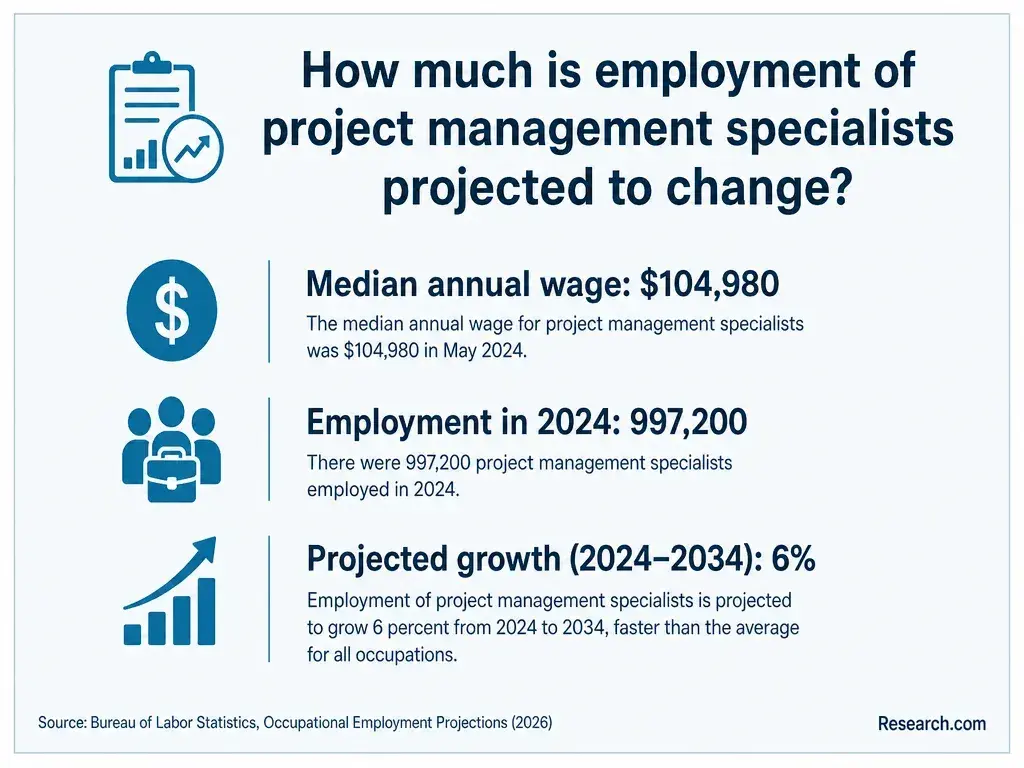
- The Bureau of Labor Statistics reports a May 2025 median wage of $102,320 for project management specialists, an occupation spanning many industries. It is not a starting-salary estimate for construction graduates.
What Is a BS in Business Administration and Construction Management?
The phrase can describe different programs: a BS in Business Administration with an official construction management concentration, a business degree with a few construction electives, or a separate BS in Construction Management. The diploma and transcript may identify these differently. Ask the school for the exact degree title, whether the concentration is formally recorded, and the courses required to complete it.
Business administration typically covers accounting, finance, operations, management, and communication. Construction management applies planning and business decisions to building projects, including estimates, schedules, contracts, safety coordination, and work performed by multiple trades. A business degree can be a strong fit for someone aiming at a contractor's operations or project-support team if it includes enough construction-specific instruction and access to jobsites. If the target is site supervision or technical estimating, a specialized construction management program may offer more direct preparation.
Construction companies also hire for functions outside project delivery, including personnel administration. If that is your intended work, education options for future HR professionals may be more relevant than construction management electives.
What Jobs Can You Get With This Business and Construction Management Degree?
Look first at assistant and coordinator positions, then compare their posted duties with your coursework and experience. Titles vary by contractor: an assistant project manager may support documentation rather than manage a project independently, while a project engineer may be a coordination role rather than a licensed engineering position.
The following roles differ in the evidence an employer is likely to seek:
| Possible first role | Typical work | Relevant evidence |
| Project coordinator or assistant project manager | Tracks submittals, meeting records, schedules, and changes | Document-control and scheduling assignments; supervised project experience |
| Estimating assistant | Supports quantity takeoffs, supplier quotes, and bid records | Plan-reading and takeoff exercises with documented assumptions |
| Field or construction operations coordinator | Helps communicate site needs, deliveries, and progress | Jobsite exposure, safety awareness, and clear reporting |
| Purchasing assistant | Tracks orders, lead times, and vendor information | Procurement coursework and spreadsheet work |
These are possible routes, not jobs conferred by a diploma. Many employers value trade, site, or internship experience; responsibility for a full budget, crew, or project generally comes later. If purchasing and materials flow interest you more than construction site work, planning an affordable supply chain education route can help you evaluate that alternative.
What Courses Prepare You for Your First Construction Management Job?
Choose courses backward from the tasks in local entry-level postings. A strong sequence combines business fundamentals with construction-specific practice: accounting before job-cost analysis, plan reading before takeoffs, and scheduling concepts before a detailed project schedule. Course names alone are less useful than syllabi and assessed assignments.
This comparison shows what each subject can contribute to a first-job work sample. It is not a claim that every business program offers all of them.
| Course area | What it should teach | Useful assessed work |
| Financial and managerial accounting | Reading financial information and tracking costs against a budget | A job-cost variance explanation |
| Construction documents and methods | Interpreting drawings, specifications, and construction sequences | A documented plan-reading exercise |
| Estimating and procurement | Quantity takeoffs, quote comparisons, and estimate assumptions | A takeoff with a transparent calculation trail |
| Project scheduling and operations | Task dependencies, progress updates, and coordination constraints | A baseline schedule and revised progress report |
| Contracts, risk, and safety | Recognizing documentation duties and when to escalate an issue | A change-log or risk-register exercise |
| Business communication and spreadsheets | Reporting clearly and checking calculations | A concise status report with a usable cost tracker |
If electives are scarce, give plan reading and estimating priority for an estimating role; choose scheduling, documents, and communication for project coordination. Seek an internship or approved project that lets you observe how those tools are used. A classroom estimate is a demonstration of learning, not a verified contractor bid, and employer records should not enter a portfolio without permission.
A specialized project management degree is another option when the desired work extends beyond construction. Compare its curriculum and total cost with construction-specific electives; financial assistance for aspiring project management graduates is one part of that comparison.
Start with institutional accreditation recognized by the U.S. Department of Education, then check any claims about business-school accreditation. AACSB, ACBSP, and IACBE accreditation have specific scopes; a school's claim does not establish that its construction coursework or a separate construction management degree is covered. Ask the program to identify the accreditor, covered academic unit or programs, and status for your intended enrollment term.
For this particular goal, the decisive evidence is the curriculum and its delivery. Request a degree plan showing which construction courses are required, which are electives, how often they run, and whether prerequisites delay them. Ask where students complete fieldwork, who supervises it, and whether career services connect students with construction employers. A program with business accreditation but no plan-reading, estimating, or realistic field-access option may be a poor fit for an estimating or site-coordination goal.
Compare a business degree with a specialized project management alternative on both accreditation scope and actual course coverage. A guide to budgeting for online project management college study can support the cost side of that comparison, but price and accreditation alone do not establish construction-job readiness.
Neither format is automatically better. Online business and scheduling courses may suit someone already employed by a contractor, especially when work provides opportunities to observe project documents and site coordination. Campus-based or hybrid study may make it easier to access estimating labs, faculty demonstrations, and local employer relationships. In either format, verify how students gain supervised, relevant experience.
Online does not always mean self-paced. Ask about live sessions, group deadlines, proctored exams, software, travel, and any campus or jobsite requirements. If you work while studying, compare those obligations against your shifts before enrolling; advice on how to balance employment and business administration college study is most useful alongside the program's actual timetable.
A practical test is whether you can complete a construction-specific assignment and explain how it relates to real project work. If you have no access to a site or construction mentor, ask how the program helps students obtain that exposure rather than assuming remote classes replace it.
Requirements depend on the institution and whether you enter as a first-year or transfer student. Schools commonly request prior academic records and may have separate conditions for entering a business major or construction concentration. Some require particular mathematics or introductory business courses before upper-level work; others include them in the degree. Check the current catalog and ask admissions which requirements must be met before admission and which can be completed afterward.
Transfer students should request a written evaluation showing not just accepted credits, but which satisfy general education, the business core, construction requirements, and electives. A prior accounting or technical course may be accepted without replacing the course your chosen program requires. If your previous study points more strongly toward personnel work, transfer pathways into online human resources programs provide another option to compare before committing to construction courses.
A bachelor's degree is commonly planned around four years of full-time study, but your remaining courses, prerequisites, transfer evaluation, and course availability determine your actual timeline. A construction elective offered infrequently can delay completion even when you have enough total credits. Ask an adviser to map the required courses by term and identify when an internship or capstone can be taken.
Compare costs using an individualized estimate: remaining tuition and mandatory fees, software and materials, travel for any site or campus requirement, and income affected by the study schedule. Aid and employer benefits may reduce what you pay, but eligibility and reimbursement timing matter. A business administration degree tuition savings guide can help you identify cost questions; the school's written degree audit and aid offer should determine your personal comparison.
For two programs with different prices, calculate the cost of remaining required coursework, not just the advertised price per credit. Add any extra term caused by missing construction prerequisites before deciding that one route is cheaper.
A business or construction management bachelor's degree does not itself grant a contractor's license, professional engineering license, or safety certification. Requirements depend on the work and jurisdiction. A graduate supporting project documentation may not need an occupational license, while someone contracting independently or performing regulated engineering work must check the applicable state rules and scope of practice.
Employers may ask for safety training or value voluntary construction and project management credentials. Check the issuer's eligibility rules - including experience and any exam - before paying for a course. Training that improves your understanding of site hazards is worthwhile, but completing a class does not authorize you to supervise work you are not qualified to oversee.
If your immediate obstacle is finishing the bachelor's degree rather than earning a voluntary credential, compare quick online bachelor's pathways with care. An accelerated calendar still needs to accommodate construction prerequisites and field experience.
There is no single wage for graduates of this degree combination. Pay depends on the actual occupation, experience, employer, location, and project type. The Bureau of Labor Statistics reports a May 2025 median annual wage of $102,320 for project management specialists. That occupation includes workers across industries and experience levels; the figure should not be treated as a construction graduate's first salary or as the wage for every assistant project manager.
To judge a first offer, compare local postings for the duties you can perform, not just the job title. Account for benefits, travel between sites, overtime expectations, and the training and responsibility offered. When weighing tuition against possible earnings, business administration college costs and potential career outcomes can frame the trade-off, but occupation-wide medians cannot establish your personal return on investment.
What Is the Job Outlook for Construction Management Careers?
The Bureau of Labor Statistics projects 7% employment growth from 2025 to 2035 for project management specialists, compared with approximately 3.5% across all occupations. This is a useful signal for a related occupation, not a construction-only forecast or a guarantee of openings for new graduates. Project coordinators and estimating assistants may be classified differently, and local construction activity affects hiring.
Use that outlook to inform, not replace, a local search: review postings from contractors in the type of work you want, note repeated software and field-experience requirements, and ask employers what they expect of an assistant. If speed to graduation is important, ranked US colleges for faster business degree completion offer options to investigate - but finishing sooner is valuable only if the course sequence still prepares you for those postings.
Other Things You Should Know About Business Administration
Yes. Trade experience can help you understand site sequences and communicate with crews. Pair it with documented practice in estimates, spreadsheets, schedules, or project records; ask your employer which office tasks you can learn under supervision.
Create an exercise using public or instructor-provided materials, label it as academic work, and show your assumptions. Do not publish employer plans, prices, or correspondence without permission.
Basic spreadsheet and document-control skills are a good start. Check local postings for commonly requested tools, then learn their underlying tasks; software names vary among employers.
A degree alone does not establish contracting authority or the experience needed to run projects. Check state and local licensing rules, insurance needs, and the responsibilities you would personally perform before taking on work.
- Program: Construction Management, B.S.C.M. | charlotte.edu https://catalog.charlotte.edu/preview_program.php
- BS in Construction Management | Sacramento State Catalog https://catalog.csus.edu/colleges/engineering-computer-science/engineering-construction-management/bs-in-construction-management/
- B.S. Construction Management | North Carolina A&T State University https://www.ncat.edu/cost/departments/built-environment/academic-programs/construction-management/index.php
- BS in Business Administration | Construction Management | Military Affairs https://www.liberty.edu/online/business/bachelors/business-administration/construction-management/
- Bachelor of Science in Construction Management - Degree Plan | UH Department of Civil and Environmental Engineering https://www.cee.uh.edu/construction-management/programs/bachelor-science-construction-management/degree-plan
- The Essential Guide to Construction Manager Education and Career Paths | ABC Southern California https://abcsocal.org/construction-manager-education/
- A Practical Guide to Financial Planning in Construction | cmicglobal.com https://cmicglobal.com/resources/article/construction-financial-management-guide
- How to Become a High-Paying Construction Estimator | Condustrial https://condustrial.com/2025/06/05/unlock-your-future-how-to-become-a-high-paying-construction-estimator/
- What can you do with a business degree? | Go Construct https://www.goconstruct.org/faqs/construction-careers/what-can-you-do-with-a-business-degree
- Messiah University - Business Administration (B.S.) Construction Management Concentration https://messiah.smartcatalogiq.com/2026-2027/undergraduate-catalog/school-of-arts-culture-and-society/department-of-business/business-administration-b-s-construction-management-concentration