2027 BS in Business Administration: Evaluating Career Claims That Include Graduate-Degree Occupations
Audited and Verified:
Our Editorial and Data Verification Process
Research.com uses government datasets, official education statistics and primary institutional information to support its career and degree guides. Our review process checks factual accuracy, occupational definitions, source dates and the requirements associated with the credentials discussed.
How This Article Was Fact-Checked
Our editorial team verifies salary estimates, employment projections, education requirements and program information against original data providers and official organizations. Salary figures are checked against the relevant occupational definitions and reporting periods. Information about licensure, accreditation and required in-person training is reviewed separately.
Fact-checked and verified on:

Co-Founder and Chief Data Scientist
A BS in Business Administration career list can make a graduate-degree occupation look like an immediate option after college. That distinction matters when you are deciding whether the degree is worth the time and cost. This guide is for prospective students and early-career employees who want to separate plausible bachelor's-level paths from jobs that require further education or substantial experience. You will learn how to test career claims against occupation requirements, interpret salary figures, and choose coursework and experience that support a realistic next step.
Key Things You Should Know
- A BS in Business Administration can support entry into business functions, but it does not by itself qualify a graduate for every occupation listed on a program's career page.
- Graduate study is typically needed for some occupations, such as economist or industrial-organizational psychologist; many management jobs instead depend heavily on relevant work experience.
- The Bureau of Labor Statistics reports a May 2025 median wage of $78,760 for market research analysts. That is an occupation-wide median, not a starting salary or a predicted outcome for business administration graduates.
What is a bachelor's degree in business administration?
A BS in Business Administration is an undergraduate degree combining general education with study of how organizations make financial, operational, marketing, and people-related decisions. "BS" describes the awarded degree, not a universal curriculum: schools differ in quantitative requirements, electives, concentrations, and applied work. A BBA or BS in Management may overlap substantially, but its official requirements can differ.
The degree is broad preparation, not a professional license, an MBA, or evidence that its holder has managed employees or budgets. If your goal is specifically organizational leadership, compare the required courses and time to finish rather than assuming similar degree names lead to identical preparation. A guide to compare completion times for organizational leadership degrees can help frame that alternative, subject to an individual credit evaluation.
What careers can you pursue with a business administration degree?
The most credible near-term options depend on what you can already do. A student with spreadsheet work and an operations internship might target an operations or procurement coordinator role; someone with customer-facing experience and campaign samples might pursue marketing coordination. HR assistant, sales support, administrative specialist, and project coordinator positions can also be reasonable targets when the applicant meets the employer's specific requirements.
Read career lists as possible pathways, not a list of jobs awarded at graduation. An analyst posting may expect statistical tools or industry knowledge; a manager posting may require a record of supervising people and delivering results. For a supply chain goal, compare business coursework with a more specialized route, including fast undergraduate routes into supply chain management. The better choice depends on the duties in the jobs you plan to seek, not the breadth of a school's career list.
Which business careers require a graduate degree?
A career claim needs two separate checks: the occupation's typical entry-level education and the qualifications for the particular job. A BS in Business Administration can be relevant preparation for later study without satisfying a graduate-level occupation's entry requirements.
The distinctions below show why a career-page title cannot stand in for an education plan. Requirements can vary by employer and specialty.
| Career claim | How to interpret it |
| Economist | A master's degree is typically needed for entry; some positions have different requirements. Undergraduate business economics courses alone are not equivalent to graduate economics training. |
| Industrial-organizational psychologist | Typically requires at least a master's degree in psychology; state rules may also affect use of the psychologist title. A business or HR concentration is not that credential. |
| Business professor | Postsecondary teaching requirements vary by institution and position; many university roles require a doctorate, while some positions accept a master's degree or professional expertise. |
| Business manager | Not universally a graduate-degree occupation. Relevant experience, demonstrated results, and employer requirements are usually more useful checks than assuming an MBA is mandatory. |
If an HR career claim seems to imply that graduate school is the only next step, first inspect the duties of entry-level HR openings. A relevant bachelor's program and experience may be more direct; transfer pathways into online human resources programs offer one comparison for students with prior college credit. Conversely, choose graduate study when the target occupation or position calls for its specific training—not merely because it appears next to a high salary on a degree page.
Most programs build a foundation in accounting, finance, economics, marketing, management, operations, and quantitative reasoning, but their depth differs. To evaluate a career claim, identify the tasks behind the job title and then look for courses and assessed work that develop those tasks. A market research applicant, for example, needs stronger evidence of research design and data interpretation than an introductory marketing course alone provides.
Look for opportunities to produce work you can explain to an employer: a spreadsheet model with stated assumptions, an authorized process analysis, or a presentation defending a recommendation. An official concentration may add useful depth, but an elective or classroom simulation is not a separate credential or proof of workplace results.
If project coordination is your aim, compare the curriculum and transfer requirements of online project management degrees for transfer applicants with a general business degree before assuming either is the faster route.
A conventional full-time bachelor's path is commonly planned over four academic years. Your actual timeline depends on accepted credits, whether those credits satisfy specific requirements, prerequisites, course availability, and how many courses you can take while working. A shorter advertised calendar is not a personal completion estimate.
Ask for a degree audit showing remaining general education, business core, concentration, and residency requirements. Then check when required courses run and whether an internship or capstone affects the final term. When comparing shorter business administration study options and career prospects, treat speed as valuable only if the schedule is feasible and the completed degree supports your target role.
There is no reliable single price for a BS in Business Administration. Compare the cost of remaining required study, not only a published tuition rate: fees, books, or software, possible travel, and financing costs can change the total. Transfer credits reduce cost only when the school applies them to requirements that would otherwise need to be taken.
Request a written cost estimate tied to your degree audit and expected enrollment pace. Compare grants and scholarships separately from loans, and check when employer reimbursement arrives if you will rely on it. Affordable accredited business administration programs accepting FAFSA can be a starting point, but FAFSA participation does not establish your individual aid award or final net cost. A graduate degree added solely to reach an impressive job title deserves its own cost-and-requirements analysis.
Choose the format that lets you complete the required work and obtain relevant experience, not the one with the most attractive flexibility claim. Online courses can still impose live meetings, group presentations, fixed deadlines, proctored exams, or in-person requirements. Campus courses may offer easier access to local recruiting and classmates but add commuting and scheduling demands.
If you are employed, request sample schedules for required courses and ask how internships or team projects fit around work. Compare those answers with your actual weekly availability; business administration degree planning for employed applicants can help organize that review. Neither delivery mode substitutes for experience required by a target management job.
Requirements vary by school and by entry point. First-year applicants may need a secondary-school credential and required application materials; transfer applicants generally need prior college transcripts. Some schools admit students directly to business administration, while others set separate conditions for entering the major. Mathematics, accounting, economics, or statistics preparation may affect course placement or progression without being an admission requirement everywhere.
Before applying, distinguish eligibility to enter the institution from eligibility to enter the business major and from credit that will count toward graduation. Collect transcripts and ask admissions and the business department which requirements apply to your record. For a closer look at possible prerequisites, browse through the academic preparation for business administration applicants on educational portals, then confirm the chosen school's current policy.
Use occupation data to compare fields, not to calculate the expected payoff from a degree. The Bureau of Labor Statistics figures below are US occupation-wide median annual wages from May 2025 and projected employment changes from 2025 to 2035. They include workers with different degrees and levels of experience; none is a starting-salary estimate for a new BS graduate.
| Occupation | Median annual wage | Projected employment growth | Career-claim caution |
| Human resources specialist | $75,940 | 6% | Check whether openings seek recruiting, HR systems, or employee-relations experience. |
| Market research analyst | $78,760 | 7% | Research and analytical skills matter beyond a general marketing course. |
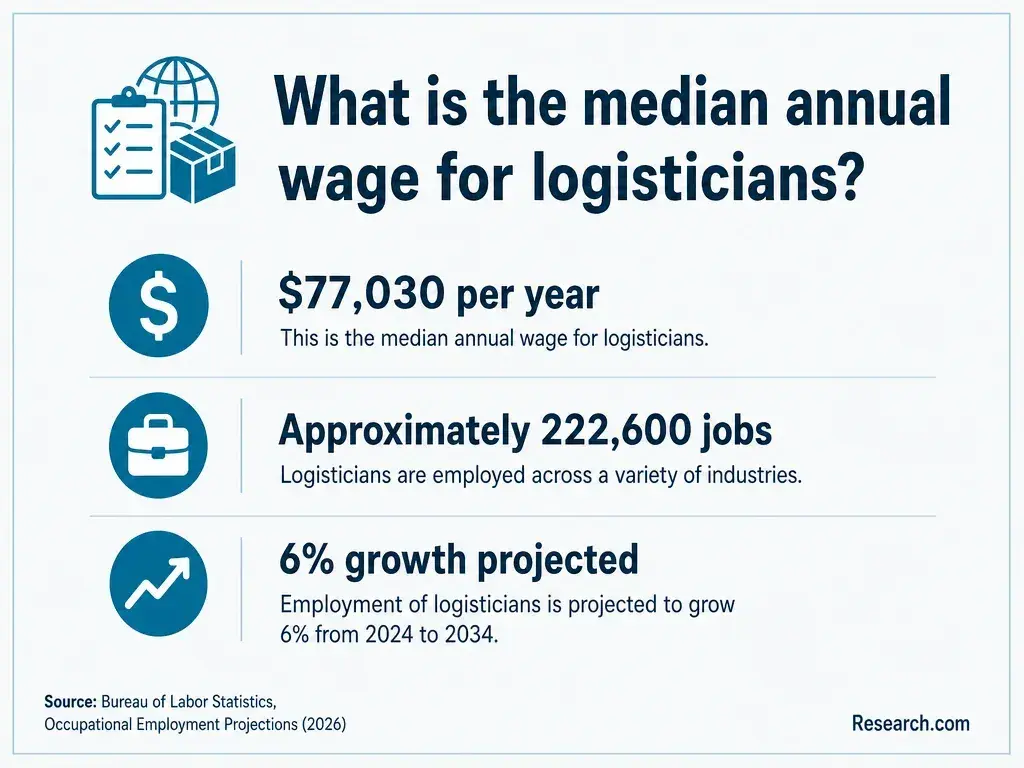
| Logistician | $82,320 | 18% | Supply chain knowledge and relevant tools may matter more than degree title alone. |
| Human resources manager | $149,280 | 6% | The occupation-wide median includes experienced managers, not just new graduates. |
Higher growth does not mean easier entry, and a manager's median is not a reason to assume a graduate degree is required—or that a bachelor's graduate will receive manager pay. If logistics interests you, weigh the role requirements against supply chain education costs and career prospects, then examine local postings for the skills and experience employers actually request.
How can you choose an accredited business administration program?
Confirm that the institution holds recognized institutional accreditation, then separately check whether any claimed AACSB, ACBSP, or IACBE accreditation covers the relevant business school or program. Programmatic accreditation can inform your comparison, but it does not verify a career claim, guarantee employment, or override an occupation's graduate-degree requirements.
Before enrolling, ask the school for its official curriculum, a personalized credit evaluation if applicable, the full cost estimate, and any published career-outcome methodology. For each promoted occupation, compare typical education, actual job postings, and the program's coursework and experiential opportunities. If application expense affects your shortlist, fee-free applications for online college may help you explore options; verify both the current fee policy and accreditation independently. Choose the program that supports your credible next role, not the one that displays the longest list of eventual careers.
Other Things You Should Know About Business Administration
An internship can strengthen an application and clarify your interests, but it does not replace a graduate degree where one is required. Seek tasks and supervision relevant to the next role you can actually pursue.
Not automatically. Check whether your target positions require one and whether the program is designed for applicants with your level of experience. Relevant work may be the more useful immediate step.
Not necessarily. Schools decide whether a concentration appears on a transcript or diploma. Confirm its official status and required courses before relying on it in an application.
Ask career services how the list was developed and request outcomes for the specific program and graduating cohort. Treat unsupported titles as possibilities to investigate, not documented graduate placements.
- Employment-Based Immigration: Second Preference EB-2 | uscis.gov https://www.uscis.gov/working-in-the-united-states/permanent-workers/employment-based-immigration-second-preference-eb-2
- Fast Facts: Employment after degree (1157) | ed.gov https://nces.ed.gov/fastfacts/display.asp
- United States Bureau of Labor Statistics Education and Training Classification System | ca.gov https://labormarketinfo.edd.ca.gov/LMID/BLS_Training_Levels.html
- Which Jobs Require a Graduate Degree? | UCLA https://www.ucla.edu/academics/graduate-benefits/which-jobs-require-a-graduate-degree
- What Jobs Can You Get with a Bachelor's Degree? | snhu.edu https://www.snhu.edu/about-us/newsroom/career/bachelors-degree-jobs
- Education and Training Data for Employment Projections | workforcegps.org https://lmi.workforcegps.org/resources/2015/06/18/11/24/Education_and_Training_Data_for_BLS_Employment_Projections
- Degree vs. Experience: Which Do Employers Prefer? | indeed.com https://www.indeed.com/career-advice/finding-a-job/degree-vs-experience