2027 Best Stackable Credentials for Transfer Students

Co-Founder and Chief Data Scientist
Transfer students often need a faster credential without sacrificing progress toward a degree. Stackable credentials solve that problem when each certificate carries college credit and fits a documented pathway to an associate or bachelor's degree.
This matters as employers increasingly value targeted skills: the U.S. Bureau of Labor Statistics projects healthcare occupations to grow faster than average from 2024 to 2034. This guide explains which credentials transfer most reliably, how to compare programs, what they cost, and how to avoid losing credits.
Key Things You Should Know
- Choose credit-bearing academic certificates with published articulation agreements; noncredit workforce certificates and many vendor certifications usually do not transfer as college credit.
- The strongest transfer sequence is often a 12- to 30-credit certificate followed by a roughly 60-credit associate degree, then a bachelor's completion program in the same discipline.
- Career value varies by field: BLS projects diagnostic medical sonographer employment to grow 13% from 2024 to 2034, while transferability still depends on the receiving school's written evaluation.
Top 10 Best Stackable Credentials for Transfer Students
Popular Trade School Programs
Credit-bearing trade credentials work best when a community college offers a certificate-to-associate pathway. Common options include electrical technology, HVAC/R, welding, automotive technology, industrial maintenance, and construction management. A short certificate can build job-ready technical skills, while an associate degree may add general education and advanced coursework needed for transfer. Apprenticeships can be a better fit for students who need paid work experience, but apprenticeship hours do not automatically become college credit. Confirm whether lab courses, safety training, and equipment fees apply before enrolling.
Healthcare Programs
Healthcare stackable pathways commonly begin with nursing assistant, medical assisting, phlebotomy, practical nursing, or health information certificates and progress into associate degrees. Nursing and allied-health transfer plans require extra care because science prerequisites, clinical placements, background checks, and state rules can limit portability. A certificate may prepare a student for an external certification examination, but it is not itself a professional certification. Students aiming for registered nursing, dental hygiene, sonography, or radiologic technology should select programs approved for the relevant licensure pathway in the state where they expect to practice.
Criminal Justice / Law Programs
Criminal justice certificates in corrections, public safety, homeland security, and legal studies can often apply toward an associate degree in criminal justice. Paralegal studies is more specialized: employers may prefer education from an American Bar Association-approved paralegal program, although approval is not required in every setting. Law enforcement hiring standards are set by agencies and states, so a certificate does not guarantee eligibility. Transfer students should prioritize courses such as criminal law, constitutional law, ethics, and writing that appear in the receiving institution's degree map.
Arts & Design Programs
Graphic design, digital media, web design, photography, animation, and user experience certificates can stack into associate degrees when they use the same studio and software courses. Portfolio quality matters as much as the credential for many creative roles. Credit transfer is strongest when the receiving program accepts the specific course number and students retain syllabi, project files, and portfolio work. Noncredit software badges may demonstrate skills to employers but typically do not replace college studio credits. Students planning to transfer should balance applied courses with transferable writing, math, and humanities requirements.
What stackable credentials transfer best into degrees?
A stackable credential is an intentionally sequenced credential that builds on earlier learning. For transfer students, the most useful version is a credit-bearing certificate that applies in full or nearly in full to a related associate or bachelor's degree. It differs from an industry certification, such as a vendor-issued technology credential, which can help with employment but usually carries no automatic academic credit.
The options below show why program design matters more than a credential's title. "Certificate" alone does not prove that credits will transfer.
| Credential path | Typical transfer strength | Best use | Main caution |
| Community college certificate to associate degree | High within the same institution | Students seeking a quick milestone and degree progress | Verify that every course applies to the declared major |
| Associate degree to university bachelor's degree | High with a statewide or institutional articulation agreement | Students planning a lower-cost bachelor's route | Major prerequisites can still create extra semesters |
| Industry certification plus college credit | Variable | Workers who need employer-recognized skills | Credit may require an exam score, review, or prior agreement |
| Noncredit workforce certificate | Usually low | Students focused on rapid skill training | It may not count toward a degree at all |
Students who are undecided about a major should compare the credential with top 10 best majors for the future before committing to a narrow sequence. A broad business, information technology, health sciences, or general studies pathway can preserve more bachelor's options than a highly specialized certificate.
Before registering, ask the receiving institution for a transfer evaluation or use its official transfer-equivalency database. Save the result, catalog year, course descriptions, and articulation agreement. Verbal assurances from a recruiter or advisor are not a substitute for written confirmation.
Which accredited schools accept stackable credentials?
Accredited community colleges, public universities, and some private nonprofit institutions may accept stackable credentials, but institutional accreditation does not create an automatic transfer guarantee. In the United States, the receiving school determines which credits apply to its programs. The most predictable choices are schools in the same public higher-education system or schools with a signed articulation agreement.
Use these checks to identify a school that is likely to honor your prior learning:
- Confirm that both institutions are institutionally accredited by an accreditor recognized by the U.S. Department of Education or CHEA.
- Find a current, written articulation agreement for your certificate, associate degree, and intended major.
- Check whether the agreement awards elective credit only or applies courses to major and general-education requirements.
- Ask for the minimum grade required for transfer and whether credit has an age limit, especially for science and technology courses.
- Request an official degree audit before enrolling whenever possible.
Programmatic approval can matter more than general accreditation in regulated fields. Nursing, radiography, dental hygiene, and paralegal education may have field-specific expectations. A transfer-friendly academic record does not by itself establish eligibility for a license, clinical placement, or certification exam.
Students considering long-term justice leadership or research careers should also understand how graduate pathways differ from undergraduate transfer plans; online PhD criminal justice no dissertation options are a separate, post-bachelor's decision rather than a substitute for foundational transfer credit.
Are online or campus stackable programs better?
Online stackable programs are better for students who need schedule flexibility and whose coursework does not depend heavily on physical labs, clinical practice, or studio equipment. Campus or hybrid programs are usually better for hands-on trades, healthcare training, and design students who benefit from supervised facilities and local employer relationships.
This comparison highlights the practical trade-off: format should support both learning requirements and the receiving institution's transfer rules.
| Factor | Online or hybrid may fit best | Campus may fit best |
| Course type | General education, business, IT theory, criminal justice | Clinical, laboratory, welding, automotive, studio-intensive courses |
| Schedule | Working adults needing asynchronous coursework | Students able to attend fixed labs and daytime placements |
| Transfer review | Equivalent credit hours and learning outcomes are documented | Receiving school requires in-person practical instruction |
| Support needs | Student is self-directed and has reliable technology | Student needs equipment access and frequent in-person feedback |
Do not equate "online" with easier or faster. Many online courses use the same credit hours and learning outcomes as campus sections, while clinical and lab requirements may still require local attendance. Students seeking flexible general-education progress can compare easy online degrees, but should still verify academic rigor, credit acceptance, and career fit.
Which credentials lead to the highest-paying jobs?
The highest-paying occupations associated with stackable pathways are often regulated healthcare roles or skilled technical occupations, but pay reflects the occupation, location, experience, licensure, and employer - not a certificate alone. In many cases, the certificate is an entry point toward an associate degree, license, apprenticeship, or additional employer training.
The following BLS 2024 wage and 2024-2034 outlook figures provide useful occupation-level context for comparing longer pathways.
| Occupation | Typical educational route | 2024 median annual pay | Projected growth, 2024-2034 |
| Dental hygienist | Accredited associate degree and state licensure | $94,260 | 7% |
| Diagnostic medical sonographer | Associate degree or postsecondary certificate; credentialing often preferred | $89,340 | 13% |
| Registered nurse | Associate or bachelor's degree and RN licensure | $93,600 | 6% |
| Electrician | Apprenticeship, technical education, and licensing requirements that vary by state | $62,350 | 9% |
| HVAC/R mechanic and installer | Postsecondary training or apprenticeship; EPA certification may be required for refrigerants | $59,810 | 8% |
Healthcare may offer stronger wage potential, but it also brings selective admissions, clinical scheduling, examination costs, and licensure requirements. Skilled trades can offer paid apprenticeships and earlier earnings, though physical demands and local licensing rules matter. For students changing fields quickly, accelerated programs for career changers can be worth comparing with a stackable sequence, particularly when prior credits already satisfy general education requirements.
How long do stackable credential programs take?
Completion time depends on credit load, prerequisites, course availability, and whether a credential includes clinical, lab, or apprenticeship requirements. A short academic certificate commonly requires 12 to 30 semester credits, while an associate degree commonly requires about 60 credits. At a full-time pace, that can mean roughly one or two terms for a short certificate and about two academic years for an associate degree.
Stacking can save time only when courses are deliberately shared. For example, a 24-credit certificate that applies fully to a 60-credit associate degree leaves about 36 credits after certificate completion. If the certificate is treated as electives, the same student may need substantially more coursework.
Ask whether required courses are offered every term, whether summer courses are available, and whether a clinical placement waitlist exists. Accelerated schedules can shorten calendar time, but they increase weekly workload and may make employment or caregiving harder to manage.
How much do stackable credentials cost?
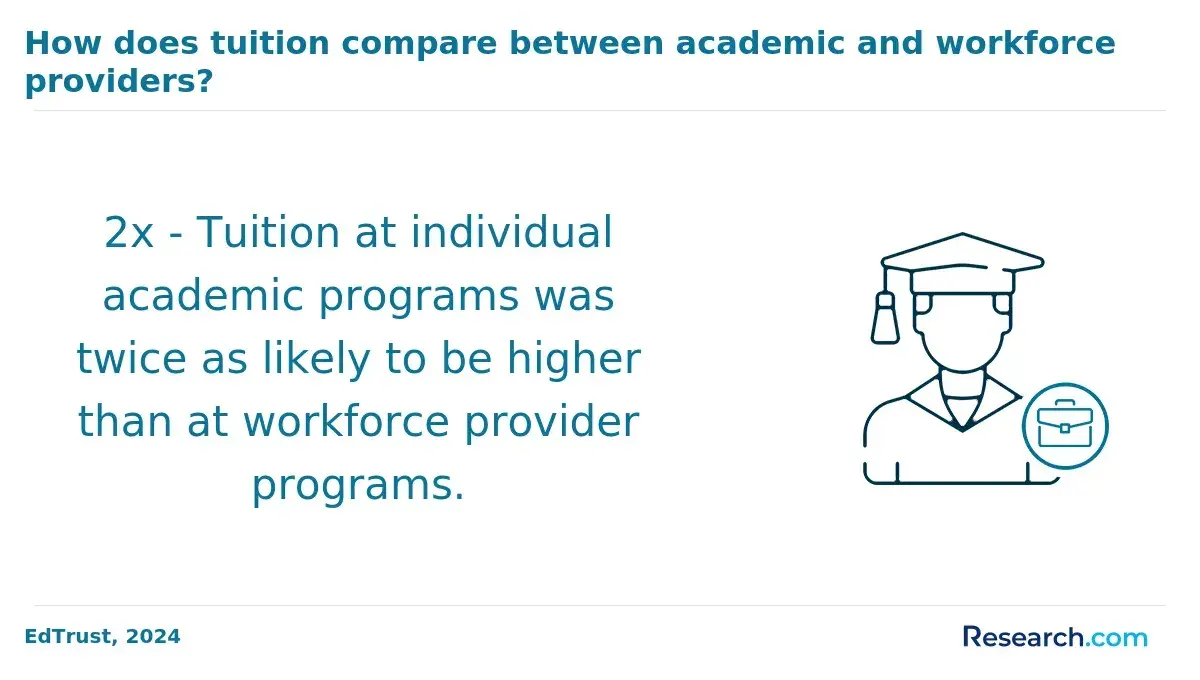
Cost is determined by residency, credit count, delivery format, supplies, transportation, testing, and clinical or licensing requirements. The College Board reported average published tuition and fees of $4,050 for in-district students at public two-year colleges in the 2024-2025 academic year. That is a useful benchmark, not a program quote: technical equipment and healthcare compliance costs can materially raise the total.
When comparing offers, separate the following costs so a low tuition figure does not hide a more expensive program:
- Tuition and mandatory institutional fees per credit or term
- Books, software subscriptions, tools, uniforms, and safety equipment
- Background checks, drug screening, immunizations, insurance, and clinical fees when required
- Certification examination, licensing, and retesting fees
- Transportation, parking, childcare, and lost work hours for campus or clinical attendance
Credit-bearing programs at eligible institutions may qualify students for federal financial aid if they meet federal and school requirements. Noncredit programs often do not, although workforce grants, state aid, employer tuition assistance, and payment plans may be available. Compare net price after grants rather than assuming the cheapest published tuition is the best value.
What admissions requirements do transfer students face?
Transfer students usually apply to the receiving college, submit official transcripts, and meet program-specific prerequisites. Requirements vary substantially by institution and credential type. A credit-bearing college certificate or associate program may review prior college GPA and placement readiness, while a noncredit workforce program may require only identity documentation and basic eligibility screening.
Selective healthcare programs commonly add science prerequisites, minimum grades, entrance testing, health records, background checks, and clinical eligibility requirements. Trade programs may require safety orientation or placement into math and technical courses. Design programs can request a portfolio. Criminal justice programs may have separate standards for internships or agency-based placements.
A practical transfer application plan is to apply early, send transcripts from every college attended, and request course-by-course evaluation before choosing classes. Do not repeat a course simply because it has a different title; first determine whether it already satisfies an equivalent requirement. Conversely, do not assume credits accepted by the college will apply to your intended major.
Which stackable credentials require licenses or certifications?
Licenses and certifications are most common in healthcare, skilled trades, transportation, and certain public-safety roles. They are separate from a school-issued certificate. A college program may prepare students for an external exam or meet part of an education requirement, but the relevant board or certifying organization decides eligibility.
Common examples include state nursing licenses for practical nurses and registered nurses, state dental hygiene licenses, ARRT credentials for many radiologic technology roles, EPA Section 608 certification for technicians servicing regulated refrigerants, and state or local electrician licensing. Requirements can include supervised clinical hours, examinations, background checks, continuing education, and a degree from an approved program.
Before choosing an online program, verify that it meets educational requirements in the state where you intend to work. This is especially important if you may relocate. Schools should clearly disclose whether a program meets, does not meet, or has not determined state licensure requirements.
How do you choose a reputable stackable program?
A reputable stackable program makes its pathway visible: it identifies the credential awarded, credit hours, next credential, transfer partner, total expected costs, and any licensing limitations. Be cautious when a school markets "transferable" training without naming the destination institution or showing how courses apply to a degree.
Use this process to make a defensible choice:
- Start with the job or degree you want in three to five years, not simply the shortest available certificate.
- Confirm whether the first credential is credit-bearing and obtain the official curriculum map.
- Compare the certificate courses with the associate or bachelor's degree audit at your intended receiving school.
- Verify institutional accreditation and any programmatic approval required for your field.
- Calculate total cost, including supplies, examinations, transportation, and unpaid clinical time.
- Ask about completion rates, course scheduling, tutoring, career services, and clinical or apprenticeship placement support.
- Get transfer and licensure claims in writing before paying a deposit.
Common mistakes include selecting a noncredit program when a degree is the goal, relying on a general accreditation claim instead of a course evaluation, and choosing a healthcare program before confirming state approval. The better alternative is to build a written pathway with named institutions and documented course equivalencies.
Other Things You Should Know About
It can, but only if the certificate is credit-bearing and the receiving institution accepts its courses. The strongest route is a published certificate-to-associate-to-bachelor's agreement in the same major.
Not automatically. Some colleges award credit for recognized certifications or examination scores, but policies vary. Ask the receiving institution whether it grants credit and how that credit applies to your degree.
An associate degree is usually better for students who need broad transferability or roles requiring a two-year degree. A stackable certificate is useful when you need an earlier employment milestone and its credits fully apply to the associate degree.
Possibly. Credit-bearing programs at eligible institutions may qualify for federal aid when students meet applicable requirements. Many noncredit certificates do not qualify, so check financial-aid eligibility before enrolling.
References
- Fixing the transfer process https://www.ccdaily.com/2026/01/fixing-the-transfer-process/
- Transfer Student Success Programs - APLU https://www.aplu.org/our-work/1-driving-student-success/achieving-university-transformation-and-systemic-changes/center-for-public-university-transformation/transfer-student-programs/
- Findings (Beyond Transfer) - Public Agenda https://publicagenda.org/resource/beyond-transfer/findings/
- Making sure you're not a bot! https://www.iastatedigitalpress.com/jtmae/article/id/14484/
- What is 'reverse transfer' and a 'stackable credential'? - Utah System of Higher Education https://ushe.edu/what-is-reverse-transfer-and-a-stackable-credential/
- What Are Stackable Credentials and Why Do They Matter? https://www.pltw.org/blog/what-are-stackable-credentials
- Supporting the Health and Well-Being of Transfer College Students - TimelyCare https://timelycare.com/blog/supporting-the-health-and-well-being-of-transfer-college-students/
- Improving Credit Transfer Can Help More Students Graduate From College - Center for Higher Education Policy and Practice https://www.chepp.org/news/from-chepp/improving-credit-transfer-can-help-more-students-graduate-from-college/
- Stackable Credentials: Living Links Between Learning and Work https://www.cael.org/resouces/pathways-blog/stackable-credentials-living-links-between-learning-and-work
- How Attaining Industry-Recognized Credentials in High School Shapes Education and Employment Outcomes https://fordhaminstitute.org/national/research/industry-recognized-credentials