
2027 Best Online Two-Year Degrees With Job Placement Support

Co-Founder and Chief Data Scientist
An online associate degree may fit your schedule, but will its career services help you move toward a job? That question matters as you weigh tuition against the time you can spend studying. The College Board reported average published tuition and fees of $4,050 for public two-year, in-district students in 2024-25; other costs can add substantially to the bill. This guide compares degree fields by career fit and the placement support worth verifying, so you can choose a program with a realistic path from coursework to employment.
Key Things You Should Know
- Start with the occupation: business, IT, and some healthcare support paths offer different entry points, while nursing requires clinical training and licensure beyond online coursework.
- Ask for program-specific internship access, employer connections, and recent graduate outcomes. Career services alone do not establish a placement rate or guarantee a job.
- Many associate programs require about 60 semester credits, but prerequisites, part-time study, and in-person requirements can extend completion beyond two years.
Top 10 Best Online Two-Year Degrees With Job Placement Support
Business Programs
An online business administration or accounting AAS can prepare students for office support, bookkeeping, or customer-facing roles. An AA or AS may make more sense if a bachelor's degree is the goal. Look for career advisers who review résumés for your target role, arrange employer events accessible to online students, and help locate internships. Accounting software practice may be more useful for an entry-level bookkeeping search than a broad business curriculum alone. Ask whether internships are required, optional, or available where you live.
Healthcare Programs
Health information technology and medical coding are worth comparing if you want healthcare work without bedside clinical training. Check whether the curriculum prepares students for a relevant credential and whether employers in your area prefer certification or experience. Career support should include help finding supervised experience or entry-level revenue-cycle openings, not just a general job board. Allied-health degrees involving patients, such as radiography, usually require in-person labs and clinical placements; verify site availability before calling any option fully online.
Information Technology Programs
An IT, networking, or cybersecurity AAS can build skills for help desk and technical support roles. Compare hands-on labs, projects, certification preparation, and access to local employers. A career office that helps students demonstrate troubleshooting work may be more valuable than one that only posts vacancies. Cybersecurity is not necessarily an entry-level destination: applicants may first need support or networking experience. Confirm that required labs can be completed remotely if you cannot visit campus.
Nursing / Pre-Nursing Programs
An associate degree in nursing combines classroom learning with supervised, in-person clinical training; online lectures do not make the entire degree online. Graduates must also meet state requirements and pass the NCLEX-RN to become licensed registered nurses. Pre-nursing coursework is preparation for applying to a selective nursing program, not an RN credential. Ask whether the school arranges clinical sites near you and offers interview preparation or healthcare employer events. Confirm admission and licensure requirements with the program and your state board before enrolling.
Criminal Justice Programs
A criminal justice AA, AS, or AAS can introduce law, corrections, and public safety systems. The best degree type depends on whether you plan to transfer or seek entry-level work. Police and corrections hiring involve separate agency standards, screening, and often academy training; the degree does not replace them. Useful career support includes introductions to local agencies and guidance on application timelines and eligibility. Ask which employers recruit online students and whether any field experience must be completed locally.
Psychology / Counseling Programs
An online psychology AA or AS is usually strongest as a transfer pathway. It may also support applications for entry-level human services work, but it does not qualify graduates to practice as licensed counselors or psychologists. Compare transfer agreements and advising for the bachelor's degree you intend to pursue. If you want immediate employment, ask about supervised volunteer opportunities, community-agency contacts, and the qualifications required for specific support roles in your area.
What Are Online Two-Year Degrees With Job Placement Support?
An online two-year degree with job placement support is an associate program that delivers some or all academic instruction online and provides career help, such as coaching, internship assistance, employer events, or job-search resources. Job placement support is a service, not a promise of employment. Schools may use "placement" to describe very different services, so ask what help online students actually receive.
Associate of Arts (AA) and Associate of Science (AS) programs often emphasize transfer, while an Associate of Applied Science (AAS) often emphasizes workforce skills. Those labels are not enough to establish career fit. A transfer-focused program can still offer valuable employer contacts, and a career-focused program may have a transfer agreement - but neither should be assumed.
"Online" also needs scrutiny. Scheduled video classes, proctored assessments, local internships, labs, and clinical placements can affect where and when you study. Request a written list of every in-person and scheduled requirement before applying.
Which Online Two-Year Degrees Lead to the Best Careers?
There is no single best field for every student. For a quicker route to entry-level work, compare business, IT, and health information programs against actual local job requirements. Nursing can lead to a defined licensed occupation, but admission, clinical training, and licensure make it a more constrained path. Psychology often makes better sense for a student prepared to continue to a bachelor's or graduate degree.
The comparison below focuses on the career transition each field requires. Use it to decide which kind of placement support would matter most to you, rather than treating all career centers as equivalent.
| Degree field | Potential direction | Career support to verify | Important limitation |
| Business | Office, customer, or accounting support | Role-specific résumé help and internships | Experience and software skills may matter as much as the major |
| Health information | Coding or records support | Credential guidance and employer contacts | Some employers prefer certification or experience |
| IT | Help desk or technical support | Project feedback and employer recruiting | Security roles may require prior IT experience |
| Nursing | Registered nursing after licensure | Clinical-site coordination and healthcare recruiting | Clinical work and state licensure are required |
| Psychology | Transfer or entry-level human services | Transfer advising and agency contacts | Licensed counseling requires further education |
Career outcome matters, but so does the route to qualifying for a role. If earning potential is your main criterion, compare quick degrees that pay well while checking each occupation's education and licensing requirements.
How Much Do Online Two-Year Degrees Cost and How Long Do They Take?
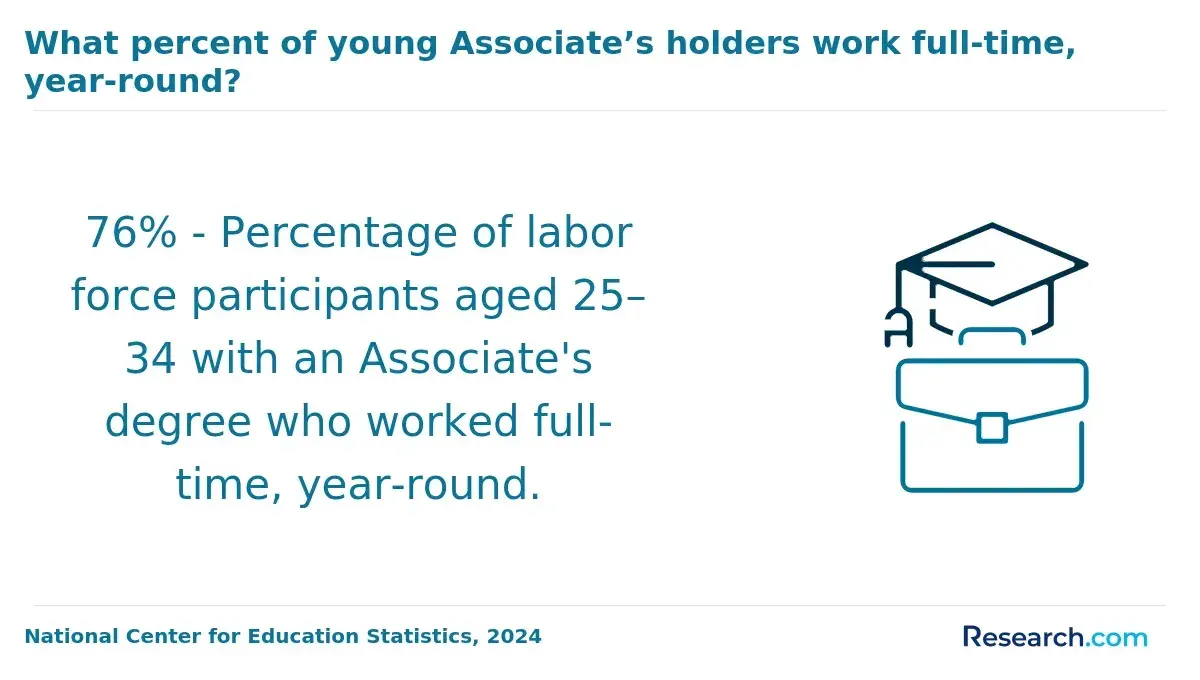
Many associate degrees are built around roughly two years of full-time study, but that is a planning estimate, not a deadline. Part-time enrollment, course sequencing, prerequisites, and clinical-site availability can lengthen the path. Accepted transfer credits may shorten it; a school must first determine which credits apply to your specific degree.
The following published price is a starting benchmark, not a quote for an online program or the full cost of finishing one.
- $4,050: Average published tuition and fees for public two-year, in-district students in 2024-25, according to the College Board.
Your total may also include online or program fees, books, equipment, transportation to clinical sites, and living expenses. Compare the price for your residency status and expected remaining credits. Ask about federal aid eligibility, scholarships, employer assistance, and payment plans; aid eligibility and awards vary. A short course term does not make an entire associate degree short. If speed is a priority, use fastest associates degree online as a starting point, then verify the prior-credit assumptions and full degree timeline behind any advertised duration.
What Accreditation Should Online Two-Year Degree Programs Have?
Start with the college's institutional accreditation and confirm its current status with the accreditor or U.S. Department of Education. Accreditation matters for federal financial aid eligibility and can affect credit transfer, but it does not mean another school must accept every course. Students considering non profit universities in USA should apply the same accreditation and program-level checks.
Some occupations require more than institutional accreditation. For nursing and certain allied-health fields, ask whether the specific program meets applicable approval or accreditation requirements and whether it satisfies licensure eligibility in the state where you intend to work. Get a direct answer for your state before paying a deposit; an online delivery label is not evidence of licensure eligibility.
What Do You Learn in an Online Two-Year Degree Program?
Most programs combine general education - such as writing and math - with courses in the major. Business students may study accounting and management; IT students may practice networking and troubleshooting; health information students may study records systems and coding. The useful question is whether assignments produce skills or work samples relevant to the job you want.
Requirements differ substantially by field. Nursing includes sciences and supervised clinical work. Some allied-health programs require labs or placements, while an AA in psychology may emphasize courses intended to transfer. Review the course map, prerequisites, and any internship or practicum rules. If transfer is your goal, confirm that courses will satisfy requirements in your intended bachelor's major, not merely arrive as elective credit.
What Are the Admission Requirements for Online Two-Year Degrees?
Colleges commonly request an application and proof of secondary-school completion or an accepted equivalent. They may also review transcripts to place students in appropriate courses. A specific major can have separate prerequisites, grades, screening, or selective admission even when the college itself broadly admits applicants; nursing is a common example.
Ask when you can enter the major, not just when you can enter the college. Schools with frequent entry points, including some online universities with multiple start dates, may still offer required courses or clinical placements on a more limited schedule. Before applying, request a transcript evaluation, a major-specific admissions checklist, and the next available sequence of required courses.
Which Jobs Can You Get With an Online Two-Year Degree?
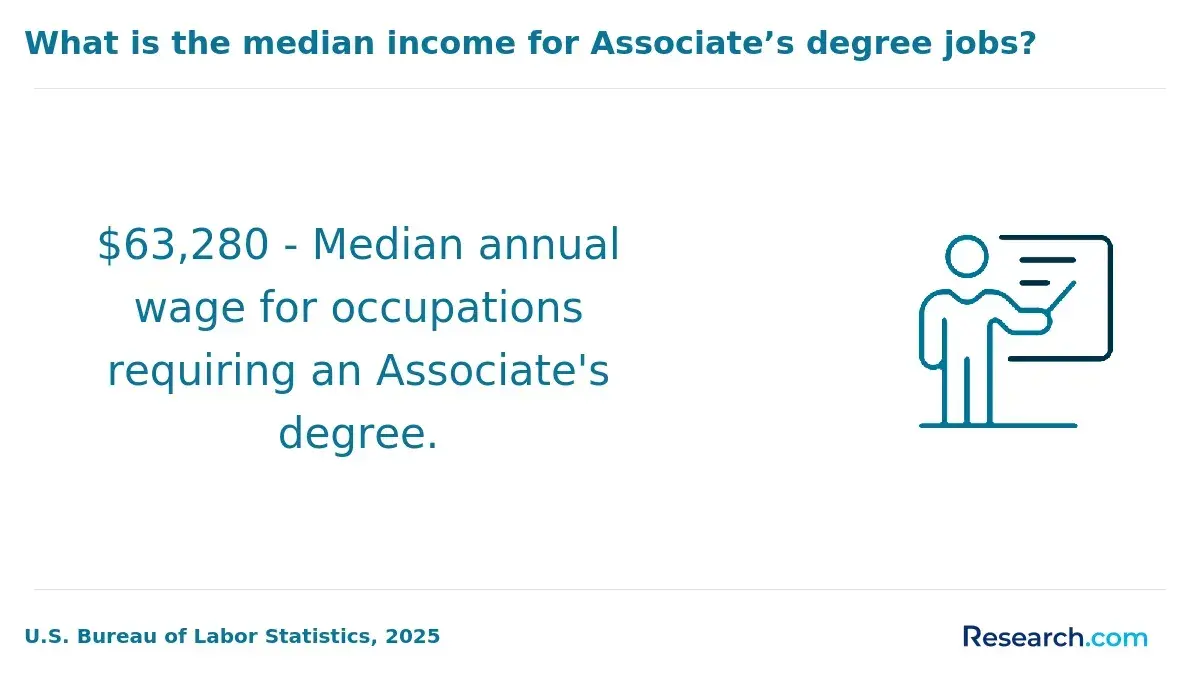
Possible jobs depend on the major, local hiring standards, and experience - not simply possession of an associate degree. Business graduates may pursue office or bookkeeping support; IT graduates may seek help desk work; health information students may pursue records or coding roles. Employers may require particular software skills or credentials for each opening.
Some paths have clearer additional gates. An associate degree in nursing can be part of the route to RN licensure, but graduates must satisfy state rules and pass the licensing exam. Criminal justice graduates must meet agency hiring standards for public safety roles. A psychology associate degree does not qualify someone for licensed counseling. Compare job postings for your target role with the program's required courses and career services before treating the degree as a direct route to employment.
What Salaries and Job Outlook Can Graduates Expect?
Salary and demand figures describe occupations, not what a particular program's graduates earn. The U.S. Bureau of Labor Statistics reports a May 2024 median annual wage of $93,600 for registered nurses and projects 5% employment growth for the occupation from 2024 to 2034. That makes nursing worth considering for its career path, but an online pre-nursing or nursing degree alone does not confer an RN license or that wage.
For other fields, compare the exact entry-level job titles you would apply for rather than a broad industry average. Ask a school for recent, program-specific employment results: who was counted, how soon after completion they were surveyed, and whether jobs were related to the major. If it cannot explain its placement figure, do not use that figure to estimate your likely earnings.
How Do You Choose a Reputable Online Two-Year Degree Program?
Choose a program by testing its claims against your career goal. A low tuition rate is little help if required classes are unavailable when you need them; a strong job board is little help if it has no relevant local openings. Before enrolling, work through these checks with an adviser and, where relevant, a licensing board.
- Identify a target job and compare its actual education, experience, and licensing requirements with the degree's curriculum.
- Confirm institutional accreditation, applicable program approval, and whether required online, campus, lab, or clinical activities fit your location and schedule.
- Request a written cost estimate for your expected credits, fees, equipment, and required travel, plus a transcript evaluation if you have previous credit.
- Ask who provides career coaching to online students, how internships or clinical sites are arranged, which employers participate, and how graduate employment is measured.
- If you plan to transfer, check a written articulation pathway with your intended bachelor's program and confirm how each course applies.
Be wary of guaranteed-job language, unexplained placement rates, or claims that an online degree automatically meets every state's licensing rules. If a school cannot document a requirement or outcome central to your decision, keep comparing options before committing.
Other Things You Should Know About
No. Career coaching, job boards, and employer events can help with a search, but they do not guarantee an offer. Ask for documented outcomes for your specific program.
Expect in-person clinical training and possibly labs. Confirm the program's location requirements and state licensure eligibility before applying.
It depends on the goal. An AAS often emphasizes workforce preparation; an AA or AS often emphasizes transfer. Compare the actual curriculum and employer requirements rather than relying on the abbreviation.
Ask whether online students receive individual help, how internships or employer introductions work, and how the school defines and verifies its reported employment outcomes.
References
- Pathways for Students and Graduates | Student Internships and Jobs | Working at CDC | Careers at CDC https://jobs.cdc.gov/working-at-cdc/student-intern-jobs/pathways.html
- Occupation Finder: Occupational Outlook Handbook | bls.gov https://www.bls.gov/ooh/occupation-finder.htm
- Fast Facts: Tuition costs of colleges and universities (76) | ed.gov https://nces.ed.gov/fastfacts/display.asp
- Understanding College Costs | Federal Student Aid https://studentaid.gov/resources/prepare-for-college/students/choosing-schools/consider-costs
- Student Internships and Nursing Clinicals | sc.gov https://dph.sc.gov/connect-us/jobs-careers/student-internships-and-nursing-clinicals
- Clinical Center Summer Internship Program | nih.gov https://www.cc.nih.gov/training/students/summer-internships
- NCWorks Career Centers | NC Commerce https://www.commerce.nc.gov/jobs-training/resources-job-seekers/ncworks-career-centers
- Employer Partnership Program - Division of Student Affairs - Adelphi University https://www.adelphi.edu/employer-partnership/
- Licensure & Professional Certification Disclosures | Johnson & Wales University https://catalog.jwu.edu/academicinformation/licensuredisclosures/
- Diné College Placement Rate Methodology - Dine College - https://www.dinecollege.edu/academics/dine-college-placement-rate-methodology/


