Best online MBA in Healthcare Management programs for public sector professionals

Co-Founder and Chief Data Scientist
A healthcare MBA can strengthen your case for managing budgets, operations, and change in a public hospital or health agency - but the best program depends on the work you want to do. Government managers also face procurement rules, public accountability, and pay structures that a private-sector-focused MBA may not address.
This guide compares online programs with healthcare concentrations, explains what to verify before enrolling, and helps you decide whether an MBA or a more specialized qualification better serves your next career move.
Key Things You Should Know
- Start with an evidence-based shortlist, not a national ranking: UMass Amherst, UNC Wilmington, Scranton, and Southern New Hampshire offer online MBA options identified with healthcare-focused study, but their fit depends on current courses and scheduling.
- For government careers, compare public-finance and policy relevance, employer tuition support, and required live attendance - not concentration names alone.
- The $126,520 May 2025 median wage for all U.S. management occupations is useful context, not an expected healthcare MBA salary or a public-sector pay estimate.
What is an online MBA in healthcare management for public sector professionals?
It is a general management degree delivered primarily online, with healthcare-focused coursework or a formal concentration. The MBA core usually develops skills in finance, operations, strategy, and organizational leadership. Healthcare study applies those tools to settings such as hospitals, health systems, insurers, and agencies. Schools use different labels, including healthcare management and healthcare administration; check what the designation actually requires.
For a county health department analyst, state Medicaid employee, or public hospital supervisor, the distinction matters. An MBA can help with resource allocation and cross-functional leadership, but private-sector pricing or growth strategies may not translate directly to statutory budgets, competitive procurement, or legislative oversight.
If your goal is chiefly public health policy or agency administration, compare an MPH or MPA; if it is healthcare administration without a broad business core, compare an MHA. A broader look at graduate business options in healthcare can help clarify the degree choices.
Which online MBA healthcare management programs are best for public sector careers?
There is no defensible single winner for every government employee. The shortlist below favors identifiable online MBAs with named healthcare-focused study and offers different institutional and career-fit options. It is not a tuition, outcomes, or nationwide ranking; course availability, delivery rules, and prices can change and must be confirmed directly before applying.
The comparison separates the program designation from an editorial assessment of its potential public-sector fit. In particular, a public university is not necessarily the cheapest option for an online or out-of-state student.
| Online MBA option | Healthcare-focused designation | Potential public-sector fit | Most important point to verify |
| University of Massachusetts Amherst, Isenberg School of Management | Healthcare Administration concentration | Worth considering for an experienced healthcare employee seeking a broad business degree at a public university | Current concentration courses, total tuition for your enrollment status, and any live or campus requirements |
| University of North Carolina Wilmington | Healthcare Management concentration | A public-university option to compare if operational leadership is your target | Current online course sequence, completion pace, and whether coursework covers your agency's challenges |
| University of Scranton | Healthcare Management specialization | A private-university alternative for applicants comparing healthcare leadership curricula | How many courses constitute the specialization, total fees, and career support for online students |
| Southern New Hampshire University | Healthcare Management concentration | An option for working professionals prioritizing an online MBA with a named healthcare focus | Current course choices, group-work expectations, and whether projects can address public institutions |
A public hospital manager seeking advancement within the same system should give particular weight to employer recognition, applicable projects, and manageable tuition. Someone trying to move from a health agency into hospital operations should also ask about healthcare employer connections and practical experience; a concentration alone cannot replace operational experience. Request each school's current catalog, full cost schedule, sample course calendar, and online-student career-service terms before making a final comparison.
How do you choose an accredited online healthcare MBA program?
First, confirm that the university holds recognized institutional accreditation. Then check whether its business school or MBA holds specialized business accreditation, such as AACSB, ACBSP, or IACBE; these are different from institutional accreditation. Verify the credential on the accreditor's directory and confirm that the online MBA - not merely another program at the institution - is covered where the accreditation is program-specific. This guide to MBA accreditation and school choices provides a starting point for comparing schools.
Accreditation is a threshold, not proof of public-sector fit. Ask for the required healthcare courses and their recent schedules. Look for work involving quality, access, regulation, budgeting, and organizational change, then ask whether applied assignments can use a government or public-hospital setting. Finally, compare the complete cost and weekly schedule against your agency's education-assistance policy. A well-known concentration has limited value if its required classes conflict with your work or its electives rarely run online.
The business core generally covers accounting, managerial finance, operations, strategy, analytics, and leading teams. Healthcare-focused courses may examine healthcare organizations, financing, quality, or policy, but their depth varies by school. A course on healthcare finance, for example, may help a manager interpret a service-line budget without teaching every rule governing a state appropriation or federal grant.
For public sector professionals, the strongest academic fit connects business decisions to mission and constraints: explaining a purchasing decision to auditors, improving patient access within a fixed budget, or managing change across clinical and administrative teams. Review syllabi rather than assuming those subjects appear because a course has "healthcare" in its title. An MBA prepares people to manage organizations; it does not provide clinical training or make a graduate qualified to practice medicine or nursing.
An online MBA can let an employee remain in a public-sector role and apply coursework at work. That advantage depends on the actual format: recorded lessons may coexist with scheduled live classes, team meetings, timed exams, or required visits. Ask for a typical term calendar and the attendance policy before treating "online" as synonymous with self-paced.
A campus MBA may offer easier access to in-person recruiting and a local healthcare network, particularly for someone changing employers. Online students should ask what recruiting, alumni events, and experiential projects they can actually use; access should not be assumed identical across formats. Experienced managers considering an executive format should also compare executive MBA tuition and fees alongside attendance demands. The better format is the one whose schedule, network, and total cost support your particular promotion or transition.
Requirements vary by school. Applicants commonly need a bachelor's degree, transcripts, and an application; programs may also request a résumé, statement, recommendations, interview, or GMAT/GRE scores. A nonbusiness undergraduate degree does not automatically rule you out, but you may need to refresh accounting or quantitative skills. Check each program's current test policy, experience expectations, and prerequisites rather than applying a generic MBA checklist as though it were an official requirement.
Public employees can make a stronger application by describing a specific management problem they have handled - such as coordinating a service change or explaining a budget decision - and what authority they actually held. Clinicians weighing combined clinical and management education should distinguish a healthcare MBA from short-duration MBA pathways degree programs that include an MSN; a dual degree serves a different purpose and may have professional-entry requirements.
Completion time depends on required credits, course sequencing, prior preparation, and how many classes you take while working. Published accelerated timelines may assume uninterrupted enrollment; a department's peak budget or reporting periods can make a slower pace more realistic.
For a meaningful price comparison, request an individualized estimate showing tuition for all required credits, mandatory fees, books or software, and any travel. Check whether tuition differs by residency or enrollment pace, whether an employer reimburses only approved courses, and when reimbursement arrives relative to your payment deadline. Ask what happens if you pause enrollment or change employers. Prior graduate work may not reduce MBA requirements, so review MBA options for applicants with prior credits and obtain a written transfer evaluation before counting on savings. Borrowing costs and time away from work also belong in your personal calculation.
An MBA may support advancement into health-system operations, agency program management, budgeting, contracting, or quality-improvement leadership. Which roles are attainable depends heavily on your existing experience, the employer's classification rules, and whether a position requires clinical or policy expertise. The degree does not itself confer supervisory authority.
These pathways show where the MBA's business training may help - and where experience remains decisive.
| Possible direction | Relevant MBA contribution | Likely additional requirement |
| Public hospital operations manager | Budgeting, staffing analysis, and process improvement | Hospital operations experience and demonstrated leadership |
| Health agency program manager | Resource allocation and cross-team coordination | Knowledge of the program's statutes, funding, and reporting duties |
| Healthcare contracting or procurement leader | Financial evaluation and vendor management | Applicable public purchasing rules and contracting experience |
Before enrolling for an internal promotion, review actual vacancy announcements and speak with your human resources office about minimum qualifications, pay grades, and whether an MBA affects eligibility. For a move into a different function, seek a work project that supplies the missing experience rather than relying on the degree title alone.
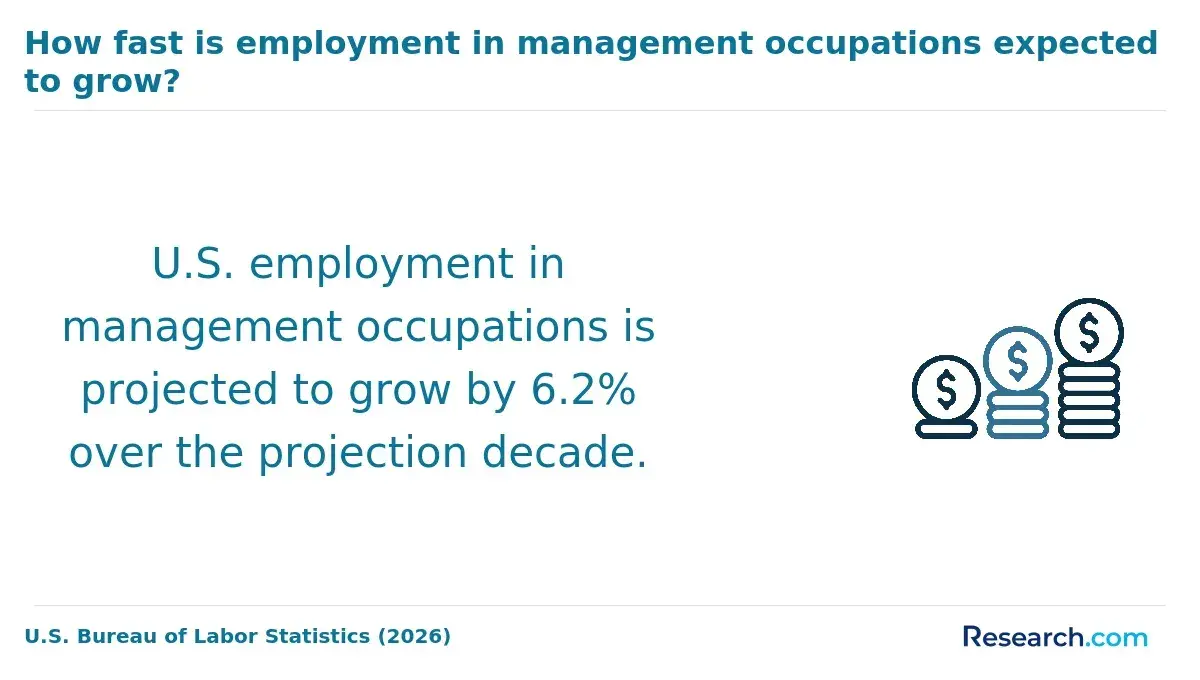
The U.S. Bureau of Labor Statistics reports a $126,520 median annual wage in May 2025 for all management occupations. That broad figure includes managers outside healthcare and outside government; it is not the median for healthcare MBA graduates or a reasonable salary forecast for a particular agency job.
For a public-sector decision, use the pay range in the specific vacancy announcement, your agency's grade schedule, and the experience needed to reach the next classification. Compare a plausible increase after promotion with your out-of-pocket degree cost, while allowing for the possibility that the promotion takes time - or does not occur. Nonfinancial benefits, such as being able to lead a service improvement, may matter, but they should not be disguised as guaranteed earnings.
Do healthcare MBA graduates need licenses or certifications?
There is no general healthcare-management license created by earning an MBA. Administrative hiring requirements depend on the job and jurisdiction. Some positions require an active clinical license because the manager also carries clinical responsibilities; nursing, medicine, and other regulated practice remain governed by their respective licensing rules. Certain facility-administrator roles may have separate state requirements.
A professional certification may demonstrate a particular skill, but it is not interchangeable with a license or an MBA. Read the exact job posting and, for a regulated role, check the relevant state board before assuming coursework satisfies an eligibility rule.
Other Things You Should Know About MBA
Possibly. Eligibility depends on the loan type, repayment plan, qualifying employer, and required payment history - not on the MBA concentration. Confirm the rules and your employer's eligibility before borrowing.
Only with appropriate employer approval and safeguards. Ask the instructor whether a public dataset or a properly de-identified example can meet the assignment requirements.
Often, but confirm that the school accepts students in your state and that any required in-person activity is feasible. State authorization and tuition rules can differ.
Obtain written approval before registering. Check eligible programs, grade requirements, annual funding limits, reimbursement timing, and any obligation to remain employed afterward.
- Health Systems Governance | who.int https://www.who.int/health-topics/health-systems-governance
- Students & Recent Graduates | U.S. Office of Personnel Management https://www.opm.gov/policy-data-oversight/hiring-information/students-recent-graduates/
- Cost of Attendance (Budget) | 2025-2026 Federal Student Aid Handbook https://fsapartners.ed.gov/knowledge-center/fsa-handbook/2025-2026/vol3/ch2-cost-attendance-budget
- DAPIP | Homepage - Office of Postsecondary Education (OPE) https://ope.ed.gov/dapip/
- Why Business School Accreditation Matters | AACSB https://www.aacsb.edu/learners/tools/why-accreditation-matters
- MBA in Healthcare Administration Online Master's Degree Program | WGU https://www.wgu.edu/online-business-degrees/mba-masters-business-administration-healthcare-administration-program.html
- How long does it really take to finish an online degree if you work full time? - Boise State Online https://www.boisestate.edu/online/2026/06/19/how-long-does-it-really-take-to-finish-an-online-degree-if-you-work-full-time/
- Health policy and management course (HPAM-GP) | NYU Bulletins https://bulletins.nyu.edu/courses/hpam_gp/
- Requirements | jhu.edu https://publichealth.jhu.edu/academics/mph/requirements
- Executive MPA Admissions - Fels Institute of Government https://www.fels.upenn.edu/admissions/executive-mpa-admissions