Online MBA in Finance: curriculum and workload for first-time managers

Co-Founder and Chief Data Scientist
Taking responsibility for a team often means making budget decisions before you have formal training in finance. An online MBA in finance can build that knowledge alongside leadership skills, but its value depends on what you study and whether the schedule fits a demanding new role. This guide explains the curriculum, the work behind an online course, and the questions to ask about format, cost, and career fit before enrolling.
Key Things You Should Know
- An online MBA in finance combines a broad management core with finance electives or a formal concentration; check which one a school actually offers.
- Weekly work depends on course load, live meetings, group projects, and your accounting and quantitative preparation - not the word "online" alone.
- The U.S. median annual wage for management occupations was $126,520 in May 2025, but that figure covers occupations, not online MBA graduates or likely starting pay.
What is an online MBA in finance, and who is it designed for?
An online MBA in finance is a graduate management degree delivered primarily online that adds finance-focused study to a general MBA curriculum. Depending on the school, "finance" may mean an officially designated concentration, a recommended set of electives, or simply available finance courses. Those distinctions matter: a course in corporate finance does not, by itself, make a degree a finance-concentration MBA.
For a first-time manager, the strongest fit is often a role that combines people leadership with responsibility for budgets, forecasts, investments, or business-unit performance. You might learn to explain a spending decision to executives while also learning to delegate work, resolve conflict, and lead a team. If your goal is narrowly technical financial modeling rather than broader management, a specialized finance master's degree or targeted coursework may be a better use of your time.
How does an online MBA in finance compare with a campus-based program?
Both formats can teach the same management and finance concepts; the practical difference is how you participate. Online delivery may reduce commuting, but it can still require scheduled discussions, team meetings, proctored exams, or campus visits. A campus-based program may make informal networking easier, while some online cohorts offer structured opportunities to meet classmates and alumni. Neither format guarantees comparable access to internships or employer recruiting.
What courses are included in an online MBA in finance curriculum?
There is no universal finance MBA curriculum. Most programs pair management subjects with finance coursework, but schools differ in which courses are required, which count toward a concentration, and whether a project or capstone applies the material. The table separates the types of learning you should look for in a published degree plan.
| Curriculum component | Common subject matter | Why it matters to a first-time manager |
| MBA core | Managerial accounting, marketing, operations, organizational behavior, strategy, and analytics | Connects financial choices to team capacity, customers, and company goals |
| Finance-focused study | Corporate finance, valuation, investments, financial markets, or risk management, depending on the school | Builds a framework for assessing funding, returns, and uncertainty |
| Applied work | Case analyses, simulations, a capstone, or an employer-based project where offered | Provides practice presenting a recommendation, not just calculating an answer |
Expect managerial application rather than automatic preparation for a specialized finance occupation. For example, a capital-budgeting assignment might require you to compare proposed projects, explain the assumptions behind a forecast, and defend a recommendation to stakeholders. It may not provide the technical depth of a specialized master's in finance. Before applying, inspect required course descriptions and ask whether finance electives rotate, have prerequisites, or are available in the online format when you need them.
There is no reliable weekly-hours figure that applies to every online finance MBA. A week may involve recorded lectures, readings, problem sets, discussion posts, and a live class; another may be dominated by a group presentation or exam. Finance courses can take longer if you need to refresh accounting or spreadsheet skills. Credit totals alone will not tell you when that work must happen.
Build a trial schedule from a prospective program's syllabus rather than relying on a general estimate. Mark fixed class times and deadlines first, then reserve separate blocks for independent work and unpredictable team coordination. Compare that schedule with your busiest work period - such as a budget cycle - and ask what happens if you must reduce your course load. Accelerated online MBA programs deserve particular scrutiny because a shorter calendar can leave less room for a new manager's urgent work and people issues.
Ask for a recent course calendar, the policy on missed live sessions, and an example of how group projects are scheduled. If you cannot protect recurring study time without neglecting your team or personal commitments, a slower pace is a sound academic choice, not a lack of ambition.
Requirements vary by institution. Online MBA applications commonly ask for an undergraduate record, résumé, and evidence of professional goals; a school may also request recommendations, essays, an interview, or a GMAT or GRE score. Test waivers, work-experience expectations, and finance prerequisites are program-specific. A nonfinance bachelor's degree does not automatically rule you out.
For a first-time manager, explain the responsibility you already hold rather than overstating your tenure in leadership. A concrete example - owning a budget, coaching a colleague, or resolving a cross-team problem - can show why the MBA fits your next step. If accounting or quantitative work is unfamiliar, ask whether the school offers foundation courses and whether they add time or cost.
Application timing is another school-specific detail. Some online MBA programs with rolling admission review applications as they arrive, but that does not establish a universal deadline or guarantee a place in your preferred start term. Confirm the finance course sequence before choosing when to begin.
Completion time depends on required credits, course availability, transfer or waiver policies, and whether you study part time or take an accelerated load. A finance concentration can affect sequencing if its courses are offered less frequently than core classes. Request a term-by-term plan based on the number of courses you can realistically take while managing a team.
For cost, compare the full degree rather than a tuition rate in isolation. Ask schools to identify tuition, mandatory fees, materials and software, and any required travel, then confirm whether charges change with your pace of study. Employer reimbursement may help, but eligibility rules and payment timing can affect your cash flow. When searching for lower-tuition mba programs, check the current total against the exact credits and finance courses you would need; a low advertised rate is not necessarily your final cost.
First, confirm the university's institutional accreditation through the U.S. Department of Education's accreditation database or the Council for Higher Education Accreditation's directory. Then check any claimed business-school accreditation directly with the named accreditor, such as AACSB, ACBSP, or IACBE. Institutional and business-school accreditation are different claims; neither should be inferred from a school's marketing language alone.
Finally, verify that the online MBA and its finance option appear in the university's current catalog. Ask whether the designation will appear on your transcript and whether all required courses can be completed online. Accreditation helps establish educational oversight, but it does not verify that a particular concentration is offered or that its schedule suits your job.
For a first-time manager, the most plausible near-term benefit may be doing your current job better: planning a departmental budget, evaluating requests for resources, and communicating financial trade-offs to your team. With relevant experience, that combination can also support progression toward roles involving financial planning and analysis, business-unit management, or finance-team leadership. An MBA alone does not grant managerial authority, replace technical finance experience, or assure a promotion.
Match the degree to the function you want to manage. Someone already working alongside a finance team may be able to seek progressively broader budgeting or planning responsibility. Someone moving from an unrelated function may need finance projects, employer training, or an intermediate role to demonstrate the required skills. In clinical settings, a nurse manager whose goals span care delivery and business leadership may also compare finance-focused study with online MSN and MBA dual-degree programs; the better choice depends on whether the intended role requires advanced nursing education as well as management preparation.
There is no dependable salary figure for everyone who completes an online MBA in finance. The U.S. Bureau of Labor Statistics reports a median annual wage of $126,520 for management occupations in May 2025. That is an occupational benchmark across many roles and experience levels - not an MBA graduate salary or a reasonable forecast of an individual raise.
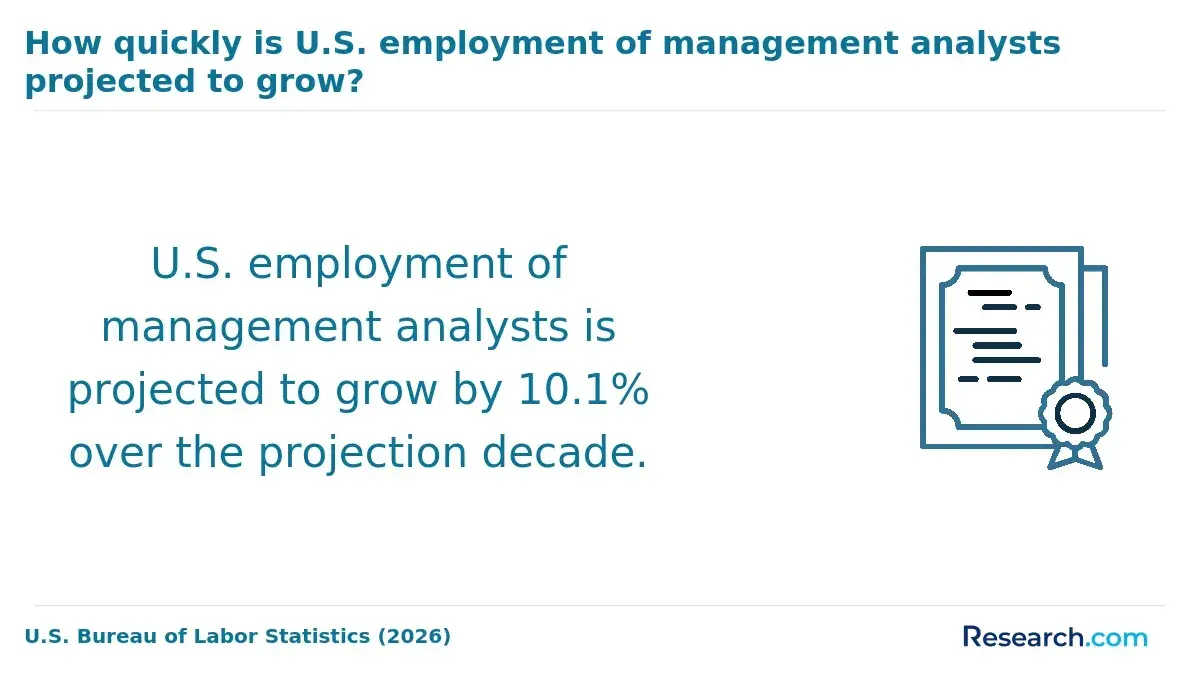
BLS projects overall management employment to grow faster than the average for all occupations from 2025 to 2035. That broad outlook does not show whether a particular employer has openings in finance leadership. For a useful personal estimate, compare pay for roles you could qualify for now and after gaining the experience those roles require, then weigh any plausible improvement against tuition and time away from other career development.
Which certifications or licenses complement an online MBA in finance?
A credential can fill a specific gap, but it is not automatically necessary alongside an MBA. The CFA charter is relevant to some investment-focused paths and entails its own exams and experience requirements. The CPA license is for accounting practice and depends on state-board rules; an MBA in finance does not itself establish CPA eligibility. Other finance or risk credentials should be assessed against the actual duties in job postings you hope to pursue.
If your immediate goal is to manage a department budget rather than enter a regulated or specialized profession, applying MBA coursework at work may be more valuable than collecting credentials. Choose a certification only after identifying the role it supports, its eligibility requirements, and the preparation time you can sustain.
Other Things You Should Know About MBA
Become comfortable building and checking spreadsheets, including formulas, charts, and basic financial statements. Ask your program which tools its finance courses actually use before buying software or training.
Only with appropriate permission. Check your employer's confidentiality rules and the school's project guidance; anonymized or public information may be a safer option.
That depends on the university. Ask to see its diploma and transcript policies if the distinction matters to you; do not assume the documents match those issued for a campus program.
Look for recurring small-group work, accessible faculty, alumni events, and career services you can use remotely. Participate consistently and follow up with classmates whose roles or industries connect to your goals.
- Considering Student Workload | CITT - University of Florida https://citt.it.ufl.edu/resources/course-design-basics/develop-and-implement/considering-student-workload/
- 8. Synchronous or Asynchronous Sessions | Guidelines for Online Teaching and Design https://open.lib.umn.edu/guidelinesforonlineteaching/chapter/synchronous-or-asynchronous-sessions/
- A Guide to Working in Groups | rutgers.edu https://learningcenters.rutgers.edu/resources/guide-working-groups
- Asynchronous and Synchronous Online Courses | nmsu.edu https://dacc.nmsu.edu/faculty-and-staff/online-quality-assurance/asynchronous-and-synchronous-online-courses.html
- Credit hours is not enough: Explaining undergraduate perceptions of course workload using LMS records - ScienceDirect https://www.sciencedirect.com/science/article/pii/S1096751622000380
- MBA Concentrations and Specializations | Eller College of Management https://eller.arizona.edu/programs/mba/mba-concentrations-specializations
- What to Consider When Evaluating Online MBA Programs | Northeastern Online https://online.northeastern.edu/resources/what-to-look-for-when-choosing-an-online-mba-program/
- Types of MBA Concentrations, Complete Guide For 2025 | Pepperdine Graziadio Business School https://bschool.pepperdine.edu/mba-programs/article/mba-specialization-types.htm
- What's the Difference Between Asynchronous and Synchronous Learning? | Ohio State Online https://online.osu.edu/content-hub/blogs/whats-the-difference-between-asynchronous-and-synchronous-learning/