2027 Best Online Bachelor's Degree Programs With No SAT or ACT Requirement

Co-Founder and Chief Data Scientist
Choosing an online bachelor's program is harder when every school seems to advertise "flexible admissions." Test-optional programs matter because they can reduce barriers for transfer students, working adults, and first-generation applicants. NCES data published in 2024 shows that more than half of U.S. undergraduates took at least one distance education course, making online quality a mainstream concern rather than a niche issue.
This guide explains how no-SAT/ACT bachelor's programs work, which majors fit different goals, what costs to expect, and how to avoid low-value or poorly accredited options.
Key Things You Should Know
- No-SAT/ACT online bachelor's programs usually evaluate GPA, prior college credit, essays, work experience, or placement assessments instead of standardized test scores.
- College Board's 2024 pricing report lists average published tuition and fees at $11,610 for in-state public four-year colleges and $43,350 for private nonprofit four-year colleges, so total cost can vary widely by institution and transfer credit.
- BLS 2024 occupational data shows strong demand in several bachelor's-level fields, but ROI depends on the major, accreditation, licensure alignment, employer recognition, and whether the program helps students finish efficiently.
Top 10 Best Online Bachelor's Degree Programs With No SAT or ACT Requirement
Business Degrees
Online business bachelor's programs without SAT or ACT scores often admit students through GPA review, transfer credit evaluation, or adult learner pathways. Common majors include business administration, accounting, finance, marketing, management, and supply chain.
This route fits students who want broad career flexibility, especially if they are unsure which industry they will enter. Look for regional accreditation and, when available, business accreditation such as AACSB, ACBSP, or IACBE. A business degree may not be enough for specialized roles like CPA-track accounting unless the curriculum meets state accounting board requirements.
Healthcare Degrees
Healthcare bachelor's programs with no test requirement often serve working adults moving from clinical support, administration, or associate-level training into management or specialized health roles. Options may include health administration, public health, health sciences, healthcare management, and medical imaging completion programs.
Students should verify whether the degree is career-preparation, licensure-preparation, or degree-completion only. The strongest programs disclose practicum expectations, transfer policies for allied health credits, and state authorization rules. This path fits students who want healthcare careers but do not necessarily want direct patient-care licensure.
Information Technology Degrees
Online IT bachelor's degrees are usually practical, systems-focused programs covering networking, databases, cloud computing, user support, systems administration, and project management. Many test-optional IT programs value prior technical coursework, certifications, or work experience. This major fits students who want applied technology jobs but prefer infrastructure and operations over heavy programming theory.
Look for hands-on labs, virtual environments, industry certification alignment, and employer-recognized coursework. Students changing careers should ask whether the program includes beginner-friendly programming, networking, and security foundations rather than assuming all IT curricula start from zero.
Computer Science Degrees
Computer science bachelor's programs without SAT or ACT scores can still be academically rigorous. Admissions may be test-optional, but the curriculum often includes programming, data structures, algorithms, software engineering, databases, operating systems, and discrete math. This major fits students who enjoy problem-solving and want software, data, AI, or systems development roles.
Strong online programs include coding projects, portfolio development, tutoring, and access to faculty with computing expertise. Students who dislike math or abstract logic may be better served by IT, cybersecurity, data analytics, or business technology programs.
Cybersecurity Degrees
Cybersecurity bachelor's programs often waive SAT or ACT scores while still requiring readiness for technical coursework. Students study networks, risk management, secure systems, digital forensics, incident response, cloud security, and governance. The best programs combine theory with labs and align coursework with certifications such as Security+, Network+, CySA+, or CISSP domains, although certification eligibility varies.
This degree fits students interested in protecting systems and investigating threats. Because cybersecurity hiring often rewards experience, students should prioritize programs offering labs, internships, projects, and career services rather than coursework alone.
Psychology Degrees
An online psychology bachelor's degree with no test requirement can prepare students for entry-level roles in human services, research support, case management, sales, training, or graduate study. It is important to understand that a bachelor's degree alone does not qualify graduates to become licensed psychologists or therapists.
Strong programs teach research methods, statistics, developmental psychology, abnormal psychology, ethics, and cultural competence. This major works best for students who enjoy human behavior and are open to graduate school or adjacent careers in business, healthcare, education, or social services.
Nursing Degrees
No-SAT/ACT nursing options are most common in RN-to-BSN programs designed for licensed registered nurses. Traditional pre-licensure BSN programs may still require prerequisites, clinical placements, background checks, entrance exams, or state-specific approvals even if SAT or ACT scores are not required. Students should confirm accreditation from ACEN or CCNE and verify that the program meets their state board's expectations. Online nursing can be highly flexible for working RNs, but clinical, practicum, or community health requirements may still occur locally and on a set schedule.
Education Degrees
Online education bachelor's programs without test scores may lead to teaching licensure, non-licensure educational studies, child development, instructional design, or early childhood roles. Students who want to become licensed teachers must verify state approval, student-teaching requirements, background checks, and required licensure exams.
A test-optional admissions policy does not remove certification rules. Non-licensure programs may suit students interested in training, tutoring, childcare administration, education technology, or nonprofit work. The best choice depends on whether the student wants classroom licensure or broader education-related employment.
Criminal Justice Degrees
Online criminal justice degrees with no SAT or ACT requirement often cover policing, courts, corrections, criminology, ethics, public policy, and homeland security. This major can fit students interested in law enforcement, probation, victim advocacy, compliance, or public safety administration. Applicants with records should review employer and licensing restrictions before enrolling.
Engineering Degrees
Fully online engineering bachelor's degrees with no test requirement are less common than business or IT programs because engineering often requires lab-intensive coursework. Options may include engineering technology, industrial technology, electrical engineering, software engineering, or completion pathways for students with prior technical credits.
Students should distinguish engineering from engineering technology and verify ABET accreditation when it matters for licensure or employer expectations. This path fits disciplined students with strong math preparation. If a program lacks labs, design projects, or accreditation clarity, ask detailed questions before applying.
What are online bachelor's programs with no SAT or ACT and how do they work?
Online bachelor's programs with no SAT or ACT requirement are undergraduate degree programs that do not require standardized admissions test scores. Some are truly test-blind, meaning scores are not considered at all, while others are test-optional, meaning students may submit scores if they believe the results strengthen the application.
These programs work much like other online degrees: students complete general education, major courses, electives, and capstone or internship requirements through a learning management system. Courses may be asynchronous, synchronous, or hybrid. The key difference is the admissions review. Instead of relying on standardized tests, schools may evaluate high school GPA, college transcripts, military training, work history, essays, recommendations, placement tests, or evidence of college readiness.
For many applicants, especially adult learners and transfer students, the no-test pathway is practical. It removes the time and cost of retesting while allowing schools to focus on more recent academic or professional evidence. A guide to what is the best degree for a convicted felon can help frame that decision. Program quality depends on faculty experience, internship access, and honest career advising.
How do admission requirements differ for online bachelor's degrees without test scores?
Admissions requirements differ most in how schools determine readiness. A no-test policy does not always mean open admission; selective programs can still review GPA, prerequisites, essays, interviews, or prior college performance.
The table below summarizes common admissions models and what they usually mean for applicants comparing online bachelor's programs.
| Admissions model | How it works | Best fit | Watch for |
| Test-optional | Applicants can choose whether to submit SAT or ACT scores. | Students with strong scores who want to add evidence, or students whose GPA and experience are stronger than test results. | Some scholarships or honors programs may still request scores. |
| Test-blind | Scores are not considered even if submitted. | Students who want admissions based on transcripts, coursework, and other materials. | Academic placement may still require separate assessments. |
| Open or broad access | Applicants meeting basic education requirements may be admitted. | Adult learners, students with uneven academic records, and first-time online students. | Completion support and advising quality become especially important. |
| Transfer-focused | Prior college credits are evaluated as the main evidence of readiness. | Students with associate degrees, military credits, or previous college coursework. | Not all credits may apply to the major or graduation requirements. |
Common mistakes include assuming "no SAT" means no standards and ignoring prerequisite rules. Before applying, ask whether the program requires minimum GPA, placement testing, specific high school courses, college-level math, criminal background checks, or professional licensure documentation.
How can students verify accreditation and quality for no-test online bachelor's programs?
Accreditation is the most important quality check for any online bachelor's degree. In the U.S., students should first confirm institutional accreditation from an agency recognized by the U.S. Department of Education or the Council for Higher Education Accreditation. This matters because accreditation affects federal financial aid eligibility, transfer credit acceptance, graduate school admission, and employer recognition.
Programmatic accreditation may also matter, especially in nursing, education, business, engineering, social work, and some health fields. The table below helps separate the quality checks that affect real-world value from marketing claims that sound impressive but may not protect students.
| Quality factor | What to verify | Why it matters |
| Institutional accreditation | The school is accredited by a recognized U.S. institutional accreditor. | Supports financial aid access, credit transfer, and degree legitimacy. |
| Programmatic accreditation | The specific major has field-specific accreditation when required or preferred. | Can affect licensure, certification, and employer acceptance. |
| State authorization | The school can enroll online students in the applicant's state. | Prevents enrollment in a program that cannot legally serve the student's location. |
| Licensure alignment | The curriculum meets requirements in the student's intended state. | Critical for nursing, teaching, counseling-related pathways, and some technical fields. |
| Student outcomes | The school publishes retention, graduation, loan repayment, or career data. | Helps students judge whether support and completion rates match the cost. |
Red flags include vague accreditation language, pressure to enroll immediately, unclear tuition pages, missing faculty information, no transfer-credit estimate, and promises of guaranteed employment. A credible school should answer accreditation and licensure questions in writing.
What majors are offered in test-optional online bachelor's degree programs?
Test-optional online bachelor's programs are available across many high-demand and broad-access majors. The best major depends on the student's career target, tolerance for quantitative work, need for licensure, and whether graduate school may be necessary later.
The most common online no-test majors usually fall into these categories because they can be delivered effectively online and serve working adults, transfer students, or career changers.
- Business and management majors for students seeking broad private-sector, nonprofit, government, or entrepreneurial pathways.
- Healthcare administration, public health, and health sciences for students who want healthcare careers without necessarily pursuing direct clinical licensure.
- Information technology, computer science, cybersecurity, and data analytics for students preparing for technical or digital roles.
- Psychology, sociology, criminal justice, and human services for students interested in people-focused, policy, advocacy, or public-service careers.
- Education, early childhood, and instructional design for students who want teaching, training, curriculum, or learning-support roles.
Students comparing majors should connect academic interest to labor-market demand, not just choose the easiest admission pathway. Looking into top degrees in demand for the future can help students compare long-term field strength before committing.
How do online formats, scheduling, and learning support compare to campus programs?
Online formats can match campus programs academically, but the student experience is different. Online students usually need stronger time management, written communication, and comfort with digital tools. Campus students may have easier access to face-to-face labs, networking events, and spontaneous faculty interaction.
The table below compares common format choices so students can decide which learning environment fits their schedule and support needs.
| Format | How it works | Best fit | Main trade-off |
| Asynchronous online | Students complete weekly work without required live class meetings. | Working adults, parents, military students, and students across time zones. | Requires self-discipline and proactive communication. |
| Synchronous online | Students attend live virtual classes at scheduled times. | Students who want structure and real-time interaction. | Less flexible for shift workers or caregivers. |
| Hybrid | Online coursework is combined with occasional campus, lab, or clinical requirements. | Students in fields that require hands-on learning. | Travel and scheduling may add hidden costs. |
| Accelerated online | Courses run in shorter terms, often five to eight weeks. | Focused students with transfer credits or strong study habits. | Fast pacing can be difficult with full-time work. |
| Competency-based | Students progress by proving mastery of skills. | Experienced adults who can move quickly through familiar material. | May not fit students who need frequent instructor-led structure. |
Support matters as much as format. Before enrolling, confirm access to online tutoring, library databases, writing help, career coaching, disability services, academic advising, technical support, and faculty office hours.
What is the typical length and total cost of test-optional online bachelor's degrees?
A bachelor's degree typically requires about 120 credits. First-time students often need four years of full-time study, while transfer students may finish sooner if prior credits apply directly to the degree. Part-time students may need longer, but the flexibility can make persistence more realistic for working adults.
Cost depends on tuition, fees, books, technology, transfer credits, residency rules, and whether the school charges online students in-state or flat-rate tuition. College Board's 2024 pricing report lists average published tuition and fees at $11,610 for in-state public four-year institutions and $43,350 for private nonprofit four-year institutions for 2024-25; these figures are a benchmark, not a personalized net price.
The table below shows the major cost drivers students should compare before choosing a no-test online bachelor's program.
| Cost factor | Why it affects total price | Question to ask |
| Tuition rate | Schools may charge by credit, term, or competency subscription. | Is tuition different for online, out-of-state, military, or transfer students? |
| Transfer credit | Accepted credits can reduce both time and cost. | How many credits will apply to my major before I enroll? |
| Fees | Technology, course, graduation, proctoring, and clinical fees can add up. | What is the full program cost, not just tuition? |
| Books and materials | Some programs use open educational resources; others require paid platforms. | Are materials included in tuition or billed separately? |
| Time to completion | Longer enrollment can increase fees and opportunity cost. | What is the realistic completion plan for my schedule? |
To reduce cost, request an official transfer evaluation, complete the FAFSA, compare net price rather than sticker price, ask about employer tuition assistance, and avoid retaking courses that could transfer from accredited institutions.
What careers can graduates pursue with an online bachelor's degree earned without test scores?
Graduates of online bachelor's programs can pursue many of the same career paths as campus graduates when the school is accredited and the curriculum matches the field. Employers generally care more about the degree's relevance, skills, portfolio, internships, certifications, and experience than whether SAT or ACT scores were used at admission.
The table below summarizes common career directions by major. It is not a guarantee of eligibility because requirements vary by employer, state, and industry.
| Major area | Possible career paths | What strengthens employability |
| Business | Operations coordinator, marketing specialist, financial services associate, project coordinator, human resources assistant. | Internships, analytics tools, communication skills, Excel, project management experience. |
| Healthcare | Healthcare administrator, public health coordinator, patient services manager, health information supervisor. | Healthcare experience, compliance knowledge, data reporting, understanding of reimbursement systems. |
| IT and computer science | Software developer, systems analyst, network administrator, cloud support associate, data analyst. | Portfolio projects, coding ability, labs, certifications, GitHub or technical documentation. |
| Cybersecurity | Security analyst, SOC analyst, risk analyst, digital forensics assistant, compliance analyst. | Hands-on labs, certifications, incident response practice, networking fundamentals. |
| Psychology and human services | Case manager, behavioral health technician, research assistant, training coordinator, community program specialist. | Field experience, statistics coursework, ethics training, graduate school planning when licensure is the goal. |
| Education | Teacher, instructional assistant, curriculum support specialist, training coordinator, early childhood administrator. | State-approved licensure pathway, student teaching, classroom experience, background clearance. |
| Criminal justice | Probation support, law enforcement pathway, corrections officer, victim advocate, compliance assistant. | Internships, physical and background eligibility, report writing, ethics and policy knowledge. |
Some students use a bachelor's degree as a foundation for graduate school. If the long-term plan includes leadership, counseling, analytics, advanced clinical practice, or executive roles, comparing most lucrative master's degrees can help clarify whether graduate study is likely to add value later.
What are salary expectations and earning potential for common test-optional bachelor's majors?
Salary expectations vary more by major, occupation, location, experience, and industry than by whether a student submitted SAT or ACT scores. BLS 2024 wage data is useful because it reports national medians for occupations, but students should treat those numbers as labor-market benchmarks rather than promised outcomes.
The table below gives salary context for several common bachelor's-level career areas linked to test-optional online majors.
| Career area | Relevant bachelor's major | U.S. median pay context from BLS 2024 data | Decision note |
| Business and financial operations | Business, finance, accounting, economics | Median annual wage was $80,920 for business and financial occupations. | Analytical skills, internships, and industry certifications can influence early-career competitiveness. |
| Computer and information technology | IT, computer science, cybersecurity, data analytics | Median annual wage was $104,420 for computer and IT occupations. | Technical portfolios and current tools can matter as much as the degree title. |
| Healthcare management | Health administration, health sciences, business | Medical and health services managers had a median annual wage of $110,680. | Many management roles prefer healthcare experience in addition to the bachelor's degree. |
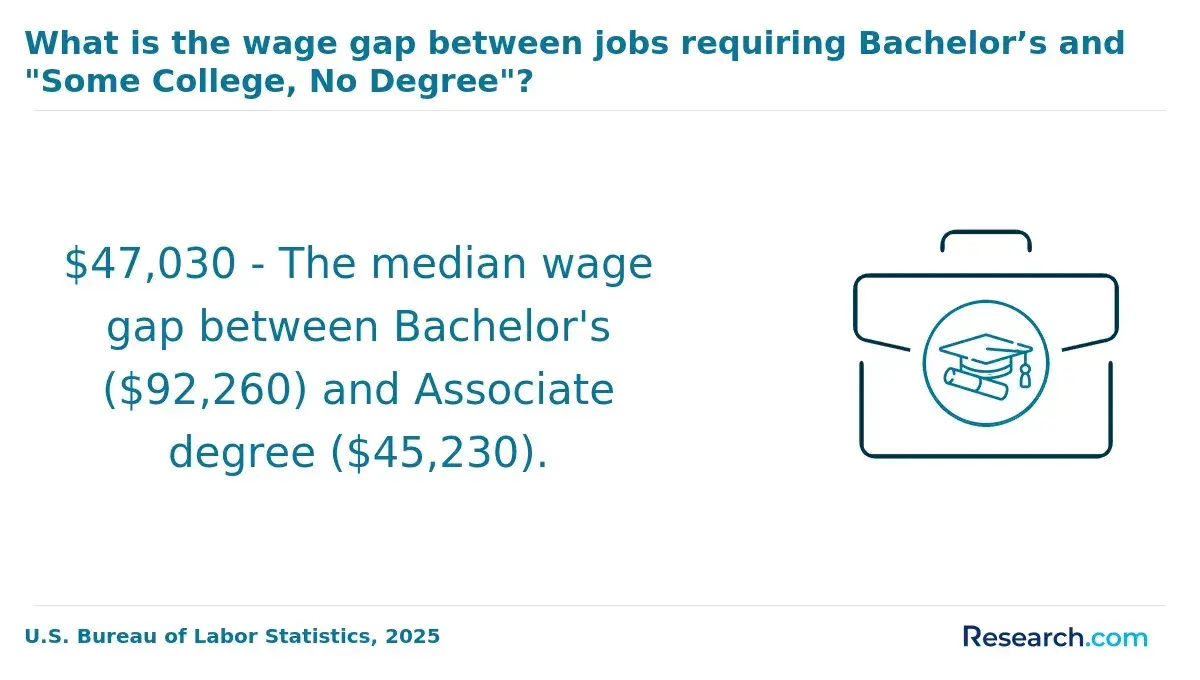
| Community and social service | Psychology, human services, sociology, criminal justice | Median annual wage was $52,000 for community and social service occupations. | Licensure-oriented counseling roles typically require graduate education. |
| Education, training, and library | Education, early childhood, instructional design | Median annual wage was $59,940 for education, training, and library occupations. | Teacher pay and eligibility vary substantially by state, district, and licensure route. |
Students focused on ROI should compare earnings potential with total program cost, completion time, and debt. Research.com's guide to the best bachelor's degrees can help identify majors with stronger salary potential, but fit and persistence still matter.
How should students choose the best no-test online bachelor's program for their goals?
The best no-test online bachelor's program is the one that helps the student graduate with a recognized credential, manageable cost, relevant skills, and a realistic path to employment or graduate study. Rankings can be useful, but they should not replace a direct review of accreditation, curriculum, support, and outcomes.
Use the following sequence to compare programs before applying. These steps help separate a flexible admissions policy from a genuinely strong academic investment.
- Define the target outcome first, such as entry-level employment, promotion, licensure, graduate school, or career change.
- Confirm institutional accreditation and any required programmatic accreditation for the field.
- Ask for a written transfer-credit evaluation before committing, especially if you have prior college, military, or professional learning credits.
- Compare total net cost, including fees, books, technology, travel, clinical expenses, and lost time from work.
- Review the curriculum for hands-on projects, labs, internships, capstones, or certification alignment.
- Check whether the program is authorized in your state and whether it meets licensure rules where you plan to work.
- Evaluate support services, including tutoring, advising, career coaching, disability accommodations, and technical help.
- Ask admissions or academic advisors how many online students persist, graduate, and use transfer credits successfully.
Common mistakes include choosing the fastest program without checking quality, focusing only on tuition per credit, ignoring licensure rules, assuming transfer credits will automatically apply, and enrolling before understanding weekly time expectations. A good program should make requirements clear before the student pays a deposit.
Other Things You Should Know About
Yes, they can be respected when the institution is properly accredited and the degree matches the job. Employers usually do not ask whether a student submitted SAT or ACT scores; they focus on the degree, skills, experience, portfolio, certifications, and interview performance.
Not always. Some programs are open-access, but others still require minimum GPA, prerequisites, essays, interviews, or prior college credits. "No test required" only means standardized test scores are not mandatory for admission.
Usually, yes, if the school is accredited by a recognized institutional accreditor and the student meets federal aid eligibility rules. Students should complete the FAFSA and compare net price after grants and scholarships, not just published tuition.
The biggest risk is enrolling without verifying accreditation, licensure alignment, transfer-credit acceptance, and total cost. A flexible admissions policy is helpful, but it does not automatically mean the program is high quality or the right fit.
References
- Best Online Colleges In Texas https://www.affordablecollegesonline.org/online-colleges/texas/
- Online Degrees With No Application Fee — Start Faster, Spend Less https://www.collegetransitions.com/blog/online-degrees-no-application-fee/
- What We’ve Learned about Test-Optional and Test-Required Admissions https://www.applerouth.com/blog/what-weve-learned-about-test-optional-and-test-required-admissions
- Find Test-Optional Colleges — No SAT/ACT Requirement https://www.accreditedschoolsonline.org/online-colleges/no-sat-or-act/
- Can Online Colleges Offer Competitive Career Outcomes? https://www.onlineu.com/magazine/popular-online-schools-career-outcomes
- Testing Policies in the Spotlight https://www.compassprep.com/testing-spotlight/
- Which Colleges Are Test Optional in 2025-2026? | Ivy Coach https://www.ivycoach.com/the-ivy-coach-blog/standardized-testing/test-optional-colleges-list/
- Thomas University waives SAT/ACT requirement for admission - Thomas University https://www.thomasu.edu/thomas-university-waives-sat-act-requirement-for-admission/