2027 Best Accredited Online Dental Assistant Degree Programs: Compare Tuition, Admissions, and Career Outcomes

Co-Founder and Chief Data Scientist
Choosing an online dental assistant degree is tricky because the best programs are rarely 100% online: accredited training still requires hands-on labs and clinical practice. The decision matters because the U. S. Bureau of Labor Statistics reports a May 2024 median annual wage of $47,300 for dental assistants, with demand supported by ongoing dental care needs. This guide is for first-time students, working adults, and career changers comparing accredited online or hybrid options. You will learn how to judge tuition, admissions, accreditation, flexibility, and career outcomes before enrolling.
Key Things You Should Know
- The best overall value usually comes from CODA-accredited public community or technical college programs that combine online coursework with supervised labs and clinical rotations.
- Dental assistant programs are often certificates, diplomas, or associate degrees; the degree route may cost more but can improve transfer options and long-term healthcare career mobility.
- The BLS reported a $47,300 median annual wage for dental assistants in May 2024, so students should compare total program cost against realistic entry-level earnings rather than tuition alone.
Which Accredited Online Dental Assistant Degree Programs Offer the Best Overall Value?
The best accredited online dental assistant degree program is not simply the cheapest program or the one that advertises the most convenient schedule. For most students, the strongest value comes from a program that is institutionally accredited, aligned with Commission on Dental Accreditation expectations when available, affordable enough to avoid unnecessary debt, and structured to help students complete clinical requirements near where they live.
Because dental assisting is a hands-on field, students should be cautious about programs marketed as fully online if they do not clearly explain lab, radiography, infection control, and externship requirements. A lower-cost online-only program may be less useful if it does not support certification eligibility, state registration, or employer expectations in your area.
The table below compares the main types of accredited online or hybrid dental assistant degree pathways and shows when each offers the best value.
| Program type | Best for | Value strengths | Potential drawback |
| Public community college hybrid associate degree | Students who want affordability, transfer options, and structured clinical training | Often combines lower tuition with institutional accreditation, faculty support, and local employer ties | May require campus labs, fixed clinical schedules, or limited program seats |
| Public technical college hybrid diploma or certificate with degree pathway | Students who want to enter the workforce quickly but may continue later | Shorter timeline and career-focused coursework can reduce opportunity cost | Credits may not transfer as easily into a future associate or bachelor's program |
| Private nonprofit college dental assisting program | Students who need smaller cohorts, structured advising, or specific regional clinical placements | May provide strong support services and organized externship coordination | Total cost can be higher, so financial aid comparisons matter |
| Online career diploma without clear CODA alignment | Students in states or offices that accept non-CODA preparation for entry-level assisting | May be flexible and faster for basic workforce preparation | May not meet certification, radiography, expanded-function, or transfer goals |
For value-focused students, the practical answer is to start with nearby public colleges that offer hybrid dental assisting and then compare them with reputable private options only if the private program offers stronger placement support, better scheduling, or a clinical site you could not otherwise access. Career changers who need a broader look at compressed degree options may also want to compare accelerated programs for career changers before committing to a dental-specific route.
A common mistake is relying on "online" as the main filter. In dental assisting, a better filter is whether the program's online coursework is paired with verified hands-on training that matches your state's credentialing rules.
What Accreditation Should Students Look for in an Online Dental Assistant Degree Program?
Accreditation is one of the most important quality checks for an online dental assistant degree program. Institutional accreditation means the college itself meets recognized academic and administrative standards, while programmatic accreditation focuses on the dental assisting curriculum and clinical preparation.
For dental assisting, the specialized accreditor most students should understand is the Commission on Dental Accreditation, commonly called CODA. CODA accreditation is especially important if your goal involves Dental Assisting National Board exam eligibility, radiography credentials, expanded functions, or smoother employer recognition. Requirements vary by state, so students should confirm both school accreditation and state rules before enrolling.
Use this checklist before you apply because accreditation problems are difficult to fix after you have already paid tuition.
- Confirm that the college holds recognized institutional accreditation through a U.S. Department of Education-recognized accreditor.
- Check whether the dental assisting program itself is CODA-accredited or clearly explains why CODA accreditation is not required for your goal.
- Ask whether the curriculum satisfies radiography, infection control, CPR, and expanded-function requirements in your state.
- Verify whether credits can transfer into an associate degree, bachelor's degree, or other healthcare program if you continue your education later.
- Request written information about externships, clinical hours, and any campus visits before signing an enrollment agreement.
The biggest red flag is vague accreditation language. Phrases such as "nationally recognized curriculum" or "industry aligned" are not the same as recognized institutional or programmatic accreditation.
How Do Tuition Costs Compare Across Accredited Online Dental Assistant Degree Programs?
Tuition for accredited online dental assistant degree programs varies widely because some students choose short certificates while others complete an associate degree. The most useful comparison is total cost of attendance, not per-credit tuition, because dental assisting programs may require uniforms, immunizations, CPR certification, background checks, instruments, radiography supplies, exam fees, and travel to clinical sites.
As a useful benchmark, College Board's 2024 Trends in College Pricing reported average published tuition and fees of $4,050 for in-district students at public two-year colleges for 2024-25. That figure does not represent a dental assisting program's full cost, but it helps explain why community colleges often deliver strong value when students qualify for local tuition rates.
The table below shows which cost categories students should compare before choosing an accredited online or hybrid dental assistant degree program.
| Cost category | Why it matters | How to compare programs |
| Tuition | Usually the largest direct academic cost | Compare per-credit and full-program cost, not just semester cost |
| Online learning fees | Can raise the price of distance coursework | Ask whether online fees apply to every course or only selected classes |
| Clinical and lab fees | Hands-on training often has separate charges | Confirm whether simulation, radiography, or lab materials are included |
| Books, instruments, and uniforms | Dental assisting programs may require specialized supplies | Request a current required-cost sheet from the department |
| Certification and exam fees | Credentials can improve employability but add cost | Ask which exams are included in tuition and which are paid separately |
| Transportation and time away from work | Hybrid programs still require in-person attendance | Estimate travel to campus labs and clinical placements before enrolling |
Students comparing healthcare support roles may also compare dental assisting with a medical assistant course online, especially if they want broader clinic-based duties outside dentistry. The better choice depends on whether you prefer dental procedures, general medical office work, or a pathway into another allied health role.
A common mistake is choosing the lowest advertised tuition without checking whether the program prepares students for the credential they actually need. A slightly higher-cost CODA-accredited or clinically stronger program can be a better investment if it reduces credentialing barriers and supports job placement.
How Competitive Is Admission to Accredited Online Dental Assistant Degree Programs?
Admission to accredited online dental assistant degree programs is usually less competitive than admission to nursing, dental hygiene, or radiologic technology programs, but it is not always automatic. Many community college programs are open-admission at the college level but selective at the program level because labs, faculty supervision, and clinical sites limit cohort size.
Students should think of admissions flexibility and academic quality as separate issues. An open-access college can still run a rigorous dental assisting program, while a selective program is not automatically the best fit if it delays your start date or requires prerequisites you do not need for your career goal.
The table below summarizes common admissions factors and what they mean for applicants comparing online or hybrid dental assistant degree programs.
| Admissions factor | Typical requirement | Decision impact |
| High school diploma or GED | Required by most programs | Usually the baseline requirement for entry |
| Placement testing or college readiness | May be required for English, math, or reading | Can affect whether you need developmental coursework before starting |
| Science prerequisite | Some programs require biology, anatomy, or health science basics | May lengthen the timeline but can improve preparation for clinical coursework |
| Background check and drug screening | Common before clinical placement | Can affect eligibility for externships, even if the college admits you |
| Immunizations and CPR certification | Often required before patient contact | Adds time-sensitive tasks before clinical courses begin |
| Interview or information session | Used by some limited-entry programs | Helps programs assess readiness and gives students a chance to ask practical questions |
Applicants can improve their chances by applying early, completing required health documentation quickly, and asking how the program ranks candidates if seats are limited. If your long-term goal is not dentistry but broader healthcare administration, compare dental assisting with healthcare administration degree programs before investing in a clinical credential.
The admissions red flag to watch for is pressure to enroll immediately without a clear explanation of clinical eligibility. If a school cannot explain background check rules, immunization deadlines, or externship placement policies, keep asking questions before paying.
Which Learning Formats Offer the Greatest Flexibility in Online Dental Assistant Degree Programs?
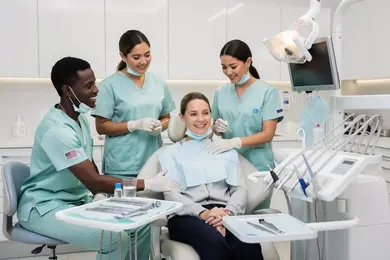
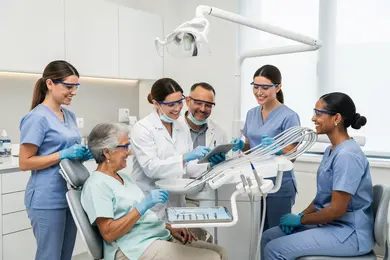
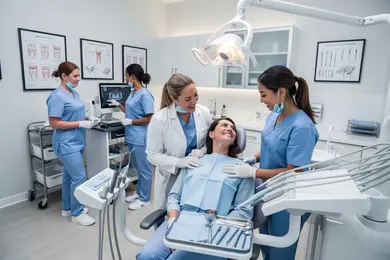
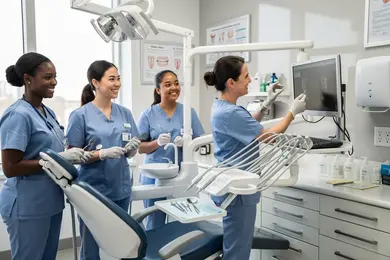
The most flexible online dental assistant degree programs separate what can be learned online from what must be learned in person. Courses such as dental terminology, ethics, anatomy basics, infection control theory, and office administration may work well online. Chairside assisting, impressions, radiography positioning, sterilization procedures, and patient-care skills require supervised practice.
The table below compares common learning formats so students can match program structure to work schedules, commute limits, and learning preferences.
| Format | How it works | Best fit | Trade-off |
| Hybrid synchronous | Online classes meet at scheduled times, with required campus labs | Students who want structure and live interaction | Less schedule flexibility for working adults |
| Hybrid asynchronous | Online coursework is completed on a weekly schedule, with scheduled labs or clinicals | Working adults who can manage deadlines independently | Requires strong time management |
| Low-residency hybrid | Most theory is online, with intensive campus visits for labs | Students who live farther from campus but can travel occasionally | Travel and lodging may increase total cost |
| Campus-based with online general education | Dental courses are mostly in person, while some nonclinical courses are online | Students who need close faculty coaching for hands-on skills | Less convenient but often highly structured |
| Online-only nonclinical career diploma | Coursework is remote and may not include supervised clinical practice | Students seeking basic dental office knowledge where accepted by employers | May not satisfy certification, state, or employer expectations |
Current online education trends make hybrid programs more practical than in the past, especially through learning management systems, virtual simulations, recorded demonstrations, and digital assessment tools. Still, simulation cannot replace the supervised clinical practice needed to build safe chairside skills.
A good rule is to choose the most flexible program that still protects your credentialing and clinical goals. If flexibility removes too much hands-on practice, the program may be convenient but not career-effective.
What Student Support Services Improve Success in Online Dental Assistant Degree Programs?
Student support can make the difference between enrolling and actually finishing a dental assistant degree program. This is especially true for online and hybrid students who must balance coursework, lab attendance, clinical documentation, and often part-time or full-time employment.
The most valuable support services are the ones tied directly to completion and employment. Before enrolling, ask whether support is delivered by the dental assisting department, a general student services office, or both.
- Dedicated program advising that maps prerequisites, lab dates, clinical deadlines, and graduation requirements before the first term begins.
- Clinical placement coordination that helps students identify approved sites rather than leaving them to find placements alone.
- Online tutoring for anatomy, dental terminology, infection control, and radiography concepts.
- Career services that include resume help, interview preparation, employer introductions, and guidance on dental assisting credentials.
- Technology support available during evenings or weekends if online coursework is designed for working adults.
- Transfer advising for students who may later pursue dental hygiene, healthcare management, or another degree.
One current trend affecting dental assisting education is the increasing use of digital dentistry tools, including intraoral scanning, electronic health records, and digital imaging workflows. Programs that expose students to modern dental office technology may better reflect the environments graduates are likely to enter.
A common mistake is treating support services as a bonus rather than a core part of program quality. If a program has weak advising, unclear externship support, or limited online help, students may face avoidable delays even when the curriculum itself is solid.
Which Financial Aid Options Are Available for Accredited Online Dental Assistant Degree Students?
Accredited online dental assistant degree students may qualify for several types of financial aid, but eligibility depends on the school, credential level, enrollment status, and program length. Students should complete the FAFSA if the institution participates in federal student aid and then compare the net price after grants and scholarships, not just the published tuition.
The main financial aid options are worth comparing carefully because they affect both upfront affordability and long-term return on investment.
- Federal Pell Grants may be available to eligible undergraduate students enrolled in qualifying programs at participating institutions.
- Federal student loans can help cover costs, but students should borrow cautiously because entry-level dental assisting wages may not support large loan balances comfortably.
- State grants and workforce training funds may support students in high-demand healthcare programs, depending on location and eligibility rules.
- Institutional scholarships may be offered by community colleges, technical colleges, or private nonprofit schools.
- Employer tuition assistance may be available for current dental office employees training for expanded duties.
- Professional association scholarships may support dental assisting students, particularly those pursuing certification or advancement.
Financial aid award letters can be difficult to compare because one school may list loans prominently while another highlights grants. Separate gift aid from borrowed aid and calculate how much you would still owe after tuition, fees, books, supplies, transportation, and exam costs.
Students who already work in healthcare and plan to move into supervisory or operations roles later may eventually compare clinical training with online MBA programs healthcare management, but that path usually makes sense after completing a bachelor's degree and gaining relevant work experience.
The biggest financial aid mistake is borrowing for a program that does not align with your state's credentialing requirements. Before accepting loans, confirm that the program supports the job title, certification, and expanded-function goals you want.
Which Career Outcomes Are Associated With Accredited Online Dental Assistant Degree Programs?
Accredited online dental assistant degree programs are designed for entry-level roles in dental offices, specialty practices, clinics, and public health settings. Graduates may support dentists during procedures, prepare instruments, take and process dental radiographs where allowed, maintain infection control procedures, update patient records, schedule appointments, and educate patients on oral hygiene instructions.
The BLS reported a May 2024 median annual wage of $47,300 for dental assistants. Students should use that figure as a national reference point, not a promise, because pay can vary by state, credential, experience, specialty practice, and whether the role includes expanded functions.
The table below connects common education outcomes with the career options students often consider after completing an accredited dental assistant program.
| Outcome | Typical career relevance | What to verify before enrolling |
| Dental assisting certificate or diploma | Entry-level chairside assisting, sterilization, front office support, and clinical support roles | Whether the credential meets employer and state requirements |
| Associate degree in dental assisting | Dental assisting roles plus stronger general education and transfer potential | Whether credits transfer into dental hygiene, healthcare administration, or bachelor's programs |
| Radiography preparation | Eligibility for dental X-ray duties where state rules allow | Whether coursework satisfies state radiography requirements |
| Expanded-function preparation | Additional clinical duties in states that authorize expanded functions | Whether the program aligns with your state dental board's rules |
| Certification preparation | May improve mobility and employer recognition | Which exams the program prepares students to take and whether graduates are eligible |
Dental assisting can be a strong starting point for students who want patient care experience without spending several years in school. It may not be the best long-term endpoint for students whose goals require higher clinical autonomy, such as dental hygiene, nursing, or advanced healthcare leadership.
If your career goal later shifts toward nursing, remember that RN to BSN online programs are designed for licensed registered nurses, not dental assistants directly. That distinction matters because changing healthcare tracks may require new prerequisites, licensure steps, and clinical training.
How Do Online and Campus-Based Dental Assistant Degree Programs Compare?
Online and campus-based dental assistant degree programs can lead to similar goals, but they differ in schedule structure, commuting burden, peer interaction, and access to labs. The right choice depends less on whether online learning is "better" and more on whether the format fits your life while still providing enough supervised clinical practice.
The comparison below shows where online, hybrid, and campus-based formats usually differ for dental assisting students.
| Factor | Online or hybrid program | Campus-based program |
| Schedule flexibility | Stronger for theory courses, especially asynchronous classes | More fixed class and lab times |
| Hands-on skill development | Depends on lab intensives, campus visits, or clinical site quality | Usually more frequent direct practice with faculty present |
| Commute and location | May reduce weekly travel but still requires clinical participation | Requires regular travel to campus |
| Peer and faculty interaction | May rely on discussion boards, video meetings, and scheduled labs | Often easier to build in-person relationships |
| Best fit | Working adults, parents, rural students, and students with reliable self-management skills | Students who prefer structure, immediate feedback, and frequent hands-on coaching |
Online programs can be a better investment when they reduce commuting and allow students to keep working. Campus-based programs can be a better fit when a student needs more direct supervision or does not have a reliable clinical site nearby.
Students considering long-term movement into management can use dental assisting as a first healthcare role, then later evaluate whether an associate or bachelor's pathway supports administration. For nonclinical advancement, compare future options carefully before assuming that every dental assisting credit will transfer into a healthcare management degree.
How Should Students Choose the Best Accredited Online Dental Assistant Degree Program?
The best accredited online dental assistant degree program is the one that fits your state requirements, budget, schedule, clinical access, and career goal. Rankings can help you start a search, but they should not replace a program-by-program review of accreditation, outcomes, and total cost.
Use the following steps to compare programs in a practical order. This sequence helps you eliminate poor-fit options before spending time on applications.
- Define your target job first, including whether you want chairside assisting, radiography duties, expanded functions, office administration, or a stepping stone to another healthcare career.
- Check state dental board rules for dental assistants, radiography, infection control, and expanded functions before comparing schools.
- Verify institutional accreditation and, when relevant to your goal, CODA programmatic accreditation.
- Calculate total cost, including tuition, fees, supplies, clinical travel, certification exams, and lost work time.
- Ask how online coursework, campus labs, and clinical placements are scheduled before assuming the program will fit your life.
- Compare admissions requirements and start dates, especially if a limited-entry program could delay your timeline.
- Review completion, certification preparation, job placement support, and employer partnerships when available.
- Speak with admissions, financial aid, and the dental assisting department before enrolling, and request important promises in writing.
Students should prioritize lower tuition when programs are similar in accreditation, clinical quality, and support. They should consider paying more only when the higher-cost program clearly improves access to clinical placement, credential eligibility, scheduling flexibility, or career support.
If you are unsure whether dental assisting is the right long-term investment, compare it with adjacent pathways before enrolling. Dental assisting is often a practical entry into oral healthcare, but students seeking broader administrative or leadership roles may eventually need additional education beyond an associate degree.
Other Things You Should Know About Dental Assistant
You may complete some coursework online, but hands-on skills usually require labs, clinical practice, or an externship. A fully online program may be acceptable for limited goals in some states, but students should verify employer expectations and state rules before enrolling.
Certificates and diplomas may take less than a year, while associate degree programs commonly take about two years of full-time study. Hybrid scheduling, prerequisites, clinical availability, and part-time enrollment can change the timeline.
A degree may be better if you want general education credits, transfer potential, or a longer-term healthcare pathway. A certificate may be better if your main goal is to enter the workforce quickly and it meets your state and employer requirements.
Ask whether the program is institutionally accredited, whether it has CODA accreditation, how clinical placements work, what the total cost is, which credentials students can pursue, and whether credits transfer to future programs.
References
- Graduate Employment Outcomes: ACG vs Government Data https://iei.asiacareersgroup.com/blogs/articles/graduate-employment-outcomes-acg-vs-government-data
- CODA | Commission on Dental Accreditation https://coda.ada.org/
- Dental Assistant Course Online - International Career Institute https://icieducation.com/courses/health-fitness/dental-assistant/
- Dental Assisting Programs: What They Cover, What They Cost, and What to Expect https://stocktondentalassistant.com/blog/dental-assisting/dental-assisting-programs-what-to-expect/
- Is Dental Assisting Better Than Other Entry-Level Healthcare Careers in Florida? https://bartramdentalassisting.com/dental-assisting-vs-other-healthcare-careers/
- Online Dental Assistant Programs: Compare Schools & Get Info https://www.edumed.org/online-schools/dental-assistant-programs/
- Commission on Dental Accreditation, American Dental Association | Council for Higher Education Accreditation https://www.chea.org/commission-dental-accreditation-american-dental-association
- Dental Assistant Career Opportunities: Job Outlook, Salaries, and How to Get Started | Trade Schools Directory https://tradecolleges.org/blog/trade-programs/dental-assistant-career-opportunities
- Dental Assistant Program Costs Explained https://www.moderndentaltraining.com/post/understanding-the-cost-of-dental-assistant-programs
- Online Dental Assistant Certificate Program | Self-Paced Course https://www.uscareerinstitute.edu/online-dental-assistant-school