2027 Anatomy and Physiology for Nursing Students: Background Knowledge and Readiness Questions
Audited and Verified:
Our Editorial and Data Verification Process
Research.com uses government datasets, official education statistics and primary institutional information to support its career and degree guides. Our review process checks factual accuracy, occupational definitions, source dates and the requirements associated with the credentials discussed.
How This Article Was Fact-Checked
Our editorial team verifies salary estimates, employment projections, education requirements and program information against original data providers and official organizations. Salary figures are checked against the relevant occupational definitions and reporting periods. Information about licensure, accreditation and required in-person training is reviewed separately.
Fact-checked and verified on:

Co-Founder and Chief Data Scientist
Anatomy and physiology can determine both whether you qualify for a nursing program and how confidently you approach later coursework. If you are preparing to apply - or returning to science after time away - the useful question is not whether you can memorize every structure now. It is whether you understand the foundations, can meet your target program's course and lab rules, and have a workable study plan. This guide explains what nursing students learn, how to assess your readiness, and what to verify before paying for a course.
Key Things You Should Know
- Anatomy studies body structures; physiology explains how they function. Nursing students need both to understand assessment findings and later courses such as pathophysiology and pharmacology.
- Many programs require a two-course anatomy and physiology sequence with labs, but acceptable grades, course age, transfer equivalencies, and online lab rules vary by school.
- Before enrolling, ask your target nursing program to confirm the exact course, lab format, completion deadline, and whether its requirements apply to admission, progression, or both.
What Is Anatomy and Physiology in Nursing?
Anatomy describes where body structures are and how they relate to one another. Physiology explains what those structures do and how the body maintains functions such as circulation, breathing, and fluid balance. Nursing students study the two together because a change in function is easier to interpret when they understand the structures involved.
For example, learning the heart's chambers and valves provides a framework for understanding blood flow; learning how circulation responds to changing demands helps make sense of vital signs. That foundation supports clinical reasoning, but an anatomy and physiology course does not authorize a student to assess or treat patients independently.
Students entering from another field should check whether their previous science courses meet nursing requirements rather than assuming a prior degree will substitute. A guide to nursing degrees without an RN background can help distinguish programs intended for initial nursing preparation from those that require an existing RN license.
Why Are Anatomy and Physiology Prerequisites for Nursing School?
Nursing courses build on normal body function before asking students to study illness, medications, and patient assessment. Knowing how kidneys normally regulate fluid, for instance, gives a student a starting point for learning why fluid balance matters in care. Prerequisites help programs establish that foundation before students enter a demanding course sequence.
A prerequisite is not the same as proof of clinical competence. A strong grade shows academic preparation; safe patient care also requires supervised practice, communication, judgment, and evaluation. Requirements differ among prelicensure ADN and BSN programs, and some schools allow an outstanding course at application while requiring completion before nursing classes begin.
The same distinction matters for applicants with prior healthcare training. Experience may make the material more familiar, but it does not automatically waive a required science course. Someone considering shorter LPN-to-RN program comparisons should still obtain a written review of prerequisite and lab equivalencies from each receiving program.
What Do Nursing Students Learn in Anatomy and Physiology?
Course organization varies, but students commonly move from cells and tissues to organ systems and the ways those systems interact. The table shows why several core topics matter in subsequent nursing study; it is not a list of clinical actions a student can perform without supervision.
| Topic | Core question | Connection to nursing coursework |
| Cells and tissues | How do cells exchange materials and form body structures? | Provides a basis for studying injury, healing, and infection. |
| Cardiovascular and respiratory systems | How are blood flow and gas exchange maintained? | Supports later learning about vital signs and oxygenation. |
| Renal and endocrine systems | How does the body regulate fluids and chemical signals? | Supports later work in fluid balance and medication effects. |
| Nervous and musculoskeletal systems | How are sensation, movement, and responses coordinated? | Provides context for health assessment and mobility concepts. |
Labs may use models, slides, specimens, or digital tools, with written exams and practical identification assessments. Students who eventually pursue advanced practice revisit these foundations at greater depth; post-master's family NP clinical training requirements are separate from - and cannot be fulfilled by - an undergraduate anatomy lab.
You do not need prior nursing experience. Basic biology helps with cells, tissues, and homeostasis; introductory chemistry helps with ions, pH, and the movement of substances across membranes.
Comfort reading graphs and using scientific terms also makes lectures and lab instructions easier to follow. A school may recommend or require particular courses, so distinguish helpful preparation from an actual admission rule.
To test your readiness, try explaining how oxygen travels from the lungs to body tissues, then identify which parts of the explanation you cannot yet describe. If cell membranes or concentration gradients are unfamiliar, review those concepts before the term starts. Study by connecting a structure to its function and checking your recall with unlabeled diagrams, rather than rereading notes alone.
If advanced practice is a distant goal, keep its educational costs separate from the decision in front of you. Comparing lower-tuition advanced practice nursing programs does not establish that a particular anatomy course will satisfy your first nursing program's requirements.
Acceptance depends on the nursing program's policy, the institution awarding the credit, course content, credits, and especially the lab format. An online lecture may be acceptable while a fully virtual lab is not. A program may also distinguish a remote lab using physical materials from a simulation-only lab.
Before enrolling, send the nursing admissions office the proposed course number, syllabus, credit hours, lab description, and awarding institution. Ask for written confirmation that the course will satisfy the nursing prerequisite, not merely transfer as elective credit.
Also check whether the policy applies to your intended entry term. Online delivery does not guarantee a self-paced schedule; labs and exams may have fixed meeting times.
Do not generalize a policy across degree levels. Exploring RN-to-BSN nontraditional clinical formats concerns postlicensure study and does not establish what a prelicensure nursing program will accept as an anatomy and physiology lab.
Requirements vary by program and entry route. For an applicant preparing for initial RN education, the important distinction is between admission to a college and selection for its nursing major. A school may also impose separate conditions before a student can attend clinical placements.
Use the program's published requirements for your intended entry term to check these items:
- Academic record: Required courses, lab credits, minimum grades, GPA rules, science-course age limits, and whether prerequisites must be complete before applying.
- Selection process: Any required entrance exam, application, interview, or other competitive criteria.
- Clinical eligibility: Requirements such as screening, immunization documentation, and site-specific onboarding after admission.
If a transcript does not clearly match the listed course, request an equivalency decision before registering for a replacement. Postlicensure routes have different entry conditions: bridge programs from an ADN to an MSN generally need to be evaluated against an applicant's RN status and prior coursework, not the admissions checklist for a first RN program.
State board approval concerns a nursing program's standing under the rules governing preparation for licensure in that state. Nursing program accreditation, when held, is a separate external review of an identified program by an accreditor such as ACEN or CCNE. Institutional accreditation applies to the college or university. None of these labels alone confirms that your particular anatomy course will transfer.
For an initial RN pathway, check the applicable state board's program information and ask the school how its graduates qualify to seek NCLEX eligibility. Then verify the exact nursing program's accreditation status and the institution's accreditation.
If studying across state lines, ask the program whether it can enroll you and arrange required learning in your location; approval and authorization questions are jurisdiction-specific.
Program labels also matter later in a nursing career. Online DNP programs emphasizing organizational practice should not be mistaken for initial RN preparation or assumed to prepare students for advanced practice licensure. Evaluate the specific track and its stated outcomes.
An ADN is commonly planned as a roughly two-year nursing route and a traditional BSN as a roughly four-year degree, but prerequisites, admission cycles, course sequencing, and part-time attendance can change the time from your first class to graduation.
A prior bachelor's degree may make an accelerated BSN possible if its prerequisites are met. Ask each school for a term-by-term plan based on your completed courses rather than relying on the degree label.
Published tuition is only part of the cost. Compare required fees, science labs, books, equipment, screening, travel to labs and clinical sites, and any income you may lose when schedules limit work. Request an estimate for your residency status and planned course load, then ask which charges could rise if you repeat a course or extend enrollment.
A faster advertised route is not automatically cheaper or more feasible. That remains true at later stages: shorter routes to a DNP degree serve a different applicant and goal than initial nursing education, and their schedules do not predict how quickly you can finish anatomy and physiology or enter an RN program.
Anatomy and physiology is preparation, not a nursing credential. Graduates of an eligible prelicensure RN program must satisfy their state board's requirements and obtain an RN license before practicing as RNs. After licensure, RNs may work in settings such as hospitals, outpatient care, or community services, with duties and onboarding shaped by the setting and employer.
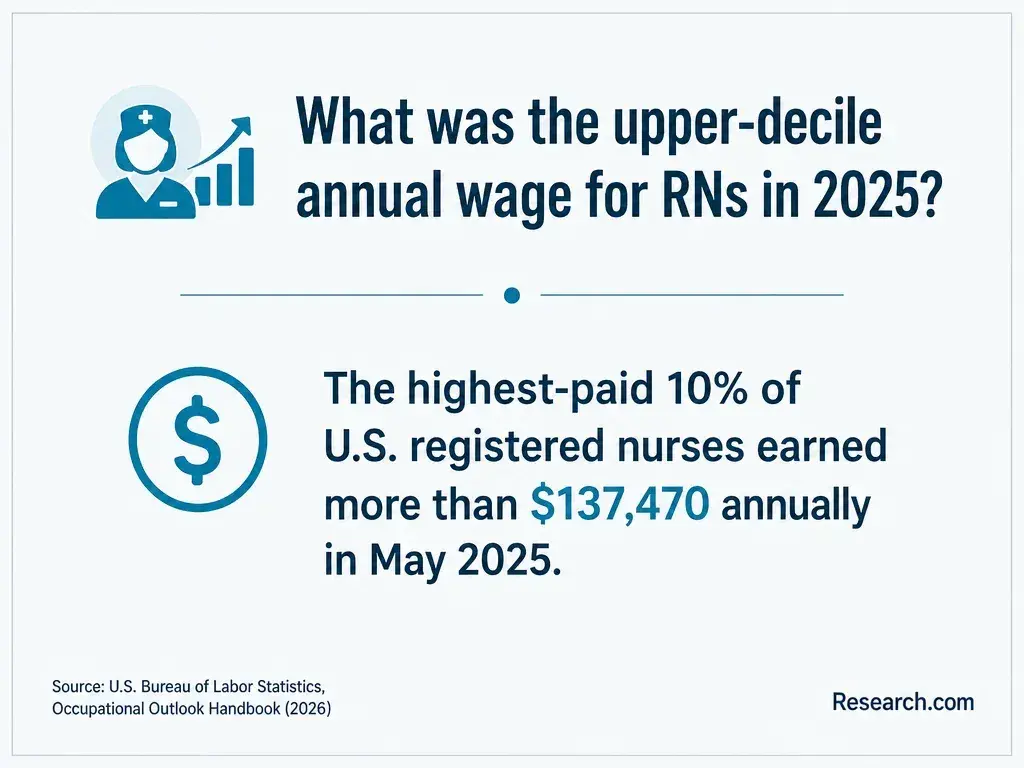
The U.S. Bureau of Labor Statistics reports pay and employment projections for the registered nurse occupation, not for people who completed a particular anatomy course or earned a specific nursing degree.
Use its current Occupational Outlook Handbook figures to understand the national market, then compare local job postings and employer requirements. An occupation-wide median is not an expected new-graduate offer, and national growth does not guarantee a position in a preferred location or specialty.
Some nurses later pursue graduate study and advanced practice preparation. Family NP programs organized by duration are relevant only after confirming the applicant's nursing credentials, the program's clinical requirements, and the intended certification and state licensing pathway.
Which Anatomy and Physiology Resources Help Nursing Students Prepare?
Start with the syllabus and lab objectives for the course you will actually take. Those documents tell you which structures, processes, and assessments matter more reliably than a generic "nursing anatomy" study list. An assigned textbook or instructor-approved open educational resource can supply explanations; diagrams, models, and practice questions help you test whether you can retrieve and apply them.
A workable routine is to preview one system, sketch or label its major structures from memory, explain its function aloud, and then answer questions that connect structure to function. Review missed questions to find the underlying concept. For lab practicals, practice identifying structures in the formats your course uses rather than relying on one familiar illustration.
Choose resources for your present course, not an unrelated future credential. For example, planning applications to accessible DNP programs may be useful much later, but a DNP admissions guide is not a substitute for your current anatomy syllabus, lab practice, and instructor feedback.
Other Things You Should Know About Nursing
Follow the sequence your school specifies. If neither course has a prerequisite, ask an advisor whether taking anatomy first would make the physiology course easier to follow and whether both will satisfy your target nursing program.
No. Physiology focuses on how body systems normally work; pathophysiology examines how disease or injury changes those functions. Understanding normal function makes the later course more meaningful.
Contact the institution's accessibility office early to discuss appropriate accommodations and how they apply to lab activities and assessments. Do not assume a change to the required course or lab format will satisfy a receiving nursing program without checking.
Usually not before reviewing the course materials. First check which diagrams, models, and practice tools your instructor provides. Buy an additional tool only if it addresses a specific study gap and fits your budget.
- Readiness Assessment - TeamSTEPPS Program | Agency for Healthcare Research and Quality https://www.ahrq.gov/teamstepps-program/curriculum/implement/pre/ready.html
- Challenges of nursing students during clinical training - PMC https://pmc.ncbi.nlm.nih.gov/articles/PMC11252586/
- Chapter 2 Medical Language Related to the Whole Body - NCBI https://www.ncbi.nlm.nih.gov/books/NBK607445/
- Anatomical Terminology - SEER Training Modules https://training.seer.cancer.gov/anatomy/body/terminology.html
- What is Anatomy and Physiology in Nursing | ECPI University https://www.ecpi.edu/blog/what-anatomy-and-physiology-nursing
- From classroom to clinic: Bridging the gap in nursing anatomy and physiology education - ScienceDirect https://www.sciencedirect.com/science/article/pii/S1471595323003323
- What to Study Before Nursing School | Harding Online https://absn.harding.edu/blog/what-to-study-before-nursing-school/
- 5 Important Classes to Take Before Nursing School | Goodwin University https://www.goodwin.edu/enews/important-classes-to-take-before-nursing-school/
- Homeostasis and Feedback Loops | lumenlearning.com https://courses.lumenlearning.com/suny-ap1/chapter/homeostasis-and-feedback-loops/