
2027 An MHA After a Bachelor's in Sociology

Co-Founder and Chief Data Scientist
A sociology degree can give you a strong understanding of institutions, inequality, and the people healthcare systems serve. It does not, by itself, teach you how to run a clinic or manage a hospital budget. A Master of Health Administration (MHA) can bridge that gap, but the right path depends on your work experience and target role.
This guide explains what sociology graduates bring to an MHA, what they may need to learn, and how to judge whether the degree is a worthwhile next step.
Key Things You Should Know
- Yes. Sociology graduates can apply to MHA programs; individual schools set their own prerequisites and experience requirements.
- An MHA teaches healthcare management, but it does not confer clinical credentials or automatically qualify a new graduate for senior leadership.
- The Bureau of Labor Statistics reports a $126,520 median annual wage for all management occupations in May 2025 - not a starting salary for MHA graduates or a figure specific to healthcare administration.
Can you earn an MHA after a bachelor's degree in sociology?
Yes. An MHA is a graduate degree in the management of healthcare organizations, and a sociology bachelor's degree can be relevant preparation. Sociology coursework may develop skills in research, interviewing, understanding organizations, and examining how social conditions affect access to care. Those strengths can be useful in patient services, community partnerships, and health-system improvement.
The likely gaps are less about your major than your exposure to healthcare operations. Depending on your transcript and experience, you may need to build confidence in accounting, quantitative analysis, medical terminology, or how care is financed. A second undergraduate degree is usually not the first solution: compare MHA foundation courses and entry-level healthcare experience before considering low-cost healthcare administration bachelor's programs.
An MHA is most compelling if you want responsibility for budgets, teams, services, or organizational performance. If you primarily want to study population health or conduct social research, compare the MHA with a Master of Public Health (MPH) or a research-focused degree before applying.
What careers can an MHA open after studying sociology?
Your first move depends heavily on what you have done since graduation. Someone who has coordinated services at a nonprofit may be ready to pursue healthcare program coordination or practice operations; someone with little work experience may need an entry-level role before competing for management jobs. The table distinguishes plausible paths from positions that typically demand more experience.
| Path | Where sociology helps | Likely additional preparation |
| Patient services or community health program coordination | Understanding communities, access barriers, and stakeholder needs | Healthcare workflows, scheduling, and program measurement |
| Clinic or practice operations | Communication, organizational analysis, and service improvement | Staff supervision, budgeting, reimbursement, and operational experience |
| Hospital department management | Change management and cross-team collaboration | Substantial healthcare experience and a record of managing people or resources |
Healthcare administration generally concerns how services are organized and delivered; health information management focuses more directly on the governance and use of health records and data. If records, coding, or information systems interest you more than service operations, compare degree choices for healthcare operations and health information careers before selecting an MHA.
What are the admission requirements for an MHA program?
Requirements vary by school. MHA applications commonly ask for an accredited bachelor's degree, transcripts, a résumé, a statement of purpose, and recommendations. Some programs expect professional experience or specify prerequisite coursework; others accept applicants from a wider range of majors. Test policies and any minimum GPA are program-specific, so do not assume either a waiver or a cutoff.
Review your transcript against each program's stated prerequisites. If you have not studied accounting or statistics, ask whether you can take a foundation course after admission or need to complete one first. In your statement, connect sociology methods and any experience in social services, research, customer service, or healthcare to a specific administrative goal. If you have not yet finished a bachelor's degree, healthcare administration degree completion after community college addresses a different starting point; it is not a prerequisite for someone who already holds a sociology bachelor's.
MHA coursework typically combines healthcare-specific management with finance, operations, leadership, strategy, policy, quality improvement, and the legal and ethical responsibilities of healthcare organizations. Depending on the program, you may apply those subjects through a capstone, internship, residency, or project with a healthcare organization. Check the actual curriculum rather than assuming every MHA offers the same practical experience.
For a sociology graduate, the valuable shift is from explaining how systems affect people to making decisions within a healthcare organization - for example, evaluating whether a proposed service improves access within a limited budget. An MHA does not usually provide the technical depth of a dedicated health information degree. If your goal is specialized work with health records and information systems, investigate accredited online health information management programs alongside MHA curricula.
Full-time study often takes about two academic years, while part-time study generally takes longer. The actual timeline depends on required credits, course sequencing, internships or residencies, and whether courses are offered throughout the year. Ask each school for a completion plan based on the pace you can sustain while working.
There is no single reliable MHA price: tuition may be quoted per credit or for the whole program, and mandatory fees, books, travel, and lost work hours can change the total substantially. For a useful comparison, multiply required credits by the applicable tuition rate, add mandatory fees and any required travel, then subtract confirmed grants or employer assistance. Compare that total - not the advertised per-credit rate - when exploring lower-tuition master's pathways in health administration. If borrowing, account for interest and repayment alongside the amount charged by the school.
Neither format is inherently better. An online MHA may let you keep a healthcare or social-services job while studying, which can make assignments more relevant and reduce time away from work. But online does not necessarily mean self-paced: live classes, group projects, field placements, and campus visits may still be required. A campus program may be a better fit if you need structured access to local employers, internships, and in-person career events.
Ask how students obtain field experience, whether placements can be completed near home, and which recruiting services are available to online students. Also distinguish graduate schedules from undergraduate marketing: online healthcare administration bachelor's programs with rolling starts do not establish that an MHA at the same or another school offers rolling admission or flexible course sequencing.
Check two separate questions: whether the university holds recognized institutional accreditation and whether its MHA program holds specialized accreditation from the Commission on Accreditation of Healthcare Management Education (CAHME). Institutional accreditation applies to the school; CAHME accreditation applies to eligible graduate healthcare management programs. Do not infer program accreditation from the university's status or from an accreditation held by its business school.
Verify the specific program and delivery format in current accreditation listings, then compare curriculum, placement requirements, total cost, and support for career changers. A useful starting point is online MHA degree options and CAHME program accreditation, but confirm each program's current status directly before enrolling. Ask for examples of where recent students with nonclinical backgrounds completed projects or placements; a school's general career claims may not answer that question.
Most general healthcare administration jobs do not have a universal administrator license. Certain positions - particularly nursing home administrator roles - are regulated and require state-specific licensing. Clinical jobs also have their own professional requirements; an MHA does not authorize you to practice medicine, nursing, or social work. Check the rules for the exact occupation and state you have in mind.
Optional professional certifications may help demonstrate experience or specialized knowledge, but employers set their own preferences. A doctorate is likewise not a general licensing requirement. If you later want one for a particular leadership, teaching, or research objective, review healthcare administration doctorate schedules before applying rather than treating further schooling as a substitute for a required license or work experience.
No published occupational median tells you what a sociology graduate will earn because of an MHA. The U.S. Bureau of Labor Statistics reports a median annual wage of $126,520 for all management occupations in May 2025. That broad figure includes many industries and experienced managers; it is not an MHA graduate salary or an appropriate starting-pay estimate. Your likely offers will depend on location, employer, role, and previous responsibility.
Judge affordability against positions you could realistically obtain, not an executive salary. For each target job, compare local postings' pay ranges and experience requirements with your current compensation and the full cost of the degree. If your goal is broad business leadership rather than specialized healthcare administration, you can also review affordable online healthcare MBA choices; compare their healthcare coursework and total costs rather than assuming an MBA and an MHA lead to identical opportunities.
What is the job outlook for healthcare administration careers?
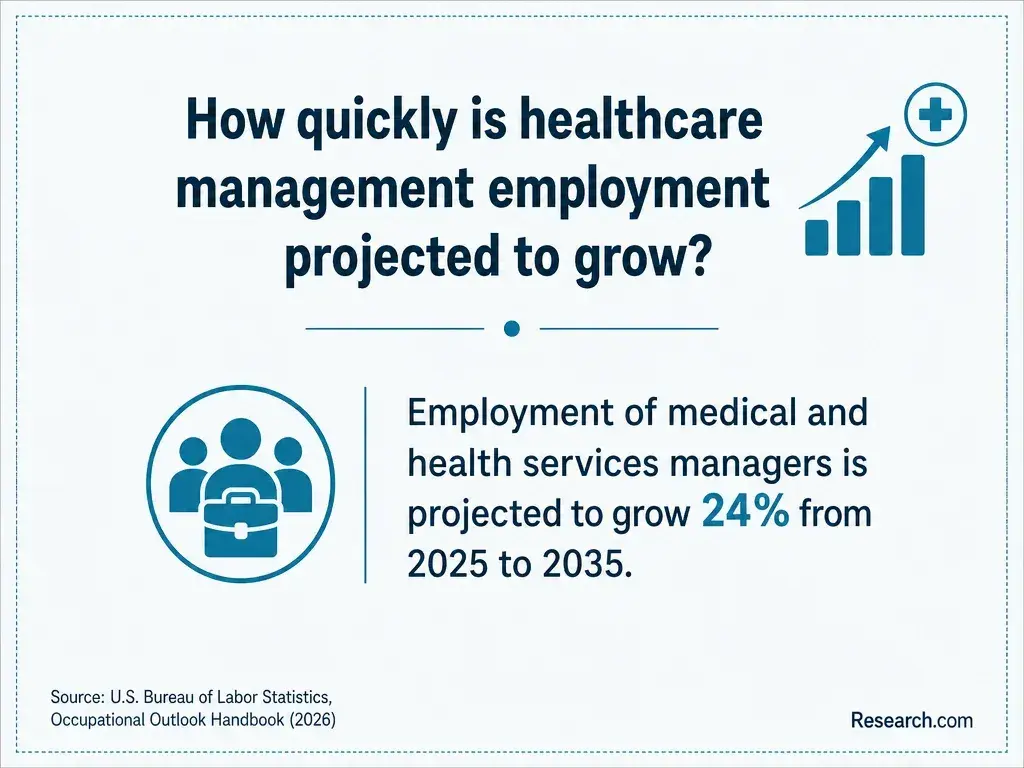
The Bureau of Labor Statistics projects employment across management occupations to grow faster than the average for all occupations from 2025 to 2035. That broad outlook is encouraging but does not predict openings for a particular MHA graduate, employer, or local healthcare market. When assessing a specific role, examine its occupational outlook separately and read job postings for the experience employers require.
For a sociology graduate, the practical route is often to gain healthcare exposure while developing management skills: pursue roles involving patient access, program coordination, quality projects, or practice operations, then seek responsibility for a process, budget, or team. You already have a bachelor's degree, so do not assume another one is necessary simply because employers mention healthcare administration as a preferred major. Looking at healthcare administration undergraduate degrees at U.S. universities can help identify subject-area gaps; targeted coursework and experience may address them more directly.
Other Things You Should Know About Healthcare Administration
An MHA primarily prepares students to manage healthcare organizations and services. An MPH generally centers on population health, prevention, and public health practice. Compare required courses and applied projects if your interests span both.
Not necessarily. Programs may require a capstone, internship, residency, thesis, or another culminating project. Check the requirements of each program you are considering.
Yes, especially if you can explain how you collected evidence, analyzed a problem, and communicated findings. Pair that experience with a clear reason for pursuing healthcare management.
It can be, but the career transition may be harder without relevant exposure. Compare programs' placement support and consider gaining healthcare experience before or during the degree.
- Master of Health Administration | Health Professions | SIU https://academics.siu.edu/health-professions/health-care/masters/mha.php
- Online MHA Tuition and Fees | Sacred Heart University https://onlineprograms.sacredheart.edu/programs/mha-master-health-administration/tuition/
- Master of Health Administration: How to Apply: Admissions | Richard M. Fairbanks School of Public Health https://fairbanks.indianapolis.iu.edu/admissions/apply/mha.html
- MHA or MPH? Salary, career path, and ROI | USC Price https://priceschool.usc.edu/price-blog/mha-or-mph-salary-career-path-and-roi/
- Admissions - Master of Healthcare Administration (MHA) | University of Minnesota School of Public Health https://www.sph.umn.edu/academics/graduate/mha/master-healthcare-administration/admissions/
- MHA admission and application | missouri.edu https://healthsciences.missouri.edu/health-sciences/masters-degree/mha-admission-and-application/
- Resident Master of Health Administration (MHA) | tamu.edu https://public-health.tamu.edu/degrees/hpm/mha/about-residential.html
- MHA Tuition and Scholarships | ufl.edu https://phhp.ufl.edu/academics/masters-programs/mha/tuition-and-scholarships/
- Master in Health Administration | MUSC College of Health Professions https://chp.musc.edu/programs/master-health-administration
- Careers in Healthcare Management | charlotte.edu https://hmp.charlotte.edu/degrees-and-programs/phs-graduate-programs/master-health-administration-mha/careers-healthcare/


