Minnesota State University Moorhead Launches Honors College With 300 Students, Expanding Research and Hands-On Learning

Co-Founder and Chief Data Scientist
Minnesota State University Moorhead has launched its new Honors College with 300 students—an especially substantial inaugural cohort for a university of about 4,400 students. The group represents roughly 6.8% of the university's total enrollment, giving the new college an unusually broad presence from its first year.
More than 200 first-year students and about 100 current and transfer students make up the inaugural class, signaling strong interest in the new program across the university.
The cohort includes students from all majors, creating a diverse academic community built around interdisciplinary coursework, research, mentorship, and hands-on learning. By bringing together students from across the university, the Honors College is positioned to foster connections that extend beyond individual academic disciplines.
Key Findings
- Minnesota State University Moorhead's Honors College opened with 300 students, including more than 200 first-year students and about 100 current and transfer students from across the university.
- Students can build personalized Honors pathways through five stackable, nine-credit certificates covering interdisciplinary study, global learning, communication, entrepreneurship, and individualized studies.
- Research, internships, study abroad, mentorship, and other applied experiences are integrated into the Honors model, giving students opportunities to connect academic work with professional and creative projects.
- Stackable certificates give students multiple ways to customize Honors study Certificate Options
- Undergraduate research forms part of the Honors pathway Undergraduate Research
- Professional experience funding supports research, internships, and creative work Experience Funding
- Mentorship adds a professional dimension to the Honors experience Professional Mentorship
- Weld Hall gives the Honors College a dedicated campus hub Campus Hub
- The Honors College operates within a broad academic portfolio Academic Diversity
- What prospective Honors students should know Student Essentials
Stackable certificates give students multiple ways to customize Honors study
The Honors College offers five stackable, nine-credit certificates that give students flexible ways to build their Honors experience alongside their undergraduate studies. Students who complete two certificates earn Honors Distinction at graduation. The certificate options add flexibility to Minnesota State University Moorhead's academic programs, allowing students to shape their Honors experience around their interests.
Dr. Kyja Kristjansson-Nelson, Dean of the Honors College, explained the vision behind the program:
"Welcoming 300 students in our very first year shows just how ready our campus was for this. We built the Honors College around a clear vision: to give motivated students from every single major a place to stretch themselves, connect across disciplines, and prepare for life after graduation. Hitting this milestone proves that when you give students clear pathways to succeed, they will jump at the opportunity.”
The five certificate options are:
- Interdisciplinary Honors: Students examine subjects that cross traditional academic boundaries, including artificial intelligence, film, communication, information and disinformation, and other interdisciplinary topics.
- Global Honors: Students engage with global learning through study abroad and other international experiences.
- Honors Communication: Students explore communication studies, group and team communication, professional communication, rhetoric, and popular culture.
- Honors Entrepreneurship: Coursework covers topics such as starting a business, digital marketing, and entrepreneurship.
- Honors Individualized Studies: Students can use approved experiential learning opportunities, including internships, undergraduate research, independent study, and learning assistant experiences.
Because the certificates are stackable, students can combine them according to their academic interests. This structure allows students to build an Honors pathway that complements their undergraduate major while adding a second area of academic focus or an individualized component.
Undergraduate research forms part of the Honors pathway
Undergraduate research is built directly into the Honors Individualized Studies Certificate. Students can earn one to five credits through HON 494 Undergraduate Research, while approved options also include independent study and internships. These options give students ways to incorporate faculty-guided and experiential work into their Honors studies.
The certificate connects academic credit, faculty mentorship, and active learning through experiences such as:
- Faculty-guided research: Students work with faculty mentors as they develop and carry out research projects.
- Research settings: Depending on the project, students can engage in active learning in laboratories, libraries, studios, and field settings.
- Academic credit: HON 494 allows students to earn one to five credits for undergraduate research. HON 497 Independent Study and HON 469 Internship also allow approved independent study and internship experiences to count for Honors credit.
- Research development: The Council on Undergraduate Research highlights the role of undergraduate research in student learning, faculty mentoring, and academic development.
- Showcase opportunities: Students can present their work at the annual Honors College Showcase, giving them a formal setting to share research completed through their Honors experience.
This structure connects research and other approved experiential activities with the academic requirements of the Honors program, allowing eligible work to contribute to students' Honors studies and academic credit.

Professional experience funding supports research, internships, and creative work
Honors College students can apply for Professional Experience Grants of up to $3,000 to pursue experiences that support their academic, creative, and professional goals. Award amounts vary by the type and scope of the experience.
| Experience | Grant Amount | What the Funding Supports |
| Study abroad | Up to $3,000 | Faculty-led or semester-long international experiences |
| Internships and work-based experiences | $1,000 - $2,000 | Internships, student teaching, and clinical placements |
| Service learning | Up to $2,000 | Approved domestic or international service-learning opportunities |
| Research and creative projects | Up to $1,500 | Faculty-mentored research, entrepreneurial, creative, and artistic projects |
The grants can also support conference presentation opportunities, entrepreneurial projects, equipment and software for research, and other experiences that fit students' goals. This gives Honors students multiple ways to use program funding for experiential learning alongside the university's broader academic offerings.
Mentorship adds a professional dimension to the Honors experience
Mentorship is part of the Honors College experience, with students able to learn from faculty, executive coaches, and alumni leaders. The program also connects mentorship with professional development, giving students opportunities to build skills and perspectives related to their academic and career goals.
The mentorship model includes:
- Faculty mentors: Students work with faculty mentors to build a personalized Honors experience around their interests, skills, and academic goals.
- Executive coaches: Professionally oriented mentorship activities can help students build networking, public speaking, and other in-demand skills.
- Alumni leaders: Alumni leaders are identified as part of the Honors College's broader mentorship model, giving students access to people with professional and community experience.
Mentorship adds a professional dimension by helping students:
- Develop workplace communication skills: MSUM's professionally oriented mentorship activities are designed to help students build networking, public speaking, and other in-demand skills.
- Gain career perspectives: The Honors College connects students with faculty mentors, executive coaches, and alumni leaders who can offer perspectives related to the fields students are preparing to enter.
- Value hands-on professional experiences: A January 2026 Student Voice survey of 1,135 two- and four-year students found that three in four students who had participated in work-integrated learning considered their experiences highly valuable. Among students who had already participated, 82% wanted to engage in more work-integrated learning.
- Build connections through work-based learning: Paid work related to a student's major was the most popular form of work-integrated learning, with 52% of students expressing interest, followed by internships at 51%. Job shadowing attracted interest from 33%, while 25% were interested in apprenticeships.
These findings reinforce the value of connecting academic experiences with professional exposure. For Honors students, mentorship and work-based opportunities can provide additional opportunities to develop professional skills and learn about careers while completing their degrees.
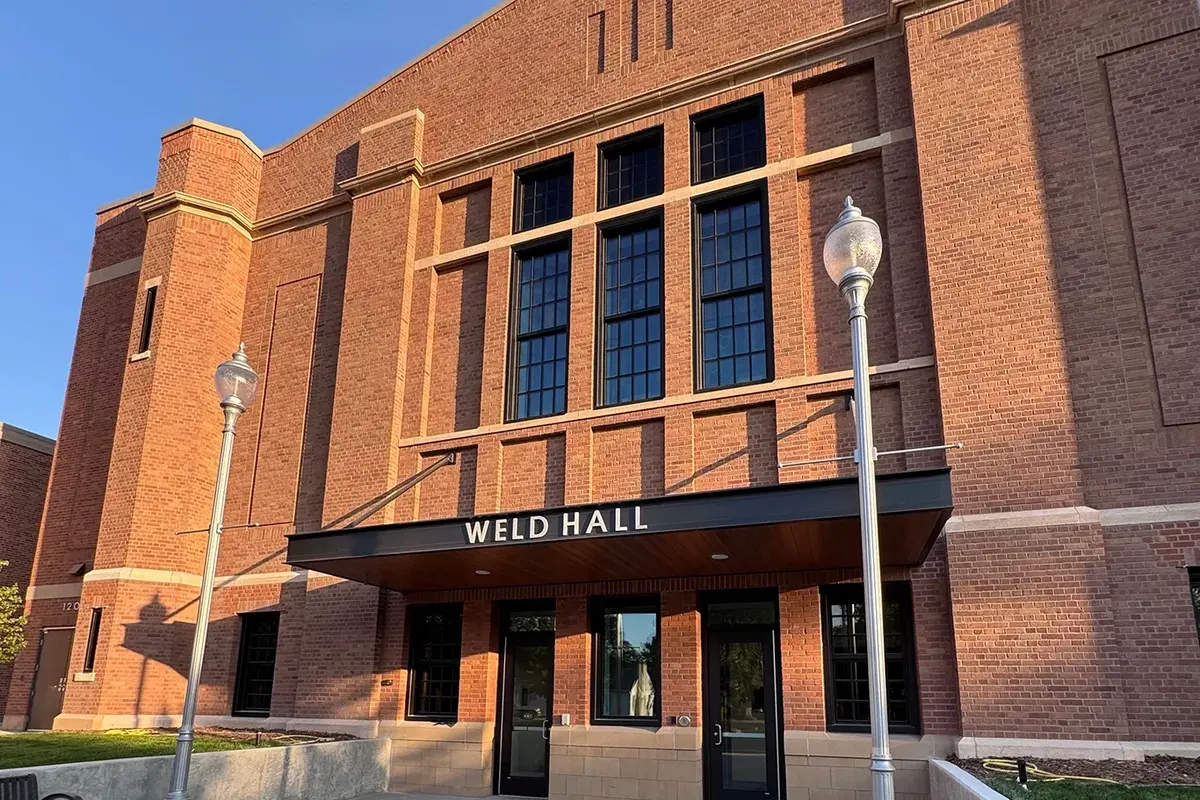
Weld Hall gives the Honors College a dedicated campus hub
Weld Hall serves as the dedicated home base of the Honors College. The historic building recently underwent a $23 million renovation and provides Honors scholars with a lounge, classroom, theater, and shared gathering space. Students can also participate in events such as the Honors Breakfast Club, movie nights, and book discussions.
South Snarr extends the Honors community
A floor of South Snarr serves as the Honors Living Community, giving participating students a dedicated residential setting within the broader Honors community. Together, Weld Hall and South Snarr give Honors students dedicated spaces for events, community building, and interaction beyond the classroom.
The Honors College operates within a broad academic portfolio
The Honors College sits within a broad academic environment that includes undergraduate and graduate degrees, majors, minors, emphases, certificates, licensures, and online programs. This gives Honors students access to a university-wide academic setting that extends beyond their individual majors.
Minnesota State University Moorhead reports that 92.1% of graduates are employed in their field or continuing their education, providing an institution-wide measure of student outcomes. Minnesota State University Moorhead is accredited by the Higher Learning Commission (HLC), according to the U.S. Department of Education's Database of Accredited Postsecondary Institutions and Programs.
This broader academic environment positions the Honors College as an additional layer within MSUM's existing undergraduate education rather than a separate degree track.
What prospective Honors students should know
Students considering the Honors College can use the following information to understand the application process, eligibility, academic commitment, and financial support:
- Apply to MSUM before Honors. Students must first apply to Minnesota State Moorhead. Once admitted, students whose academic records qualify them for Honors receive information about applying to the Honors College and competing for exclusive scholarships.
- Meet the academic eligibility requirements. High school students with a 3.5 GPA or higher can apply regardless of major. Current MSUM students can also apply by submitting a letter of interest to the Honors College director.
- Plan Honors study within the existing degree. Participation does not add tuition, fees, or extra time to a student's degree. Each Honors certificate requires nine credits and can be completed alongside any undergraduate degree.
- Consider the available financial support. The university states that 100 competitive scholarships are awarded each year through an interview process. The Honors College's reported annual investment totals $1 million across tuition scholarships, housing awards, and professional development stipends.
Together, these details give prospective students a practical overview of Honors eligibility, application steps, academic requirements, and financial opportunities before they apply.
References:
- Carnegie Classification of Institutions of Higher Education. (2026). Minnesota State University Moorhead. Retrieved October 4, 2026, from https://carnegieclassifications.acenet.edu/institution/minnesota-state-university-moorhead/
- Minnesota State University Moorhead. (2026). Accreditation & Compliance. Retrieved October 4, 2026, from https://www.mnstate.edu/about/accreditation
- Minnesota State University Moorhead. (2026). Facts. Retrieved October 4, 2026, from https://www.mnstate.edu/about/facts
- Minnesota State University Moorhead. (2026). Honors College Frequently Asked Questions. Retrieved October 4, 2026, from https://mnstate.edu/academics/colleges-schools/honors-college/faqs
- Minnesota State University Moorhead. (2026). Honors College launches with 300 students. Retrieved October 4, 2026, from https://mnstate.edu/stories/leadership-mentorship/honors-college-launches-with-300-students
- Minnesota State University Moorhead. (2026). The Honors College. Retrieved October 4, 2026, from https://www.mnstate.edu/academics/colleges-schools/honors-college
- Minnesota State University Moorhead. (2026). Honors College Professional Experience Grants. Retrieved October 4, 2026, from https://mnstate.edu/academics/colleges-schools/honors-college/grants
- Minnesota State University Moorhead. (2026). Undergraduate Research Funding & Scholarships. Retrieved October 4, 2026, from https://www.mnstate.edu/academics/opportunities/undergraduate-research/scholarships
- National Center for Education Statistics. (2026). Integrated Postsecondary Education Data System: Minnesota State University Moorhead. Retrieved October 4, 2026, from https://nces.ed.gov/ipeds/
- National Science Foundation. (2026). Undergraduate research and education resources. Retrieved October 4, 2026, from https://www.nsf.gov/
- Pew Research Center. (2024). Is college worth it? Retrieved October 4, 2026, from https://www.pewresearch.org/social-trends/2024/05/23/is-college-worth-it-2/
- U.S. Bureau of Labor Statistics. (2026). Education pays, 2025. Retrieved October 4, 2026, from https://www.bls.gov/careeroutlook/2026/data-on-display/education-pays.htm
- U.S. Census Bureau. (2024). Educational attainment, 2024 American Community Survey. Retrieved October 4, 2026, from https://data.census.gov/table/ACSST1Y2024.S1501
- U.S. Census Bureau. (2025). Educational attainment in the United States: 2024. Retrieved October 4, 2026, from https://www.census.gov/data/tables/2024/demo/educational-attainment/cps-detailed-tables.html
- U.S. Department of Education. (2026). Institutional accrediting agencies. Retrieved October 4, 2026, from https://www.ed.gov/laws-and-policy/higher-education-laws-and-policy/college-accreditation/institutional-accrediting-agencies
Frequently Asked Questions (FAQs)
The Honors College is designed to fit within a student's existing undergraduate degree without adding tuition, fees, or additional time to the degree. Each Honors certificate requires nine credits, and students can complete the certificates alongside their undergraduate programs. Students should still review certificate requirements and plan Honors coursework and experiential activities with their academic advisers.
Students must meet the requirements for the Honors certificates they choose and complete the work needed to earn Honors Distinction. The Honors College offers five nine-credit certificates, and students who complete two certificates earn Honors Distinction at graduation. Students should review the requirements for their selected certificates with the Honors College to understand what they must complete throughout their undergraduate studies.
Yes. Honors certificates are designed to be completed alongside undergraduate degree requirements, allowing students to incorporate Honors coursework and approved experiential learning into their existing academic plans. Students in programs with fixed course sequences, clinical experiences, laboratories, or other required coursework should plan their Honors requirements with their academic advisers to avoid scheduling conflicts.
Students who do not complete the requirements for their selected certificates may not earn those certificates or the resulting Honors Distinction. Because the Honors College offers multiple certificate options, students who change their plans should discuss their remaining requirements with the Honors College to determine which certificates and Honors opportunities they can still complete.