2027 Signs Online College Might Not Be Right for You

Co-Founder and Chief Data Scientist
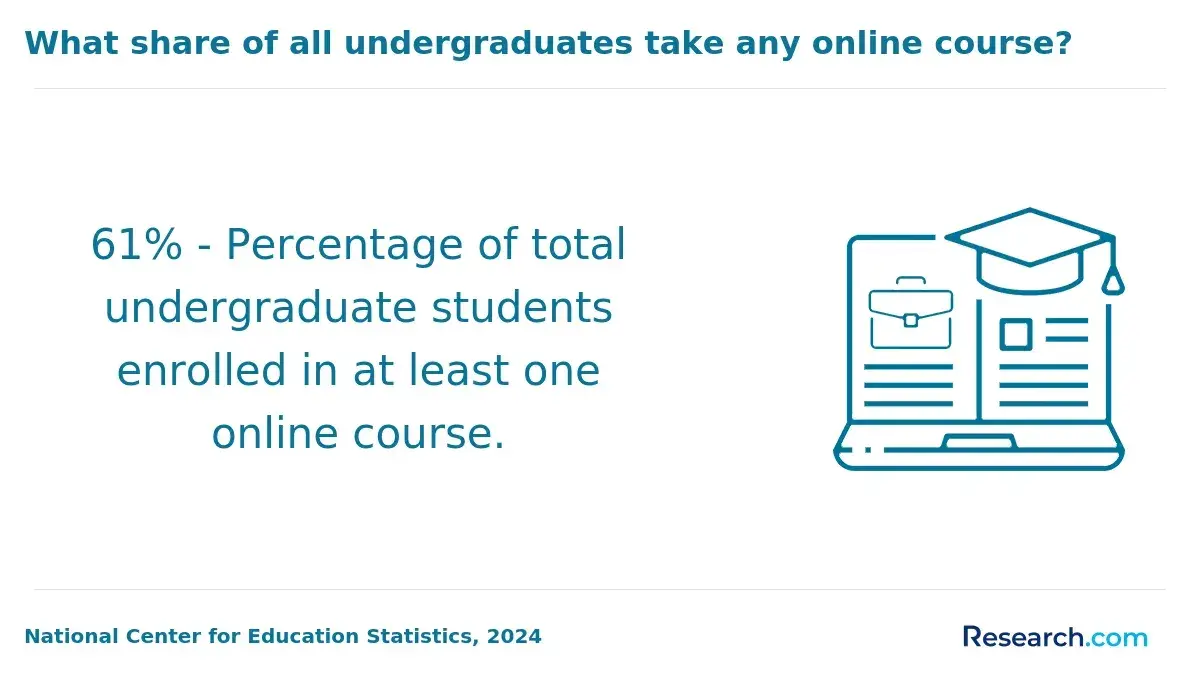
Online college can be convenient, but it is not the best fit for every student or every career goal. NCES reported in its 2024 Condition of Education that more than half of postsecondary students took at least one distance education course in fall 2022, showing how common online learning has become. This guide is for students comparing online, hybrid, and campus programs. You will learn the warning signs, accreditation checks, cost trade-offs, and career factors that can help you avoid a poor-fit program before you enroll.
Key Things You Should Know
- Online college may be a poor fit if you need daily structure, hands-on labs, in-person mentoring, or a supervised clinical pathway that a fully online format cannot reliably provide.
- Cost savings are not automatic. College Board's 2024 pricing data lists average published tuition and fees at $11,610 for public four-year in-state students and $43,350 for private nonprofit four-year students, before housing, aid, and fees are considered.
- Accreditation is nonnegotiable because unaccredited programs can limit federal financial aid, credit transfer, licensure eligibility, graduate admission, and employer acceptance.
What are the most common signs that an online college program may not fit your needs?
The most common signs online college might not be right for you are practical rather than personal flaws. A program can be reputable and still be the wrong choice if its format does not match your learning needs, career requirements, schedule, or support system.
The table below summarizes the biggest warning signs and what they usually mean. Use it as a first-pass filter before comparing schools, tuition, or rankings.
| Sign | Why it matters | Better option to consider |
| You fall behind without fixed class times | Asynchronous courses often require students to plan weekly reading, lectures, assignments, and exams without daily reminders. | A campus, hybrid, or live online program with scheduled meetings |
| Your major requires extensive labs, studios, clinics, or fieldwork | Some skills are difficult to verify without supervised practice, equipment access, or in-person feedback. | A campus-based or low-residency program with required hands-on placements |
| You need frequent tutoring, advising, or faculty access | Some online programs provide strong support, but others rely heavily on self-service portals and delayed communication. | A school with in-person advising, learning centers, and faculty office hours |
| Your home environment is noisy or unpredictable | Online coursework requires sustained focus, exam privacy, reliable internet, and a place to participate professionally. | A campus program, library-based study plan, or evening hybrid schedule |
| You are choosing online only because it sounds easier | Quality online courses often require as much work as campus courses, with more self-management. | A structured program that matches your actual study habits |
One of the most overlooked warning signs is choosing the format before choosing the goal. If your intended career requires licensure, supervised hours, a portfolio, or employer-recognized clinical training, the first question should be whether the program meets that requirement, not whether the classes are convenient.
How do your learning style and self-motivation affect whether online college is a good choice?
Your learning style affects whether online college feels flexible or frustrating. Online programs usually require independent reading, written discussion, video lectures, digital assignments, and long-term planning, which can work well for students who are self-directed but can be difficult for students who learn best through immediate feedback and live interaction.
Self-motivation matters because online college shifts more of the "classroom management" responsibility to the student. Before enrolling, ask yourself whether the following statements describe your normal habits, not just your best intentions.
- You can study several times per week without someone reminding you.
- You are comfortable asking questions by email, chat, learning management system, or virtual office hours.
- You can manage overlapping deadlines for readings, discussion posts, quizzes, group work, and exams.
- You can recover quickly if you miss a deadline instead of avoiding the course.
- You are willing to learn new academic technology before the course becomes demanding.
If you like flexibility but still need structure, look for formats that reduce the risk of falling behind. Synchronous online programs, hybrid courses, cohort models, and competency-based programs can each help different types of learners. For example, students researching what is a competency-based master's degree should understand that this format can reward prior knowledge and self-pacing, but it still requires disciplined progress and strong documentation of mastery.
In what situations is a campus-based program better than an online degree for students?
A campus-based program is often better when the educational experience depends on physical space, close supervision, peer practice, or immediate feedback. Online delivery can handle lectures and theory well, but it may not fully replace labs, studios, clinics, rehearsals, field placements, or in-person networking.
Campus programs may be the stronger choice in the following situations because the learning environment itself is part of the training.
- You are entering a field with state licensure rules that require approved clinical hours, supervised practice, or site-specific documentation.
- You need lab equipment, simulation centers, art studios, performance spaces, maker labs, or specialized software that you cannot access at home.
- You are a first-generation or returning student who wants daily exposure to advising, tutoring, financial aid staff, and peer study groups.
- You are changing careers and need internships, faculty introductions, campus recruiting, or local employer relationships.
- You struggle with isolation and know that face-to-face accountability improves your persistence.
For some students, a staged path works better than jumping directly into a fully online bachelor's program. Starting with an associates degree at a community college, especially in a hybrid or campus format, can provide structure, lower upfront cost, and a clearer transfer route.
How can you tell if an online college is properly accredited and academically reputable?
Accreditation is the quality-control system that helps determine whether a college is recognized by employers, graduate schools, licensing boards, and federal financial aid rules. In the U.S., institutional accreditation applies to the college or university as a whole, while programmatic accreditation applies to specific professional programs such as nursing, education, counseling, business, engineering, social work, or architecture.
You should verify accreditation before speaking with an admissions representative or paying an application fee. Follow this sequence so you are checking independent sources rather than relying only on marketing language.
- Search the school in the U.S. Department of Education's Database of Accredited Postsecondary Institutions and Programs.
- Confirm that the accreditor is recognized for the institution, not just mentioned somewhere on the school's website.
- Check whether your specific degree program needs programmatic accreditation for licensure, certification, or employer recognition.
- Ask the school for recent pass rates, placement outcomes, transfer policies, and graduate school acceptance information when relevant.
- Contact your state licensing board if the program leads to nursing, teaching, counseling, social work, accounting, therapy, or another regulated profession.
Accreditation alone does not prove a program is the best value, but lack of recognized accreditation is a serious problem. If a school cannot clearly explain its accreditation status, credit transfer rules, and licensure alignment, treat that as a reason to pause.
What red flags suggest an online program might be a diploma mill or low-quality option?
Diploma mills and low-quality online programs often use the language of flexibility, speed, and affordability while avoiding evidence of academic quality. The risk is not only wasting tuition; it can also mean credits that do not transfer, credentials employers question, or degrees that fail to meet licensure rules.
Watch for red flags that suggest the school is selling a credential more than an education. One warning sign may not prove the program is illegitimate, but several together should make you walk away.
- The school promises a degree in an unrealistically short time with little coursework or assessment.
- Admissions are based mainly on payment rather than transcripts, prerequisites, or placement requirements.
- The school claims accreditation from an agency that is not recognized by the U.S. Department of Education or a legitimate higher education authority.
- Tuition, fees, refund rules, and total program cost are hard to find before enrollment.
- Faculty credentials, course descriptions, student outcomes, and academic policies are vague or missing.
- The program pressures you to enroll immediately or discourages you from contacting licensing boards or employers.
A common mistake is enrolling in a full degree when a shorter credential would meet the same career goal. If you need a targeted skill for advancement rather than a licensure pathway or degree requirement, compare reputable certifications online before committing to a multi-year program.
How do online and on-campus programs differ in support services, mentoring, and faculty access?
Support services can be the difference between finishing and quietly stopping out. Online and campus programs may offer the same catalog of services, but the access experience can be very different: campus students may walk into offices, while online students may rely on appointments, ticket systems, email queues, or virtual advising.
The table below compares common support areas. It can help you ask better questions during admissions calls and avoid assuming that "available online" means "available when you need it."
| Support area | Online program experience | Campus program experience |
| Academic advising | Often handled by email, phone, portal messages, or scheduled video meetings | May include walk-in advising, department meetings, and easier same-day referrals |
| Faculty access | Usually through discussion boards, email, virtual office hours, or recorded feedback | May include in-person office hours, informal conversations, and lab or studio coaching |
| Tutoring and writing help | Can be strong if available through live chat, appointment systems, or asynchronous paper review | Often includes learning centers, study groups, workshops, and face-to-face tutoring |
| Career services | May include virtual resume reviews, job boards, webinars, and remote coaching | May include career fairs, employer visits, mock interviews, and local internship pipelines |
| Peer connection | Depends heavily on cohorts, group projects, chats, and student communities | Often easier through clubs, study groups, residence life, and campus events |
If you are considering an accelerated graduate option, support access becomes even more important because shorter calendars leave less room to recover from confusion or missed deadlines. Students comparing the shortest master's degree programs online should look closely at advising response times, course load expectations, and whether faculty support is available outside standard business hours.
Which majors or career paths are least suited to fully online degrees and why?
Some majors can work well online because they rely heavily on reading, writing, data analysis, software, research, or management concepts. Others are less suited to fully online delivery because they require supervised practice, specialized equipment, physical performance, direct patient or client contact, or licensure documentation.
The table below does not mean these fields can never include online courses. Instead, it shows where a fully online degree may be risky unless the program includes approved in-person components.
| Major or career path | Why fully online may be difficult | What to look for instead |
| Nursing and allied health | Clinical hours, patient care skills, simulations, and state board requirements usually require approved hands-on training. | Hybrid programs with local clinical placements and board-approved curriculum |
| Teacher preparation | Student teaching, classroom observation, and state licensure rules often require supervised school placements. | State-approved programs with documented field experience partnerships |
| Counseling, social work, and therapy fields | Licensure paths often require supervised practicum, internship, and post-degree hours. | Programs with programmatic accreditation and clear placement support |
| Engineering and laboratory sciences | Lab work, design projects, equipment use, and accreditation standards can be difficult to reproduce fully online. | ABET-aligned or accredited options with campus labs, residencies, or approved lab kits where appropriate |
| Performing arts, studio arts, and some design fields | Performance critique, studio culture, equipment, and portfolio development often benefit from live interaction. | Campus or low-residency programs with intensive critique and portfolio review |
Career outcomes also depend on the labor market behind the major. For example, BLS Occupational Outlook Handbook data updated in 2024 lists registered nurses as having a median pay of $86,070 and projected employment growth of 6% from 2023 to 2033, but nursing also requires approved clinical preparation and state licensure. A fully online lecture format cannot replace those requirements.
How do costs, financial aid, and potential debt compare for online versus campus programs?
Online college can reduce some costs, especially housing, commuting, relocation, and lost work time. However, tuition may be similar to campus tuition, and online students can still face technology fees, proctoring fees, course materials, clinical placement expenses, travel for residencies, and student loan debt.
College Board's 2024 pricing data shows why total cost matters more than format alone: average published tuition and fees for public four-year in-state students were $11,610, while private nonprofit four-year tuition and fees averaged $43,350. Those figures do not tell you your net price, but they show why financial aid and institution type can change the affordability picture dramatically.
The table below highlights cost factors that can differ by format. Use it to compare net price, not just tuition per credit.
| Cost factor | Online program | Campus program |
| Tuition | May be lower, similar, or higher depending on residency rules and online fees | Often varies by in-state, out-of-state, public, private nonprofit, or private for-profit status |
| Housing and commuting | Often lower if you study from home | Can be significant if you relocate, live on campus, or commute daily |
| Fees and materials | May include technology, proctoring, platform, or digital material fees | May include campus, lab, activity, facility, or transportation fees |
| Work flexibility | Often better for students who must keep full-time or irregular employment | May be harder if required courses meet during the workday |
| Financial aid | Available if the school and program meet federal aid eligibility rules | Available under the same federal eligibility principles for accredited institutions |
Before borrowing, compare the program's net price after grants and scholarships with realistic earnings in your target field. College Board reported in 2024 that bachelor's degree recipients who borrowed from public and private nonprofit institutions had average education debt of $29,300 in 2022-23, so even moderate borrowing deserves a repayment plan.
At the graduate level, especially for doctoral study, comparing options such as the most affordable online doctoral programs can help you avoid overpaying for a credential that may not increase earnings enough to justify high debt.
How might an online degree impact your career options, salary potential, and employer perceptions?
An online degree from a properly accredited, academically reputable institution can support career advancement, especially when the program aligns with the job's required skills and credentials. Employer perception is usually strongest when the school is recognizable, the degree title is standard, the curriculum is rigorous, and the graduate can demonstrate relevant projects, internships, certifications, or work experience.
The career impact of an online degree depends less on the delivery format and more on the match between the program and the occupation. Use the table below to separate situations where online study is often practical from situations where extra verification is needed.
| Career situation | How an online degree may be viewed | What strengthens the credential |
| Business, management, HR, or project roles | Often accepted when the institution is accredited and the student has relevant experience | Applied projects, internships, leadership experience, and industry certifications |
| Technology, analytics, or cybersecurity roles | Can be competitive if the graduate has a strong portfolio and practical skills | GitHub work, labs, cloud experience, internships, and skill-based certifications |
| Healthcare and education roles | May be accepted only if licensure, clinical, or field placement requirements are met | State approval, supervised hours, exam eligibility, and programmatic accreditation |
| Research-intensive or academic careers | May require closer review of faculty mentorship, thesis work, research output, and institutional reputation | Research methods training, publications, assistantships, and strong faculty references |
Salary potential should be evaluated by role, not by format. BLS data updated in 2024 shows that computer and information systems managers had median pay of $169,510, but access to those roles typically depends on experience, leadership ability, technical depth, and industry context. An online degree may help you qualify for consideration, but it does not replace experience or guarantee a promotion.
What personal technology, home environment, and time constraints can make online college unworkable?
Even motivated students can struggle online if their technology, home environment, or schedule makes regular participation unrealistic. Online college is not just "school on a laptop"; it requires dependable systems for studying, submitting work, communicating, testing, and storing files.
Before enrolling, test your situation against these practical constraints. If several apply, a campus, hybrid, part-time, or delayed start may be safer than forcing a fully online schedule.
- Your internet connection is unreliable during the hours you would attend class, stream lectures, or take exams.
- You do not have regular access to a working computer that can run required software, webcams, proctoring tools, or secure browsers.
- Your home lacks a quiet place for exams, live discussions, recorded presentations, or complex reading.
- Your work schedule changes frequently and prevents predictable weekly study blocks.
- Your caregiving responsibilities make uninterrupted class participation nearly impossible.
- You are uncomfortable troubleshooting logins, file uploads, discussion boards, video calls, or academic software without immediate help.
A useful test is to build a sample weekly calendar before applying. Block out work, sleep, commuting, caregiving, meals, and obligations first; then add 10 to 15 study hours for each demanding course. If the calendar only works by sacrificing sleep or emergency time, the program format or pace is probably not sustainable.
Other Things You Should Know About
No. A reputable online program should have comparable academic expectations to a campus program. The main difference is that online students often need more self-discipline because lectures, discussions, assignments, and communication are managed through digital platforms.
Often, the diploma and transcript list the institution and degree rather than the delivery format. Employer perception usually depends on accreditation, school reputation, relevant experience, and whether the degree fits the role.
Ask about accreditation, total cost, transfer credits, faculty access, tutoring, career services, licensure eligibility, required in-person components, course format, graduation rates, and refund policies. Get important answers in writing.
Choose hybrid if you need flexibility but also benefit from labs, live feedback, clinical placements, campus resources, or face-to-face accountability. Hybrid programs can be a strong middle ground for students who are not fully comfortable learning alone.
References
- What can you do so that your device doesn’t make you stupid? https://languageonthemove.com/what-can-you-do-so-that-your-device-doesnt-make-you-stupid/
- The Psychology of Self-Motivation in Internet Learning https://www.janets.org.uk/the-psychology-of-self-motivation-in-internet-learning/
- Major Challenges of Online Learning & in Distance Education https://advantagesschool.com/online-education-challenges/
- Legitimate Online Colleges vs. Diploma Mills https://www.onlineu.com/resources/college-planning/diploma-mills-vs-legitimate-online-colleges
- What College Majors Should You Choose If Your Classes Are Online - Student Research Foundation https://studentresearchgroup.com/which-college-majors-and-careers-should-you-consider/
- CourseCareers https://coursecareers.com/blog-posts/college-vs-online-career-training
- These tips can help you tell if an online degree program is the real deal - and save you money https://abc13.com/post/online-degrees-college-scams-diploma-mills-how-to-contact-bbb/13642986/
- Online Vs On Campus Study: Which is Right For You? https://studee.com/guides/online-vs-on-campus-study-which-is-right-for-you
- 13 Best Degrees for Remote Work https://www.virtualvocations.com/blog/telecommuting-job-search-help/13-best-degrees-for-remote-work/
- How Do You Know If A University Is Accredited? https://www.accreditedschoolsonline.org/accreditation/