2027 Social Workers and Special Education Coordinators: Roles in Student Support Planning
Audited and Verified:
Our Editorial and Data Verification Process
Research.com uses government datasets, official education statistics and primary institutional information to support its career and degree guides. Our review process checks factual accuracy, occupational definitions, source dates and the requirements associated with the credentials discussed.
How This Article Was Fact-Checked
Our editorial team verifies salary estimates, employment projections, education requirements and program information against original data providers and official organizations. Salary figures are checked against the relevant occupational definitions and reporting periods. Information about licensure, accreditation and required in-person training is reviewed separately.
Fact-checked and verified on:

Co-Founder and Chief Data Scientist
Student support plans work best when someone can address both a student's needs beyond the classroom and the school's obligation to deliver appropriate services. School social workers and special education coordinators often contribute to the same plan, but they bring different expertise and may follow different qualification routes.
For education and human services professionals considering either career, this guide explains how the roles collaborate on IEPs, what preparation employers may require, and how to compare programs without mistaking a degree for a school credential or license.
Key Things You Should Know
- School social workers typically address social, emotional, family, and community factors; special education coordinators typically organize evaluation, IEP, service-delivery, and compliance processes. District job descriptions determine the exact division of labor.
- For child, family, and school social workers, the U.S. Bureau of Labor Statistics reports a May 2025 median annual wage of $59,550 and projects 4% employment growth from 2025 to 2035; those figures do not describe coordinator pay.
- An MSW may be a route into school social work, while special education coordination more often builds on teaching or special education experience. Neither job title establishes a uniform national credential requirement.
What do school social workers and special education coordinators do?
A school social worker helps students participate in school by assessing barriers connected to relationships, mental health, family circumstances, attendance, housing, or access to services. Depending on qualifications and district policy, the work can include counseling, crisis support, family engagement, consultation with teachers, and referrals. A social worker does not independently determine special education eligibility merely by identifying a student's needs.
A special education coordinator generally manages how a school or district organizes special education services. The position may involve scheduling evaluations and meetings, supporting case managers, monitoring timelines and documentation, coordinating providers, and helping staff implement individualized education programs (IEPs). Some coordinators supervise personnel; others are primarily instructional or compliance specialists.
The comparison below distinguishes their usual contributions, not exclusive authority. In either role, the district's staffing model and the student's IEP team govern who performs a particular task.
| Decision area | School social worker | Special education coordinator |
| Primary lens | Student and family needs in their social and community context | Special education service coordination and implementation |
| Typical planning contribution | Relevant assessment, family input, supports, and referrals | Meeting coordination, documentation, service logistics, and follow-through |
| Common career foundation | Social work education and applicable school qualifications | Special education, teaching, or related school experience |
If the direct student-and-family work is more appealing, choosing among online social work programs should begin with whether a program supports the school role and jurisdiction you intend to enter. A coordinator position does not automatically require a social work degree.
How do they collaborate on IEPs and student support plans?
Under the Individuals with Disabilities Education Act (IDEA), an IEP is developed by a defined team that includes the parent and specified school participants. Neither the social worker nor the coordinator should be treated as the sole author of a student's goals or placement decision. Their useful collaboration begins with identifying what information each can contribute and what the team needs to decide.
For example, if attendance is interfering with a student's progress, a social worker might help the team understand relevant family circumstances, student strengths, and barriers to accessing support. A coordinator might check that the team has the evaluation information it needs, arrange participation by required members, and track assigned services after the meeting. The team can then consider measurable goals and supports rather than treating attendance as a stand-alone explanation for the student's difficulties.
Plans outside special education, including schoolwide supports, may have different procedures. Across settings, staff should document their own observations and responsibilities, involve families meaningfully, and share student information only as permitted by law and district policy. A referral to a community provider is not proof that a school-delivered IEP service has been provided.
For aspiring school social workers, a placement that permits supervised participation in team meetings can make this distinction concrete. When comparing schools, examine MSW field placement support and student responsibilities rather than assuming a school placement will be available on request.
What degrees and experience are needed for each role?
School social work postings commonly seek an MSW, school-based experience, and the qualifications required by the state education agency or district. A BSW develops generalist social work skills but may not satisfy a particular school social worker posting. Someone with a non-social-work bachelor's degree can generally consider a traditional or foundation MSW; advanced-standing MSW entry is typically reserved for applicants with a qualifying BSW under the program's rules.
Coordinator requirements vary more by employer. Many positions build on a teaching or special education degree, educator credentials, and experience implementing IEPs. Some employers seek a master's in special education, educational leadership, or a related area. A social worker with substantial school experience may qualify for certain coordination jobs, but an MSW is not a substitute for an educator credential when the posting requires one.
For a career changer, the shortest useful route depends on the work: choose social work preparation for student-and-family assessment and direct support; investigate teaching and special education pathways for instructional leadership or IEP operations. Compare actual vacancies before enrolling. If continuing to work during an MSW, review online MSW timelines for working students against the time required for field education, not just the advertised course sequence.
There is no single national school social work license. A state may require a social work license, a separate school credential or endorsement, or a particular combination; districts can impose additional hiring requirements. The state education agency and social work licensing board answer different questions, so check both where applicable. An MSW degree, clinical concentration, or passed examination does not itself issue a credential or authorize independent clinical practice.
For coordinators, the relevant credential may be a teaching license, special education endorsement, or administrator credential, depending on the position and state. Some coordination roles have no separate coordinator certificate but still require an underlying educator qualification. Ask the hiring district which credentials must be active at appointment, rather than assuming they can all be completed after hiring.
If studying across state lines, checking online MSW alignment with licensing goals is a starting point, not a substitute for written confirmation from the appropriate state authorities. Confirm school-specific requirements separately from social work licensure.
For an intended social work route, check the institution's accreditation and the exact BSW or MSW program's Council on Social Work Education (CSWE) accreditation status for the relevant enrollment and graduation period. Then confirm the state's education, school-credential, and social work licensing rules. For a coordinator route, evaluate the educator-preparation program against the state's requirements for the specific teaching, special education, or leadership credential sought. Institutional accreditation alone does not establish either outcome.
Before paying a deposit, obtain answers to the questions that could change your eligibility or completion date:
- Which exact state credential or license does this degree's curriculum prepare graduates to pursue, and what additional steps remain?
- Will the program help arrange an approved school placement in the district and state where you can attend?
- Are there required campus visits, live classes, prerequisite courses, or credential examinations not apparent in the program overview?
- Will the university and relevant state authority confirm the pathway for your entry term and intended work location?
Compare total cost only after ruling out programs that cannot support the needed qualification. Affordable online Master of Social Work options may widen the shortlist, but lower tuition does not compensate for an unsuitable field or credential pathway.
School social workers benefit from coursework in child and adolescent development, social work assessment, disability and education systems, family engagement, ethics, and evidence-informed interventions. Supervised field learning can build skills in consultation, documentation, culturally responsive communication, and working within a multidisciplinary team. Seek opportunities to learn how school supports connect with community services without assuming a student placement permits every task performed by an employee.
Prospective coordinators should prioritize special education law and procedures, evaluation processes, instructional supports, IEP implementation, data use, and communication with families and providers. Practical experience managing service schedules and supporting teachers may matter more than adding an unrelated social work degree.
Field education is not post-degree clinical supervision. Even a clinically oriented school placement does not automatically satisfy a licensing board's supervised-experience rules. If independent clinical practice is a separate career goal, checking social work clinical hour categories can help frame questions for the state board and a prospective supervisor.
Online study can reduce commuting and expand course choices, while campus programs may offer easier access to nearby school partnerships and in-person skills practice. Neither format guarantees a district placement. An online MSW can still require live classes, skills activities, background screening, and substantial in-person field time during school hours.
Compare programs by the schedule you can actually sustain: required meeting times, who secures and approves placements, whether a qualified field instructor is available, and what happens if a school site falls through. For educator preparation, ask separately about student teaching, observed practice, and state authorization. Comparing flexible online MSW learning formats is useful only if you also test how their fixed field obligations fit your work and caregiving commitments.
MSW admissions commonly consider prior degree work, transcripts, recommendations, a statement of purpose, and readiness for field learning; prerequisites and minimum grades vary. Traditional MSW and advanced-standing MSW applicants follow different eligibility rules. Educator and leadership programs may also require a teaching credential or documented classroom experience, so admission to the university is not necessarily admission to the credential pathway.
Compare the total path to the job, not tuition alone. Request a written estimate covering tuition and fees, placement travel, screening, materials, possible reduced earnings during fieldwork, and any later credential or examination expenses. Ask how long the sequence takes at your intended course load and whether placement availability could delay completion. Part-time study may make weekly commitments manageable while extending the period before you can apply for qualified roles.
Funding can change the comparison, but eligibility is program-specific. Ask the financial aid office whether graduate assistantships for online MSW students are available in your track and what work or enrollment conditions apply. Do not count on an award until its terms are confirmed.
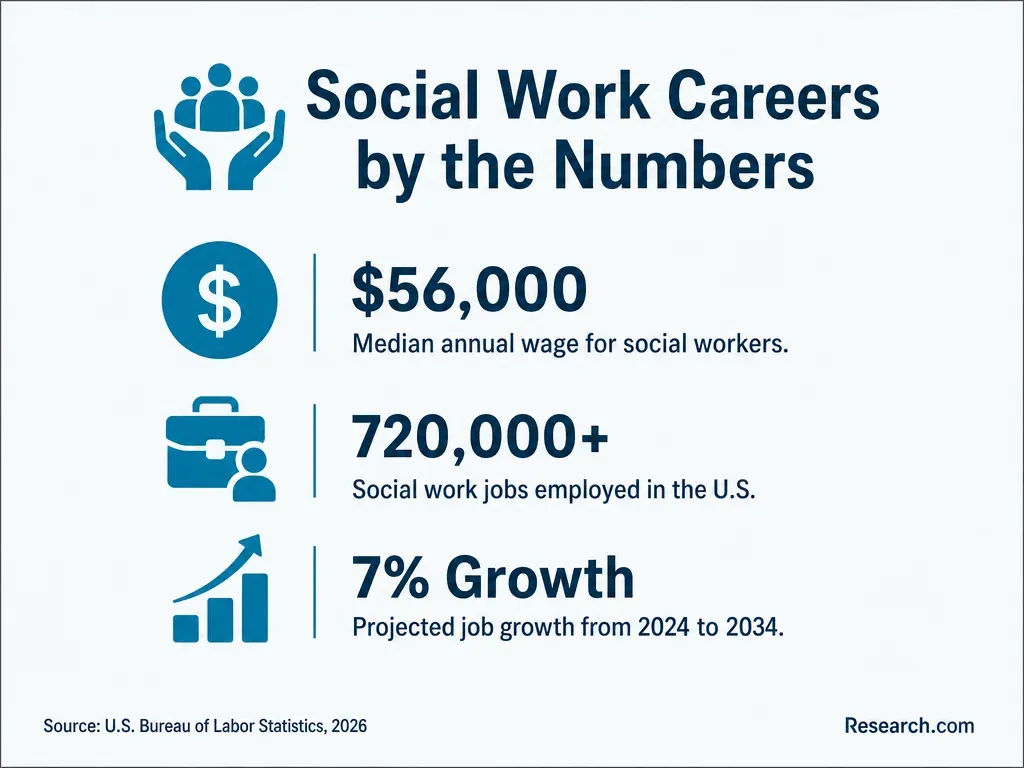
The U.S. Bureau of Labor Statistics reports a $59,550 median annual wage in May 2025 for child, family, and school social workers and projects 4% employment growth from 2025 to 2035 for that combined occupation. The category includes workers outside schools, so neither figure predicts a particular school district's salary or a new graduate's offer.
Special education coordinator is a district job title, not a matching national BLS wage category. Avoid borrowing the social worker median - or an administrator median - to estimate coordinator pay. Instead, compare posted district salary schedules, contract length, required credentials, and whether the position includes supervisory duties. For school social work comparisons across locations, social work earnings across different state markets can provide context alongside the actual district pay scale.
What advancement opportunities are available in school social work and special education?
Experienced school social workers may move into lead practitioner, supervision, district student-services leadership, training, or community partnership roles. Coordinators may advance into broader special education administration or district leadership. In either path, openings, required credentials, management experience, and public-sector salary schedules matter more than a degree title alone.
A DSW may suit an experienced social worker pursuing practice or organizational leadership; a research-focused PhD is a different route for someone aiming to produce original scholarship. Neither is a routine requirement for IEP coordination, and an educator leadership credential may be more direct for a coordinator seeking an administrative post. Before considering doctoral study, weigh the target job's requirements against time and cost; a social work doctoral program cost guide can inform that comparison without establishing that a doctorate will raise pay.
Other Things You Should Know About Social Work
A parent can ask the school to include a social worker whose knowledge would help the team. Participation and the person's role should be coordinated with the school; a social worker is not automatically a required member of every IEP team.
No. Schools may offer social work support through general education or other student services. Access, consent, and documentation depend on the service and district policy.
Ask the school to explain the decision and how to provide additional information. For an IEP dispute, consult the district's procedural safeguards notice for available IDEA processes and applicable deadlines.
Schools should arrange communication that enables meaningful family participation, including interpretation or translation when needed. Staff should follow district procedures rather than relying on a student to interpret sensitive planning discussions.
- Scope of Practice Addressing Barriers to Learning | CT.gov https://portal.ct.gov/sde/publications/delivery-of-school-social-work-services/scope-of-practice-addressing-barriers-to-learning
- NC Policies Governing Services for Children with Disabilities https://www.dpi.nc.gov/policies-governing-students-children-disabilities/download
- BVI00202 (Previous applicants need not reapply) - Virginia Jobs https://www.jobs.virginia.gov/jobs/education-coordinator-bvi00202-previous-applicants-need-not-reapply-richmond-virginia-united-states-3086811e-942a-4523-8f65-3f941688084c
- About IDEA - Individuals with Disabilities Education Act https://sites.ed.gov/idea/about-idea/
- Information Sharing in the School Setting During a Public Health Emergency - PMC https://pmc.ncbi.nlm.nih.gov/articles/PMC7240309/
- Collaborative Planning for EL and Special Education Programs | mn.gov https://education.mn.gov/mdeprod/idcplg
- FERPA | Protecting Student Privacy - Department of Education https://studentprivacy.ed.gov/FERPA
- Rule 3301-51-07 | Individualized education program (IEP). https://codes.ohio.gov/ohio-administrative-code/rule-3301-51-07
- Collaborating with Families of Students with Disabilities | vanderbilt.edu https://iris.peabody.vanderbilt.edu/module/dll/cresource/q2/p04/
- NASW Practice Standards for School Social Workers https://www.socialworkers.org/Practice/NASW-Practice-Standards-Guidelines/NASW-Standards-for-School-Social-Work-Services