2027 MSW Research Courses for Practice-Oriented Students: Why the Content Matters
Audited and Verified:
Our Editorial and Data Verification Process
Research.com uses government datasets, official education statistics and primary institutional information to support its career and degree guides. Our review process checks factual accuracy, occupational definitions, source dates and the requirements associated with the credentials discussed.
How This Article Was Fact-Checked
Our editorial team verifies salary estimates, employment projections, education requirements and program information against original data providers and official organizations. Salary figures are checked against the relevant occupational definitions and reporting periods. Information about licensure, accreditation and required in-person training is reviewed separately.
Fact-checked and verified on:

Co-Founder and Chief Data Scientist
An MSW research course can look like a detour from client work until you need to judge whether an intervention is helping, explain a program's results, or spot a misleading statistic. For practice-oriented students, the useful question is not simply whether a program requires research. It is whether the instruction helps you make sound decisions with real-world evidence. This guide explains what the courses cover, how research connects to field education and agency work, and what to check before choosing an MSW program.
Key Things You Should Know
- Strong MSW research instruction connects study design and data interpretation to practice decisions, such as choosing measures and recognizing when an apparent improvement has another explanation.
- Compare actual assignments and approved field opportunities, not just course titles; an agency project may be limited by confidentiality, data access, and oversight requirements.
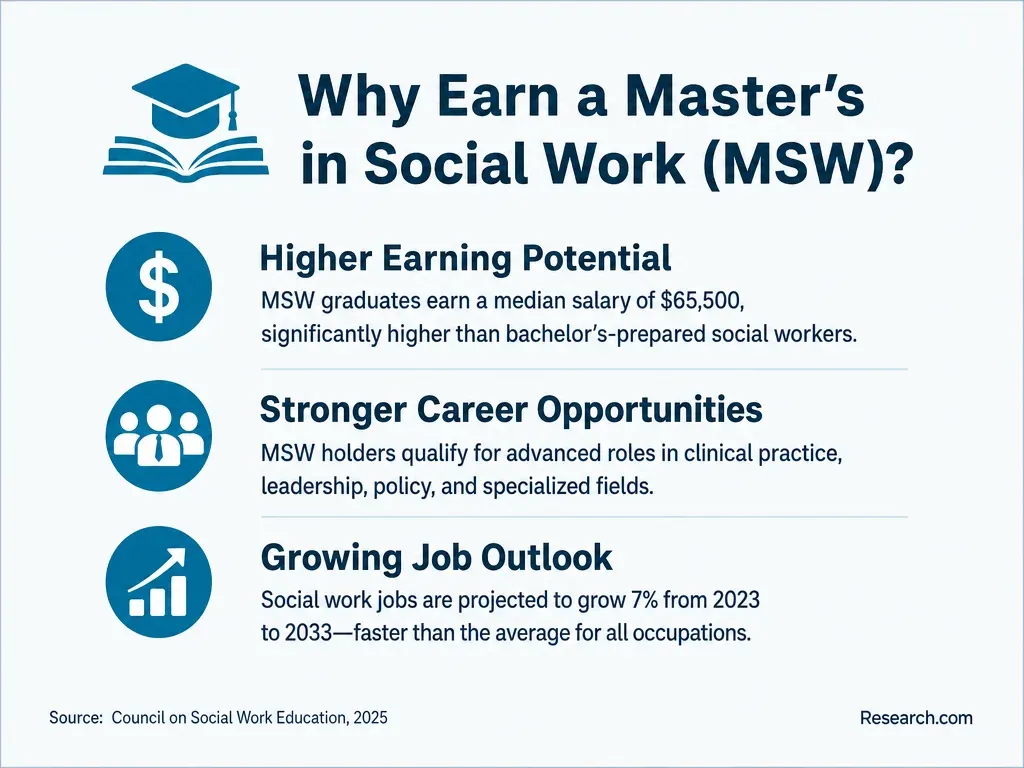
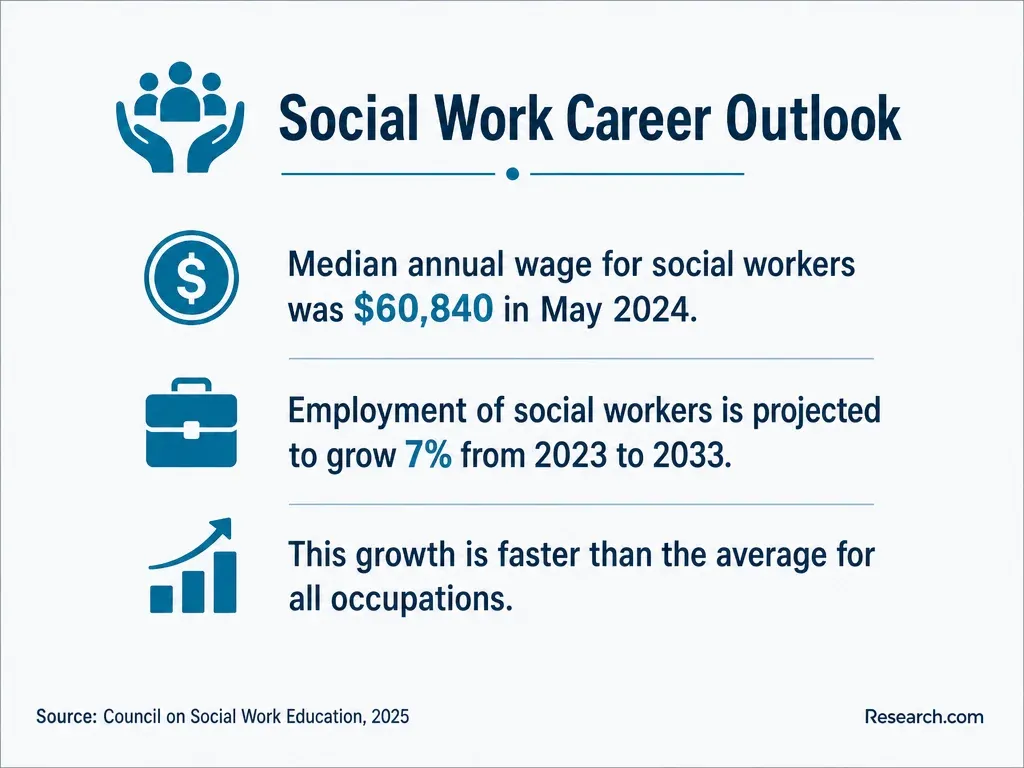
- The U.S. Bureau of Labor Statistics reports a $61,780 median annual wage for social workers across specialties in May 2025 and projects 6% employment growth from 2025 to 2035; neither figure predicts an individual MSW graduate's pay or job prospects.
What are MSW research courses?
MSW research courses teach students to find, assess, produce, and use evidence relevant to social work. Depending on the program, the content may appear in a stand-alone methods course, a statistics or evaluation course, a practice seminar, or a capstone. A practice-oriented course asks how evidence can inform a decision while accounting for client preferences, professional judgment, organizational constraints, and structural inequities.
Research literacy is different from training to become an academic researcher. An MSW student might critique a published intervention study or design a feasible agency evaluation without conducting an original study. A research-oriented PhD generally places much greater emphasis on developing original scholarship; a practice-oriented DSW may emphasize applied inquiry and leadership, although requirements vary. Students considering later doctoral study can investigate exploring shorter online social work doctorates, but a shorter format is not a substitute for checking its research expectations.
Why do MSW research courses matter for social work practice?
Social workers regularly encounter claims about what works. Research skills help them distinguish a promising approach from a well-supported one and ask whether published findings apply to the people an agency serves. A study conducted with one population, service setting, or level of support may not transfer neatly to another.
Consider a hypothetical housing program reporting that most participants remained housed after receiving services. A practice-minded graduate would ask how "remained housed" was defined, how many people were followed, whether those lost to follow-up differed from those reached, and whether other assistance could have contributed. Those questions make the result more useful without dismissing the program or claiming that the services caused the outcome.
Research also supports ethical practice: selecting measures that clients understand, noticing whose experiences a dataset excludes, and reporting uncertainty rather than overstating success. It complements - not replaces - supervision and observed practice competence. For students pursuing clinical roles, clinical hours and social work professional preparation involve separate, state-specific requirements; completing a research assignment does not satisfy post-degree supervision rules.
What research methods, statistics, and assignments do MSW courses cover?
Courses vary in mathematical depth, but practice-oriented instruction should help students match a question to an appropriate method and explain the limits of the answer. The comparison below shows what common content can contribute to agency decisions.
| Course content | Typical practice application | Important limitation |
| Evidence searches and critical appraisal | Assess whether an intervention study fits a client population or service setting | A published finding may not apply under different conditions |
| Qualitative interviews or thematic analysis | Understand participant experiences and barriers to access | Convenience samples may leave important perspectives out |
| Surveys and measurement | Track needs, satisfaction, or changes over time | Questions may be inaccessible, biased, or poorly matched to the goal |
| Descriptive statistics and basic comparisons | Summarize service reach or compare outcomes across periods | Observed differences alone do not establish causation |
| Program or practice evaluation | Examine whether services are delivered as intended and what outcomes are observed | Data access, small samples, and missing follow-up can limit conclusions |
Assignments may include a literature review, research proposal, article critique, evaluation plan, presentation, or capstone. Some programs teach statistical software; others prioritize interpreting results. Ask to see a recent syllabus and assignment rubric rather than assuming every MSW requires coding, a thesis, or a particular software package.
If you are considering accelerated MSW study planning, check whether compressed terms leave enough time for feedback and revision on substantial methods assignments alongside field education. Faster completion is less valuable if the schedule prevents you from learning to use the material.
The Council on Social Work Education (CSWE) accredits social work degree programs, not individual research courses. Its educational standards make research-informed practice part of social work preparation, but accredited programs can teach and assess that competency in different ways. Verify the exact MSW program's accreditation status and whether it applies to your intended entry cohort; institutional accreditation alone answers a different question.
State licensing boards determine their own educational and other eligibility requirements. An accredited MSW may be important to a licensing pathway, but graduation does not issue a license or authorize independent clinical practice. Before enrolling, check the board rules for the state where you expect to practice, including any examination and post-degree supervision requirements relevant to your intended license.
For online applicants, understanding online social work degree choices also means verifying that the program can enroll you and support required field education in your location. Accreditation, enrollment authorization, placement feasibility, and eventual licensing eligibility are related questions - not interchangeable assurances.
Neither format is inherently better for learning methods. Online courses can support recorded explanations, discussion of published studies, and remote collaboration; campus courses may make in-person workshops and immediate group feedback easier to arrange. Instructor access, assignment design, feedback quality, and scheduling often matter more than the delivery label.
For students balancing employment or caregiving, "online" does not necessarily mean asynchronous. Methods courses may require live presentations or group projects, while the wider MSW may require skills labs, campus visits, and agency field hours at set times. Before relying on planning online MSW study around employment, request a sample weekly schedule that includes research coursework, live requirements, and practicum commitments.
Start with the work you hope to do: direct practice, community programs, policy, or agency leadership. Then look for evidence that research instruction fits that goal. A program's claim that students are "evidence-based" is less informative than its syllabi, assignment rubrics, faculty interests, and examples of appropriately approved student projects.
Use these questions with admissions staff, research faculty, and the field office. Their answers should reveal both learning opportunities and practical limits.
- Where do students learn to interpret quantitative findings, assess qualitative evidence, and evaluate services?
- What feedback do students receive on an evaluation plan or other practice-oriented research assignment?
- Can a field learning agreement include evaluation tasks, and who approves those tasks at the school and agency?
- What happens if a placement cannot provide appropriate data access or evaluation opportunities?
- What rules govern client information, agency records, consent, and any required institutional review?
A practicum is not automatically a research site. An agency may offer excellent supervised practice while restricting record access or student-led surveys. Students seeking exploring MSW programs with practicum assistance should ask how placements are arranged and supported, rather than assume an appealing project idea can determine their site. Never use identifiable client information for coursework without the required approvals and safeguards.
Traditional or foundation MSW tracks commonly admit applicants with bachelor's degrees in disciplines other than social work; programs set their own prerequisites, grades, application materials, and experience expectations. Advanced-standing tracks are generally intended for applicants with a qualifying BSW, subject to the school's accreditation, recency, grade, and other rules. A psychology, sociology, or human services degree does not by itself establish advanced-standing eligibility.
If research coursework is a concern, review your transcript for statistics, methods, and writing preparation, then ask each program whether it requires a specific prerequisite or offers academic support. Relevant service or analytical experience can strengthen an application, but it does not replace the program's entry requirements. When comparing social work master's application options by selectivity, weigh admission accessibility alongside the quality of methods teaching, field support, and fit for your goal.
A traditional MSW typically includes foundation and specialized study; an approved advanced-standing route omits some foundation work. Full-time and part-time schedules, term lengths, and field-course sequencing therefore change the completion time. Ask for the curriculum map for your actual entry route rather than relying on a program-wide "finish in" claim.
Compare total cost, not a single tuition rate. Include mandatory fees, books or software, travel or campus visits, field-placement transportation, and any reduction in paid work needed to complete required learning. A shorter route is not automatically cheaper if its pace causes lost earnings or requires support you must pay for. When comparing lower-cost MSW pathways, request a written estimate based on your credits, residency status, enrollment pace, and likely field schedule. Treat scholarships, paid placements, and employer assistance as possibilities until eligibility and terms are confirmed.
What are the salary expectations and job outlook for social workers?
The U.S. Bureau of Labor Statistics figures below describe occupations, not salaries awarded for completing an MSW or its research courses. They can provide context for a career decision, but pay varies by setting, location, experience, employer, and job duties.
| U.S. occupation | May 2025 median annual wage | Projected employment growth, 2025-2035 |
| Social workers, all specialties | $61,780 | 6% |
| Child, family, and school social workers | $59,550 | 4% |
| Healthcare social workers | $67,880 | 8% |
| Mental health and substance abuse social workers | $60,280 | 10% |
The specialty differences make it important to compare occupations that resemble your target work. These categories do not isolate program evaluators, distinguish BSW from MSW graduates, or show a wage premium for research skills. Use social work master's career options to identify roles worth investigating, then compare local postings and total education costs before making a financial decision.
Other Things You Should Know About Social Work
Possibly, but publication is not automatically permitted. Discuss the plan with the instructor and agency before collecting or sharing information, and confirm any required permissions, ethics review, confidentiality protections, and authorship arrangements.
Do not assume the student owns it. Agency agreements, consent terms, university policies, and applicable law may control access and reuse. Ask the field office and agency what can be retained or presented after the placement ends.
Only within the course's academic-integrity rules and the agency's data policies. Never enter identifiable client or confidential agency information into a tool without explicit authorization, and check every generated citation and factual claim.
Use the university library while enrolled, ask a librarian about available databases and interlibrary loan, and look for legitimately available public reports or open-access versions. Check the original study's methods before relying on a summary.
- The Current State of Evidence-Based Practice in Social Work | nih.gov https://pmc.ncbi.nlm.nih.gov/articles/PMC2943634/
- Training package for critical appraisal | who.int https://www.emro.who.int/evidence-data-to-policy/training-package/critical-appraisal.html
- Ethical Issues | sagepub.com https://methods.sagepub.com/hnbk/edvol/the-handbook-of-social-work-research-methods/chpt/ethical-issues
- SWRK 540: Social Work Research Methods | wku.edu https://app.wku.edu/syllabus/get/
- What Is Qualitative Research? An Overview and Guidelines | sagepub.com https://journals.sagepub.com/doi/10.1177/14413582241264619
- Social Work Research Methods | Virginia Commonwealth University https://onlinesocialwork.vcu.edu/blog/social-work-research/
- Social Work Research " Academics | Boston University https://www.bu.edu/academics/ssw/courses/social-work-research/
- Introduction to EBP - Social Work: Evidence-Based Practice https://guides.lib.umich.edu/EBP-Research
- Graduate Research Methods in Social Work | Open Textbook Library https://open.umn.edu/opentextbooks/textbooks/graduate-research-methods-in-social-work
- Mixed Methods Research | umich.edu https://ssw.umich.edu/courses/2260/sw861/32239