2027 Social Work Workload Studies: Measuring Activities Beyond Direct Contacts
Audited and Verified:
Our Editorial and Data Verification Process
Research.com uses government datasets, official education statistics and primary institutional information to support its career and degree guides. Our review process checks factual accuracy, occupational definitions, source dates and the requirements associated with the credentials discussed.
How This Article Was Fact-Checked
Our editorial team verifies salary estimates, employment projections, education requirements and program information against original data providers and official organizations. Salary figures are checked against the relevant occupational definitions and reporting periods. Information about licensure, accreditation and required in-person training is reviewed separately.
Fact-checked and verified on:

Co-Founder and Chief Data Scientist
A social worker's calendar may show a manageable number of appointments while leaving little time for records, referrals, travel, and supervision. That gap matters to agency leaders setting staffing levels and to students or job seekers judging whether a role is sustainable. A social work workload study makes the full workweek visible rather than treating client contacts as the whole job.
This guide explains what to count, how to measure it without compromising privacy, and how to interpret the results when comparing jobs, training, and staffing options.
Key Things You Should Know
- A workload study measures direct service and necessary work around it, including documentation, coordination, travel, supervision, and administrative tasks.
- Caseload is a count of assigned cases, not hours of work: two workers with 25 cases each may have substantially different demands.
- As an illustration, 18 hours of client visits in a 40-hour week leaves 22 hours for other work; staffing decisions must account for those hours rather than assume they are unused capacity.
What is a social work workload study?
A social work workload study is a structured examination of the time and effort required to perform a defined set of duties. It can help an agency estimate staffing needs, examine delays, compare service models, or identify tasks that displace client care. Its unit of analysis might be a worker's shift, an episode of service, a team, or a program - not necessarily the number of people assigned to a worker.
Good studies state their purpose before collecting data. A short operational study might ask whether a team has enough time to complete required follow-up. A formal research project might test how workload differs across settings and require additional review, sampling, and analysis. A doctorate is not a prerequisite for an agency time study; someone considering a sustained research or leadership route can separately review a guide to lower-cost doctoral social work programs.
What social work activities count beyond direct client contact?
Count activities required to deliver, coordinate, document, and improve services, even when the client is not present. Define categories before measurement so staff classify the same task consistently; otherwise, an apparent difference between teams may be a coding difference.
The table separates common activities from direct contact and shows why excluding them would distort a staffing estimate.
| Activity | Examples | Why it matters |
| Documentation | Assessment notes, care plans, required reports | Records often have deadlines and cannot simply be deferred. |
| Coordination | Referrals, calls with providers, school or family meetings | Access to services may depend on work between appointments. |
| Travel and logistics | Home-visit travel, scheduling, arranging interpretation | Service geography and accessibility change time per case. |
| Supervision and consultation | Case review, field instruction, safety consultation | These activities support decisions, learning, and accountability. |
| Program and administrative work | Eligibility checks, reporting, outreach, team meetings | Required work consumes capacity even when it is not billed as a visit. |
For field students, distinguish approved learning tasks and academic supervision from an employee's ordinary duties. Schools and agencies decide what counts toward a placement; students concerned about the time available for both learning and service can examine graduate social work placement coordination options.
How do workload studies measure social workers' time?
Common methods include time diaries completed during or soon after work, periodic activity sampling, observation with appropriate safeguards, interviews, and review of scheduling or administrative records. Each captures something different: calendar data can show booked visits but may miss interruptions, while a diary can capture interruptions but relies on consistent reporting.
A practical study needs a defined observation period, activity categories, a rule for simultaneous tasks, and a denominator such as paid hours. These steps make the findings more useful than a raw count of appointments.
- Specify the decision first, such as whether a team can meet documentation and follow-up expectations within scheduled hours.
- Define mutually understandable categories and test them with staff before collecting data.
- Sample ordinary and unusually busy periods, including variation in shifts, locations, and case complexity where relevant.
- Compare recorded activities with available work hours, then discuss discrepancies and missing work with staff before changing assignments.
Report the method alongside the results. A one-week diary during a seasonal surge should not be presented as a permanent staffing norm. Students interested in learning these evaluation skills while choosing among online social work programs can ask whether research courses teach sampling, measurement bias, and responsible use of agency data.
Workload categories should reflect the actual service model. Hospital social workers may spend substantial time coordinating discharge and resources across teams. School social workers may balance student meetings with family contact, consultation, and school procedures. Child welfare roles can involve travel, court-related preparation, and time-sensitive records. Community organizers may spend less time in individual appointments and more time building partnerships and planning collective action.
Clinical roles may add treatment documentation and consultation, but job title alone does not establish duties or legal scope. A prospective clinician reviewing online clinical MSW programs should ask how coursework and field learning address documentation, scheduling, supervision, and care coordination alongside interviewing skills. For any job, request a realistic account of a typical week and the support available when urgent work displaces planned tasks.
A workload study can reveal that a service target is achievable only through overtime, skipped documentation time, or delayed follow-up. Leaders can use that finding to test changes such as redistributing assignments, adding administrative support, changing referral processes, protecting supervision time, or revising targets. Measure again after a change; recording a problem is not evidence that an intervention solved it.
Burnout has multiple causes, so a time study alone cannot diagnose or prevent it. Pair time data with staff feedback, turnover, service delays, quality measures, and funding constraints. For a worker weighing whether further education will improve their options, exploring the career value of affordable MSW study is useful only alongside the workload, supervision, and advancement conditions of the jobs they actually want.
Time records can undercount interrupted work, after-hours tasks, and the cognitive effort of complex decisions. Staff may also change behavior when observed or classify similar tasks differently. Results should describe the sample, missing data, unusual events, and whether findings can reasonably be applied to another team.
Collect only the information needed for the study. Use activity categories rather than client names where possible, limit access, set retention rules, and follow agency policy and applicable confidentiality law. Be transparent with staff about whether information will inform team staffing, individual performance review, or both; those uses have different implications for trust and interpretation. Agency evaluation may also require organizational or research-ethics review depending on its purpose and how findings will be used.
For professionals considering formal training in evaluation, privacy instruction and supervised opportunities to work with appropriately authorized data matter more than price alone. Keep those criteria in view when comparing affordable social work master's degrees.
How do workload, salary, and job outlook compare across social work careers?
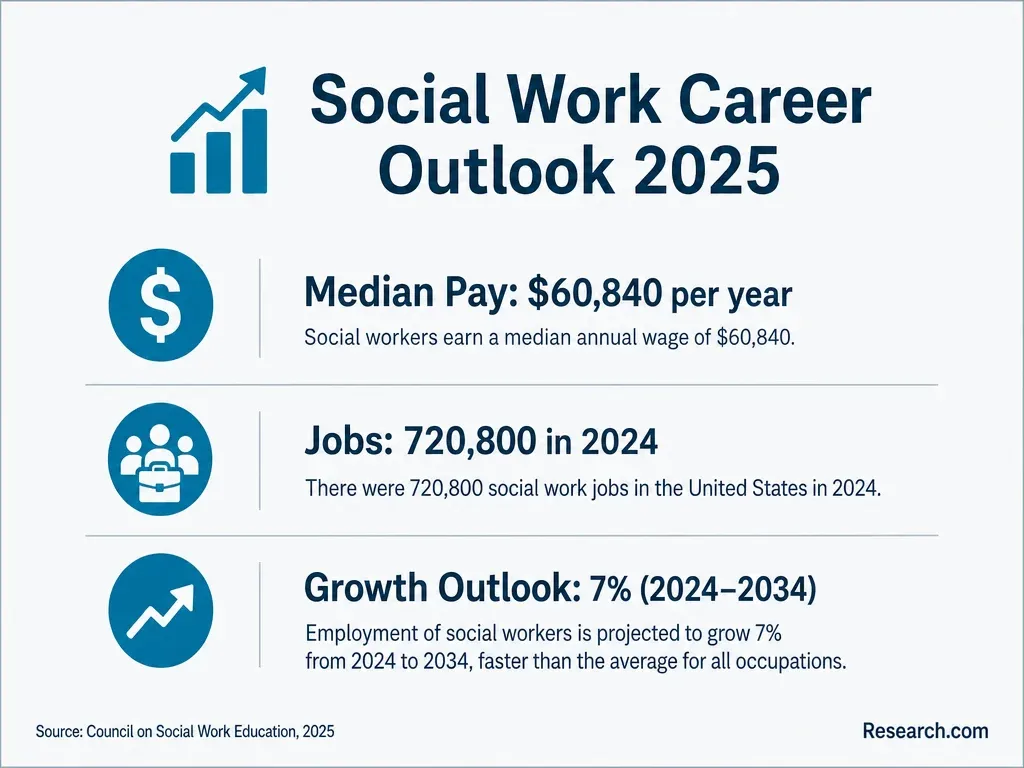
Pay and employment projections provide context for a career choice, but they do not measure case complexity or predict an individual offer. The following U.S. Bureau of Labor Statistics figures are occupation-wide medians for May 2025 and projected employment changes for 2025-2035; agency job titles and state license categories may not match these categories exactly.
| BLS occupation | Median annual pay, May 2025 | Projected employment change, 2025-2035 | Workload questions to ask |
| Social workers, all specialties | $61,780 | +6% | Which specialty and duties does the offer actually cover? |
| Child, family, and school social workers | $59,550 | +4% | How much time goes to travel, records, family contact, or school coordination? |
| Healthcare social workers | $67,880 | +8% | What are the discharge, coverage, and interdisciplinary expectations? |
| Mental health and substance abuse social workers | $60,280 | +10% | How are documentation, consultation, and urgent needs scheduled? |
Use the figures to frame questions, not to price an MSW or assume a higher-paying category has a lighter workload. Compare the actual salary offer, benefits, schedule, supervision, and expected after-hours work. Geography also matters; MSW compensation and relocation considerations can inform a comparison, but state-level pay differences must be weighed against local costs and licensing requirements.
Other Things You Should Know About Social Work
Yes, if the study tracks scheduled time and its consequences. Record the cancellation separately from completed contact and note any rescheduling, outreach, or documentation it generated.
Separate time spent available for calls from time spent actively responding. State the employer's on-call rules so the study does not confuse availability with completed service.
Yes. Periodic sampling or a short end-of-shift diary may be feasible, though delayed entries can miss brief interruptions. Choose a method staff can use consistently and disclose its limitations.
Ask about a typical week, documentation deadlines, coverage during absences, supervision, overtime expectations, and what happens when urgent cases exceed scheduled capacity.
- Nursing workload, nurse staffing methodologies and tools - PMC https://pmc.ncbi.nlm.nih.gov/articles/PMC7086229/
- WISN - Workload indicators of staffing need - IRIS https://iris.who.int/server/api/core/bitstreams/8b880867-a0a8-43e4-83b7-cc35f36809a9/content
- 7. BHSA Components and Requirements | ca.gov https://policy-manual.mes.dhcs.ca.gov/behavioral-health-services-act-county-policy-manual/LIVE/7-bhsa-components-and-requirements
- Understanding caseload and workload approaches | education.gov.uk https://support-for-social-workers.education.gov.uk/employer-standards/standard-3/caseload-and-workload
- Workload and Caseload Management | psu.edu https://militaryfamilies.psu.edu/resources/view/workload-and-caseload-management/
- Practicum Education Handbook | The University of Kansas https://socwel.ku.edu/current-students/program-handbooks/practicum-education-handbook
- Full article: Measuring early childhood educators' time at work using an electronic random time-sampling approach https://www.tandfonline.com/doi/full/10.1080/1743727X.2022.2128102