2027 Home Health Social Worker: Responsibilities, Education, and Career Fit
Audited and Verified:
Our Editorial and Data Verification Process
Research.com uses government datasets, official education statistics and primary institutional information to support its career and degree guides. Our review process checks factual accuracy, occupational definitions, source dates and the requirements associated with the credentials discussed.
How This Article Was Fact-Checked
Our editorial team verifies salary estimates, employment projections, education requirements and program information against original data providers and official organizations. Salary figures are checked against the relevant occupational definitions and reporting periods. Information about licensure, accreditation and required in-person training is reviewed separately.
Fact-checked and verified on:

Co-Founder and Chief Data Scientist
Home health social workers help people manage the practical and emotional barriers to receiving care at home. For someone considering the role, the key distinction is between a Medicare home health medical social worker position and a broader home-based support job: they may involve similar families but require different qualifications.
This guide explains the work, education and licensing considerations, earnings, and day-to-day conditions so you can judge whether to pursue an MSW, build healthcare experience, or explore a different service role.
Key Things You Should Know
- Home health social workers assess barriers to care, support patients and caregivers, and coordinate community resources; they work within a clinical team rather than providing every needed service themselves.
- Medicare home health medical social worker positions have specific federal personnel qualifications. A BSW or related degree may instead fit an assistant or other support role, subject to the job's requirements.
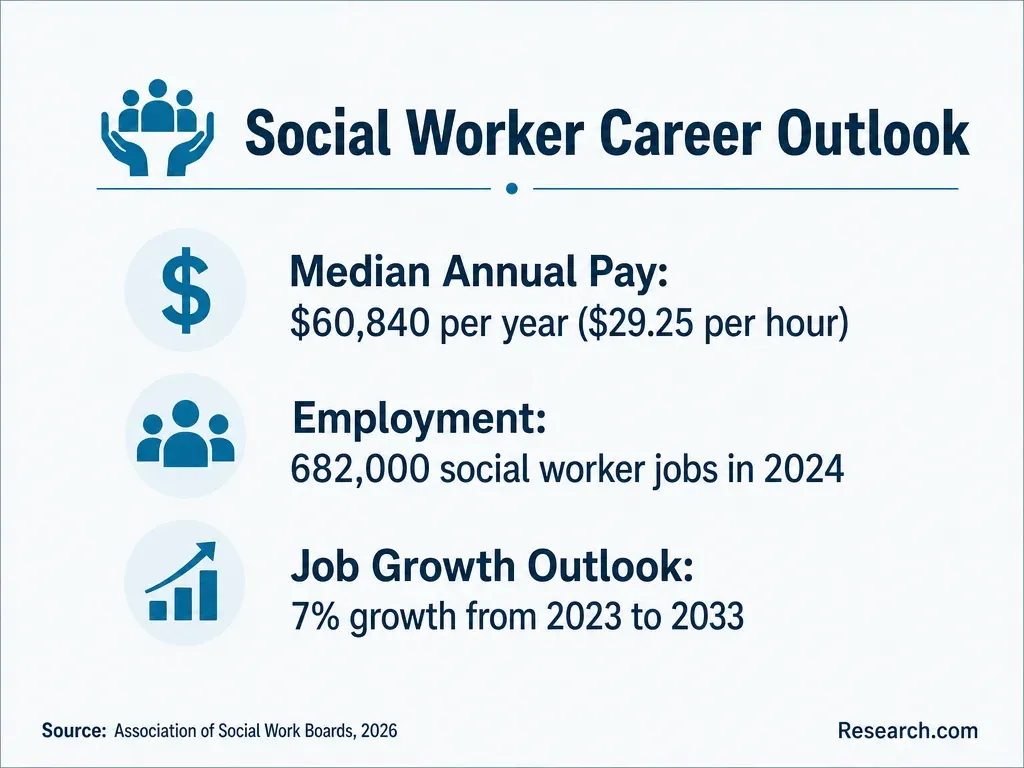
- The U.S. Bureau of Labor Statistics reports a $67,880 median annual wage for healthcare social workers in May 2025 and projects 8% employment growth from 2025 to 2035; neither figure describes home health jobs alone.
What does a home health social worker do?
A home health social worker supports a person receiving services at home when illness, disability, caregiving demands, finances, or living conditions complicate the care plan. In a Medicare-certified home health agency, medical social services are part of a coordinated plan of care. Duties depend on the referral, the patient's goals, agency policy, and the worker's authorized role.
A visit might involve assessing whether a patient can obtain food or transportation, discussing caregiver strain, helping the household understand available benefits, or arranging a referral to a community organization. The social worker documents findings and communicates concerns to nurses, therapists, and other team members. They may help families plan for changing support needs, but they cannot guarantee benefit eligibility, housing, or a service opening.
This is generally short-term, care-plan-focused work - not automatically ongoing psychotherapy or independent clinical treatment. If you are comparing home health with hospital, behavioral health, or community positions, a guide to MSW job families and professional development can help clarify which duties match your goal.
What degree do you need to become a home health social worker?
For a Medicare home health medical social worker position, check the federal personnel qualification and the agency's job description before choosing a degree. Medicare's home health standards specify graduate social work education and healthcare social work experience for the social worker role. State rules and employers may add requirements. A job with "home health" in its title is not necessarily that federally defined position.
A CSWE-accredited BSW provides generalist social work preparation and may lead to relevant healthcare support or social work assistant opportunities where the applicant meets the applicable qualifications. Other care-coordination jobs may accept a related degree. Those positions can build experience, but a BSW or related bachelor's degree should not be assumed to qualify someone for a Medicare medical social worker opening.
If you are starting without a degree, compare local role requirements before committing to an online bachelor of social work program option. If you already hold a bachelor's degree in another field, a traditional or foundation MSW may be a more direct route to graduate social work preparation. Advanced-standing MSW entry generally requires a qualifying prior BSW; related work experience alone does not confer eligibility.
Do home health social workers need a license or certification?
There is no single nationwide "home health social worker license." Whether you need a state social work license depends on the state's title and practice rules, your duties, and the employer's requirements. Federal home health personnel qualifications, state licensure, and agency hiring standards are separate checks; meeting one does not establish that you meet the others.
Some positions require an entry-level or master's-level social work license, while independent clinical activities may require a separate clinical license and documented post-degree supervised experience. An MSW, clinical concentration, field placement, or passed examination does not itself grant independent clinical authority. Specialty certification may be useful for professional development but is not a substitute for a required state license.
Before enrolling or accepting a job, compare the posting with the current state board rules for the license title and activities involved. For education planning, use MSW licensure alignment before enrollment as a starting point, then confirm the requirements with the board that would license you.
The role fits people who can build trust quickly, listen to patients and caregivers with different priorities, assess barriers without making assumptions, and turn a conversation into a realistic follow-up plan. Healthcare or community-service experience can help, but new workers still need orientation to the agency's documentation, referral, safety, and escalation procedures.
Compared with a clinic-based position, home visits can offer a clearer view of a person's living circumstances and more independence between team contacts. They also bring travel, schedule changes, limited control over available community resources, and situations that call for safety judgment and timely consultation. Ask a prospective supervisor about visit territories, caseload expectations, access to team members, and procedures for unsafe conditions - not just the number of visits per week.
If your strongest interest is long-term therapy, a home health medical social services role may not provide enough of that work. If you prefer benefits navigation or community outreach without pursuing the qualifications for a medical social worker position, compare the actual duties and credentials of adjacent roles before choosing a degree. Comparing social work degrees before enrollment is most useful after you have identified which job functions you want to perform.
BSW applicants generally need to meet university admission requirements, but entry into the social work major or field sequence may involve an additional application and academic standards. Traditional MSW programs admit qualified applicants with bachelor's degrees in various disciplines; they set their own GPA, prerequisite, writing, reference, and experience expectations. An applicant with a psychology or human services degree should not assume advanced-standing eligibility.
Advanced-standing MSW applicants typically need a qualifying BSW and must meet the program's additional criteria, which can include recency or academic-performance rules. Admission is also distinct from being ready for placement: an agency may require screening or onboarding before field work begins.
If an admissions requirement is your main obstacle, review less restrictive social work master's admission options, then verify each program's current criteria and field expectations. A less selective application process does not reduce the qualifications needed for a later job or license.
How long do social work degrees take, and how much do they cost?
A full-time BSW commonly takes about four years from first-year entry, while a traditional MSW often takes about two years of full-time study after a bachelor's degree. An advanced-standing MSW may take about one year full time for eligible BSW graduates. Transfers, part-time enrollment, required course sequences, and placement availability can change those timelines. The distinction between the two MSW routes is explained in comparing MSW credits across entry tracks.
There is no responsible single price for becoming a home health social worker: programs set different charges, and the route you already qualify for matters. Compare each school's published tuition and fees for your entire expected sequence. Add books, technology, screening, placement travel, and any required visits; also account for paid hours you may give up during field education. If licensure is needed, budget separately for applicable application, examination, and supervision-related expenses.
For a career changer, the strongest cost comparison is between realistic routes to the same target job. If an employer requires an MSW and healthcare experience, a cheaper qualification that does not meet those requirements is not a lower-cost route to that position.
Other Things You Should Know About Social Work
Social workers should respect an informed patient's choices, document the discussion according to agency policy, and coordinate with the care team as appropriate. Safety concerns or decision-making questions require consultation under applicable rules and procedures.
Policies differ. Before accepting an offer, ask whether mileage and travel time are paid, how the service territory is assigned, and which expenses you must cover yourself.
Do not assume so. The agency's service model, payer rules, patient needs, and applicable practice requirements determine when a remote contact is appropriate and whether an in-person visit is required.
Both can involve visits to a person's home and support for caregivers. Hospice work is organized around a hospice plan of care for someone receiving end-of-life care; home health medical social services support the goals of a home health plan. Compare specific job postings and team models rather than treating the settings as interchangeable.
- Levels and Eligibility Requirements | North Carolina Social Work Certification and Licensure Board https://www.ncswboard.gov/levels-and-eligibility-requirements/
- Social Work During Skilled Home Healthcare: Prevalence and... - PMC https://pmc.ncbi.nlm.nih.gov/articles/PMC12082084/
- 42 CFR Part 484 -- Home Health Services | ecfr.gov https://www.ecfr.gov/current/title-42/chapter-IV/subchapter-G/part-484
- Social Worker and Social Worker Associate - Licensing Requirements | Washington State Department of Health https://doh.wa.gov/licenses-permits-and-certificates/professions-new-renew-or-update/social-worker-and-social-worker-associate/licensing-requirements
- 42 CFR § 410.73 - Clinical social worker services. - LII | LII / Legal Information Institute https://www.law.cornell.edu/cfr/text/42/410.73
- Social Work Role | Center for Health Interprofessional Practice and Education https://healthipe.utexas.edu/social-work-role
- Duties of a Medical Social Worker | Keuka College https://onlinedegrees.keuka.edu/blog/medical-social-worker
- NASW Standards for Social Work Practice in Health Care Settings | socialworkers.org https://www.socialworkers.org/Practice/NASW-Practice-Standards-Guidelines/NASW-Standards-for-Social-Work-Practice-in-Health-Care-Settings