2027 Social Work Interviewing Skills: Open Questions, Listening, and Role Boundaries
Audited and Verified:
Our Editorial and Data Verification Process
Research.com uses government datasets, official education statistics and primary institutional information to support its career and degree guides. Our review process checks factual accuracy, occupational definitions, source dates and the requirements associated with the credentials discussed.
How This Article Was Fact-Checked
Our editorial team verifies salary estimates, employment projections, education requirements and program information against original data providers and official organizations. Salary figures are checked against the relevant occupational definitions and reporting periods. Information about licensure, accreditation and required in-person training is reviewed separately.
Fact-checked and verified on:

Co-Founder and Chief Data Scientist
A useful client interview does more than collect answers: it gives a person room to describe their situation while helping the worker understand needs, strengths, and next steps. For BSW and MSW students, new graduates, and social services professionals, the challenge is knowing when to invite a fuller story, when to listen, and where the limits of the role lie.
This guide offers examples you can adapt, explains how supervised practice develops interviewing judgment, and identifies the education and credential checks that matter before taking on more responsibility.
Key Things You Should Know
- Start broadly, then narrow: "What would you like help with today?" can reveal priorities that a checklist misses, while specific follow-ups clarify safety, eligibility, or service needs.
- Active listening means checking your understanding - not merely staying quiet - and allowing clients to correct your summary before you agree on next steps.
- Interviewing competence develops through observed practice and feedback; a BSW or MSW degree, field placement, or clinical concentration does not by itself authorize independent clinical practice.
What are social work interviewing skills, and why are they important?
Social work interviewing skills are the communication and judgment used to engage someone, understand their circumstances, clarify goals, and decide on an appropriate next step together. They include explaining the worker's role, asking purposeful questions, listening for both strengths and barriers, checking understanding, and closing with a clear account of what happens next.
An interview is not simply a script. A housing intake may need accurate eligibility information; a school meeting may involve a student's and caregiver's different perspectives; a clinical assessment may require questions within a licensed professional's authorized scope. In each setting, the worker must balance a person-in-environment view of the client's circumstances with the agency's purpose and the client's right to participate in decisions.
If you are choosing where to learn these skills, compare opportunities for feedback and supervised client contact - not just course titles. A review of social work degree options and program formats can help frame that comparison, but confirm the actual skills labs and field arrangements with each program.
How do social workers use open-ended questions in client interviews?
An open-ended question invites an explanation rather than a yes-or-no answer. It helps the client set priorities and gives the worker a fuller picture before moving to necessary specifics. The strongest questions are plain, relevant to the interview's purpose, and asked one at a time.
These examples show a progression from the client's account to a collaborative next step:
- "What brought you in, and what feels most important to address first?"
- "What have you already tried, and what helped even a little?"
- "How are work, family, transportation, or other circumstances affecting your options?"
- "What would a useful next step look like to you?"
Open questions do not replace focused ones. After hearing the client's account, a worker may need precise information for a referral, safety procedure, or application. Avoid a string of "why" questions that could sound accusatory; ask "What made that option difficult?" when the aim is to understand a barrier.
Students entering a BSW after other college study should check when interviewing courses and placements occur in the degree sequence. Associate-to-BSW course and field education planning matters because accepted transfer credits do not necessarily replace supervised practice in the social work major.
How does active listening improve social work interviews?
Active listening is the deliberate effort to understand and verify what a client means. It can make an interview more accurate: instead of assuming that "I need help at home" means one particular service, a worker can ask what tasks are difficult, what support already exists, and what the client wants to change.
Useful listening responses include a brief reflection - "It sounds as though the schedule is the biggest obstacle" - and a check: "Have I understood that correctly?" A summary near the end can separate what the client said from what the worker inferred. Silence can also give someone time to think; it should not become pressure to disclose more than they want to share.
Listen for practical and structural barriers, not just individual choices. A missed appointment might reflect an inaccessible bus route or caregiving obligation. At the same time, listening is not agreement with every proposed plan: workers still have to explain service limits and follow applicable safety procedures.
Prior coursework affects how much foundational material an MSW student takes, but it does not eliminate the need to demonstrate interviewing skills. Students comparing advanced standing vs traditional MSW should ask how each route assesses live practice and provides feedback.
BSW programs generally introduce interviewing within generalist practice: engagement, assessment, service planning, ethics, and work with people and systems. Traditional MSW programs build a foundation before specialized study; advanced-standing tracks recognize qualifying prior BSW preparation under the receiving program's rules. MSW practice courses may ask students to handle more complex interviews, but the emphasis varies by concentration and placement.
Programs may use demonstrations, paired role-plays, recorded simulations, feedback rubrics, reflective writing, and field seminars. A simulation offers a safer place to make mistakes; field education adds agency procedures, supervision, and real accountability. Neither a convincing role-play nor completed field hours alone proves readiness for independent practice.
When comparing programs, ask who observes interviews, how feedback is delivered, what happens if a skill needs improvement, and whether field sites offer appropriate interviewing opportunities. Compare those answers alongside total cost; lower-tuition Master of Social Work pathways are valuable only if the learning and placement support fit your goals and circumstances.
What are social workers' salary expectations and job outlook?
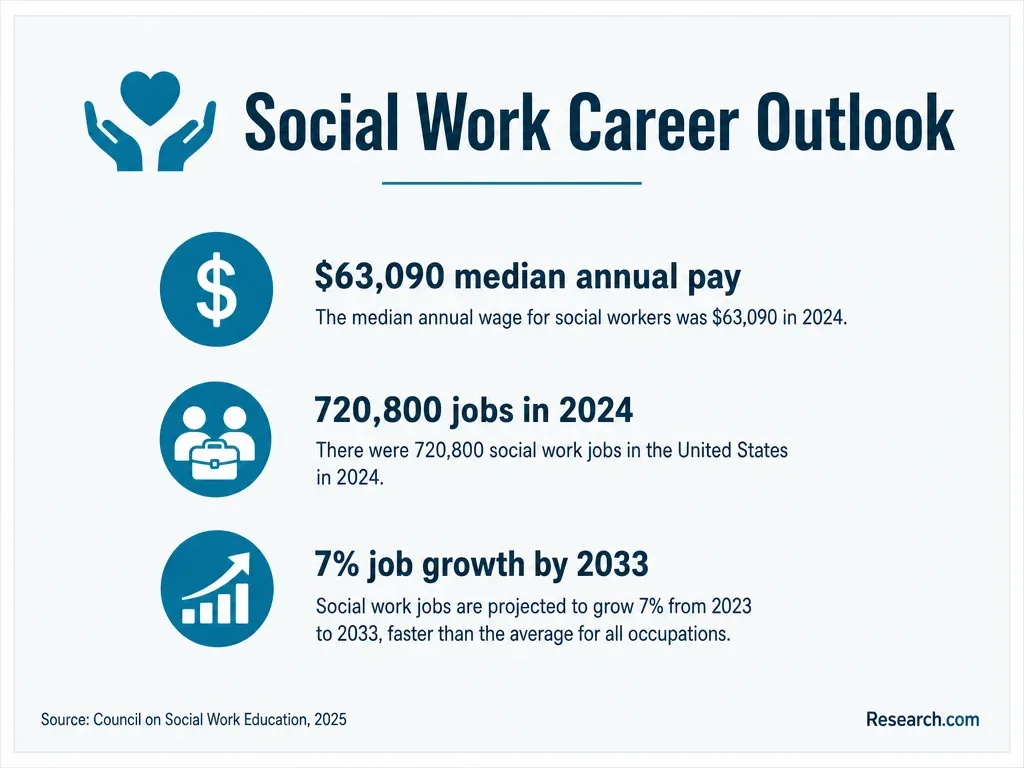
U.S. Bureau of Labor Statistics occupation data offer context for career planning, not a pay forecast for a particular graduate. The figures below distinguish social work specialties because interviewing-intensive jobs span different settings.
| BLS occupation | Median annual pay, May 2025 | Projected employment growth, 2025-2035 |
| Social workers, all specialties | $61,780 | 6% |
| Child, family, and school social workers | $59,550 | 4% |
| Healthcare social workers | $67,880 | 8% |
| Mental health and substance abuse social workers | $60,280 | 10% |
These are occupation-wide medians, not starting salaries or returns promised by a BSW or MSW. A job's pay also depends on location, employer, experience, duties, and licensing requirements. Use a guide to comparing social worker pay by location alongside current local postings, then weigh likely earnings against program cost and any reduction in income during field education.
Other Things You Should Know About Social Work
Use a qualified interpreter when needed and available under agency policy. A family member may affect privacy, accuracy, or the client's freedom to speak; follow the setting's language-access procedures.
Allow a reasonable pause, then check whether the question was clear or whether the client would prefer to move on. Silence does not automatically mean refusal or agreement.
Explain why notes are needed, keep them relevant, and check key points with the client. Follow agency rules for records, privacy, and where notes may be stored.
Use age-appropriate language, clarify each person's role, and follow agency procedures on consent, privacy, and speaking separately. Do not promise a child confidentiality beyond what the law and setting allow.
- The Role of Empathy in Health and Social Care Professionals | nih.gov https://pmc.ncbi.nlm.nih.gov/articles/PMC7151200/
- Interview Techniques - StatPearls https://www.ncbi.nlm.nih.gov/books/NBK526083/
- Reflective Supervision: What We Know and What We Need to Know to Support and Strengthen the Home Visiting Workforce https://acf.gov/opre/report/reflective-supervision-what-we-know-and-what-we-need-know-support-and-strengthen-home
- Full article: The Relative Effectiveness of Active Listening in Initial Interactions | tandfonline.com https://www.tandfonline.com/doi/full/10.1080/10904018.2013.813234
- Cultural Competence in Social Work - a Vital Skill | Virginia Commonwealth University https://onlinesocialwork.vcu.edu/blog/cultural-competence-in-social-work/
- Reflecting and Paraphrasing | Counselling Tutor https://counsellingtutor.com/basic-counselling-skills/reflecting-and-paraphrasing/
- Counseling Skills: Active Listening, Reflection, and Treatment Planning Study Guide | Quizlet https://quizlet.com/study-guides/counseling-skills-active-listening-reflection-and-treatment-c59ecbf7-1449-46e6-9130-f2224c94a86a
- Understanding Motivational Interviewing https://motivationalinterviewing.org/understanding-motivational-interviewing
- Risk assessment process and key points to risk identification in virtual interactions - SCIE https://www.scie.org.uk/social-work/advice-best-practice/risk-assessment-process/
- SDMR Safety Assessment Definitions | state.mn.us https://www.dhs.state.mn.us/main/idcplg