2027 Rehabilitation Social Worker: Responsibilities, Education, and Career Fit
Audited and Verified:
Our Editorial and Data Verification Process
Research.com uses government datasets, official education statistics and primary institutional information to support its career and degree guides. Our review process checks factual accuracy, occupational definitions, source dates and the requirements associated with the credentials discussed.
How This Article Was Fact-Checked
Our editorial team verifies salary estimates, employment projections, education requirements and program information against original data providers and official organizations. Salary figures are checked against the relevant occupational definitions and reporting periods. Information about licensure, accreditation and required in-person training is reviewed separately.
Fact-checked and verified on:

Co-Founder and Chief Data Scientist
Rehabilitation social workers help people navigate the social and practical consequences of injury, illness, disability, or substance use - not the physical rehabilitation treatment itself. If you are considering this career, the key decision is whether you want to coordinate services and advocate for clients, provide clinical treatment, or pursue a related rehabilitation role.
Those paths can require different degrees and licenses. This guide explains the work, qualifications, pay context, and education choices so you can compare them against the jobs you actually want.
Key Things You Should Know
- Rehabilitation social workers coordinate care, assess social needs, support adjustment, and connect clients with services; physical therapy and vocational counseling are separate professions.
- A BSW may qualify you for some supervised service-coordination roles. Many hospital and clinical positions seek an MSW, while independent psychotherapy requires a state-specific clinical license - not just a degree.
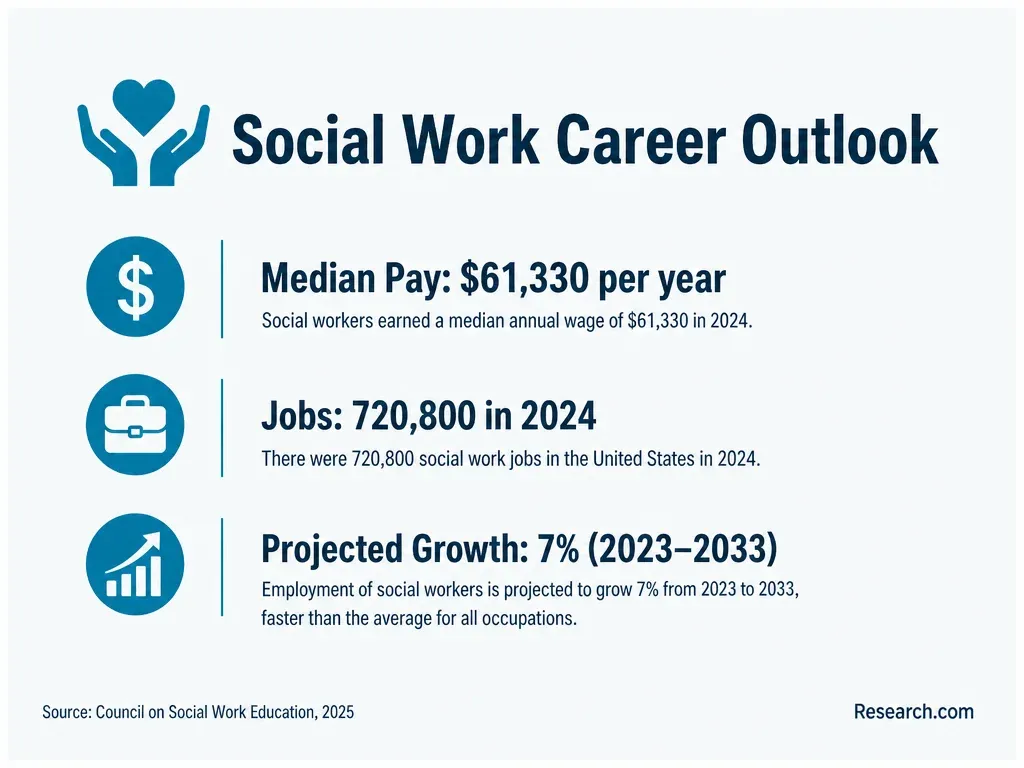
- The U.S. Bureau of Labor Statistics reports a May 2025 median annual wage of $67,880 for healthcare social workers and projects 8% employment growth from 2025 to 2035; neither figure represents every rehabilitation job.
What does a rehabilitation social worker do?
A rehabilitation social worker addresses barriers that can make recovery, adaptation, or community living harder. Depending on the setting, that may mean assessing a person's support system, housing, insurance, transportation, caregiving needs, emotional adjustment, and access to services. The worker develops a plan with the client, coordinates with clinicians and family when authorized, documents progress, and revises referrals as circumstances change.
In an inpatient rehabilitation unit, a typical workday might include discharge planning, a meeting with an interdisciplinary team, and helping a client understand available community supports. In a substance use treatment program, it may involve care coordination, family engagement, and planning for follow-up services.
The title alone does not establish authority to diagnose or provide psychotherapy: those activities depend on state law, license status, supervision, and employer policy. Students considering treatment-focused roles should distinguish graduate field learning from the post-degree experience involved in understanding required experience in clinical social work.
What degree do you need to become a rehabilitation social worker?
There is no single degree attached to every job called "rehabilitation social worker." Read the duties and minimum qualifications in local postings: employers may seek a BSW for generalist case management, an MSW for more complex hospital work, or a clinical license for psychotherapy. Some service-coordination jobs accept an adjacent human services degree, but that does not make the holder a licensed social worker.
The routes differ most in the work they prepare you to do. A BSW offers generalist social work preparation and can be a starting point for supervised, nonclinical roles; compare program recognition when choosing an accredited BSW program.
An MSW adds graduate-level practice and field education and is commonly preferred for medical social work and necessary for many clinical-license pathways. Applicants with a qualifying BSW may seek advanced standing; applicants with other bachelor's degrees can apply to traditional or foundation MSW tracks. A DSW or PhD is generally unnecessary for frontline rehabilitation service.
What licenses or certifications do rehabilitation social workers need?
Requirements depend on the state and the job, not on the word rehabilitation. A state may regulate the social worker title, require a particular license for a hospital position, or reserve independent diagnosis and psychotherapy for clinical licensees. Employers can also set qualifications beyond the legal minimum. A degree, passing an exam, and receiving a license are separate steps; clinical licensure can additionally require qualifying post-degree supervised experience.
Before accepting a position or enrolling, compare its duties with the licensing board's current rules for the state where you intend to work. Ask which license category the employer requires and whether supervision will be available if you need it. Prospective online students should also check MSW licensure alignment before enrollment. Specialty training or a voluntary certification may strengthen an application, but it does not replace a required state license or expand legal scope of practice.
Settings include rehabilitation hospitals, general hospitals, outpatient programs, substance use treatment agencies, disability services, community health organizations, and agencies supporting older adults. Clients may be adapting to a spinal cord injury, stroke, chronic condition, acquired disability, or substance use disorder. Their needs vary: one person may need accessible housing and caregiver support; another may need coordinated follow-up care and help reconnecting with community services.
Setting changes the job substantially. Hospital work may revolve around short discharge timelines and interdisciplinary rounds, while community-based work may involve longer relationships, benefits navigation, and travel. When exploring MSW education and career pathway connections, compare actual job descriptions rather than assuming that all rehabilitation positions offer the same client contact, clinical responsibilities, or advancement opportunities.
How long does a social work degree take, and what does it cost?
A full-time BSW commonly takes about four academic years from first undergraduate enrollment. A traditional full-time MSW commonly takes about two years; eligible advanced-standing students may finish a shorter sequence. Part-time enrollment, prerequisites, course sequencing, and placement availability can extend those timelines. A prior degree may reduce undergraduate requirements without qualifying you for advanced standing.
Schools price programs differently, so compare total required credits and fees rather than a single per-credit figure. Include books, screening, travel or parking for placements, possible campus visits, and earnings lost if field hours conflict with paid work. Use online MSW tuition comparisons as a starting point, then request a school-specific cost estimate for your entry route. The least expensive degree is not necessarily the best value if its placement arrangements or state licensure alignment do not support your target job.
Other Things You Should Know About Social Work
No. Their work can overlap around employment goals, but vocational rehabilitation counselors specialize in helping people prepare for, obtain, or retain work. Compare job duties and required credentials rather than treating the titles as interchangeable.
No. Physical therapists provide physical therapy. Social workers may coordinate with them and help address barriers to following a discharge or community-support plan.
Generally, social workers can help clients understand applications, gather information, or find advocacy resources, but the responsible benefits agency decides eligibility.
Some coordination and client meetings may be remote, depending on employer policy, client needs, privacy safeguards, and applicable practice rules. Jobs involving inpatient teams or discharge planning often require substantial on-site work.
- NASW Standards for Social Work Case Management | nycourts.gov https://www.nycourts.gov/reporter/webdocs/nasw_standards_socialwork_casemgt.htm
- Pages - Frequently Asked Questions https://www.njconsumeraffairs.gov/sw/Pages/FAQ.aspx
- Social work practice and outcomes in rehabilitation: a scoping review - PMC https://pmc.ncbi.nlm.nih.gov/articles/PMC11609207/
- Levels and Eligibility Requirements | North Carolina Social Work Certification and Licensure Board https://www.ncswboard.gov/levels-and-eligibility-requirements/
- What Degree Do You Need To Be a Social Worker? | The University of Olivet https://www.uolivet.edu/what-degree-do-you-need-to-be-a-social-worker/
- Pathway Social Work Licensure in CA | USC Suzanne Dworak-Peck School of Social Work https://dworakpeck.usc.edu/pathway-to-social-work-licensure
- How to Become a Social Worker: Qualifications & Requirements | UC News https://www.online.uc.edu/blog/becoming-social-worker.html
- Social Work Salaries: Career Paths & Earning Potential | Virginia Commonwealth University https://onlinesocialwork.vcu.edu/blog/social-work-careers-salary-earning-potential/
- How to Become a Social Worker - MSW | Syracuse University Online Master's Programs https://onlinegrad.syracuse.edu/social-work/msw/become-a-social-worker/
- What Do Social Workers Do? Roles, Responsibilities and Impact | CU Online https://online.campbellsville.edu/social-work/roles-responsibilities-career-guide/