2027 Ecological Systems Theory in Social Work: Micro, Meso, and Macro Contexts
Audited and Verified:
Our Editorial and Data Verification Process
Research.com uses government datasets, official education statistics and primary institutional information to support its career and degree guides. Our review process checks factual accuracy, occupational definitions, source dates and the requirements associated with the credentials discussed.
How This Article Was Fact-Checked
Our editorial team verifies salary estimates, employment projections, education requirements and program information against original data providers and official organizations. Salary figures are checked against the relevant occupational definitions and reporting periods. Information about licensure, accreditation and required in-person training is reviewed separately.
Fact-checked and verified on:

Co-Founder and Chief Data Scientist
A social worker can understand a person's immediate needs and still miss the school rules, housing conditions, family relationships, or policies shaping those needs. Ecological systems theory offers a way to examine those connections without treating people or environments as the sole cause of a problem.
For social work students and early-career practitioners, the distinction matters in assessment, fieldwork, and career planning. This guide explains the theory, separates its system levels from practice levels, and shows how to use it to choose appropriate learning opportunities and roles.
Key Things You Should Know
- Ecological systems theory examines interactions among people and their environments; its microsystem, mesosystem, exosystem, macrosystem, and chronosystem are not the same categories as micro, mezzo, and macro social work practice.
- In a hypothetical school case, a useful assessment might connect family and peer relationships, communication between home and school, a caregiver's work schedule, school policy, and changes over time, not assume that one factor explains the student's situation.
- Choose coursework and field tasks that require you to assess and respond at more than one level. A degree or placement develops competence but does not itself confer a state license or independent clinical authority.
What is ecological systems theory in social work?
Ecological systems theory explains development and experience through ongoing interactions between a person and surrounding environments. Associated with developmental psychologist Urie Bronfenbrenner, the model describes nested systems rather than treating behavior as an isolated individual trait.
Social workers use it alongside the broader person-in-environment perspective to ask how relationships, institutions, resources, and social conditions affect a person's choices and opportunities.
The systems name different kinds of influence. A microsystem includes settings a person participates in directly, such as home or school. The mesosystem concerns connections between those settings, such as communication between a caregiver and a teacher.
An exosystem can affect the person without their direct participation - for example, a caregiver's employer changing work hours. The macrosystem includes wider cultural, economic, and policy conditions. The chronosystem adds time: a move, a policy change, or the cumulative effects of repeated disruptions.
This is a framework for asking better assessment questions, not a diagnosis or a treatment with proven results in every setting. It can inform clinical, school, community, and policy work, but the appropriate response depends on evidence, client priorities, professional scope, and available services.
Students considering planning professional progression with an MSW can use the framework to identify whether they want to work chiefly with individuals, organizations, or broader service systems.
How do ecological systems differ from micro, mezzo, and macro practice?
Ecological systems describe contexts of influence; practice levels describe where a social worker directs their work. The similar-sounding terms mesosystem and mezzo practice are especially easy to confuse. This comparison shows why there is no one-to-one conversion between the two sets of labels:
| Concept | What it identifies | Example |
| Ecological microsystem | A setting with direct participation | A student's classroom |
| Ecological mesosystem | A connection between direct settings | Communication between home and school |
| Ecological exosystem | An indirect setting that affects daily life | A caregiver's workplace schedule |
| Ecological macrosystem and chronosystem | Broader conditions and the effects of time | Housing policy and repeated moves |
| Micro, mezzo, and macro practice | Intervention with individuals or families; groups or organizations; and communities, systems, or policy | Individual support, a school-team initiative, and district-level advocacy |
A social worker doing micro practice may consider all five ecological systems while meeting with one client. Conversely, a macro practitioner studying housing policy still needs to understand its effects in households. The framework directs attention; it does not dictate the intervention level.
Nor does "micro" automatically mean psychotherapy: clinical activities and any qualifying post-degree supervision depend on state rules. Readers pursuing that route should separately check social work clinical hours and approval questions.
What are examples of ecological systems theory in social work practice?
Consider a hypothetical student whose attendance has become irregular. An ecological assessment would not label the student unmotivated based on attendance alone.
With appropriate consent and within the worker's role, it might explore the student's health and relationships; how the family and school communicate; whether a caregiver's changing shifts affect transportation; how attendance rules operate; and whether a recent move changed the family's access to services. None of those possibilities is an established fact about a real client.
The next step is to turn a broad systems picture into a focused, collaborative response. In this example, a worker could:
- Ask the student and caregiver which barriers they identify and what support they want.
- Check available school and community resources rather than assume a referral can be accessed.
- Agree on a role-appropriate action, such as coordinating a meeting or helping clarify a transportation option.
- Review whether the action improved access, and revise the plan if the barrier remains.
The same reasoning applies in healthcare: a discharge plan may depend not only on a patient's preferences but also on family support, a clinic's referral process, insurance rules, and travel distance.
Ecological reasoning does not override confidentiality, informed consent, school or agency procedures, or a client's self-determination. If the work moves into activities reserved for licensed professionals, verify the applicable requirements using the state board and a social work master's licensure requirement guide.
Ecological systems theory is useful across roles, but knowing it does not establish eligibility for any job or licensed activity. A BSW provides generalist preparation and can fit some entry-level social work positions.
A traditional or foundation MSW admits eligible applicants from other academic disciplines, while advanced-standing MSW study generally requires a qualifying BSW and satisfaction of the program's additional criteria. Neither route alone grants a license.
For a school-based, hospital, or community role, compare the actual job description with the state's rules: employers may require a particular degree, license, school qualification, experience, or agency training.
Independent clinical practice typically requires a qualifying degree, board-approved post-degree supervised experience, and other state-specific steps before a license is issued. An MSW field placement cannot simply be counted as that post-degree experience.
DSW and PhD study may suit particular advanced practice, leadership, teaching, or research goals, but neither is necessary simply to apply ecological theory.
If a target role is open to people with human services, public health, education, or policy backgrounds, targeted training and relevant experience may be more direct than another degree. Compare the role's credential rules with the time commitment shown in MSW completion time and program format comparisons before choosing a route.
BSW applicants generally need to meet university requirements and, where admission to the major is separate, the social work program's requirements. Those may include specified courses, grades, an application, or a statement of interest.
Traditional MSW programs may admit graduates of other disciplines, subject to each program's academic and application criteria. A psychology, sociology, or human services degree does not automatically qualify someone for advanced standing; programs review the prior social work degree and their own eligibility rules.
If you are new to the field, use an application essay or interview to explain what your experience taught you, and what you still need to learn about ethics, policy, assessment, and supervised practice.
Before applying, ask whether any prerequisite must be completed before entry and whether separate conditions apply to field placement onboarding. Admission, placement approval, and eventual license eligibility are different decisions.
Funding can affect which offer is feasible, but an assistantship is not an admission benefit to assume. Ask whether awards are available to your track, what work or enrollment they require, and whether support continues during field education. Comparing stipends and tuition support in MSW assistantships can help frame those questions.
What are social worker salaries and job outlook?
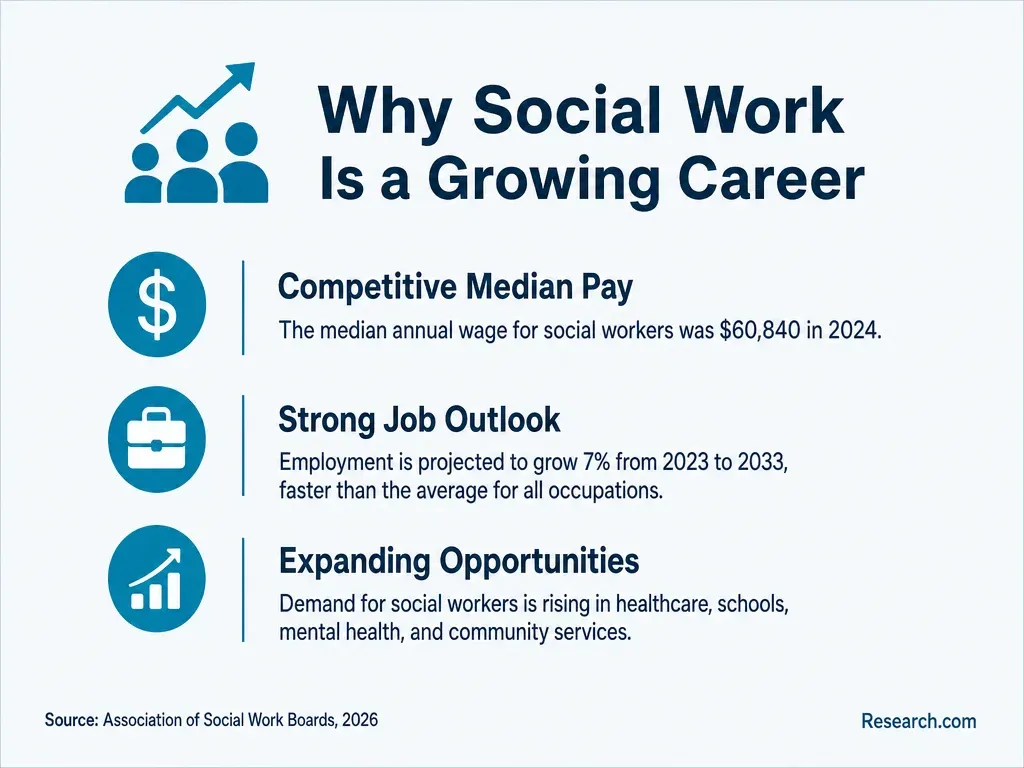
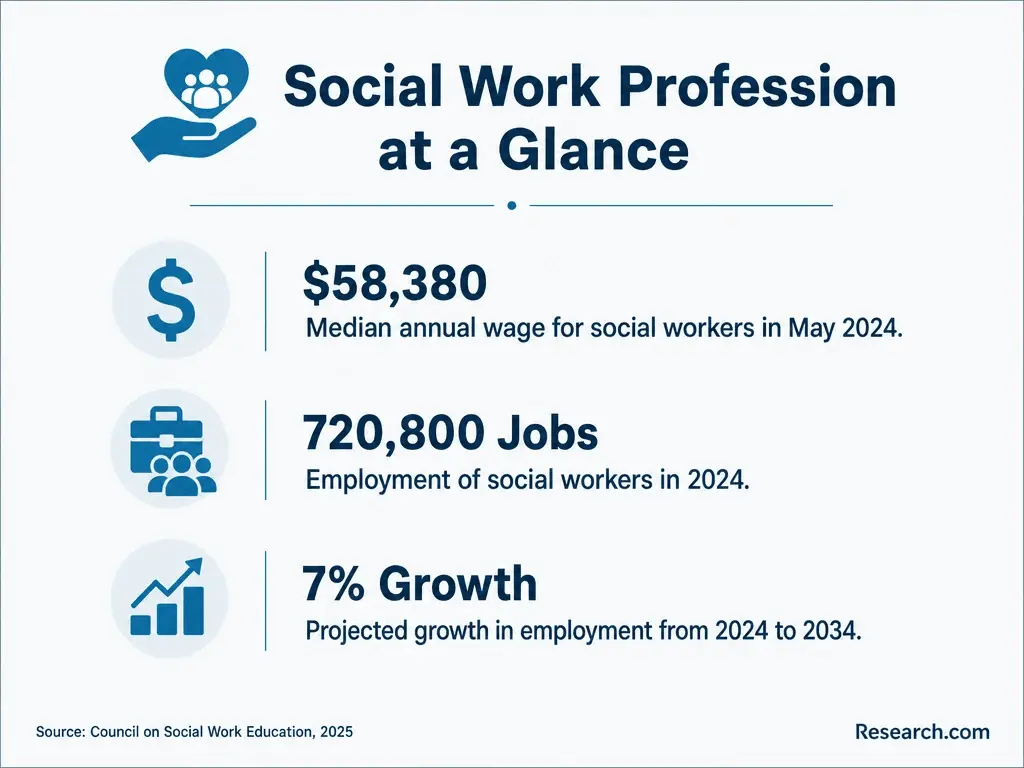
U.S. Bureau of Labor Statistics figures provide occupational context, not a return-on-investment estimate for studying ecological theory. The following May 2025 median annual wages and 2025-2035 employment projections distinguish several social work occupations that may use the framework:
| BLS occupation | May 2025 median annual wage | Projected employment growth, 2025-2035 |
| Social workers, all specialties | $61,780 | 6% |
| Child, family, and school social workers | $59,550 | 4% |
| Healthcare social workers | $67,880 | 8% |
| Mental health and substance abuse social workers | $60,280 | 10% |
These are occupation-wide medians, not starting salaries or wages guaranteed by a BSW, MSW, license, or concentration. Pay and openings vary by location, setting, experience, and job duties; some adjacent case-management or policy jobs fall outside these BLS social worker categories.
Use local postings for your target role alongside social worker earnings and location considerations when weighing education costs against realistic opportunities.
Other Things You Should Know About Social Work
No. The theory is a way to understand relationships between people and environments. An eco-map is a visual tool that can help a worker and client represent selected relationships and resources; the drawing is not the theory itself.
An eco-map emphasizes connections between a person or family and outside systems, such as schools or services. A genogram focuses on family relationships across generations. Either tool requires appropriate consent, privacy protections, and careful interpretation.
No. It helps identify possible influences and questions to investigate. A plausible connection is not proof of causation, and a worker should check interpretations with the client and other appropriate sources.
Its breadth can produce an assessment with many identified barriers but no workable priority. Collaborative goal setting helps narrow the focus, while cultural humility helps prevent the worker from imposing assumptions about which relationships or systems matter most.
- The Social Ecology of Childhood and Early Life Adversity - PMC https://pmc.ncbi.nlm.nih.gov/articles/PMC7897233/
- Social Work Theories | LibGuides at California State University Fresno https://guides.library.fresnostate.edu/c.php
- Implementing Effective Interventions - Community Tool Box https://ctb.ku.edu/en/best-change-processes/implementing-effective-interventions/overview
- Understanding Evidence-Based Social Work | Virginia Commonwealth University https://onlinesocialwork.vcu.edu/blog/evidence-based-social-work/
- Understanding Micro, Mezzo and Macro Social Work Practice | socialworkers.org https://joblink.socialworkers.org/career-resources/navigate-social-work-9/understanding-micro-mezzo-and-macro-social-work-practice-30
- Standards and Indicators for Cultural Competence in Social Work Practice | socialworkers.org https://www.socialworkers.org/Practice/NASW-Practice-Standards-Guidelines/Standards-and-Indicators-for-Cultural-Competence-in-Social-Work-Practice