2027 Diffusion of Innovations in Social Work: How Social Service Programs Spread
Audited and Verified:
Our Editorial and Data Verification Process
Research.com uses government datasets, official education statistics and primary institutional information to support its career and degree guides. Our review process checks factual accuracy, occupational definitions, source dates and the requirements associated with the credentials discussed.
How This Article Was Fact-Checked
Our editorial team verifies salary estimates, employment projections, education requirements and program information against original data providers and official organizations. Salary figures are checked against the relevant occupational definitions and reporting periods. Information about licensure, accreditation and required in-person training is reviewed separately.
Fact-checked and verified on:

Co-Founder and Chief Data Scientist
A promising social service program can succeed at one agency and stall at the next. Diffusion of innovations helps explain why adoption depends not only on evidence but also on trusted relationships, local needs, staffing, funding, and the experience of people receiving services.
This guide is for social work students and community, nonprofit, and public-sector professionals deciding whether and how to introduce a program elsewhere. You'll learn how adoption unfolds, what to measure before expanding, and when additional social work education—or targeted implementation experience—would help.
Key Things You Should Know
- Diffusion is the spread of a new practice through a social network; adoption is a local decision, not proof that the practice works or is equitable.
- Rogers's model describes five adoption stages: knowledge, persuasion, decision, implementation, and confirmation. Organizations may revisit stages or stop using a program.
- Before scaling, compare reach, service quality, client outcomes, costs, and differences between groups—not just the number of agencies that sign up.
What is diffusion of innovations in social work?
Diffusion of innovations describes how an idea or practice spreads over time through communication among people and organizations. In social work, the innovation might be a housing referral process, a family-support model, a screening workflow, or an outreach program. It need not be new to the world; it may simply be new to the agency considering it.
Everett Rogers's framework draws attention to four elements: the innovation, communication channels, time, and the social system in which decisions occur. A county agency, for example, may learn about a neighboring county's referral process through peer meetings, examine whether it fits local eligibility rules, pilot it, and later decide whether to retain it.
Diffusion is not the same as effectiveness. A program can spread because it is easy to explain or fund, while a less visible program may serve clients better. For someone beginning social work study, starting a social work bachelor's degree without an associate degree is one possible route to learning the generalist practice and research skills needed to question such assumptions; a degree is not required merely to help an agency share a workflow.
What are the stages of innovation adoption?
Rogers's five stages describe how a potential adopter moves from awareness to continued use. For a social service agency, the adopter may be a team or organization rather than one worker.
- Knowledge: Staff learn what the program is and which need it aims to address.
- Persuasion: Staff, leaders, and community partners form views about its likely benefits and drawbacks.
- Decision: The organization chooses to try, reject, or postpone it.
- Implementation: Staff put it into practice, often adapting procedures to local conditions.
- Confirmation: Decision-makers assess experience and continue, revise, or discontinue use.
These are a thinking tool, not a mandatory schedule. Staff may learn of new evidence after launch and reconsider an earlier decision. Rogers also described adopter categories, from innovators through late adopters, but labels should not be used to dismiss cautious workers or communities: their concerns may identify real safety, access, or workload problems.
Program adoption takes time even when professional education moves quickly. Someone exploring shorter online MSW degree options should distinguish the pace of a degree from the separate time an agency needs to test, revise, and sustain a service.
How do social service programs spread between communities and organizations?
Programs commonly travel through professional networks, agency partnerships, funders, public contracts, training providers, and referrals from organizations that have tried them. A respected peer agency may make an idea credible; a funder may make a pilot feasible. Neither replaces a local assessment of whether the new setting has the right population, resources, and authority to deliver it.
Consider a hypothetical benefits-navigation program shared by two counties. The receiving county might retain its core goal—helping eligible residents complete applications—but change appointment hours, languages, transportation arrangements, and referral partners. Those changes could improve access, yet they also make it important to record what was changed and whether the program still delivers its intended service.
To judge whether a program is ready to travel, ask the originating organization for its service description, staffing and training needs, costs, outcome measures, and known failures. Then ask prospective sites and service users which features are essential and which need local adaptation. Recruiting qualified staff is part of this planning; comparing less restrictive social work master's admission options may help a prospective student assess entry routes, but easier admission by itself cannot solve an agency's training, supervision, or retention needs.
Count more than participating agencies. An evaluation should distinguish reach (who can access the service), implementation (what was actually delivered), and outcomes (what changed for clients or communities). It should also track resources used and whether the program can continue without extraordinary support. A rise in referrals, for example, is not by itself evidence that more people received timely help.
Start with a feasible question and measures the agency can collect responsibly. Compare results across relevant groups or locations where sample size and privacy protections permit, and seek service-user input on barriers the records may miss. Document adaptations, missing data, and plausible alternative explanations; a before-and-after comparison alone rarely establishes that the program caused a change. Follow agency data rules and obtain an appropriate determination about evaluation or research oversight before collecting or sharing restricted information.
Equity also affects whether staff can sustain a service. Pay and travel costs may differ across regions, so a rollout budget should reflect the local hiring market rather than a national wage alone. For that narrower comparison, understanding location differences in MSW earnings can inform questions for employers; it cannot establish what a particular agency must pay or what its clients will experience.
What careers involve spreading social service programs, and what are their salary and outlook?
Implementation work appears in community outreach, program coordination, agency management, policy, training, and evaluation. A coordinator may recruit partner sites and monitor referrals; an evaluator may examine reach and outcomes; a social worker may help adapt a service while delivering or supervising care within their authorized role. Job titles alone do not establish degree or license requirements.
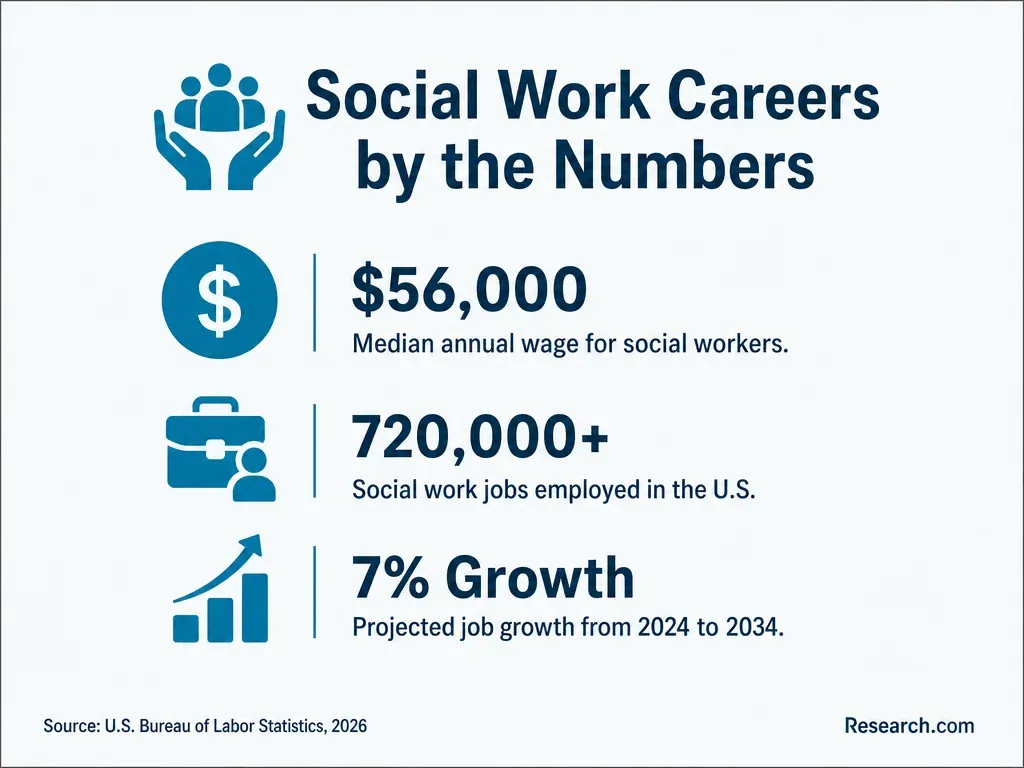
The U.S. Bureau of Labor Statistics reports the following national figures for social work occupations. They provide context for social-worker positions, not a salary estimate for every program coordinator, evaluator, manager, or MSW graduate.
| BLS occupation | May 2025 median annual pay | Projected employment growth, 2025-2035 |
| Social workers, all specialties | $61,780 | 6% |
| Child, family, and school social workers | $59,550 | 4% |
| Healthcare social workers | $67,880 | 8% |
| Mental health and substance abuse social workers | $60,280 | 10% |
For a program-spreading career, build evidence of the work employers need: partnership development, accessible outreach, training, budget awareness, ethical data use, and honest reporting of results. Look at local postings to see whether they require a BSW, MSW, license, evaluation skills, or simply relevant agency experience. MSW career options for prospective graduate students can help you compare roles, but an additional degree makes the most sense when it closes a documented qualification or skills gap.
Other Things You Should Know About Social Work
No. It can be an established practice that is new to a particular team, agency, or community.
Often, but first identify its essential features, any contractual or training conditions, and the reason for each proposed change. Record adaptations so results can be interpreted accurately.
Not necessarily. It may indicate a poor local fit, insufficient resources, weak delivery, or an ineffective program. Examine those possibilities before drawing a conclusion.
The responsible agency or governing body makes the formal decision, informed by service users, frontline staff, community partners, outcome evidence, costs, and applicable obligations.
- Outcomes for Implementation Research: Conceptual... - PMC https://pmc.ncbi.nlm.nih.gov/articles/PMC3068522/
- CDC Program Evaluation Framework, 2024 | MMWR https://www.cdc.gov/mmwr/volumes/73/rr/rr7306a1.htm
- What is an evidence-informed approach to practice and why | aifs.gov.au https://aifs.gov.au/resources/short-articles/what-evidence-informed-approach-practice-and-why-it-important
- CHIPS Articles: The Diffusion of Innovation - DON CIO https://www.doncio.navy.mil/chips/ArticleDetails.aspx
- Adapting interventions to new contexts - the ADAPT guidance | The BMJ https://www.bmj.com/content/374/bmj.n1679
- What Is Social Work Program Design and Evaluation? | Tulane University https://online.tulane.edu/social-work/blog/what-is-social-work-program-design-and-evaluation