
2027 Confounding Variables in Social Work Research: Why Associations Can Mislead
Audited and Verified:
Our Editorial and Data Verification Process
Research.com uses government datasets, official education statistics and primary institutional information to support its career and degree guides. Our review process checks factual accuracy, occupational definitions, source dates and the requirements associated with the credentials discussed.
How This Article Was Fact-Checked
Our editorial team verifies salary estimates, employment projections, education requirements and program information against original data providers and official organizations. Salary figures are checked against the relevant occupational definitions and reporting periods. Information about licensure, accreditation and required in-person training is reviewed separately.
Fact-checked and verified on:

Co-Founder and Chief Data Scientist
A program evaluation may find that clients receiving intensive services have worse outcomes than those receiving fewer services. That finding does not necessarily mean the program caused harm: clients with greater needs may have been more likely to receive it. For social work students, practitioners, and agency evaluators, recognizing this problem is essential before changing services or claiming an intervention works. This guide explains how confounding variables mislead, what researchers can do about them, and how to judge whether a study offers evidence strong enough to inform practice.
Key Things You Should Know
- A potential confounder precedes the intervention or exposure, is related to who receives it, and independently affects the outcome; an association alone does not establish cause.
- Service eligibility, baseline need, and referral pathways often create confounding in social work studies, so comparisons should start with how clients entered each group.
- Matching, statistical adjustment, and stronger study designs can reduce measured confounding, but none can guarantee that an observational finding is causal.
What is a confounding variable in social work research?
A confounding variable is a factor that offers an alternative explanation for an observed relationship between an exposure and an outcome. In a study of whether housing assistance reduces emergency department visits, the exposure is receiving assistance and the outcome is subsequent visits. Baseline health may be a confounder if it affects both eligibility for assistance and later emergency care.
The timing and causal relationships matter. A plausible confounder generally exists before the exposure, helps determine who is exposed, and influences the outcome through a route other than that exposure. It need not be the sole cause of either. Researchers should describe the specific relationship they are trying to estimate before deciding what to measure or adjust for.
BSW students often first encounter this distinction in research-literacy coursework. When comparing accredited online BSW programs, a student interested in evaluation can look for opportunities to apply it to agency data, not just memorize its definition.
How can confounding variables make associations misleading?
Confounding can make a helpful service appear ineffective or harmful when the people receiving it started at higher risk. It can also make an ineffective service appear successful if participants had more stable housing, stronger support networks, or easier access to transportation before enrollment.
Consider a hypothetical comparison of two agencies offering different lengths of case management. If clients at the agency with longer services also face more severe housing instability, a lower overall rate of stable housing there cannot be attributed to service length alone. Even comparing outcomes within broad categories such as "high need" and "low need" may leave important differences within each category.
This is especially relevant when evaluating faster graduate social work study routes: a comparison of graduates' outcomes could reflect differences in applicants' prior experience or preparation, not just program pace. In either setting, the first question is how people came to be in each group.
What are examples of confounding variables in social work studies?
The same variable is not a confounder in every study. Its role depends on the question, the setting, and when it was measured. These examples show why an evaluator needs to understand agency procedures as well as the dataset.
| Study question | Potential confounder | Why it matters |
| Is intensive case management associated with housing stability? | Housing instability at intake | Clients with greater need may receive more intensive help and have a harder path to stable housing. |
| Are school-based referrals associated with attendance? | Attendance before referral | Students already missing more school may be more likely to be referred and to continue missing school. |
| Is participation in a parenting program associated with fewer child welfare reports? | Prior agency involvement | Prior involvement can influence both program assignment and the likelihood that concerns are observed or reported. |
| Are outcomes different across field-placement models? | Student and site selection | Student preferences, site capacity, and available supervision may shape both placement assignment and learning opportunities. |
That last example matters when examining online MSW field coordination models. A reported difference in student outcomes may reflect which agencies accepted students, not solely the school's coordination approach. None of these examples establishes that confounding actually occurred; each identifies an explanation the study should investigate.
Researchers begin before running a regression. They specify the exposure, outcome, target population, and time order, then ask practitioners, clients, and agency staff how eligibility, referrals, and service uptake work. Prior research and a simple causal diagram can help distinguish common causes from variables that occur after services begin.
A useful planning sequence is:
- Define the comparison - for example, the effect of being offered a service versus not being offered it - and the outcome period.
- Map who becomes eligible, who is referred, who accepts, and what predicts the outcome before the offer.
- Choose feasible baseline measures for those common causes and check whether they are recorded consistently for both groups.
- Document important factors that cannot be measured, such as undocumented referral judgments, before interpreting results.
Selection can occur before a study starts. For example, people who meet admission criteria across online MSW programs may differ in ways that also predict graduation; graduation comparisons alone cannot isolate the effect of program format. In agency research, an equally careful review of eligibility rules and missing records helps prevent an impressive-looking but misleading comparison.
A confounder is a common cause that can distort the exposure-outcome comparison. A mediator lies along a pathway through which the exposure may affect the outcome. A moderator identifies when or for whom the effect may differ. These labels describe a variable's role in a particular research question, not a permanent property of that variable.
Suppose an agency studies whether transportation assistance increases appointment attendance. Preexisting access to a car could confound the comparison if it influences both who receives assistance and attendance.
More reliable transportation after receiving assistance could be a mediator. Rural versus urban location could be a moderator if the assistance has different effects across those settings; it might also need consideration as a confounder if location influences who receives assistance.
Adjusting for a mediator can remove part of the effect a study intends to estimate. The distinction also matters when comparing MSW pathway differences by prior degree: qualifying prior education affects pathway eligibility and may predict later performance, while experiences gained during the MSW occur after entry. Researchers must state which effect they mean before treating those variables as interchangeable controls.
No technique repairs a comparison without considering how groups were formed. A randomized assignment, when ethical and feasible, reduces systematic baseline differences on average, though chance imbalances, nonparticipation, and loss to follow-up remain possible. Most agency evaluations instead use observational data and must address selection directly.
The main approaches address different parts of that problem:
- Restriction and stratification: Compare more similar clients or examine results within baseline-risk groups; narrow groups can reduce generalizability or leave too few observations.
- Regression adjustment: Account for measured baseline factors in a model; results depend on what was measured and whether the model represents the relationships adequately.
- Matching or propensity-score methods: Compare clients with similar measured characteristics; clients without comparable counterparts may be excluded, and unmeasured differences remain.
- Difference-in-differences or other quasi-experimental designs: Use a comparison group and timing to strengthen inference; their assumptions, such as comparable trends without the program, need scrutiny.
Researchers should also report who was excluded, how missing data were handled, whether groups had meaningful overlap, and how sensitive conclusions are to plausible unmeasured confounding.
A study comparing social work master's pacing and workload comparisons, for instance, should consider students' employment and caregiving commitments before attributing completion differences to pacing alone. Sophisticated adjustment does not substitute for that contextual knowledge.
Delivery format alone does not determine research quality. For a BSW or MSW, verify the specific program's CSWE accreditation status and the requirements applicable to your cohort; institutional accreditation answers a different question. Then compare what students actually do: study design, statistics, qualitative methods, ethical data handling, and supervised evaluation projects.
Online and campus options can offer different practical access to research training. Live methods labs, faculty meetings, agency partnerships, software support, and project supervision may be available in either format, but schedules and access rules differ. Online students should also verify field-placement responsibilities and any on-site or synchronous requirements; being online does not remove field education.
When reviewing online social work degree programs, request course descriptions, examples of permissible capstone datasets, faculty research interests, and the process for obtaining agency and institutional approvals. Do not assume enrollment grants access to client records or that an agency evaluation is exempt from oversight.
What are the salary and job outlook for social work research careers?
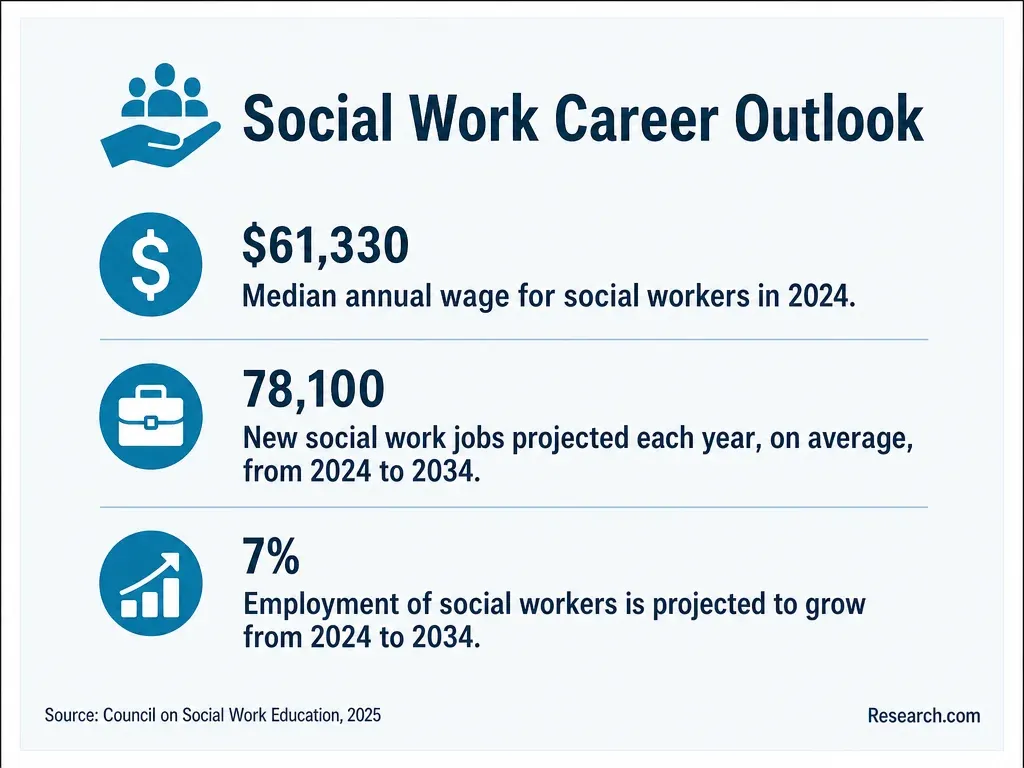
The U.S. Bureau of Labor Statistics reports a May 2025 median annual wage of $61,780 for social workers across specialties and projects 6% employment growth from 2025 to 2035. Those figures describe the broad social worker occupation - not program evaluators, research analysts, MSW graduates, or licensed clinicians specifically. They cannot establish the salary return from learning causal inference.
Research-oriented jobs span different occupational classifications and pay structures. To assess an opportunity, compare posted pay ranges for the exact job title and location, required methods skills, degree requirements, and whether the role includes direct service. State-level salary context for MSW careers can inform a geographic comparison, but occupation-wide figures should not replace an employer's stated range or a public agency's pay scale.
Other Things You Should Know About Social Work
Yes. It can describe service use, reveal measurement problems, or generate questions for a stronger study. Report uncertainty and avoid presenting an association as a proven effect.
No. Assess how much is missing, why it is missing, and whether missingness differs between groups. Those patterns determine which conclusions remain credible.
Not without appropriate agency permission, data safeguards, and any required institutional review. Use approved, de-identified or synthetic data when access to client records is not authorized.
No. The project's purpose, design, data use, and plans to share findings may affect oversight requirements. Ask the agency and relevant institutional review office before collecting or reusing protected data.
- Analyzing and Interpreting Data | Field Epi Manual https://www.cdc.gov/field-epi-manual/php/chapters/analyze-interpret-data.html
- Assessing bias: the importance of considering confounding | nih.gov https://pmc.ncbi.nlm.nih.gov/articles/PMC3503514/
- Chapter 6: Methods to address bias and confounding - ENCePP https://encepp.europa.eu/encepp-toolkit/methodological-guide/chapter-6-methods-address-bias-and-confounding_en
- Avoiding overadjustment bias in social epidemiology through appropriate covariate selection: a primer - ScienceDirect https://www.sciencedirect.com/science/article/abs/pii/S0895435622001433
- Missing Data and Multiple Imputation | Columbia University Mailman School of Public Health https://www.publichealth.columbia.edu/research/population-health-methods/missing-data-and-multiple-imputation
- Confounding | Catalog of Bias https://catalogofbias.org/biases/confounding/
- Confounding in epidemiological studies | Health Knowledge https://www.healthknowledge.org.uk/node/803


