# 1 position
Most Affordable Pharmacy Technician Schools & Training in Orlando for 2027
Audited and Verified:
Our Editorial and Data Verification Process
Research.com uses government datasets, official education statistics and primary institutional information to support its career and degree guides. Our review process checks factual accuracy, occupational definitions, source dates and the requirements associated with the credentials discussed.
How This Article Was Fact-Checked
Our editorial team verifies salary estimates, employment projections, education requirements and program information against original data providers and official organizations. Salary figures are checked against the relevant occupational definitions and reporting periods. Information about licensure, accreditation and required in-person training is reviewed separately.
Fact-checked and verified on:

Co-Founder and Chief Data Scientist

Reviewed by Karolina Broda
Fact-Checker and Data Verification
Choosing a low-cost pharmacy technician program is not just a tuition decision: in Florida, your training must support state registration before you can work as a registered technician. The U.S. Bureau of Labor Statistics reports a $45,750 national median annual wage for pharmacy technicians in May 2025. For students and career changers, this guide explains costs, credentials, hands-on training, and career prospects. It also features a Most Affordable Pharmacy Technician Trade Schools in Orlando for 2027 ranking, created by the Research.com team of data scientists to help you identify programs worth considering.
Key findings about pharmacy technician degrees in Orlando
- Florida generally requires pharmacy technicians to complete a Board-approved training program and register with the Florida Board of Pharmacy; a certificate or national certification alone does not replace state registration.
- The national median wage was $45,750 in May 2025, according to the U.S. Bureau of Labor Statistics. Use it as career context, not an expected starting wage in Orlando.
- The lowest-tuition option may not be the least expensive route: compare fees, required practical training, travel, exam costs, aid, and earnings lost during training before enrolling.
Table of Contents
- Most Affordable Pharmacy Technician Schools & Training in Orlando for 2027
- What can I expect from a pharmacy technician trade school program in Orlando?
- Where can I work with a pharmacy technician trade school training in Orlando?
What can I expect from a pharmacy technician trade school program in Orlando?
Expect instruction in medication names and calculations, prescription processing, inventory, safety, and pharmacy law, followed by opportunities to practice tasks under supervision. Technicians assist pharmacists; they do not make clinical judgments or independently counsel patients, according to the U.S. Bureau of Labor Statistics. A program is valuable when its practical training matches the setting where you want to work, not merely when it awards a certificate.
Orlando applicants can compare public technical training, career-school programs, and Board-approved employer-based training. Orange Technical College and Concorde Career Institute-Orlando are examples of providers to investigate; confirm each current pharmacy technician offering, location, schedule, and approval rather than assuming a school's other health programs meet technician requirements. Ana G. Mendez University is another institution readers may encounter in local searches, but its current offerings and their suitability require the same program-level check.
Ask where students practice prescription entry, dispensing workflow, and safety checks, and whether a supervised pharmacy placement is arranged or left to the student. A paid employer-based route may suit someone who needs income while training, but only if that particular training program meets Florida's approval requirements.
Where can I work with a pharmacy technician trade school training in Orlando?
Registered technicians may work in community pharmacies, hospital and health-system pharmacies, long-term-care services, and other medication-distribution settings. Retail roles often emphasize insurance claims, customer contact, and prescription volume; hospital roles may place greater emphasis on medication distribution, sterile-compounding procedures, and shift coverage. The U.S. Bureau of Labor Statistics identifies pharmacies and drug retailers and hospitals among major national employers, but availability of a particular role varies locally.
If you prefer predictable, task-focused work, compare the actual duties and interruptions in each setting rather than assuming all pharmacy jobs fit a list of careers for introverts. Ask placement staff which Orlando-area employers accept students for practical experience and whether those sites hire entry-level technicians.
The U.S. Bureau of Labor Statistics reports a $45,750 national median annual wage for pharmacy technicians in May 2025. A median divides employed workers into two equal groups; it is neither an Orlando wage estimate nor a likely first-year offer. Shift differentials, employer type, experience, and specialized duties can change pay.
Before using wages to judge a program's return, look up the latest Orlando-Kissimmee-Sanford metropolitan estimate in the BLS Occupational Employment and Wage Statistics series and compare entry-level job postings with similar schedules. Do not compare a metro estimate from one reference year with a national estimate from another as though they measure the same moment.
Length depends on the approved curriculum, weekly schedule, and access to required practical training. Florida's Board-approved pharmacy technician training standards specify a minimum of 160 hours, according to the Florida Board of Pharmacy; a provider may require more. Confirm how its published hours are divided among instruction, labs, and supervised pharmacy experience, and whether placement wait times extend the calendar schedule.
A faster course may reduce time away from work but leave less room for part-time employment or exam preparation. Working adults comparing schedules sometimes encounter best accelerated online degree programs for working adults; pharmacy technician training is a different pathway, and speed does not remove Florida's program-approval or hands-on requirements.
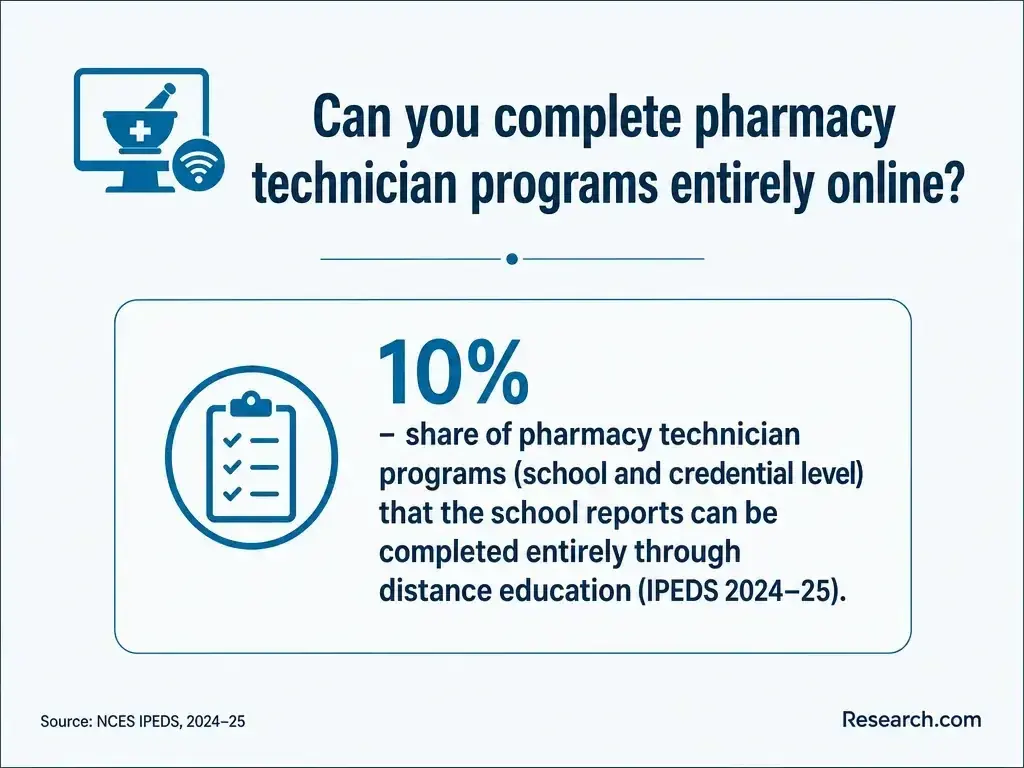
Online instruction can cover terminology, calculations, law, and inventory concepts. Campus labs and supervised pharmacy work provide practice with equipment, prescription workflow, and safety procedures that reading or video alone cannot establish. A hybrid format may reduce commuting for lectures without eliminating travel for labs or placements.
The comparison below focuses on what each format can realistically deliver. It does not establish that any particular program qualifies for Florida registration.
| Format | Potential advantage | Point to verify before paying |
| On-campus | Scheduled access to instructors and practice facilities | Placement availability, commute, and total required attendance |
| Hybrid | Remote theory with scheduled practical sessions | Location and timing of labs and supervised experience |
| Online coursework | Flexible study for theory | Florida Board approval and how required practical competencies are completed |
Online learning resources, including pages about best online degree programs for seniors, may help readers think about study flexibility, but they cannot establish pharmacy technician registration eligibility. Obtain the program's approval details and practical-training plan in writing.
There is no defensible single Orlando average in this guide: providers publish different price components, schedules, and aid eligibility, and employer-sponsored training may have a very different out-of-pocket cost. Treat any quoted tuition as a starting figure, not the price of becoming job-ready.
To make offers comparable, request an itemized estimate that separates these costs and offsets:
- Tuition, mandatory fees, textbooks, software, uniforms, and other required materials.
- Background checks or health requirements, if applicable, plus transportation to labs and pharmacy placements.
- Florida registration and optional certification-exam costs, including any retake costs.
- Grants, scholarships, eligible federal aid, workforce funding, or paid employer training that reduce your net cost.
Federal Student Aid eligibility depends on the school and program, not simply the occupation. CareerSource Central Florida may be able to explain applicable workforce-training assistance. Also count wages you would forgo while attending: a shorter but expensive program can cost more overall than a longer schedule that lets you keep working.
A training provider may award a certificate or diploma documenting completion. Florida registration is the state occupational credential needed for registered pharmacy technician work; national certification, such as the Pharmacy Technician Certification Board's CPhT credential, is a separate examination-based credential. Neither a school certificate nor CPhT certification automatically grants Florida registration, according to the Florida Board of Pharmacy and Pharmacy Technician Certification Board.
Ask the provider for the exact credential name, whether the training is Board-approved, and whether it prepares students for a national certification exam. Academic credentials discussed in resources on short phd programs serve an entirely different goal; they are not part of this occupational entry route.
School admission requirements and Florida registration requirements are separate. A provider may ask for proof of prior schooling, an assessment, identification, or documentation needed for a pharmacy placement. The Florida Board of Pharmacy sets the occupational registration rules, including completion of approved training; a school's acceptance decision does not confirm that an applicant will later qualify for registration.
Before paying a deposit, disclose any issue that could affect a background review or placement and ask how the school handles it. Request its current admission checklist, placement requirements, and written refund policy. For an employer-based option, verify that the specific training - not merely the employer - is Board-approved.
Core training connects medication terminology and dosage calculations to prescription entry, labeling, inventory control, insurance workflows, patient privacy, and error prevention. In practical sessions, students should learn when to stop and refer a question to the supervising pharmacist. These boundaries matter because accuracy and escalation are central to technician work, according to the U.S. Bureau of Labor Statistics.
Compare curricula against your intended workplace. Someone targeting a hospital should ask about preparation for institutional medication systems and sterile-compounding practices; someone targeting community pharmacy should ask about prescription processing, claims, and customer interactions. Do not assume a classroom unit alone demonstrates competence in a specialized task.
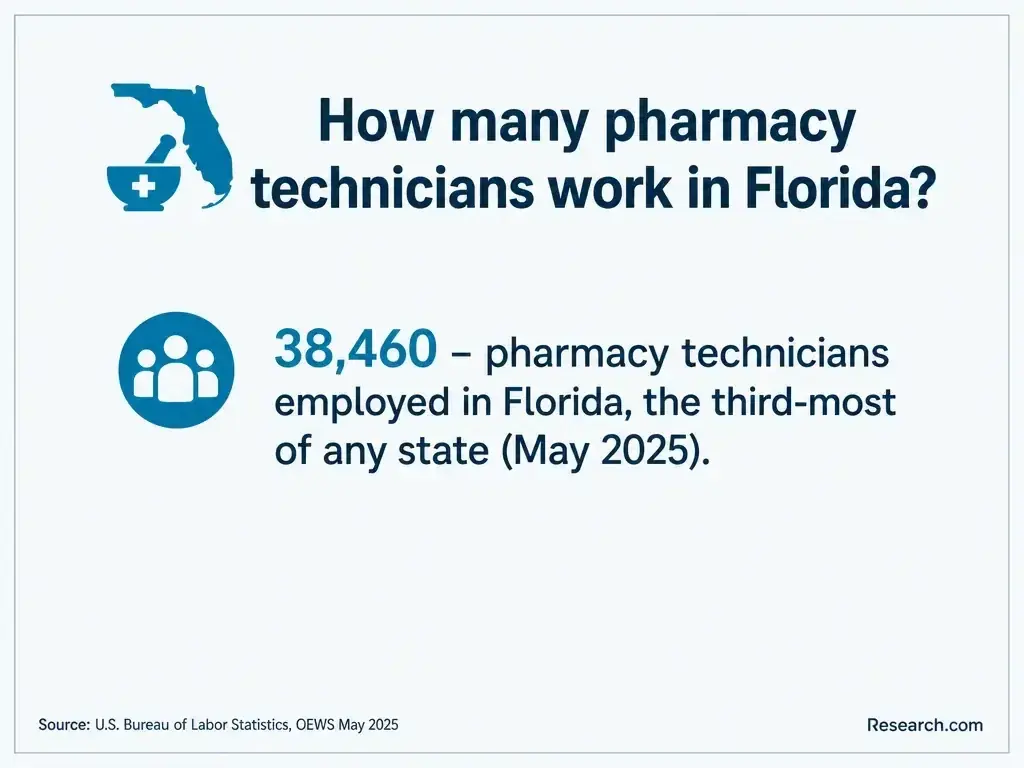
You generally need Florida Board of Pharmacy registration to work as a registered pharmacy technician. Florida ties that registration to completion of an approved training program, subject to the Board's current rules and applicable exceptions. The Board, not a school or national certifier, determines state eligibility. Confirm the current application, fees, and documentation directly with the Board before enrolling.
National certification is distinct from registration. The Pharmacy Technician Certification Board offers a CPhT pathway through recognized education or qualifying work experience followed by its exam, but passing that exam does not replace Florida registration. Ask employers whether they require or prefer certification for the specific role you want, particularly if you hope to move into specialized duties.
Start with eligibility, then compare net cost and training fit. Institutional accreditation concerns a school; Florida Board approval concerns the technician training route; certification concerns a separate credential. None should be treated as a substitute for the others. The affordability ranking can identify options to investigate, but its score does not measure Board approval or practical-training quality.
These checks help prevent the costliest enrollment mistakes:
- Confirm the exact program's current Florida Board approval and ask how its required hours and practical experience are delivered.
- Request a written, all-in price and aid estimate; include travel, registration, and lost work time.
- Ask who secures placements, when students typically start them, and whether evening or part-time attendance changes completion time.
- Compare completion and employment information using the school's definitions, reporting period, and number of students; do not treat a wage median as a graduate earnings promise.
Choose the route that gets you eligible and prepared at a manageable net cost, not the one with the most impressive unrelated credential. Searches such as can you get a phd without a dissertation address a different educational decision and offer no evidence of pharmacy technician training quality.
An entry-level technician may begin with prescription processing or medication distribution under a pharmacist's supervision, then build experience in a community or hospital setting. With additional employer training and, where required, credentials, technicians may pursue specialized work such as sterile compounding, inventory coordination, or lead-technician duties. Those are possible progression routes, not automatic outcomes of a certificate.
Ask prospective employers which duties require added training or certification and whether they pay for it. If your immediate goal is paid work, compare an approved employer-training opening with a school program's net cost and placement access. If your goal is a hospital specialty, give greater weight to relevant supervised practice than to a low tuition figure alone.
The U.S. Bureau of Labor Statistics projects 6.4% national employment growth for pharmacy technicians from 2025 to 2035. This is a national occupation projection, not a forecast of Orlando openings or a guarantee of employment. It supports considering the occupation, but local hiring conditions and preferred credentials still matter.
For a local decision, check current Orlando-area postings by setting and schedule, then ask programs which employers host their students. Increasing use of pharmacy technology makes accuracy with electronic workflows important, while supervised medication-handling skills remain essential, as reflected in the U.S. Bureau of Labor Statistics' description of technician duties. A program is a stronger investment when its practice environment resembles the jobs you intend to pursue.
Most Affordable Pharmacy Technician Schools & Training in Orlando for 2027
Investing in training is an important decision, especially when a low advertised tuition may not reflect the full cost of becoming job-ready. Research.com compares programs with others in the same occupation and location, checks the underlying data for credibility and accuracy, and includes only programs with completions reported to IPEDS. That makes the ranking a useful comparison of its included programs, not an inventory of every Orlando training route.
The most affordable ranking evaluates tuition, cost of attendance, median student debt, and federal loan default rates. Its weights use an entropy-based method, which gives more weight to measures that differ more across programs. Accreditation and other quality indicators do not contribute to this affordability score. Research.com's separate best programs rankings assess student outcomes, earnings and return on investment, costs and debt, and quality and recognition. Their weights assign 20% to occupation-relevant programmatic accreditation or industry recognition, 10% to institutional accreditation, 10% to student support, and the remaining 60% to outcomes, earnings, and costs using the entropy-based method.
The ranking draws on the following data sources. Some recognition and apprenticeship sources cover trades beyond pharmacy technology; their inclusion does not mean a dental or construction credential applies to this occupation.
- IPEDS database: reported completions, institutional characteristics, and education-cost data.
- National Center for Education Statistics: federal education-data definitions and context.
- College Scorecard database: available cost, debt, and student-outcome measures.
- Peterson's database: supplementary institution and program information.
- Commission on Accreditation of Allied Health Education Programs: allied-health program recognition information where relevant.
- Accrediting Bureau of Health Education Schools: health-education accreditation information where relevant.
- Commission on Dental Accreditation: occupation-specific recognition information for applicable rankings, not pharmacy technician approval.
- Dental Assisting National Board: occupation-specific credential information for applicable rankings, not pharmacy technician certification.
- National Center for Construction Education and Research: construction-training recognition information for applicable rankings.
- Apprenticeship.gov Partner Finder: information on work-based training alternatives where applicable.
Use the ranking to narrow your cost comparison, then confirm current prices and Florida Board of Pharmacy training approval directly with each provider. IPEDS and College Scorecard do not cover every employer-sponsored or other noncollege training option. More detail on the ranking approach appears in Research.com's methodology.
# 2 position
Ana G. Mendez University - Pharmacy Technician/Assistant.
associate# 3 position
Ana G. Mendez University - Pharmacy Technician/Assistant.
certificate or diploma# 4 position
Orange Technical College - Pharmacy Technician/Assistant.
certificate or diplomaFrequently asked questions about pharmacy technician programs in Orlando
What is the cheapest way to become a pharmacy technician in Orlando?
Compare Board-approved school programs with approved employer-based training, which may let you earn while learning. Request total out-of-pocket costs and confirm approval before assuming either route is cheaper.
Can I become a pharmacy technician through an entirely online program?
Do not assume so. Online theory may be useful, but verify Florida Board approval and how the program delivers and documents practical training before enrolling.
Is a school certificate the same as Florida registration?
No. A certificate documents training completion; the Florida Board of Pharmacy determines whether you qualify for state registration.
Do I need national certification for an Orlando pharmacy technician job?
National certification and Florida registration are different. Check the Board's registration rules and the requirements of the specific employer; certification may be preferred for some jobs.
How should I compare two programs with similar tuition?
Compare mandatory fees, practical-training access, schedules, financial aid, transportation, and time away from paid work. Verify each program's Florida Board approval first.
- U.S. Bureau of Labor Statistics - Pharmacy Technicians
Used to verify salary, employment outlook, and typical education requirements.
https://www.bls.gov/ooh/healthcare/pharmacy-technicians.htm - NCES College Navigator (IPEDS)
Used to verify programs offered and institutional accreditation.
https://nces.ed.gov/collegenavigator/ - PTCB - Certified Pharmacy Technician (CPhT)
Professional certification reference for graduates of this occupation.
https://www.ptcb.org/credentials/certified-pharmacy-technician - Concorde Career Institute-Orlando - official website
Official school website (programs, tuition, admissions).
https://www.concorde.edu/campus/orlando-florida - Ana G. Mendez University - official website
Official school website (programs, tuition, admissions).
https://www.agmu.edu/ - Orange Technical College - official website
Official school website (programs, tuition, admissions).
https://www.orangetechcollege.net/