# 1 position


Audited and Verified:
Our Editorial and Data Verification Process
Research.com uses government datasets, official education statistics and primary institutional information to support its career and degree guides. Our review process checks factual accuracy, occupational definitions, source dates and the requirements associated with the credentials discussed.
How This Article Was Fact-Checked
Our editorial team verifies salary estimates, employment projections, education requirements and program information against original data providers and official organizations. Salary figures are checked against the relevant occupational definitions and reporting periods. Information about licensure, accreditation and required in-person training is reviewed separately.
Fact-checked and verified on:

Co-Founder and Chief Data Scientist

Reviewed by Karolina Broda
Fact-Checker and Data Verification
Finding an affordable paralegal associate degree in Washington, D.C., means checking more than tuition: the degree must also fit your career goal, schedule, and budget. The U.S. Bureau of Labor Statistics projects essentially flat national employment for paralegals and legal assistants from 2025 to 2035, making program value especially important. This guide explains costs, coursework, and local opportunities. It will feature a Most Affordable Paralegal Associate Degree Programs in District of Columbia for 2027 ranking, created by the Research.com team of data scientists to help students choose programs worth considering.
Expect a mix of general education and legal-support coursework: writing, research, document preparation, ethics, and the procedures used in litigation and office practice. Paralegals assist lawyers; an associate degree does not authorize graduates to practice law or give independent legal advice (U.S. Bureau of Labor Statistics; D.C. Court of Appeals Rules of Professional Conduct).
The degree title is useful only when paired with its course plan. The comparison below shows why a student seeking immediate legal-office work may evaluate a program differently from someone planning to transfer credits later.
| Associate degree pathway | Typical emphasis | Best question to ask |
| Associate of Applied Science (AAS) | Career-focused legal coursework and practical skills | How much legal research, drafting, and supervised practice does the curriculum include? |
| Associate of Arts (AA) or Associate of Science (AS) | A broader general-education foundation, potentially with a paralegal concentration | Which courses will the intended receiving institution accept toward further study? |
At the University of the District of Columbia, check the current catalog for the exact paralegal degree, required courses, and delivery format before applying. D.C.'s legal employers include law firms, government offices, and organizations working with federal regulation; coursework using legal research databases and real-world documents can therefore be particularly valuable. Do not assume that two similarly named degrees offer the same practical experience.
Paralegals work in law offices, corporate legal departments, government, and organizations that handle legal or regulatory matters (U.S. Bureau of Labor Statistics). In D.C., proximity to federal agencies and courts creates reasons to look for employers handling administrative law, contracts, compliance, and litigation. It does not mean every opening is entry-level: some positions require subject-area experience, a background check, or federal hiring eligibility.
When reviewing internship options, ask whether students work on research, filings, document review, or case management under supervision. That answer tells you more about career preparation than an employer logo alone. If you expect to work across the D.C.-Maryland-Virginia area, also check where in-person placements occur and whether the commute is workable.
The national median annual wage for paralegals and legal assistants was $62,890 in May 2025 (U.S. Bureau of Labor Statistics, Occupational Outlook Handbook). This is an occupation-wide midpoint, not a D.C. starting salary or an earnings estimate for associate degree holders. Pay for a particular applicant can depend on experience, employer, legal specialty, and responsibilities.
For a useful return-on-investment estimate, compare actual entry-level offers in the area where you intend to work with what you could earn without enrolling. Then account for your aid, likely borrowing, time to completion, and any wages you would give up while studying. A high occupational median alone cannot establish that a particular degree will pay for itself.
An associate degree is commonly planned around two academic years of full-time study, but the required credits and calendar depend on the institution. Part-time enrollment, course sequencing, and the availability of a required internship can extend completion. Ask for a term-by-term plan showing when each legal course is offered, especially if you will work while enrolled.
Transfer credits or approved prior learning may shorten the schedule, but only after the school evaluates them. An accelerated calendar can also increase the weekly workload. If you are weighing time commitments across very different education goals, accelerated online bachelor degree programs offer a separate comparison - not evidence that a paralegal associate degree can be completed at the same pace.
Legal terminology, writing, and some research assignments can be taught online. Campus or hybrid study may offer easier access to instructors, legal-research resources, and local employer contacts. An internship, if required, may still take place at an employer site even when academic courses are online. Confirm the location and supervision rules rather than assuming "online" means no travel.
Choose the format you can complete consistently: a flexible online schedule is useful for a working adult only if its courses and internship fit their week. Ask how students receive feedback on legal drafts and practice with research databases. Short online courses for jobs that pay well may help you explore a skill, but they should not be mistaken for the coursework or degree awarded by an associate program.
There is no single reliable price for a D.C. paralegal associate degree: residency classification, enrollment pace, aid, and the programs currently offered all affect the amount a student pays. Compare each school's current total cost for all required terms, not one term's tuition. Request a 2027 estimate when available and ask which charges may change.
The following cost categories help turn published tuition into a more realistic comparison. The relevant amount for each category should come from the institution or your own circumstances.
| Cost category | What to check |
| Tuition and mandatory fees | Residency rules, per-credit charges, required course fees, and the credits needed to finish |
| Learning materials and technology | Textbooks, legal-research access, software, and a suitable computer |
| Attendance and lost income | Commuting to classes or internships, living expenses, and work hours you may forgo |
| Amount remaining after aid | Grants, scholarships, employer assistance, and the debt needed to cover the balance |
A lower-cost online option can widen your choices beyond D.C., but compare its full degree requirements and support services before deciding. The cheapest online associate degrees are a starting point for price research, not a substitute for verifying a paralegal curriculum.
Eligible students can use the Free Application for Federal Student Aid (FAFSA) to determine eligibility for federal grants, work-study, and loans at a participating institution (Federal Student Aid). D.C. residents should also check current District-administered aid rules: eligibility can depend on residency, institution, program, and enrollment status (D.C. Office of the State Superintendent of Education). School scholarships and employer tuition assistance may reduce the remaining balance.
Before accepting a loan, get a written estimate of the cost to finish under your expected full-time or part-time schedule. Ask whether a grant requires minimum enrollment or satisfactory academic progress, and whether an internship affects your ability to keep working. Aid that covers one term does not necessarily cover every term needed for the degree.
Admissions requirements are set by the institution, not by a D.C. paralegal licensing board. Expect to check the school's requirements for prior schooling, placement or prerequisite courses, application materials, and residency documentation. A program may also require certain writing or introductory courses before advanced legal classes; confirm these rules in its current catalog.
Separate admission from graduation requirements. Being admitted does not mean previously earned credits will count, or that every required legal course will be available in your preferred format. Request an official credit evaluation and a degree plan before relying on a projected completion date.
Common subjects include legal research and writing, civil procedure, litigation support, contracts, legal ethics, and law-office technology, alongside general-education writing and communication. Exact courses vary by school. For D.C.-area work, pay particular attention to whether research instruction distinguishes federal and local sources and whether assignments involve drafting and checking documents, not simply memorizing legal terms.
A strong course plan should show how students learn confidentiality, citation accuracy, deadline management, and the limits of a paralegal's role. Ask to see the catalog description for any internship or capstone: find out whether it is required, how it is assessed, and who arranges a placement.
Specialization often comes through electives, assignments, and internships rather than a formally named concentration. Litigation, contracts, administrative matters, and compliance can align with work found among D.C.-area employers. Check the actual course rotation before choosing a school for a specialty; an elective listed in a catalog may not run every term.
Choose broad research and writing skills first if you are unsure which legal setting suits you. If your main goal is maximizing pay rather than working in legal support, comparing other occupations - including top paying trades - may prevent you from selecting a paralegal degree for the wrong reason.
Start with the job or transfer destination you want, then compare programs against it. Institutional accreditation concerns the school; a program's recognition or approval, where applicable, is a different question. The American Bar Association approves some paralegal education programs but does not accredit them, and ABA approval is not a D.C. occupational license (American Bar Association; D.C. Court of Appeals). Confirm recognition directly rather than inferring it from a ranking or school name.
Use these checks before paying an enrollment deposit; each addresses a mistake that can make an apparently inexpensive degree costly.
A paralegal associate degree is an entry route into legal-support work, not a shortcut to an unrelated academic goal such as 1 year phd programs online no dissertation. Keep the comparison tied to the work you actually want to do.
Graduates may pursue paralegal or legal assistant openings in litigation teams, government offices, corporate legal departments, and organizations handling regulatory matters (U.S. Bureau of Labor Statistics). Entry requirements differ by employer; some applicants first build experience in legal administrative support. The most useful internship is one that develops documented research, drafting, and case-management skills relevant to the intended role.
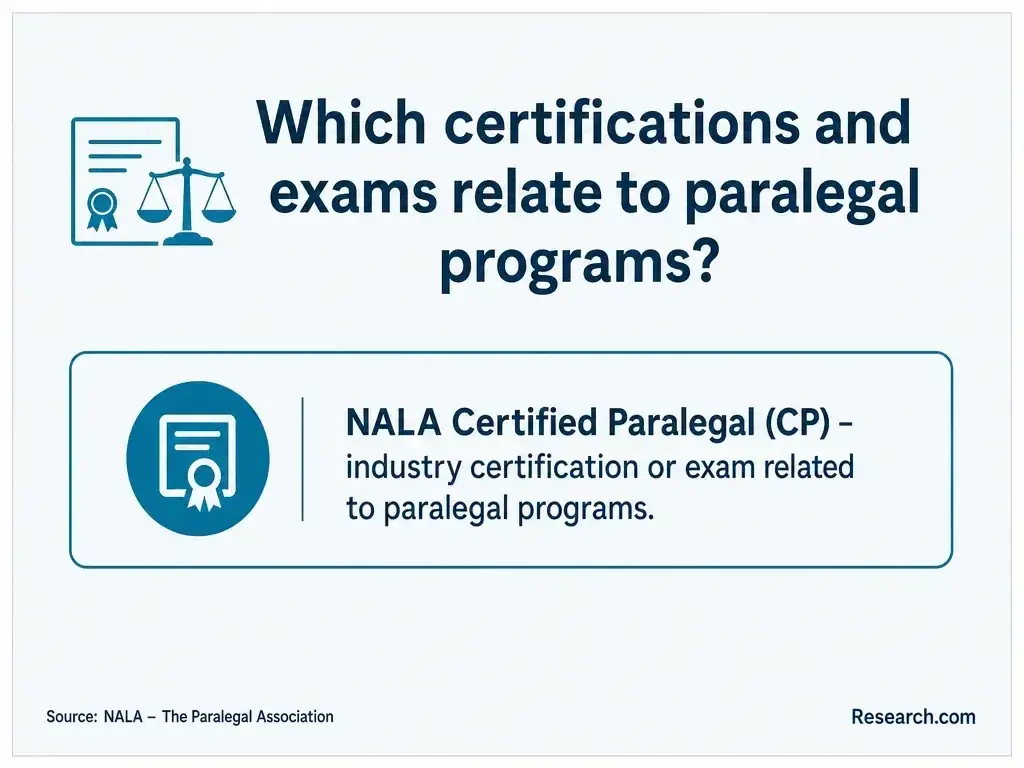
With experience, a paralegal may take on more complex matters or coordinate work within a legal team. Professional certification can be an optional way to demonstrate knowledge, but it is distinct from an associate degree and from occupational licensure. Verify a certifying organization's eligibility rules before assuming any particular program qualifies you.
National employment of paralegals and legal assistants is projected to change by −0.3% from 2025 to 2035 - essentially flat (U.S. Bureau of Labor Statistics, Employment Projections). That projection is not a D.C.-specific count of openings. It does, however, argue against enrolling on the assumption that demand alone will make finding a first job easy.
Legal employers use technology for research and document review, so compare programs on the judgment and accuracy students practice alongside those tools (U.S. Bureau of Labor Statistics). For a local decision, review recent entry-level postings for the type of D.C.-area employer you want: note the requested software, writing tasks, experience, and work location. Then check whether the degree's courses and internship give you credible examples of that work.
Education is a significant investment, so Research.com's team examines reported costs and debt rather than treating a low advertised tuition rate as the whole answer. The Most Affordable ranking compares programs in the same occupation and location and includes only programs with completions reported to IPEDS. It scores tuition, cost of attendance, median student debt, and federal loan default rate; an entropy-based method gives more weight to measures that vary more across programs. Accreditation and other quality measures are not part of the affordability score. Readers should check those separately before enrolling.
The team uses the following data sources in its ranking research. Some cover occupations other than paralegal studies; their inclusion does not mean a healthcare or construction organization approves paralegal programs.
The ranking can narrow your cost comparison, but it cannot establish that every listed degree fits your intended employer or transfer destination. Confirm current program availability, degree requirements, and your own aid offer with each institution. See Research.com's methodology for more on how rankings are created.
# 1 position
# 2 position
Legal Assistant/Paralegal
Delivery mode: On Campus (May Include Online Courses)
16.75
/ 100
Final score
Accreditation
Institutional accreditation from Middle States Commission on Higher Education.
The Catholic University of America received a Research.com Affordability Score of 16.75/100.
It can be sufficient for some openings, but employers set their own education and experience requirements. Compare job postings with the program's coursework and practical experience before enrolling.
D.C. does not issue a general occupational license for paralegals. Paralegals work under lawyer supervision and cannot independently practice law (D.C. Court of Appeals Rules of Professional Conduct).
An AAS often emphasizes career-entry skills; an AA or AS may better suit a transfer plan. Course content and written transfer arrangements matter more than the degree initials alone.
That depends on the school's current format and whether it requires an in-person internship or other activity. Ask where every required component can be completed before applying.
Request each school's estimated cost through graduation, subtract aid you are likely to receive, and account for commuting and work hours you may lose. Do not compare one school's annual tuition with another school's full-program price.