
Best Diagnostic Medical Sonographer Training Programs & Trade Schools in Wyoming for 2027
Audited and Verified:
Our Editorial and Data Verification Process
Research.com uses government datasets, official education statistics and primary institutional information to support its career and degree guides. Our review process checks factual accuracy, occupational definitions, source dates and the requirements associated with the credentials discussed.
How This Article Was Fact-Checked
Our editorial team verifies salary estimates, employment projections, education requirements and program information against original data providers and official organizations. Salary figures are checked against the relevant occupational definitions and reporting periods. Information about licensure, accreditation and required in-person training is reviewed separately.
Fact-checked and verified on:

Co-Founder and Chief Data Scientist

Reviewed by Karolina Broda
Fact-Checker and Data Verification
Choosing sonography training in Wyoming means checking more than tuition: you need supervised scanning experience and a credible path to certification. The U.S. Bureau of Labor Statistics projects 13.9% national growth for diagnostic medical sonographers from 2025 to 2035, making program quality especially important. For new students and healthcare workers changing roles, this guide explains credentials, costs, clinical training, and career prospects. It accompanies the Best Medical Sonographer Trade Schools in Wyoming for 2027 ranking, created by the Research.com team of data scientists to help students identify training programs worth considering.
Key findings about medical sonographer degrees in Wyoming
- Choose for clinical access and certification eligibility: A Wyoming sonography program should document supervised scanning placements and explain its graduates' eligibility under the American Registry for Diagnostic Medical Sonography (ARDMS) prerequisites; a similarly named credential alone is insufficient.
- Plan around time and location: An associate-degree pathway commonly takes about two years, but required clinical schedules can make commuting or temporary relocation the deciding cost for students outside a training site.
- Use wages as context, not a promise: The national median for diagnostic medical sonographers was $96,590 in May 2025, according to the U.S. Bureau of Labor Statistics; it is neither a Wyoming wage nor an expected starting salary.
Table of Contents
- Best Diagnostic Medical Sonographer Training Programs & Trade Schools in Wyoming for 2027
- What can I expect from a medical sonographer trade school program in Wyoming?
- Where can I work with a medical sonographer trade school training in Wyoming?
What can I expect from a medical sonographer trade school program in Wyoming?
Diagnostic medical sonographers use ultrasound equipment to produce images and measurements that clinicians interpret. Training therefore combines anatomy, patient care, image acquisition, and repeated supervised scanning - not simply instruction in operating a machine (U.S. Bureau of Labor Statistics, Occupational Outlook Handbook). Laramie County Community College is one Wyoming provider to investigate, but applicants should confirm its current sonography offering, admission cycle, accreditation, and clinical-site arrangements directly rather than assume every campus or cohort has the same options.
The right pathway depends on your existing clinical background. These distinctions matter more than whether a provider calls itself a trade school:
| Pathway | Typical fit | Decision point |
| Sonography associate-degree program | Student seeking structured preparation for entry-level scanning | Confirm the accredited specialty, supervised clinical placements, and ARDMS prerequisite route. |
| Postsecondary sonography certificate | Applicant with qualifying prior healthcare education or experience | Check entry prerequisites and exam eligibility; a short certificate is not automatically an entry-level shortcut. |
| Employer-supported training | Healthcare worker whose employer offers a documented ultrasound training pathway | Confirm supervision, clinical experience, credential outcome, and whether the arrangement meets certification prerequisites. |
Registered apprenticeships are not the standard entry route for diagnostic medical sonographers; do not substitute an unrelated apprenticeship for supervised sonography education. If you are comparing useful college majors, focus this decision on the credential and clinical experience required for the specific ultrasound role you want.
Where can I work with a medical sonographer trade school training in Wyoming?
Hospitals, physicians' offices, and diagnostic laboratories employ sonographers nationally (U.S. Bureau of Labor Statistics, Occupational Outlook Handbook). In Wyoming, ask programs where their recent students completed clinical rotations and where graduates found work. A placement at a rural hospital may expose you to varied examinations; a specialized department may offer deeper practice in one area. Neither is automatically better for your intended first job.
Because a clinical placement is not a job offer, compare the locations of training sites with the locations where you could realistically work. If you cannot travel for rotations or move for an opening, ask the program and prospective employers about local opportunities before paying an enrollment deposit.
Wyoming pay depends on the employer, specialty, experience, and work schedule. For a national benchmark - not a Wyoming estimate - the U.S. Bureau of Labor Statistics reports a May 2025 median annual wage of $96,590 for diagnostic medical sonographers. A median describes workers already in the occupation and should not be used as a new graduate's earnings forecast.
For a local comparison, look up the most recent Wyoming occupational wage release from the state labor-market agency or the BLS Occupational Employment and Wage Statistics program. Match the occupation to diagnostic medical sonographers, check the reference year, and compare actual job postings by region and specialty. That is more useful for a repayment plan than applying the national median to a Wyoming entry-level offer.
An associate-degree sonography pathway commonly takes about two years of full-time study; certificate length depends heavily on prior qualifications and the program's clinical schedule (U.S. Bureau of Labor Statistics, Occupational Outlook Handbook). Do not assume an advertised completion time includes prerequisites, a wait for the next cohort, or time needed to complete certification exams.
There is no single national clock-hour total that makes every sonography program equivalent. Request the program's published breakdown of classroom, scanning-lab, and supervised clinical hours, plus the number of days each week spent at a clinical site. For a working adult, a shorter calendar may be less affordable if daytime rotations require substantial unpaid time away from work. Readers comparing quick degrees that make good money should judge sonography by its entire time to job readiness, not classroom duration alone.
Online delivery can reduce trips for lectures, but it cannot replace supervised patient scanning. Anatomy or other theory coursework may be remote; scanning labs, competency assessments, and clinical rotations require in-person participation. Before enrolling in a hybrid program, obtain written confirmation of who secures Wyoming-area clinical placements, when attendance is required, and whether a placement is guaranteed or competitive.
An on-campus option may simplify access to equipment and instructors, while a hybrid option may suit someone who lives farther away and has an approved clinical site nearby. Neither format establishes ARDMS eligibility on its own. Open enrollment college courses online might help with an accepted prerequisite, but verify transfer acceptance before registering; they do not substitute for a sonography clinical rotation.
There is no reliable single Wyoming sonography-program average that captures tuition, clinical travel, and required supplies across every available pathway. Ask each provider for a current, program-specific estimate and whether resident tuition applies to you. Compare the total cost to become job-ready, not just the advertised tuition:
- Tuition and mandatory fees, including charges for labs and clinical education.
- Books, software, uniforms, immunizations or health checks, background screening, and any required supplies.
- Certification examination fees and travel to clinical sites or testing appointments.
- Income forgone during required rotations, offset where applicable by grants, scholarships, employer support, or eligible federal aid.
Use the institution's aid office to check federal-aid eligibility and ask Wyoming workforce-services staff about applicable training assistance; neither source guarantees an award (Federal Student Aid; Wyoming Department of Workforce Services). For return on investment, weigh completion probability, debt, forgone earnings, your current pay, plausible post-training pay, and how long you expect to work in the field. A comparison framed as what is the cheapest bachelor degree does not answer the more immediate sonography question: what will this particular clinical pathway cost you to finish?
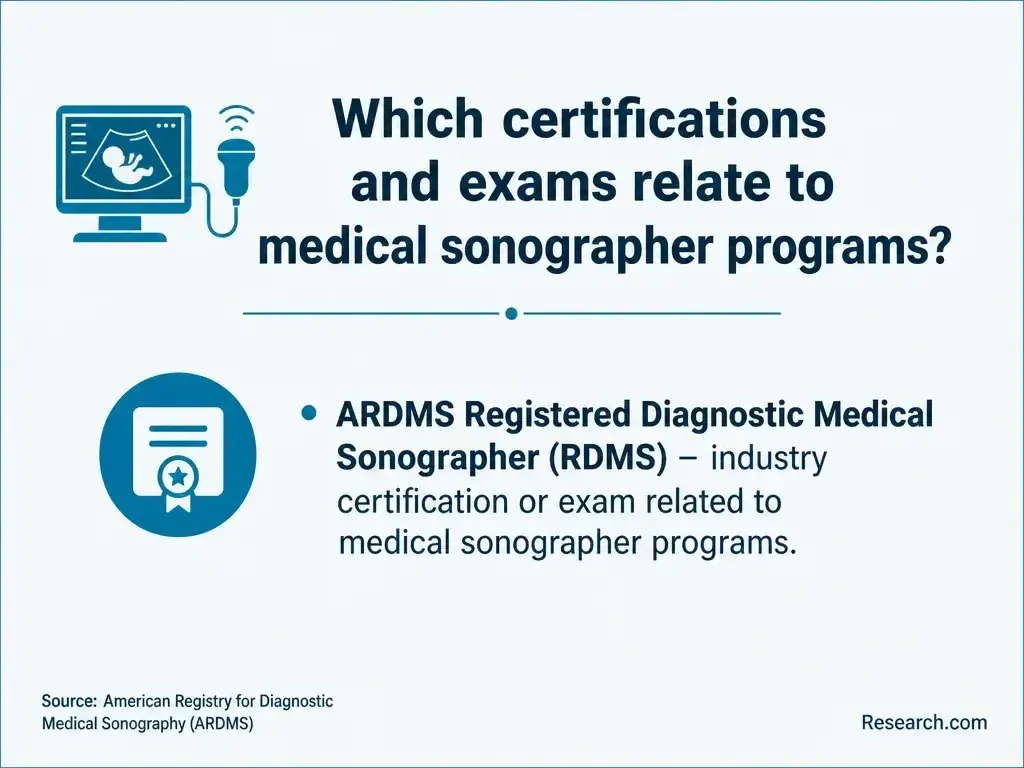
The school credential may be an associate degree or a postsecondary certificate; the award depends on the program. Neither award is the same as a professional certification. The American Registry for Diagnostic Medical Sonography awards credentials after applicants meet the applicable prerequisite pathway and examination requirements, including the Sonography Principles and Instrumentation examination and an appropriate specialty examination.
Check programmatic accreditation for the specific sonography concentration you intend to study in CAAHEP's directory. Then ask the school to identify, in writing, the ARDMS prerequisite pathway its graduates use. Institutional accreditation, programmatic accreditation, state authorization, professional certification, and occupational licensure describe different things; one does not automatically confer another (CAAHEP; ARDMS).
Requirements vary by provider and cohort. Expect to check for prerequisite coursework in subjects such as anatomy and mathematics, application deadlines, and any competitive selection criteria. Clinical sites may require health documentation, screening, or background checks. Ask whether a clinical-site restriction could prevent you from completing the program even if you meet its classroom admission standards.
If you have prior healthcare training, request a written evaluation of transferable coursework or advanced standing. Credit for a prerequisite does not necessarily reduce required scanning competencies or clinical hours. Applicants without a clinical background should be particularly wary of a short certificate that does not clearly explain how they will obtain supervised experience and qualify for certification.
Expect instruction in ultrasound physics, sectional anatomy, image optimization, patient positioning, safety, documentation, and the examinations covered by the program's specialty. Students practice obtaining diagnostic-quality images in a lab before demonstrating competencies with patients under supervision (U.S. Bureau of Labor Statistics, Occupational Outlook Handbook; CAAHEP).
Ask to see the competency checklist and clinical rotation plan. This reveals whether you will practice the examination types needed for your target job and whether the program has enough clinical access to support that practice. Ultrasound technology can improve image acquisition, but employers still need practitioners who recognize inadequate images, communicate with patients, and know when to seek a supervising clinician's guidance.
Do not confuse sonography with radiologic technology when checking state rules. Wyoming's Board of Radiologic Technologist Examiners is the relevant authority to consult about the scope of its licensing rules; applicants should verify whether a planned position involves any separately regulated duties. For sonography hiring, the practical question is often which professional credentials an employer requires or expects, rather than whether a school awards a state sonographer license (Wyoming Board of Radiologic Technologist Examiners; ARDMS).
Before enrolling, ask prospective employers which ARDMS specialty credentials they accept and ask the program to document how its curriculum and clinical experience support eligibility. Passing a course, holding institutional accreditation, and meeting an employer's certification policy are separate milestones.
Start with the job you want, then work backward from its specialty and hiring requirements. A ranking can identify options to investigate, but it cannot establish that a particular clinical placement, schedule, or cost works for you. Take these questions to each program before committing:
- Is the intended sonography concentration currently CAAHEP-accredited, and which ARDMS prerequisite pathway applies to graduates?
- Where are clinical placements, who arranges them, and how many supervised hours and assessed scanning competencies are required?
- What is the complete cost through graduation and certification, including travel, fees, and time away from paid work?
- What are the program's recent completion, certification-exam, and job-placement results, and how are those measures defined?
A red flag is an "online-only" claim that cannot explain in-person clinical training. Another is a low tuition quote that excludes required travel or supplies. Choose the affordable program only if it also provides a workable path to the experience and credential your intended employer recognizes.
Initial roles depend on the examinations a graduate can perform competently and the credentials an employer requests. With additional supervised experience and appropriate specialty certification, a sonographer may pursue areas such as abdominal, obstetric and gynecologic, or vascular imaging. Experienced practitioners may later take on training or department leadership responsibilities; those are progression possibilities, not automatic outcomes of graduation (ARDMS; U.S. Bureau of Labor Statistics, Occupational Outlook Handbook).
For a career changer, the strongest first step is to match a program's specialty and clinical placements to available jobs, rather than choose training by a general earnings list such as highest paying online master's degrees. Sonography employers assess occupation-specific scanning ability and credentials.
The U.S. Bureau of Labor Statistics projects 13.9% growth for diagnostic medical sonographers nationally from 2025 to 2035. This signals national demand, not the number of openings near a particular Wyoming clinical site or a guarantee of employment. Wyoming applicants should check the latest state occupational projections and current postings for the specialty they plan to study.
In a smaller local labor market, flexibility about work location, shift, or examination type may matter as much as the national trend. Ask a program where its clinical partners hire and whether its graduates commonly need to search outside their immediate area. Use those answers when deciding whether the training investment fits your mobility and income needs.
Best Diagnostic Medical Sonographer Training Programs & Trade Schools in Wyoming for 2027
Education is a substantial investment, so the Research.com team designed the ranking to compare sonography programs with other programs in the same occupation and location - not with unrelated schools. The team reviewed outcomes, costs, accreditation, and recognition using multiple sources to improve the ranking's quality, credibility, and accuracy. Only programs with completions reported to IPEDS are eligible; an unlisted provider is not necessarily unapproved or ineffective.
For best-program rankings, student outcomes include completion and full-time and part-time retention. Earnings and return on investment include median earnings one year after completion and earnings relative to annual attendance cost. Costs and debt include resident and nonresident tuition, attendance cost, median debt - including debt held by students who withdrew - and federal loan default rates. Quality and recognition include institutional accreditation, occupation-relevant programmatic accreditation or industry recognition, and student support. Programmatic accreditation or industry recognition receives 20% of the score, institutional accreditation 10%, and student support 10%. The remaining 60% covers outcomes, earnings, and costs, with entropy-based weighting that gives more weight to indicators that differ more across programs.
Most-affordable-program rankings use only tuition, attendance cost, median debt, and federal loan default rates, weighted through the same entropy-based approach; accreditation and other quality indicators are not part of that score. The following sources were used to create the rankings, although not every source describes a sonography-specific requirement:
- IPEDS database - program completions and institutional data.
- National Center for Education Statistics - federal education data and definitions.
- College Scorecard database - available cost, debt, and earnings measures.
- Peterson's database - supplementary institutional information.
- Commission on Accreditation of Allied Health Education Programs (CAAHEP) - relevant programmatic accreditation information.
- Accrediting Bureau of Health Education Schools (ABHES) - healthcare-school accreditation information.
- Commission on Dental Accreditation (CODA) - accreditation information for other health occupations in the broader ranking system.
- Dental Assisting National Board (DANB) - recognition information for other health occupations in the broader ranking system.
- National Center for Construction Education and Research (NCCER) - industry-recognition information for other trades in the broader ranking system.
- Apprenticeship.gov Partner Finder - information on apprenticeship providers and alternatives.
The ranking is a starting point for a shortlist, not proof that a particular graduate qualifies for a certification exam or local job. Readers should confirm each program's current accreditation status, clinical placements, costs, and graduate outcomes directly. More detail on the scoring approach is available in Research.com's methodology.

# 2 position
Laramie County Community College
certificate or diplomaDiagnostic Medical Sonography/Sonographer and Ultrasound Technician
Delivery mode: On Campus (May Include Online Courses)
50.45
/ 100
Final score
- School graduation rate
- 38%
- Students receiving Pell Grants
- 31%
- In-state tuition & fees (per year)
- $4,613
- Out-of-state tuition & fees (per year)
- $10,913
- School website
- lccc.wy.edu
Accreditation
Institutional accreditation from Higher Learning Commission.
Laramie County Community College earned a Research.com Trade Program Score of 50.45/100.
Frequently asked questions about medical sonographer programs in Wyoming
Can I become a sonographer entirely online?
No classroom format removes the need for in-person scanning practice and supervised clinical experience. Ask a hybrid program to identify its approved clinical sites before enrolling.
Is an associate degree or certificate better?
An associate-degree pathway often fits a new entrant; a certificate may fit someone with qualifying prior healthcare preparation. The better choice is the one that meets your certification prerequisite pathway and provides sufficient clinical training.
Does graduating automatically make me ARDMS-certified?
No. ARDMS applies its own eligibility and examination requirements. Ask the school which prerequisite pathway its graduates use.
Should I use the national sonographer median to estimate my first salary?
No. The BLS median covers workers at different experience levels nationwide. Compare local entry-level postings and your likely debt instead.
What should I verify before paying a deposit?
Confirm current concentration-specific accreditation, clinical placement arrangements, certification eligibility, the complete cost, and whether the schedule is feasible for you.
- U.S. Bureau of Labor Statistics - Diagnostic Medical Sonographers and Cardiovascular Technologists and Technicians
Used to verify salary, employment outlook, and typical education requirements.
https://www.bls.gov/ooh/healthcare/diagnostic-medical-sonographers.htm - CAAHEP - Find an Accredited Program
Used to verify programmatic accreditation or industry recognition of programs.
https://www.caahep.org/students/find-an-accredited-program - ARDMS - Certification
Professional certification reference for graduates of this occupation.
https://www.ardms.org/ - Laramie County Community College - official website
Official school website (programs, tuition, admissions).
https://www.lccc.wy.edu/