# 1 position


Audited and Verified:
Our Editorial and Data Verification Process
Research.com uses government datasets, official education statistics and primary institutional information to support its career and degree guides. Our review process checks factual accuracy, occupational definitions, source dates and the requirements associated with the credentials discussed.
How This Article Was Fact-Checked
Our editorial team verifies salary estimates, employment projections, education requirements and program information against original data providers and official organizations. Salary figures are checked against the relevant occupational definitions and reporting periods. Information about licensure, accreditation and required in-person training is reviewed separately.
Fact-checked and verified on:

Co-Founder and Chief Data Scientist

Reviewed by Karolina Broda
Fact-Checker and Data Verification
Choosing sonography training near Cypress means checking more than tuition: a program must provide supervised scanning experience and a credible route to certification. The U.S. Bureau of Labor Statistics reports a May 2025 national median annual wage of $96,590 for diagnostic medical sonographers, but that is not a starting-pay estimate. This guide explains local training options, costs, credentials, and career prospects. It also accompanies the Best Medical Sonographer Trade Schools in Cypress for 2027 ranking, created by the Research.com team of data scientists to help students identify programs worth considering.
Diagnostic medical sonographers use ultrasound equipment to produce images that clinicians interpret. Entry training combines anatomy, ultrasound physics, image acquisition, patient care, and supervised examinations. A Cypress-area applicant should expect campus labs and clinical rotations, even if some lectures are delivered online (U.S. Bureau of Labor Statistics).
Cypress College is a local public-college option to investigate for its current diagnostic medical sonography offering. A private career-school certificate or diploma may offer a different schedule, but the credential's name alone says little about clinical access or examination eligibility. Confirm the exact award, specialty track, required placements, and current program status directly with the provider before comparing it with another option.
The pathways below differ most in what a student brings to training and what practical experience the program supplies.
| Pathway | Best fit | Decision-critical check |
| Associate-degree sonography program | New entrants seeking an academic credential with structured technical and clinical training | Verify programmatic accreditation, clinical rotations, and the applicable certification pathway. |
| Certificate or diploma | Applicants who meet its prerequisites, sometimes including an existing healthcare credential | Do not assume a shorter award independently meets certification prerequisites. |
| Employer-supported cross-training | Current healthcare workers with access to supervised scanning | Get written confirmation of training, documented experience, and examination eligibility. |
Potential workplaces include hospitals, outpatient imaging centers, physician offices, and specialty clinics. Diagnostic medical sonographers may work in abdominal, obstetric and gynecologic, or vascular imaging; cardiac ultrasound is a related specialty with its own credential routes (U.S. Bureau of Labor Statistics; ARDMS; Cardiovascular Credentialing International).
For someone living in Cypress, the practical labor market extends across Orange County and, if the commute is workable, neighboring parts of the Los Angeles area. That wider search can increase the range of clinical and job settings, but it may also add substantial travel during training. Ask whether rotations are assigned by the program, whether a car is necessary, and whether the sites offer exposure to the specialty you want.
The U.S. Bureau of Labor Statistics reports a $96,590 national median annual wage for diagnostic medical sonographers in May 2025. A median describes workers across experience levels, specialties, and employers; it is not a Cypress starting salary. Compare current Orange County-area postings for the intended specialty, schedule, and required credential before estimating your own earnings.
When weighing training costs against pay, use a conservative entry-level estimate rather than the national median. Hospital shifts, outpatient schedules, experience, and additional credentials can affect opportunities, while the cost of commuting to a clinical site or workplace affects what an offer is worth to you.
Length depends on prerequisites, the award, and the clinical schedule. The U.S. Bureau of Labor Statistics identifies associate-degree and certificate programs as common routes, but a published program length may exclude prerequisite courses or time spent waiting for a cohort place. Request a term-by-term plan showing prerequisites, lab sessions, clinical rotations, and the earliest realistic completion date.
No single clock-hour total applies to every Cypress sonography program. Compare each provider's documented scanning and supervised clinical requirements, including whether placements run during normal work hours. A fast online associates degree may be useful as a general scheduling comparison, but speed cannot replace required in-person ultrasound competencies.
Online delivery can make lectures, readings, and some assignments easier to fit around work. Transducer handling, patient positioning, image optimization, and supervised examinations still require in-person practice. A hybrid option is useful only if its lab and clinical locations, hours, and placements are feasible for a Cypress student.
Institutional accreditation is worth checking, including when comparing top online universities with national accreditation. It does not, by itself, establish sonography program accreditation or eligibility for an ARDMS examination. Ask the program to identify the precise certification prerequisite its graduates can meet and which parts of training must be completed on site (ARDMS; CAAHEP).
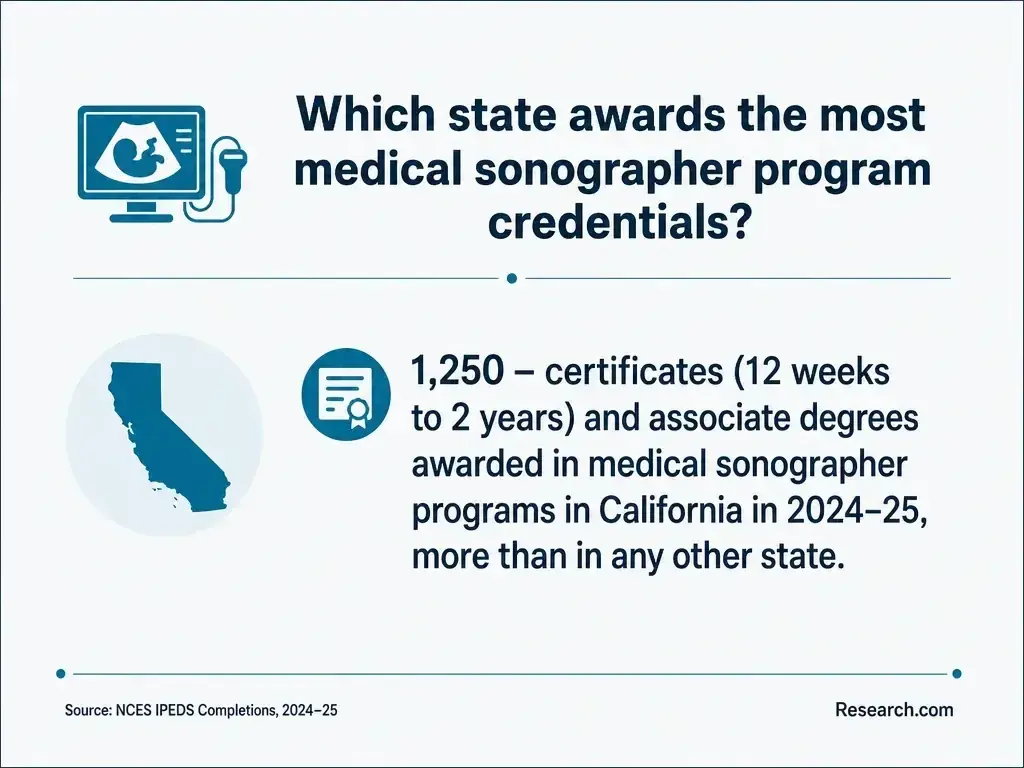
There is no reliable single Cypress average that covers public-college programs, private providers, different prerequisite loads, and clinical travel. Obtain a current written cost sheet from each provider instead. For Cypress College, check the applicable residency classification, current enrollment charges, and program-specific fees; do not treat a per-unit tuition figure as the price of becoming job-ready.
Build one comparable total for each option. Include required tuition and fees, prerequisite courses, books or software, uniforms, health screening, immunizations, background checks, certification examinations, transportation to clinical sites, and earnings you may give up to attend. Then subtract grants or other aid you are actually eligible to receive. California's College Promise Grant can waive eligible community-college enrollment fees, but it does not necessarily cover the remaining expenses (California Community Colleges Chancellor's Office).
Federal aid eligibility depends on the school, program, and student. Lists of online accredited colleges that accept financial aid are not proof that a particular sonography program qualifies; confirm that point with its financial-aid office (Federal Student Aid). Compare debt, likely completion time, and forgone wages alongside price before deciding that an accelerated or lower-tuition option is cheaper overall.
The educational award could be an associate degree, certificate, or diploma, depending on the program. That award is distinct from a professional certification. For example, the American Registry for Diagnostic Medical Sonography (ARDMS) awards credentials after applicants satisfy an applicable prerequisite and pass required examinations; its RDMS route includes the Sonography Principles and Instrumentation examination and a specialty examination (ARDMS).
Check the exact award and specialty preparation before enrolling. A certificate designed for someone already trained in healthcare may not suit a first-time entrant, and two associate-degree programs may offer different clinical experiences. Programmatic accreditation, institutional accreditation, state authorization to operate, and professional certification each answer different questions; none should be treated as a synonym for the others (CAAHEP; U.S. Department of Education; ARDMS).
Requirements are set by the individual program. Expect to check prerequisite science or math courses, application deadlines, selection criteria, and any clinical-site requirements such as health records, immunizations, or a background check. Ask which prerequisites must be finished before applying and whether admission to the college also means admission to the sonography cohort; it may not.
Returning students should ask Cypress College or another provider for a transcript review and written guidance on transferable prerequisites or prior learning. A list of top degree programs for seniors online can help frame questions about flexible study, but it does not establish whether previous coursework meets sonography admissions rules or whether clinical hours can fit your schedule.
Core instruction typically covers cross-sectional anatomy, ultrasound physics and instrumentation, scanning techniques, patient communication, infection prevention, and recording diagnostic-quality images. Supervised clinical work develops the judgment to recognize when an image needs improvement and to communicate relevant findings within the sonographer's role (U.S. Bureau of Labor Statistics; ARDMS).
Compare curricula by specialty and scanning exposure, not course titles alone. Ask how much practice occurs in skills labs before patient rotations, which examinations students perform under supervision, and how clinical performance is assessed. Those answers matter more to job readiness than whether two programs both advertise "hands-on training."
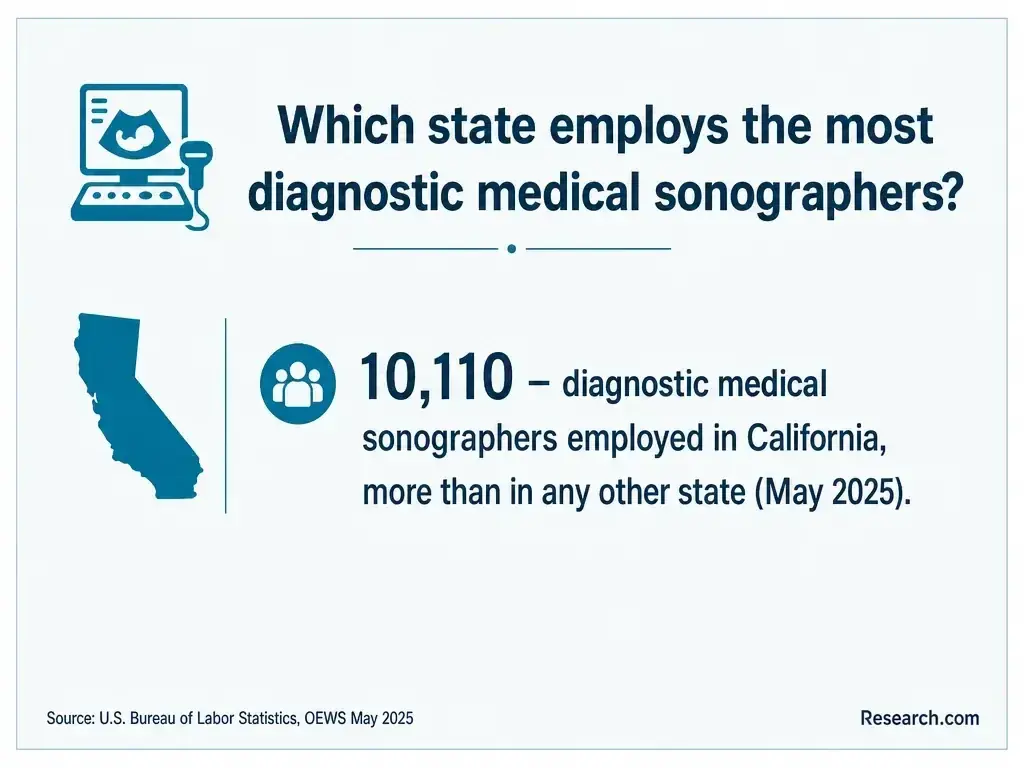
California does not generally license diagnostic medical sonographers to perform conventional ultrasound examinations. That is different from California's regulation of certain radiologic technologies; do not assume an X-ray credential is an ultrasound credential (California Department of Public Health, Radiologic Health Branch). Employers may nevertheless require or prefer a professional sonography certification, often within a stated period after hiring.
ARDMS certification is a separate process from graduation. Its examination prerequisites vary with education, program accreditation, and clinical experience, so ask a prospective program for the specific ARDMS pathway it supports and verify the answer against current ARDMS requirements. For a cardiac-focused goal, check the relevant ARDMS or Cardiovascular Credentialing International route rather than assuming a general ultrasound credential covers every specialty (ARDMS; Cardiovascular Credentialing International).
Start with your intended job - such as general, vascular, or cardiac sonography - then work backward from its likely employer credential requirements. A ranking can narrow your search, but it cannot tell you whether a clinical assignment is reachable or whether a program fits your prerequisites and work schedule. Unrelated price comparisons, including a most affordable master's degree online list, are not substitutes for comparing entry-level sonography training.
Before paying an enrollment deposit, get answers to these program-specific questions in writing:
Check accreditation in the accreditor's current directory and certification prerequisites with the certifying body, rather than relying on a brochure (CAAHEP; ARDMS). A warning sign is a promise of an "online-only" route to scanning competency without a clear supervised clinical plan. To judge value, weigh total cost and debt against completion probability, your current earnings, plausible post-training earnings, and the time required to reach them - not tuition or a ranking position alone.
An entry-level program can lead toward general diagnostic sonography if its clinical preparation and the employer's credential requirements align. With appropriate specialty training and experience, a sonographer may move into vascular, obstetric and gynecologic, abdominal, or cardiac imaging, or later take on lead, education, or equipment-application responsibilities (U.S. Bureau of Labor Statistics; ARDMS).
Specialization is not automatic. Someone targeting echocardiography, for example, should compare cardiac-focused clinical access and the relevant certification route before choosing a general program. Current healthcare workers may find employer-supported cross-training worthwhile if supervised examinations and eligibility can be documented; for a newcomer, a structured program with arranged clinical placements is usually easier to evaluate than an informal promise of on-the-job training.
U.S. employment of diagnostic medical sonographers is projected to grow 13.9% from 2025 to 2035, according to the U.S. Bureau of Labor Statistics. This is a national occupational projection, not a forecast of vacancies in Cypress. It supports investigating the field, but it does not remove the need to find an appropriate clinical placement and meet local employers' specialty and certification expectations.
For a realistic Orange County job search, review recent postings across hospitals and outpatient settings and record which credentials, specialties, and experience levels recur. Compare those requirements with each program's documented clinical rotations. If most appealing openings require a specialty the program does not teach, a different training route may be the better investment.
Investing in occupational training is a consequential decision. Research.com created its ranking to help readers compare sonography programs with other programs serving the same occupation and location, rather than with unrelated schools. The team examines reported outcomes, costs, recognition, and student support; only programs with completions reported to IPEDS are eligible. That coverage rule means an unlisted training provider is not necessarily unavailable or poor quality.
Best-program rankings assess completion and full- and part-time retention; median earnings one year after completion and earnings relative to annual attendance cost; tuition, attendance cost, debt - including debt held by students who withdrew - and federal loan default rates; plus accreditation or relevant industry recognition and student support. Programmatic accreditation or industry recognition carries 20% of the score, institutional accreditation 10%, and student support 10%. Outcomes, earnings, and costs share the remaining 60% through an entropy-based method that gives more weight to indicators that differ more across programs. Most-affordable-program rankings use only cost and debt measures, weighted by the same method; quality indicators are not scored.
The following databases and organizations inform the ranking. Some cover the broader trade-school methodology rather than sonography specifically; for example, dental and construction bodies do not accredit ultrasound programs.
The ranking is a screening tool, not a substitute for confirming a program's current accreditation, clinical placements, certification eligibility, and total cost. Readers can review Research.com's methodology for more detail.
# 1 position
# 2 position
No. It is a local option to investigate, but compare its current offering with any other viable provider on clinical access, certification eligibility, schedule, and total cost. Confirm each program's status directly before applying.
No classroom format replaces supervised scanning practice. Online coursework may cover some theory, but labs and clinical examinations require in-person participation (U.S. Bureau of Labor Statistics; ARDMS).
California does not generally license conventional diagnostic ultrasound sonographers. Employers can still set certification requirements, so check the intended job and certification pathway (California Department of Public Health, Radiologic Health Branch; ARDMS).
Not automatically. Eligibility depends on the applicable ARDMS prerequisite, which can include specified education and clinical experience. Ask the program to identify its graduates' pathway and verify it with ARDMS.
Not necessarily. Compare prerequisites, mandatory fees, clinical travel, aid, lost work time, and whether the certificate meets your certification goal. A shorter route that leaves a training gap can cost more to complete.