
Most Affordable HVAC Technician Schools & Training in Thatcher for 2027
Audited and Verified:
Our Editorial and Data Verification Process
Research.com uses government datasets, official education statistics and primary institutional information to support its career and degree guides. Our review process checks factual accuracy, occupational definitions, source dates and the requirements associated with the credentials discussed.
How This Article Was Fact-Checked
Our editorial team verifies salary estimates, employment projections, education requirements and program information against original data providers and official organizations. Salary figures are checked against the relevant occupational definitions and reporting periods. Information about licensure, accreditation and required in-person training is reviewed separately.
Fact-checked and verified on:

Co-Founder and Chief Data Scientist

Reviewed by Karolina Broda
Fact-Checker and Data Verification
Choosing HVAC training in Thatcher means comparing more than tuition: a lower-priced program may still require tools, travel, and hands-on experience before you can work confidently. The U.S. Bureau of Labor Statistics projects 10.9% national employment growth for heating, air conditioning, and refrigeration mechanics and installers from 2025 to 2035. For prospective students and career changers, this guide explains costs, credentials, practical training, and Arizona requirements. It also features a Most Affordable HVAC Technician Trade Schools in Thatcher for 2027 ranking created by the Research.com team of data scientists to help students identify programs worth considering.
Key findings about HVAC technician degrees in Thatcher
- Compare the complete cost, not the ranked price. Thatcher students should obtain written 2027 estimates for tuition, fees, tools, safety gear, certification testing, and travel; a paid apprenticeship may change the calculation substantially.
- Check practical training and refrigerant preparation. HVAC work requires equipment skills, and technicians who handle regulated refrigerants generally need U.S. Environmental Protection Agency Section 608 certification; a school completion credential is not that certification (U.S. Environmental Protection Agency).
- Use national wages as context, not a local starting-pay promise. The occupation's U.S. median annual wage was $61,010 in May 2025, but the figure includes experienced workers across the country and does not establish what a new technician will earn in Thatcher (U.S. Bureau of Labor Statistics).
Table of Contents
- Most Affordable HVAC Technician Schools & Training in Thatcher for 2027
- What can I expect from an HVAC technician trade school program in Thatcher?
- Where can I work with an HVAC technician trade school training in Thatcher?
What can I expect from an HVAC technician trade school program in Thatcher?
Expect a mix of classroom instruction and supervised work with HVAC equipment. Training typically covers electrical diagnostics, refrigeration cycles, airflow, controls, installation, maintenance, and safe handling procedures. The decisive comparison is not whether two programs both say "HVAC"; it is what equipment students actually troubleshoot and how much instructor-supervised practice they receive.
Eastern Arizona College is the local institution to investigate for current HVAC-related offerings, locations, schedules, and credential details. Confirm its 2027 catalog rather than assuming that a previously listed course will run in Thatcher. If the available schedule does not fit, ask local employers about entry-level helper positions or paid training. A short program can suit someone who needs foundational skills quickly; a more extensive credential may suit someone seeking broader electrical, controls, and refrigeration instruction. Neither replaces experience on real service calls.
Before enrolling, ask for a course-by-course list of lab hours, equipment, any work placement, and preparation for the specific certifications employers request. Lists of certification that pay well can provide career context, but an HVAC-specific curriculum and practical access matter more than a credential's general appeal.
Where can I work with an HVAC technician trade school training in Thatcher?
Potential settings include residential service contractors, commercial building maintenance, facilities teams, refrigeration service, and installation crews. Thatcher's smaller local market makes travel and an employer's service territory especially important: a job advertised nearby may involve calls across the surrounding area. Ask employers where a typical workday begins, whether travel time is paid, and whether the role focuses on cooling, heating, or refrigeration before choosing specialized training.
School training can help a candidate qualify for an entry-level helper or apprentice role, but employers may still expect supervised field experience before assigning independent troubleshooting. The U.S. Bureau of Labor Statistics describes installation, maintenance, and repair as core duties; a program focused narrowly on installation may be a weaker match for a service-diagnostics goal.
A reliable Thatcher-specific wage figure is not established here, so the national median should serve only as a benchmark. The U.S. Bureau of Labor Statistics reports a May 2025 U.S. median annual wage of $61,010 for heating, air conditioning, and refrigeration mechanics and installers. That midpoint includes workers with different experience, specialties, and employers; it is not a forecast of first-year pay in Thatcher.
For a useful local comparison, request wage ranges for helper and technician openings separately. Also compare paid hours, overtime practices, on-call demands, travel reimbursement, and benefits. A higher hourly offer may be less attractive if it requires substantial unpaid driving or irregular work. Do not use the national median as the assumed post-training income in a loan or return-on-investment calculation.
There is no single required school-program length for becoming an entry-level HVAC worker in Thatcher. A focused certificate may take less time than a broader diploma or associate degree, while a paid apprenticeship combines instruction and supervised work over a longer period. Actual completion time depends on course availability, full- or part-time attendance, prerequisites, and whether a work placement is required.
Ask Eastern Arizona College for the current credential's total credits or clock hours, separate lab hours, course sequence, and next scheduled start. If you already have relevant trade experience, ask whether documented prior learning or applicable coursework can shorten the route; do not assume that experience automatically earns credit. Compare time until you can start paid work with time until you finish a credential - those milestones may differ.
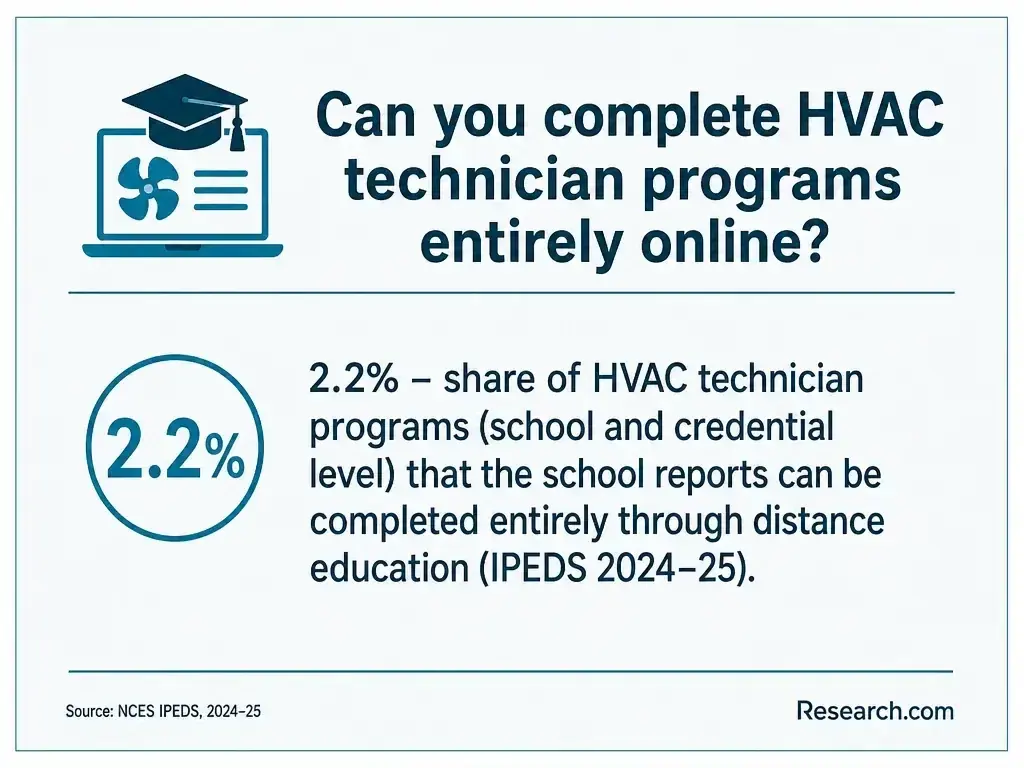
Online instruction can cover concepts such as refrigeration theory, electrical fundamentals, safety, and reading technical diagrams. It cannot by itself demonstrate that a student can safely wire a circuit, measure system performance, recover refrigerant, or diagnose a malfunction on physical equipment. A hybrid option makes sense only if its in-person labs or supervised worksite training are accessible from Thatcher.
The comparison below identifies what each format can realistically deliver. It is a planning guide, not a claim that every school offers each format.
| Format | Potential advantage | Question to resolve before paying |
| On-campus | Regular access to equipment and instructor feedback | Are lab times and the commute workable? |
| Hybrid | Remote theory with scheduled hands-on sessions | Where, when, and how often are labs held? |
| Online-only coursework | Flexible study of foundational concepts | How will practical skills be taught and assessed? |
Do not treat a convenient online course as equivalent to job-ready training without verifying its practical component. When comparing broader education-planning options, keep HVAC's equipment requirements separate from questions about remote coursework.
A defensible Thatcher-wide average is not available here, and a quoted tuition figure alone would be misleading. For a 2027 decision, obtain Eastern Arizona College's current program charges and confirm any residency-based tuition rules directly with the institution. Then price the items required to finish training and begin work, not merely the classes.
A complete estimate should include mandatory fees, books, tools, meters, personal protective equipment, consumable materials, certification exams, transportation to labs or worksites, and earnings forgone during unpaid training. Compare that figure with any grants, eligible federal or state aid, employer reimbursement, or wages available through a paid apprenticeship. Eligibility varies by program and student; verify it with the school's financial aid office or the training sponsor.
An application fee is a small part of this calculation. Even when considering accredited online schools offering no-cost applications, an aspiring HVAC technician should first confirm where hands-on instruction takes place. To judge value, weigh total net cost and likely debt against completion prospects, the time before paid work begins, and a conservative estimate of future earnings rather than assuming the national occupational median will follow immediately.
The credential depends on the specific offering: trade training may lead to a school certificate, diploma, or associate degree, while an apprenticeship produces a separate record of completed occupational training. Request the exact credential title from Eastern Arizona College before applying. A similarly named credential from another provider may represent different lab work, scope, or employer recognition.
School completion, professional certification, and occupational authorization are distinct. In particular, U.S. Environmental Protection Agency Section 608 certification is earned through an approved test and applies to technicians performing regulated refrigerant-handling activities; finishing a school program does not automatically confer it (U.S. Environmental Protection Agency). Broader guides to other academic credentials do not answer whether an HVAC course prepares you for that test or for practical service work.
Requirements depend on the training route. Ask Eastern Arizona College whether the specific HVAC offering requires an application, placement or prerequisite coursework, a minimum age, or safety equipment before the first lab. Do not assume that admission to the institution guarantees a place in a particular course or that a course is offered every term.
Employer and apprenticeship entry rules may differ from school admissions rules. A sponsor may assess work readiness, availability for field schedules, and the ability to reach job sites. Before choosing a route, ask whether you can meet its attendance and transportation requirements and whether applicants need to secure an employer first. Those practical conditions may determine whether a lower-cost option is genuinely accessible.
Useful entry-level instruction connects theory to repeatable diagnostic tasks: tracing an electrical fault, checking airflow, interpreting pressure and temperature readings, using tools safely, and documenting findings for a customer or supervisor. Refrigerant practices and safety should be explicit parts of the curriculum because work involving regulated refrigerants triggers federal certification requirements (U.S. Environmental Protection Agency).
Ask for a lab inventory and sample assessments rather than relying on a course title. A program with actual systems to inspect and troubleshoot can offer different preparation from one built mainly around videos or demonstrations. Also look for instruction in communicating findings and following service procedures: technicians work in occupied homes and businesses, not just in a shop (U.S. Bureau of Labor Statistics).
Do not confuse technician employment with operating an HVAC contracting business. Arizona's Registrar of Contractors regulates contractor licensing; if your goal is to bid for or perform contracting work independently, check its current license classifications, qualification, examination, and business requirements. A school credential alone is not a contractor license (Arizona Registrar of Contractors).
Federal rules are separate. Technicians who maintain, service, repair, or dispose of equipment in ways that may release regulated refrigerants generally must pass an approved Section 608 certification exam for the relevant equipment type (U.S. Environmental Protection Agency). Ask a prospective program whether it prepares students for the exam and whether testing is included in the price. An entry-level employer can explain which tasks you may perform while learning, but employer training does not replace a required federal certification.
Start with the job you want - installation helper, residential service technician, facilities maintenance worker, or eventual contractor - and work backward to its practical skills. The least expensive program is worth considering only if you can attend its labs, finish it, and use its training in the role you intend to pursue.
Use the following checks when speaking with Eastern Arizona College and with any employer or apprenticeship sponsor. They expose common gaps that a tuition comparison or ranking cannot show.
- Request a written 2027 estimate covering fees, tools, safety gear, testing, and travel, plus the exact credential and scheduled completion time.
- Confirm where hands-on training occurs, which systems students use, and whether supervised work experience is arranged or must be found independently.
- Ask how the curriculum prepares students for applicable Section 608 testing and what an entry-level employer would still need to teach.
- Verify institutional accreditation or other applicable school authorization separately from certification preparation and Arizona contractor-licensing rules.
- Compare expected debt and time away from paid work with a helper job or paid apprenticeship, using realistic local offers rather than national median wages.
A warning sign is a promise that an online-only credential automatically makes you certified, licensed, or ready for independent service calls. Another is a price quote that excludes required equipment or off-site travel. Rankings can help form a shortlist; written answers to these questions should decide whether a particular route is a sound investment.
A common progression is from helper or apprentice to a technician who can handle increasingly complex maintenance and diagnosis under an employer's procedures. With experience, workers may concentrate on residential service, commercial systems, refrigeration, or controls, then pursue lead-technician or supervisory responsibilities. Independent contracting is a different step that requires attention to Arizona's contractor rules, not simply an advanced school credential (Arizona Registrar of Contractors).
Choose training for the next role, not the most impressive-sounding future title. For example, someone seeking refrigeration work should ask whether the labs use refrigeration equipment; someone planning to enter quickly may benefit more from paid supervised experience than from extra classroom time. When exploring certificates that pay well, remember that an optional certificate and a required refrigerant certification serve different purposes.
The U.S. Bureau of Labor Statistics projects 10.9% national employment growth from 2025 to 2035 for heating, air conditioning, and refrigeration mechanics and installers. This supports considering the occupation, but it does not measure vacancies in Thatcher or guarantee a local placement.
For a location-specific decision, inspect current openings across the area you could reasonably travel, noting whether employers seek helpers, experienced service technicians, or a particular specialty. Compare those requirements with the program's labs and work-based training. If nearby openings mostly require experience, a paid helper or apprenticeship route may provide a more direct first step than classroom training alone.
Most Affordable HVAC Technician Schools & Training in Thatcher for 2027
Investing in occupational training is an important decision, particularly when the advertised price does not capture every cost of becoming job-ready. Research.com created its Thatcher ranking to help readers compare locally relevant programs using consistent, documented measures. Programs are evaluated against others in the same occupation and location; only programs with completions reported to the Integrated Postsecondary Education Data System (IPEDS) qualify. Consequently, the ranking does not represent every apprenticeship, employer training opportunity, or trade provider.
The most affordable ranking scores tuition, cost of attendance, median student debt, and federal loan default rates. It uses an entropy-based weighting method, which gives more weight to measures that distinguish programs more clearly. Accreditation and other quality indicators are not part of this affordability score. Research.com's separate best programs rankings also assess completion, retention, earnings, student support, and relevant recognition. Readers should therefore use an affordability rank as a cost-screening tool, not proof of superior instruction, certification preparation, or job placement.
To check cost, outcomes, recognition, and training-pathway information, the Research.com team drew on the following sources. Some cover occupations other than HVAC; their inclusion among the ranking's data sources does not imply that their occupation-specific approvals apply to HVAC programs.
- IPEDS database - institutional reporting on programs, completions, and costs.
- National Center for Education Statistics - federal education data and definitions.
- College Scorecard database - available college-level costs, debt, and outcomes.
- Peterson's database - supplemental institutional information.
- Commission on Accreditation of Allied Health Education Programs (CAAHEP) - occupation-specific recognition data where relevant.
- Accrediting Bureau of Health Education Schools (ABHES) - occupation-specific recognition data where relevant.
- Commission on Dental Accreditation (CODA) - occupation-specific recognition data where relevant.
- Dental Assisting National Board (DANB) - occupation-specific credential information where relevant.
- National Center for Construction Education and Research (NCCER) - construction-trade training and credential information.
- Apprenticeship.gov Partner Finder - information on potential apprenticeship connections.
This approach helps readers narrow their options while keeping its limits visible: college datasets may omit paid training, and a low score on cost cannot establish that a program fits an individual's schedule or career goal. Research.com explains its broader approach on its methodology page.
# 2 position

Frequently asked questions about HVAC technician programs in Thatcher
Is there an HVAC trade school option in Thatcher?
Eastern Arizona College is the local institution to ask about current HVAC-related courses and credentials. Confirm the 2027 catalog, campus location, and schedule directly; availability can change.
Is the cheapest HVAC program the best choice?
Not necessarily. Compare total job-ready cost, lab access, completion time, and certification preparation. A lower tuition quote can cost more overall if required tools or travel are excluded.
Can I become an HVAC technician through online training alone?
Online coursework can teach theory, but practical diagnosis and equipment skills require in-person training or supervised work. Verify how any online provider assesses those skills.
Do I need EPA certification before working with refrigerants?
For regulated refrigerant-handling activities, technicians generally need the appropriate U.S. Environmental Protection Agency Section 608 certification. Ask employers which tasks the role involves and whether a program includes exam preparation.
Could a paid apprenticeship be cheaper than trade school?
It may be, especially if it provides wages while you learn. Compare its entry requirements, available openings, instruction, supervision, and time to completion with a school program before deciding.
- U.S. Bureau of Labor Statistics - Heating, Air Conditioning, and Refrigeration Mechanics and Installers
Used to verify salary, employment outlook, and typical education requirements.
https://www.bls.gov/ooh/installation-maintenance-and-repair/heating-air-conditioning-and-refrigeration-mechanics-and-installers.htm - NCCER - Accredited Training
Used to verify programmatic accreditation or industry recognition of programs.
https://www.nccer.org/ - EPA - Section 608 Technician Certification
Professional certification reference for graduates of this occupation.
https://www.epa.gov/section608/section-608-technician-certification - Eastern Arizona College - official website
Official school website (programs, tuition, admissions).
https://www.eac.edu/