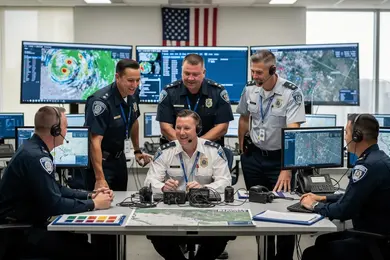
2027 Homeland Security Roles at the Center of AI-Enabled Threat Analysis

Co-Founder and Chief Data Scientist
Security analysts today face an escalating challenge: rapidly identifying AI-driven threats within vast, dynamic data streams where false positives can trigger costly operational errors. The Department of Homeland Security reported a 27% increase in AI-related incident investigations in the past two years, reflecting growing adversarial sophistication that outpaces traditional analysis methods. This surge forces professionals to integrate AI-enabled intelligence tools while managing workforce readiness and skills gaps intensified by inconsistent access to tailored education.
Nationwide shifts toward flexible, online program enrollment-up 15% among adult learners since 2023-signal a critical demand for adaptable training pathways synchronized with evolving threat landscapes. This article examines key homeland security roles central to AI-powered threat detection and offers a clear framework for selecting educational routes that align with career advancement and operational effectiveness.
Key Things You Should Know
- Federal workforce data from 2024 reveals AI-enabled threat analysis roles require 40% more advanced data science credentials, forcing candidates to choose between deep AI specialization or broad security training, limiting versatility in operational assignments.
- Employers prioritize candidates with combined cyber-intelligence and AI modeling skills, yet 65% report persistent skill gaps, pressuring HR to invest in costly in-house upskilling that extends time-to-deployment by six months.
- The average private-sector training cost for AI-integrated homeland security roles rose 22% in 2025, disproportionately limiting access for mid-career professionals balancing job retention with required upskilling timelines.
What are AI-enabled threat analysis roles in homeland security?
AI threat detection roles in homeland security agencies require nuanced integration of advanced machine learning with intelligence operations to identify and respond to evolving cyber threats effectively. The Department of Homeland Security's 2025 assessment reveals that over 85% of critical infrastructure cyber incidents involved adversaries utilizing AI-enabled tools, illustrating a pressing demand for professionals skilled in both cybersecurity and AI-driven threat analysis.
Practitioners in homeland security positions in AI-driven threat analysis must manage large volumes of unstructured data-network logs, social media signals, sensor information-to detect preemptive threat indicators. For instance, an analyst tasked with critical infrastructure protection might employ AI algorithms to flag automated phishing attempts targeting power grids, enabling rapid defensive actions. Conversely, border security roles could incorporate AI-based image recognition alongside anomaly detection to spot unauthorized crossings with minimal latency and human error.
Employers seek individuals who combine traditional cyber threat intelligence capabilities with ongoing expertise in AI model validation, ethical algorithm deployment, and adversarial AI countermeasures. This hybrid skill set demands continuous learning, reflecting the rapid AI tool evolution and the operational tradeoff between automation precision and human oversight to mitigate false positives without sacrificing response speed.
For those beginning this career path, foundational credentials such as the best online associates in criminal justice can provide a pragmatic entry point, balancing technical understanding and practical employability in security-focused roles.
What degrees prepare students for AI-enabled homeland security careers?
Among educational pathways for careers in AI-driven Homeland Security, degrees in computer science, data science, cybersecurity, and artificial intelligence offer the most direct route to operational roles. These programs equip students with practical skills for building and refining AI systems, such as machine learning models that improve threat detection-a core function in Homeland Security analysis. A data scientist, for example, must navigate both technical complexity and government-specific data regulations to translate algorithm outputs into actionable intelligence.
Degrees in systems engineering, information technology, or applied mathematics provide valuable analytical foundations but usually require further specialization in AI or homeland security policy to meet job readiness. Without that focus, graduates risk a skill mismatch in an environment where understanding workflows and compliance is as vital as technical proficiency.
The inventory of DHS AI use cases, which reached 159 by mid-2025, reflects the escalating demand for professionals who can integrate AI capabilities with mission needs across threat analysis, biometric identification, and cybersecurity domains. Prospective students should prioritize programs incorporating hands-on AI tools, government internships, and coursework on risk management and computational ethics to avoid falling short in practical expertise.
Choosing a program without these elements often results in theoretical knowledge that lacks direct application, disadvantaging candidates in a workforce increasingly reliant on AI-augmented decision-making. For those evaluating options, consulting resources on the best cybersecurity courses can clarify which offerings provide relevant, experiential learning aligned with Homeland Security degree programs for artificial intelligence threat analysis.
How do online and campus programs compare for homeland security?
Campus and online homeland security education comparison reveals critical tradeoffs that influence workforce readiness and practical capability. Campus programs offer immersive access to government-standard AI and security technology labs, facilitating hands-on skills essential for roles like border security and narcotics interdiction. For example, DHS's CBP unit's deployment of a machine-learning model that improved narcotics detection by 25% depended on detailed data pattern recognition and field feedback, competencies best honed in campus-based simulations.
In contrast, online homeland security degree pathways provide flexibility for working professionals and those constrained geographically or by family obligations but often require students to secure supplemental internships or local government collaborations to gain equivalent operational experience. This gap affects immediate employability since employers typically value campus graduates for sharper operational AI proficiency and reduced onboarding time.
- Campus programs more directly prepare specialists with applied AI threat analysis capabilities aligned with DHS operational demands.
- Online programs suit candidates balancing work or family but necessitate proactive efforts to obtain practical experience.
- Employers prioritize graduates demonstrating hands-on skills over convenience-based credentials.
Prospective students weighing online homeland security degree vs campus programs should integrate employer expectations with their personal circumstances. Those targeting high-impact roles or seeking to join agencies swiftly may find campus programs more effective, while online options benefit career changers needing hybrid practicums. Considering pathways within broader forensic careers can also help clarify relevant skill applications and sector demands.
What accreditation should a homeland security program have?
Accreditation by ABET or equivalent regional bodies recognized by the U.S. Department of Education remains a pivotal factor influencing employer trust and graduate success in homeland security fields. Programs meeting these standards ensure curricula that combine technical rigor with policy integration, equipping students to handle AI-enabled threat analysis and intelligence functions with operational precision. This dual emphasis is essential when assessing homeland security program accreditation standards given today's interdisciplinary workforce demands.
Graduates from ABET-accredited tracks demonstrate proficiency in emerging technologies-skills highly sought in sensitive operations like counterterrorism or trafficking investigations. For instance, Homeland Security Investigations' Operation Renewed Hope in August 2023, which used AI training from accredited programs, identified 311 previously undiscovered victims in under a month. Such results illustrate how accreditation correlates with field efficacy, not merely academic recognition.
Key workforce implications include:
- Increased access to federal internships and security clearances tied to recognized accreditation
- Enhanced readiness for AI-driven roles requiring both policy context and technical skill
- Risks of gaps in knowledge and employability challenges from unaccredited programs
To align educational pathways with these realities, students evaluating homeland security degrees should verify accreditation covers both technical and policy elements. This verification mitigates friction in career pivots and advances operational competencies essential for impactful roles. Professionals weighing alternatives may also consider cross-disciplinary options like forensic psychology graduate programs online, which share overlapping investigative frameworks and employability trends.
What courses are included in AI and threat analysis curricula?
The practical value of AI and threat analysis curricula lies in their multidisciplinary approach to rapidly evolving adversarial threats. Employers expect graduates to deliver actionable insights against AI-driven extremist tactics, which demand more than theoretical knowledge in machine learning and natural language processing. Professionals in homeland security, for example, must decode AI-amplified disinformation on social platforms and adjust mitigation strategies in near real-time, a challenge beyond traditional intelligence timelines.
These programs focus on operational skills including anomaly detection within vast datasets and behavioral analytics that track recruitment patterns, addressing critical workforce needs. Graduates face tradeoffs such as balancing data integrity from multiple, often incomplete sources while managing the computational expense of large AI models. Coursework emphasizes secure data pipelines and cloud optimization to mitigate these challenges while maintaining processing accuracy under pressure.
Additional elements like ethical AI use, threat actor profiling, and scenario-based simulations prepare students for the complexity of AI deployment in counterterrorism. Coordination with law enforcement and familiarity with AI governance policies are necessary to translate insights into concrete counterterrorism actions. Graduates aiming for strategic homeland security roles must be ready to continuously refine detection models as adversaries accelerate technological adaptation.
- Hands-on experience with generative AI misuse and countermeasures
- Scenario simulations that replicate AI-driven attack dynamics
- Advanced study of AI governance and policy integration
What admission requirements do homeland security programs usually ask for?
A minimum of a bachelor's degree-often in fields like criminal justice, cybersecurity, or political science-is standard for admission into homeland security master's and certificate programs, but effective candidacy hinges on more than credentials alone. Employers and admissions panels prioritize candidates with 3 to 5 years of relevant experience in law enforcement, intelligence, emergency management, or IT security. For example, a cybersecurity analyst moving from private industry may still need to demonstrate direct operational exposure to cyber threat mitigation to be competitive.
Military or government service experience can substitute for traditional work history, particularly if it involves hands-on cyber operations or counterterrorism activities tied to AI-enhanced threats. Given the U.S. Intelligence Community's documented rise in AI-augmented network compromises-up 60% from 2023 to 2025-programs increasingly expect applicants to show foundational cybersecurity knowledge aligned with these evolving challenges.
Standardized test scores like the GRE are optional and rarely decisive unless complemented by quantitative coursework or certifications such as CISSP. Letters of recommendation and personal statements must emphasize analytical rigor and ethical judgment under pressure, reflecting intelligence community standards.
Applicants without security-specific degrees frequently face requirements to complete foundational training, which can delay entry and demand extra resources. This tradeoff affects those pivoting careers who must balance immediate employment demands against the time to credential.
Adapting admissions criteria to evolving threats provides a filter for candidates prepared for the complex, AI-driven risk landscape that defines homeland security work today.
How long do homeland security degree programs usually take?
Choosing a homeland security degree requires balancing educational duration with workforce expectations for AI-related roles. Typically, associate degrees span two years and bachelor's degrees four, reflecting standard undergraduate timelines. Yet working professionals should anticipate longer completion times-often six months to two years more-when opting for part-time, accelerated, or online formats. Employers increasingly demand bachelor's-level expertise in risk assessment, cybersecurity, and intelligence analysis to effectively collaborate with AI tools in threat prediction.
Graduate certificates and master's programs, lasting 12 to 24 months, offer focused skill sets in AI governance, data analytics, and policy oversight. These credentials align with rising public and agency calls for transparency and independent review of AI systems, demonstrated by a 2024 RAND survey where support for DHS AI efforts increases from 39% to 63% given strict governance conditions. This underscores the growing importance of practical governance training for mid-career professionals navigating complex operational environments.
Students must weigh challenges such as managing course load alongside occupational demands and prioritize programs with embedded experiential components, like internships, that enable immediate application of AI operational skills. The tension between academic rigor and real-world utility shapes employability trajectories more than credential length alone.
- Associate degrees: ~2 years, foundational knowledge
- Bachelor's degrees: ~4 years, AI-integrated curriculum
- Graduate certificates/Master's: 12-24 months, specialized governance and analytics focus
What can homeland security graduates do after earning this degree?
Homeland security roles increasingly demand advanced AI and data science skills that surpass traditional analytic methods, reshaping workforce expectations significantly. Positions in intelligence analysis, incident response, and threat assessment now depend on the ability to fuse machine learning outputs with geopolitical insight, making pure domain expertise insufficient without technical fluency. For example, counterterrorism analysts use AI-driven natural language processing to monitor social media and dark web chatter-tasks that require continuous updating of AI knowledge and navigating ethical challenges tied to automated decision-making.
This shift means graduates must critically assess program emphasis on coding, algorithm design, and AI ethics against operational realities, including collaboration with IT and data science teams. Career trajectories often involve project management of AI systems or policy advising on AI usage within intelligence settings, demanding interdisciplinary adaptability rather than linear progression.
Practitioners upgrading skills should focus on AI model validation, interpretability, and integration to sustain relevance. Without robust AI literacy, risk of obsolescence grows as DHS increasingly automates intelligence functions. Real-world employability hinges on hands-on experience with government AI platforms and compliance with federal data regulations, which are key differentiators in competitive hiring.
- DHS projects over 30% of new analyst roles will explicitly require AI expertise through 2027
- Legacy functions like manual data analysis are rapidly losing value without automation skills
- Interdisciplinary collaboration and ethical fluency are essential for operational success
How much do AI threat analysis jobs in homeland security pay?
AI threat analysis roles within homeland security now demand more than technical coding expertise; they require proficiency in regulatory compliance and bias mitigation. Median salaries range from $90,000 to $140,000 annually, with entry-level positions near $85,000 and senior analysts exceeding $150,000-especially in agencies prioritizing responsible AI governance. For example, analysts managing real-time bias corrections in border security must blend AI proficiency with adherence to evolving federal standards, a combination that significantly influences compensation.
Salary progression is tightly linked to one's ability to navigate complex federal mandates such as human-in-the-loop controls and auditability requirements specified in the 2025 DHS AI Strategy. Candidates lacking compliance-focused skills often experience slower wage growth despite technical competency. Career switchers should consider advanced training or certifications centered on AI risk and governance, as agencies increasingly favor candidates who can operationalize continuous risk assessments aligned to federal guidelines.
Regional factors and employer context-federal versus state-also affect wage disparities, making geographic choices consequential for financial outcomes. Employers value professionals who integrate regulatory frameworks effectively rather than purely algorithmic development talents. This reality emphasizes a strategic tradeoff: prioritizing interdisciplinary skill sets in AI oversight offers greater long-term employability and compensation than narrowly technical roles.
What certifications help advance homeland security careers?
Certifications in cybersecurity and intelligence analysis are crucial for professionals aiming to manage AI-enabled threats within homeland security. Candidates holding credentials like Certified Information Systems Security Professional (CISSP) and Certified Ethical Hacker (CEH) demonstrate not only foundational security expertise but also an ability to anticipate and mitigate attacks exploiting AI vulnerabilities. For instance, recognizing synthetic media used for radicalization is a practical skill increasingly demanded by employers.
Though credentialing specific to AI threat assessment remains nascent, programs blending machine learning basics with terrorism risk interpretation are becoming essential. This aligns with budget-conscious efforts such as the Generative AI Terrorism Risk Assessment Act, which anticipates costs under $500,000 over five years-emphasizing workforce skill over expensive technology deployment.
Employers expect a balance of technical certification and operational experience using AI tools, while purely theoretical courses without applied context offer limited career advancement. Also, certifications must align with federal standards to be relevant; otherwise, professionals risk exclusion from advanced analytic roles.
- Prioritize cybersecurity certifications recognized by Homeland Security or federal bodies
- Engage in intelligence analysis training that integrates AI components
- Acquire hands-on experience with AI-enabled threat detection and analysis
This pragmatic certification path addresses both the fiscal constraints of homeland security agencies and the evolving threat landscape shaped by generative AI technologies.
Other Things You Should Know About Homeland Security
Integrating AI tools into homeland security threat analysis introduces significant workflow complexity. Professionals must balance reliance on automated outputs with human judgment, as AI can produce false positives or overlook nuanced threats that require contextual understanding. This means agencies must allocate time and resources to train analysts in interpreting AI results critically, which can slow down response times initially and demands ongoing learning to keep pace with evolving AI capabilities.
AI-enabled systems increase the volume and velocity of data analysts must review, shifting their role from data collection to strategic interpretation. This transition requires advanced analytical skills, including data literacy and understanding of algorithmic bias. Consequently, employers prioritize candidates who demonstrate both technical proficiency and the ability to integrate AI insights into operational decisions. Professionals without these skills risk being sidelined as workflows become more AI-dependent.
Prioritizing AI technical skills can offer immediate employability advantages, but neglecting foundational homeland security knowledge weakens long-term effectiveness. Professionals must achieve a balance; AI skills are essential for handling modern threat environments, but understanding broader security principles remains critical for context and ethical decision-making. Programs combining both elements produce better-prepared candidates, and individuals should seek curricula that emphasize this integration rather than focusing narrowly on AI alone.
References
- AI Threat Detection: How It Works & 6 Real-World Applications https://www.oligo.security/academy/ai-threat-detection-how-it-works-6-real-world-applications
- Future-Proof Your Career with a Master’s in Homeland Security Leadership | UMGC https://www.umgc.edu/blog/umgc-new-masters-degree-homeland-security-leadership
- Certified Homeland Protection Professional (CHPP) https://www.sheriffs.org/homeland-security-2/chpp/
- Differences Between a Criminal Justice and Homeland Security Degree https://www.nec.edu/news/criminal-justice-vs-homeland-security-degree
- What Can You Do With A Homeland Security Degree? https://www.criminaljusticeprograms.com/articles/what-can-you-do-with-a-homeland-security-degree/
- Choosing a bachelor's in homeland security | edX https://www.edx.org/resources/how-to-choose-a-bachelors-in-homeland-security
- ACADEMY | C4SEM | GLOBAL https://www.c4sem.org/homeland-security
- Dept. of Homeland Security clarifies English-language program accreditation requirements https://www.highereddive.com/news/agency-clarifies-mandate-on-accreditation-of-english-language-programs/38234/
- Emergency Management & Homeland Security Accreditation | CAEMHSE https://www.caemhse.education/
- DHS I&A — We keep the homeland safe https://www.intelligencecareers.gov/dhsia