World Online Ranking of Best Ecology and Evolution Scientists - 2026 Report
Audited and Verified:
Our Editorial and Data Verification Process
Research.com uses government datasets, official education statistics and primary institutional information to support its career and degree guides. Our review process checks factual accuracy, occupational definitions, source dates and the requirements associated with the credentials discussed.
How This Article Was Fact-Checked
Our editorial team verifies salary estimates, employment projections, education requirements and program information against original data providers and official organizations. Salary figures are checked against the relevant occupational definitions and reporting periods. Information about licensure, accreditation and required in-person training is reviewed separately.
Fact-checked and verified on:

Co-Founder and Chief Data Scientist
On May 15, 2026, Research.com released the 5th edition of the annual ranking of the best scientists in the ecology and evolution field. This report aims to provide the academic community with a transparent and robust list of the world's most influential researchers.
This ranking serves as a vital resource for academic institutions and policymakers seeking to understand the shifting dynamics of ecological studies. By highlighting the leading experts, the report enables rising scholars to identify potential mentors and collaborative opportunities.
For the 2026 edition, our research team meticulously evaluated over 8,400 profiles using OpenAlex, CrossRef, and other bibliometric databases. This extensive data collection ensures that only the most active and recognized scholars are featured in the final list.
The methodology requires a minimum D-index of 30 for a scientist to be considered for this discipline. Beyond this threshold, the ranking carefully considers the scholar's D-index score, the proportion of their work contributed specifically to the field, and notable awards or achievements.
Latest studies in ecology and evolution research
Recent studies in ecology and evolution have revealed massive, untapped biological resources while simultaneously reshaping our understanding of human history. For example, a massive 2026 study in Nature examined 820 coral samples from the Pacific Ocean, discovering that coral microbiomes rival traditional sponges in their potential to produce new medicines. However, this vast molecular library faces severe practical challenges as global warming and coral bleaching threaten to destroy these ecosystems before they can be fully explored.
Scientists identified over 4,000 microscopic species living inside these corals, with over 90% completely unknown to modern genetics. These tiny lifeforms create special chemicals that could lead to breakthrough medical treatments or new eco-friendly industrial materials. Unfortunately, the rapid destruction of coral reefs means researchers are racing against the clock to safely catalog this vital biodiversity.
On the evolutionary front, another major 2026 study published in Quaternary Science Reviews shifted our view on why our ancient Neanderthal cousins vanished. Using advanced computer models of ancient European habitats, researchers found that the harsh Ice Age climate alone did not wipe out the Neanderthals. Instead, modern humans ultimately survived because they built stronger, more resilient social networks that helped them adapt to a changing world.
The key findings for the 5th edition of the best ecology and evolution scientists ranking
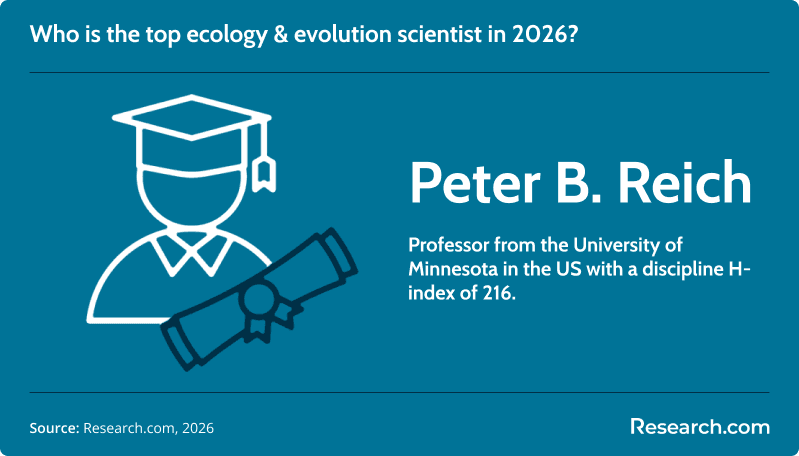
- Peter B. Reich from the University of Minnesota is the world's #1 active scientist in ecology and evolution.
- The United States continues to lead the global ranking, serving as the top country with 367 featured scientists.
- The Spanish National Research Council ranks as the top institution, hosting 18 leading researchers.
- China showed the most improvement year-over-year based on the previous report, moving up from 10th place to 9th place globally.
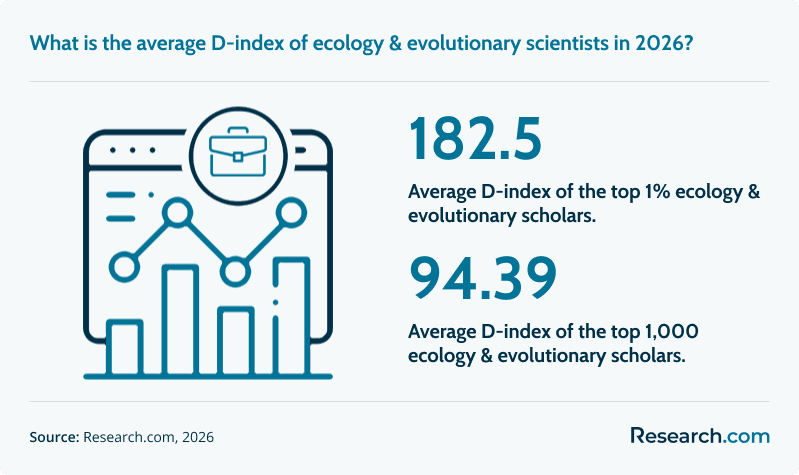
- The average D-index for the top 1% of scientists is 182.5, which is nearly double the overall average of 94.39 for all ranked researchers.
- A minimum D-index of 30 is required for a scientist to be considered for inclusion in the top ranking.
The full ranking for the 2026 list of the best ecology and evolution scientists can be found here:
[WORLD’S BEST ECOLOGY AND EVOLUTION SCIENTISTS RANKING]
Countries with the highest number of leading ecology and evolution scientists
The United States continues to lead the world in ecology and evolution research, holding the 1st place position with 367 featured scientists compared to 380 scholars in the 2025 report. The United Kingdom follows in 2nd place with 135 scholars, down from 141, while Australia maintains its 3rd place ranking from the previous report, increasing its representation from 80 to 82 researchers. These three dominant nations represent a substantial portion of the world's elite ecological experts.
Germany secured 4th place with 68 scientists, improving its overall count despite holding the same 4th place ranking with 63 scholars in the previous report. China demonstrated notable growth by moving up from 10th place and 20 researchers in the previous report to 9th place globally with 23 scientists. Meanwhile, Switzerland slid to 10th place with 23 experts this year after previously holding the 9th place position with 25 scholars.
The geographical distribution of these researchers provides valuable insight into the global centers of academic excellence.
Please note that the country associated with a scientist is based on the affiliated research institution according to MAG, not on their actual nationality.
Institutions with the highest number of leading scientists
The Spanish National Research Council claims the highest position globally this year with 18 leading scientists, maintaining its 1st place ranking from the 2025 report, where it hosted 16 scholars. The University of Oxford closely follows in 2nd place with 16 scholars, stepping down slightly from its shared 1st place position and 16 researchers last year. Wageningen University & Research completes the top three, maintaining its 3rd place ranking and its exact count of 14 featured researchers from the previous report.
The University of British Columbia secured the 4th spot with 13 scientists, showing significant progress by moving up from 7th place. Stanford University also saw upward mobility, climbing to 5th place with 12 scientists after sitting in 6th place with 13 researchers last year. Conversely, the University of California, Davis, experienced a slight shift downward from 3rd place and 14 experts in the previous report, landing in 6th place this year with 12 experts.
Advancing ecology and evolution research through online universities
The ongoing shift toward remote learning is a broader academic trend impacting all fields, including the study of natural ecosystems. According to the 2025 Changing Landscape of Online Education (CHLOE 10) report published by EDUCAUSE and Quality Matters, higher education institutions plan to expand their digital offerings over the next three years. This institutional expansion allows modern online universities to attract diverse, non-traditional students who might otherwise be unable to participate in intensive graduate-level science programs.
As distance education grows, many online universities are finding innovative ways to incorporate field research and ecological data analysis into their remote curricula. This ongoing evolution of digital learning frameworks ultimately broadens the global talent pool for future academic discovery. By breaking down geographic barriers, these distance programs ensure that passionate scholars from any location can effectively contribute to the ecology and evolution community.
H-index ranking—leaders, averages, and distribution
The top active scholars across the globe are distributed widely, with Peter B. Reich from the University of Minnesota in the United States leading North America at a global rank of 1 with a D-index of 216.
In Europe, Kevin J. Gaston of the University of Exeter in the United Kingdom holds the top continental spot, ranking 2nd globally with a D-index of 194.
Asia is led by Carlos M. Duarte from Saudi Arabia's King Abdullah University of Science and Technology, who ranks 3rd with a D-index of 191.
For Oceania, the leading researcher is Hugh P. Possingham from the University of Queensland in Australia, claiming the 8th global spot with a D-index of 170.
Africa's leading expert is David M. Richardson from Stellenbosch University in South Africa, ranking 24th globally with a D-index of 153.
South America is represented by Sandra Díaz of the National University of Córdoba in Argentina, ranking 182nd with a D-index of 107.
The average D-index for the top 1% of scientists is 182.5, compared to an average of 94.39 for all ranked scholars.
When examining research output, the top 1% of scientists published an average of 883.7 articles, which contrasts with the 334.13 average publications for the entire top 1000 list.
Finally, the leading 1% of researchers garnered an average of 159,022.2 citations, significantly higher than the 42,312.11 average citations seen across the broader ranking.
You can learn more about the methodology used to create this report here.
About Research.com
All research was coordinated by Imed Bouchrika, Ph.D., a computer scientist with a well-established record of collaboration on a number of international research projects with different partners from the academic community. His role was to make sure all data remained unbiased, accurate, and up-to-date.
Research.com is the number one research portal for science and educational rankings. Our mission is to make it easier for professors, research fellows, and students to progress with their research and find the top experts in a wide range of scientific disciplines. Research.com is also a leading educational platform that helps students find the best colleges, academic opportunities, and career paths.