2027 ESL Teacher Requirements & ESOL Certification in Virginia

Co-Founder and Chief Data Scientist
Becoming an ESL teacher in Virginia means preparing to work with students who are learning academic English while also keeping up with grade-level content. That work matters because more than 10% of Virginia’s student population requires ESL support, and schools need educators who understand language development, culturally responsive instruction, assessment, and state licensure rules.
This guide explains how ESOL certification works in Virginia, what education and exams are required, which alternative routes may fit career changers, how renewal works, what salaries look like, and how to decide whether this teaching path matches your goals. It is designed for future teachers, licensed educators adding an endorsement, out-of-state teachers moving to Virginia, and professionals considering a switch into K–12 education.
Quick Answer: ESL Teaching Requirements and ESOL Certification in Virginia
To teach ESL in Virginia public K–12 schools, you generally need a bachelor’s degree, completion of an approved teacher preparation route or qualifying ESOL coursework, required state exams, and an ESOL endorsement through the Virginia Department of Education. Licensed Virginia teachers may be able to add the ESOL endorsement without starting the full licensure process again.
- Minimum education: A bachelor’s degree from an accredited institution is the baseline requirement for teacher licensure in Virginia. Many candidates strengthen their preparation with TESOL, linguistics, reading, or education coursework.
- ESOL endorsement testing: Virginia requires candidates to pass applicable licensure exams, including the English Language Teaching or ESOL-related certification assessment required for K–12 endorsement.
- Renewal matters: ESOL certification is not a one-time step. Virginia requires ongoing professional learning, which is especially important as the state’s diverse ESL student population grew 20% over the last decade.
- What education do you need to teach ESL in Virginia?
- How do you earn ESOL certification in Virginia?
- What alternative routes can lead to ESL teaching in Virginia?
- Which exams are required for Virginia ESL teacher certification?
- How often is ESL teacher certification renewed in Virginia?
- What continuing education is required for ESL teachers?
- What career advancement options are available for ESL teachers in Virginia?
- How long does it take to become an ESL teacher in Virginia?
- Does Virginia offer reciprocity for ESL certification?
- Is there demand for ESL teachers in Virginia?
- What local resources support ESL teachers in Virginia?
- How much do ESL teachers earn in Virginia?
What are the education requirements to teach ESL in Virginia?
Virginia expects ESL teachers to have both general teacher preparation and specialized training in how students acquire English as an additional language. The goal is not only to qualify candidates for licensure, but also to prepare them to teach reading, writing, speaking, listening, vocabulary, and academic content to students at different English proficiency levels.
- Bachelor’s degree: A baccalaureate degree from an accredited college or university is required for Virginia teacher licensure.
- State-approved teacher preparation: Many candidates complete an approved educator preparation program that includes pedagogy, classroom management, assessment, and supervised clinical experience.
- ESOL-specific coursework option: Candidates who do not complete an approved ESL preparation program may qualify through 24 semester hours in required ESOL-related areas such as reading and writing instruction, English linguistics, cross-cultural education, second language acquisition, ESL methods, assessment, and approved electives.
- Optional post-baccalaureate certificate: Some institutions offer a 12-credit post-baccalaureate certificate in ESL for educators or career changers who want focused preparation beyond an initial degree.
| Education option | Who it usually fits | What to check before enrolling |
| Bachelor’s degree with teacher preparation | First-time college students who know they want to teach | Confirm the program is approved for Virginia licensure and includes the right endorsement pathway. |
| Post-baccalaureate ESL certificate | Degree holders who need targeted ESOL coursework | Ask whether the credits satisfy endorsement requirements or only provide professional development. |
| 24 semester-hour coursework pathway | Candidates completing requirements outside a single approved ESL program | Map every course to Virginia’s required ESOL content areas before paying tuition. |
| Associate degree starting point | Students beginning at a community college or exploring education careers | Plan transfer credits early if your long-term goal is teacher licensure. |
If you are starting with a lower-division credential, review how education associate degree pathways may transfer into a bachelor’s program that can lead to licensure. An associate degree alone is not enough for Virginia teacher licensure, but it can be a cost-conscious first step if credits transfer cleanly.
How do you get ESOL certified in Virginia?
ESOL certification in Virginia is obtained by meeting education, clinical practice, testing, and application requirements. The exact sequence depends on whether you are a first-time teacher, already licensed in Virginia, or entering through an alternative pathway.
- Earn a bachelor’s degree: Complete a degree from an accredited institution. Your major may be education, English, linguistics, TESOL, or another field, but your coursework must ultimately satisfy teacher licensure and ESOL endorsement expectations.
- Complete an approved preparation route or required ESOL coursework: Finish a state-approved teacher preparation program focused on ESL or complete at least 24 semester hours in areas such as linguistics, second language acquisition, teaching methods, assessment, and cross-cultural education.
- Complete field experience: Most pathways include supervised practicum, student teaching, or another school-based placement where you work with English learners under guidance.
- Pass required exams: Candidates typically need the Virginia Communication and Literacy Assessment and the Praxis Subject Assessment in English to Speakers of Other Languages (#5362), along with any other tests required for their licensure route.
- Submit the licensure or endorsement application: Apply through the Virginia Department of Education or, if you are already employed and licensed, work with your school division’s licensure office to add the ESOL endorsement.
- Pay required fees: Budget for exam registration, application processing, transcript requests, and any program-related fees. Amounts can vary by pathway and agency.
| Applicant type | Most likely next step | Decision point |
| New college student | Choose a Virginia-approved teacher preparation program with ESOL alignment | Do not choose a program based only on convenience; verify licensure outcomes first. |
| Licensed Virginia teacher | Add the ESOL endorsement through approved coursework or a preparation program | Ask your division licensure office which courses and exams remain. |
| Career changer | Consider a Career Switcher or Alternative Route to Licensure option | Make sure the program supports ESOL endorsement, not just general teaching entry. |
| Out-of-state ESL teacher | Submit credentials for Virginia review | Expect possible testing or coursework if your prior preparation does not align with Virginia standards. |
What are the alternative routes to becoming an ESL teacher in Virginia?
Virginia’s alternative licensure routes can help schools fill vacancies while giving qualified adults a structured way into teaching. These options are most useful for candidates who already have a bachelor’s degree, relevant professional experience, or an existing teaching license.
- Career Switcher Program: This route is designed for candidates with at least five years of professional experience. Participants need a bachelor’s degree, complete state-approved preparation, and may begin with a provisional teaching license before working toward a full five-year renewable license.
- Alternative Route to Licensure programs: ARL programs serve degree holders who did not major in education. Some formats allow candidates to begin teaching within eight weeks while completing pedagogy requirements under supervision.
- Provisional teaching license: Candidates hired by a Virginia public school or accredited private school may be eligible for a provisional license valid up to three years while they finish remaining coursework, exams, or endorsement requirements.
- Adding ESOL to an existing Virginia license: Current teachers can expand into ESL instruction by completing an approved ESL educator preparation program or the required ESOL coursework rather than repeating initial licensure.
- Out-of-state credential review: Teachers licensed elsewhere may qualify after Virginia reviews transcripts, testing, experience, and endorsement preparation.
| Alternative route | Best for | Main advantage | Main caution |
| Career Switcher Program | Experienced professionals with at least five years of work history | Recognizes professional experience and creates a structured path into teaching | Teaching while completing requirements can be demanding. |
| Alternative Route to Licensure | Bachelor’s degree holders without an education major | Can be faster than returning for a traditional education degree | Not every fast-track route is equally aligned with ESOL endorsement needs. |
| Provisional license | Candidates hired by a school before all requirements are finished | Allows paid classroom experience while completing licensure steps | The license is temporary and requirements must be completed on time. |
| Add-on endorsement | Already licensed Virginia teachers | Builds on an existing license rather than restarting | Coursework and exam requirements may still apply. |
A Virginia ESL teacher who entered education from another profession described the alternative route as both practical and intense. The provisional license allowed her to learn while employed, but the workload required careful planning. She said the strongest part of the experience was mentorship, because feedback from experienced educators helped her connect ESOL theory to real classroom decisions.
What exams are required for ESL teacher certification in Virginia?
Virginia uses exams to confirm that future teachers can communicate effectively, understand core academic skills, and demonstrate ESOL-specific instructional knowledge. Requirements can vary by program, endorsement, and prior licensure status, so candidates should confirm the current testing plan with their preparation provider or licensure office.
- Core Academic Skills for Educators: This ETS exam assesses reading, writing, and mathematics skills and is often used for admission into educator preparation programs.
- Virginia Communication and Literacy Assessment: The VCLA measures reading and writing communication skills. The stated passing requirement is 235 on both reading and writing or a composite 470.
- Praxis English to Speakers of Other Languages Subject Assessment: This ESOL content exam evaluates knowledge of language acquisition, linguistics, instruction, assessment, and professional practice for teachers of English learners.
- Teaching Reading: Elementary, Praxis 5205: This exam focuses on early literacy and reading instruction. The stated passing score is 159.
Students comparing educator preparation options may also want to examine online bachelor’s degrees in special education, especially if they are interested in serving students who need both language support and specialized instructional services.
How often do ESL teachers need to renew their certification in Virginia?
Virginia teacher license renewal is designed to keep educators current in instructional practice, legal responsibilities, student support, and subject-specific teaching. ESL teachers should track renewal requirements from the start of each cycle rather than waiting until the final year.
- Renewal timeline: ESL teachers hold a renewable license valid for ten years. Licenses issued before 2018 followed a five-year cycle, but the current standard is renewal every ten years under Virginia Board of Education rules.
- Professional development points: Teachers must complete 270 professional development points during the ten-year period through approved learning activities.
- Individualized renewal plan: Educators create a professional growth plan connected to their goals and school priorities, then review progress with an advisor.
- Required statutory training: Renewal also includes state-mandated training in areas such as child abuse recognition, CPR, dyslexia, and mental health.
- Documentation: In the final renewal year, teachers submit evidence such as transcripts, certificates, training records, and other required materials to the appropriate division or state office.
- Renewal fee: A fee is required with the renewal application, and teachers should verify the current amount with the Virginia Department of Education or their local licensure office.
What are the continuing education requirements for ESL teachers in Virginia?
Continuing education helps ESL teachers improve instruction for students at different proficiency levels, stay current with assessment practices, and maintain licensure. Because renewal rules may reference different cycles depending on license issue date and policy updates, teachers should confirm their exact requirements with their school division or the Virginia Department of Education.
- Renewal cycle reference: Virginia requirements have included five-year renewal references, with continuing education completed inside each cycle.
- Professional development total: Teachers must earn 180 professional development points during each five years through approved activities when operating under that renewal framework.
- Approved activities: Graduate courses, conferences, workshops, in-service training, and professional seminars may count when they meet state or division criteria.
- Graduate-level coursework: A graduate course often counts as three credits and can support both renewal and long-term career development.
- Division-based training: School division workshops and Virginia Department of Education programs are common ways to document professional learning.
- Records and reporting: Teachers should keep transcripts, certificates, agendas, and official completion records for renewal submission.
- ESL relevance: Professional learning should include topics tied to English language acquisition, ESL methods, multilingual learners, assessment, or cultural competency.
- Endorsement-related courses: Some educators may need coursework in linguistics, cross-cultural education, ESL assessment, or related areas to satisfy endorsement requirements.
- Local oversight: School divisions may require pre-approval for certain activities and may monitor whether professional learning meets state standards.
| Professional development choice | Why it can help ESL teachers | Question to ask before counting it |
| Graduate TESOL or education course | Builds deeper expertise and may support salary movement or future roles | Will this course count toward renewal, endorsement, or both? |
| District ESL workshop | Connects directly to local curriculum, assessment, and student needs | Will the division issue official documentation? |
| Conference or professional seminar | Exposes teachers to instructional strategies and policy updates | Is the activity approved for professional development points? |
| In-service training | Often convenient and aligned with school improvement goals | Does it meet the content requirements for my renewal plan? |
If you plan to use continuing education to move into a higher credential, compare tuition, transfer policies, and licensure alignment before enrolling. Research.com’s guide to the most affordable online education degrees can help you begin that cost comparison.
What Are the Career Advancement Opportunities for ESL Teachers in Virginia?
ESL teachers in Virginia can advance by moving into roles that influence instruction beyond one classroom. Common paths include ESL lead teacher, mentor teacher, instructional coach, curriculum developer, testing or assessment coordinator, district ESOL specialist, and school administrator. Some educators also pursue graduate study in TESOL, literacy, special education, curriculum and instruction, or educational leadership.
Career growth is strongest when teachers choose professional development strategically. For example, a teacher who wants to coach colleagues may focus on adult learning and instructional leadership, while a teacher interested in literacy intervention may prioritize reading assessment and language development coursework. Those comparing related credentials can review Virginia English teacher requirements to understand how English and ESL teaching pathways overlap and differ.
| Advancement path | Typical focus | Preparation that may help |
| ESL lead teacher | Supports colleagues and helps coordinate services for English learners | Strong classroom results, mentoring experience, and ESOL expertise |
| Instructional coach | Guides teachers on lesson design, differentiation, and language supports | Professional learning in coaching, curriculum, and assessment |
| ESOL coordinator | Oversees program implementation, compliance, and data use | Leadership experience and advanced knowledge of ESL regulations |
| Curriculum specialist | Develops resources and aligns instruction to standards | Coursework in curriculum design, literacy, and multilingual education |
| Administrator | Leads schoolwide or districtwide programs | Educational leadership preparation and administrative credentialing |
How long does it take to become an ESL teacher in Virginia?
Starting from the beginning of college, becoming an ESL teacher in Virginia generally takes five to six years. The timeline can be shorter for candidates who already have a bachelor’s degree or a teaching license, but all candidates must still satisfy coursework, field experience, testing, and application requirements.
- Bachelor’s degree: Full-time students typically spend four years completing an undergraduate degree.
- Teacher preparation or ESL program: Preparation commonly takes one to two years, depending on whether the candidate studies full time, part time, or through an accelerated alternative route.
- Required exams: Exam preparation, registration, and score reporting can add several weeks, although many candidates complete testing while finishing coursework.
- Licensure application: After requirements are completed, processing and license issuance may take about eight to ten weeks.
- Student teaching or practicum: Candidates usually complete a semester-long supervised placement or, in some pathways, a year-long paid residency.
| Pathway | Approximate timeline using stated requirements | Best fit |
| Traditional undergraduate route | Five to six years from college entry to licensure | Students beginning their first bachelor’s degree |
| Post-baccalaureate or endorsement route | One to two years after the bachelor’s degree, depending on remaining requirements | Degree holders or licensed teachers |
| Alternative Route to Licensure | May allow teaching within eight weeks while requirements continue | Career changers ready for an intensive work-and-study model |
| Provisional license route | Up to three years to complete outstanding requirements | Candidates hired by a school before completing all licensure steps |
A Virginia ESL teacher who completed a local program described the process as a long but useful sequence. Balancing coursework, exam preparation, and student teaching was difficult, but the classroom placement helped connect theory to student needs. The waiting period after submitting the application also gave him time to prepare for the first year of teaching.
Does Virginia have reciprocity for ESL certification?
Virginia does not treat out-of-state ESL certification as automatic, true reciprocity. Teachers licensed elsewhere must submit documentation for review, and the state evaluates whether their preparation, exams, supervised experience, and endorsement area are comparable to Virginia’s ESOL requirements.
Out-of-state applicants should be ready to provide transcripts, test scores, proof of current licensure, and evidence of teaching or clinical experience. If Virginia determines that a candidate’s prior preparation does not fully match state standards, additional coursework or exams may be required. This review can lengthen the timeline, but it also ensures that teachers entering Virginia classrooms meet the same expectations as in-state candidates.
Is there a demand for ESL teachers in Virginia?
Yes. Demand for ESL teachers in Virginia is supported by the growth of English language learners, continuing school staffing needs, and the importance of language support in academic achievement. About 10% of students are classified as ELLs, and Virginia schools serve students from increasingly varied linguistic and cultural backgrounds.
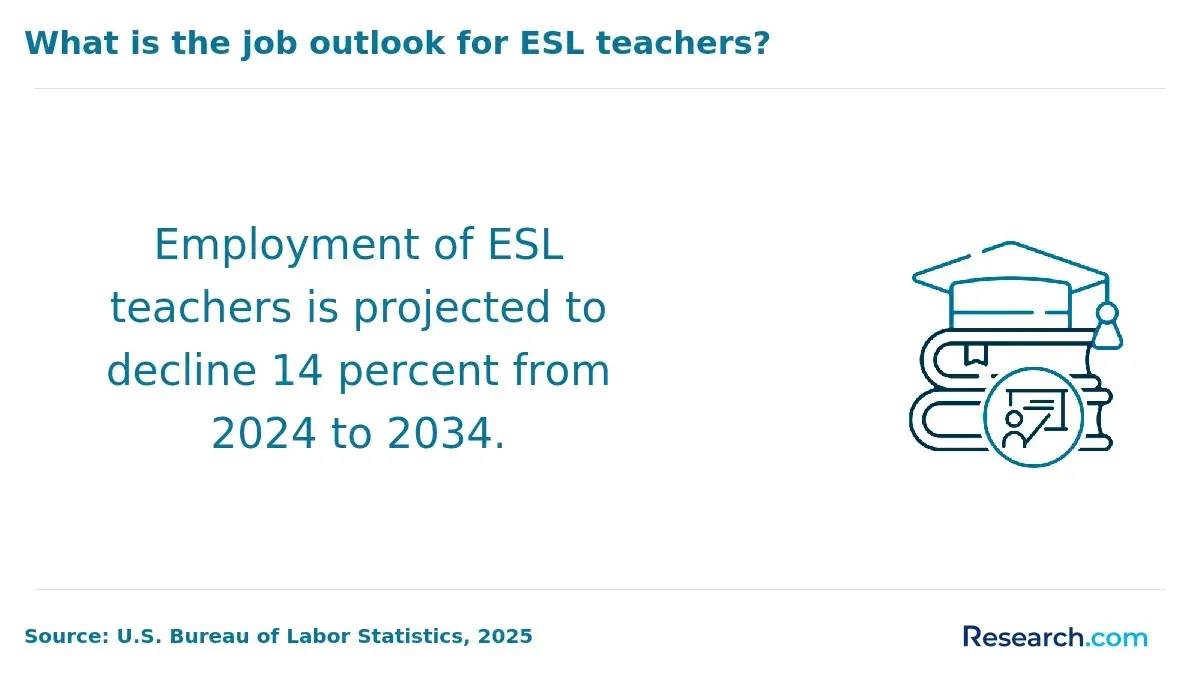
K–12 public schools are the main employment setting for ESL teachers, especially in urban districts and in rural communities experiencing growth in immigrant populations. The Virginia Department of Education reported a shortage of over 3,500 teachers in the 2022–2023 school year, and ESL roles are regularly identified as critical shortage areas. Adult education programs and community colleges also employ ESL instructors, although national projections indicate a decline in adult ESL positions over the next decade.
Teachers considering long-term specialization should choose credentials that match where they want to work. A K–12 ESOL endorsement is not the same as preparing for adult education, higher education, or program administration. If you are exploring advanced study outside teacher licensure, Research.com’s affordable online master’s degree rankings can also help you compare how graduate programs vary in cost and flexibility.
What local support networks and resources are available for ESL teachers in Virginia?
Virginia ESL teachers can find support through school division induction programs, mentor teachers, district ESOL teams, professional learning communities, university certificate programs, and state or regional workshops. These resources are especially valuable during the first years of teaching, when educators are learning how to manage language assessment, family communication, co-teaching, and differentiated instruction.
New teachers should ask their school division about mentoring, curriculum resources, translation and interpretation procedures, English learner identification, progress monitoring tools, and training for required documentation. Prospective teachers can also review Virginia teacher certification requirements to understand how ESOL endorsement fits within the broader licensure system.
How much do ESL teachers make in Virginia?
ESL teacher pay in Virginia depends on district salary schedules, degree level, years of experience, school type, geographic location, and whether the educator works in K–12, adult education, or an administrative role. Candidates should compare local salary scales rather than relying only on statewide averages.
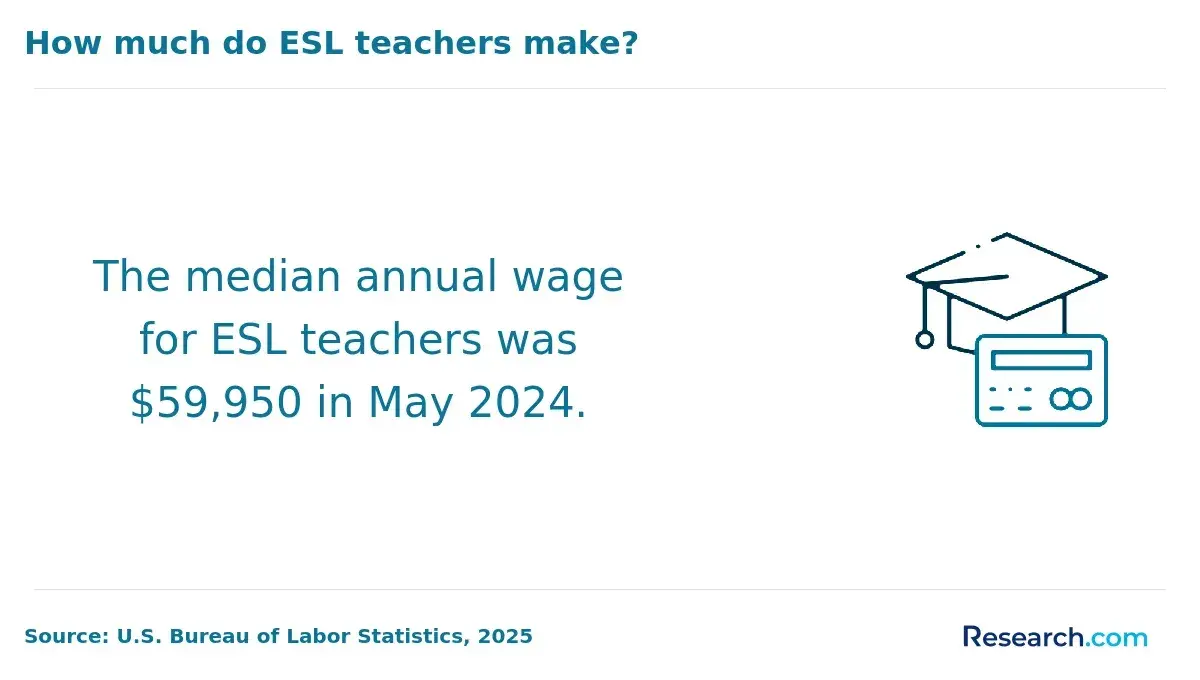
On average, ESL teachers in Virginia earn between $49,000 and $57,000 per year. Some urban areas, including Richmond, offer salaries exceeding $60,000 annually. The national average for ESL teacher salary in Virginia is stated as around $96,500, a figure influenced by postsecondary roles and higher-paying regions across the country.
- Location: Districts such as Virginia Beach and Richmond may pay more than some rural areas because of demand and cost-of-living differences.
- Public or private school setting: Public school teachers often receive stronger benefits and structured salary schedules, while private schools may have compensation tied more closely to tuition revenue.
- K–12 or adult education: K–12 positions often provide more stable full-time salary structures than adult education roles, which may be part time or grant funded.
- Advanced credentials: A Master’s degree in TESOL or additional endorsements can improve eligibility for higher pay lanes or specialist positions.
- Experience: District pay scales usually reward years of service, making long-term employment important for earnings growth.
- Leadership duties: ESL coordinators and program leaders can earn $69,000 or more because they carry broader responsibilities.
| Salary factor | How it affects pay | What candidates should do |
| District location | Urban and high-need districts may offer higher salaries | Compare district salary schedules before accepting an offer. |
| Degree level | Graduate credentials may qualify teachers for higher lanes | Confirm whether a master’s degree changes pay in the target district. |
| Role type | Coordinators and leaders often earn more than classroom-only roles | Build leadership experience if advancement is a goal. |
| School sector | Public and private schools may differ in salary and benefits | Evaluate health insurance, retirement, leave, and contract length, not only base salary. |
Educators considering doctoral-level leadership, research, or administrative roles can review information about online doctorate in education cost before committing to a major graduate investment.
What Do ESL Teachers in Virginia Say About Their Career
- Earning ESOL certification through the University of Virginia helped me enter a local school with stronger confidence. The program’s attention to Virginia’s multilingual classrooms pushed me to adapt lessons for different cultural and language backgrounds. The work is meaningful because I can see students gain access to academic content as their English grows. Dotty
- George Mason University’s ESOL certification program challenged me to rethink what language teaching means. In my Virginia school, the role is not limited to vocabulary and grammar; it also involves family engagement, inclusion, and helping students feel seen. Ongoing professional development has helped me keep improving. Layne
- After completing certification at Norfolk State University, I learned how closely ESL teaching connects to community relationships. Supporting students often means understanding their families, their histories, and the barriers they face outside school. Watching students become more confident makes the career worth the effort. Chad
Common Mistakes to Avoid When Pursuing ESOL Certification in Virginia
- Choosing a program before checking licensure alignment: Not every education or TESOL program automatically leads to Virginia ESOL endorsement.
- Looking only at tuition: Exam fees, application fees, practicum travel, transcript costs, and time away from work can change the real cost of preparation.
- Assuming online coursework always qualifies: Online programs can be convenient, but candidates must verify that credits meet Virginia endorsement rules.
- Waiting too long to plan exams: Testing delays can slow down licensure, especially if a candidate needs a retake.
- Ignoring renewal requirements: Professional development is easier to manage when teachers collect documentation throughout the cycle.
- Assuming reciprocity is automatic: Out-of-state teachers should prepare for an individual Virginia review and possible additional requirements.
- Relying only on salary averages: District salary schedules, benefits, contract length, and advancement options matter more than a single statewide figure.
Questions to Ask Before Choosing an ESL Teacher Preparation Program in Virginia
- Is this program approved or clearly aligned for Virginia ESOL endorsement?
- Which exams will I need, and when should I take them?
- Does the program include supervised experience with English learners?
- Will completed credits count toward both endorsement and future graduate study?
- How does the program support working adults, career changers, or licensed teachers adding an endorsement?
- What are the total costs beyond tuition?
- Who verifies that my coursework satisfies the 24 semester-hour ESOL requirement if I am not in an approved program?
- What placement, mentoring, or job search support is available in Virginia school divisions?
Key Insights
- Virginia ESL teachers generally need a bachelor’s degree, teacher preparation or qualifying ESOL coursework, required exams, and an ESOL endorsement for K–12 public school teaching.
- The fastest route is not always the best route. Career Switcher, ARL, provisional license, and add-on endorsement pathways can work well, but only if they satisfy ESOL-specific requirements.
- Testing is a major checkpoint. Candidates should plan for the VCLA, Praxis ESOL assessment, and any additional exams required by their program or endorsement area.
- Renewal and professional development are part of the career. Teachers should track training records early and confirm whether their license follows the current ten-year and 270-point framework or another applicable renewal structure.
- Demand is strongest in K–12 public schools, where about 10% of students are classified as ELLs and Virginia reported a shortage of over 3,500 teachers in the 2022–2023 school year.
- Salary varies widely. Virginia ESL teachers average between $49,000 and $57,000 per year, with some urban areas exceeding $60,000 and coordinator roles reaching $69,000 or more.
- Before enrolling in any program, verify accreditation, endorsement alignment, field placement quality, transferability of credits, total cost, and support for licensure paperwork.
Related Articles for Nearby States
- 2027 ESL Teacher Requirements & ESOL Certification in West Virginia
- 2027 ESL Teacher Requirements & ESOL Certification in Maryland
- 2027 ESL Teacher Requirements & ESOL Certification in North Carolina
- 2027 ESL Teacher Requirements & ESOL Certification in Tennessee
- 2027 ESL Teacher Requirements & ESOL Certification in Kentucky
- 2027 ESL Teacher Requirements & ESOL Certification in Pennsylvania
- 2027 ESL Teacher Requirements & ESOL Certification in South Carolina
- 2027 ESL Teacher Requirements & ESOL Certification in Ohio
- 2027 ESL Teacher Requirements & ESOL Certification in Delaware
- 2027 ESL Teacher Requirements & ESOL Certification in New Jersey
References:
- English as a Second Language: Certificate | UVA School of Education and Human Development https://education.virginia.edu/academics/programs/english-second-language-certificate
- TESOL Certification in Virginia | How to Become an ESL Teacher in VA | ESL Endorsement and Jobs https://www.eslteacheredu.org/virginia/
- ESOL Programs | EducateVA https://educateva.com/esol-programs
- Post-Baccalaureate Certificate – English as a Second Language | W&M School of Education https://education.wm.edu/academics/ci/degrees/esl/certificate/
- Virginia Retirement System | Home for Active & Retired Members https://www.varetire.org/
- Virginia Retirement System (VRS) | Fairfax County Public Schools https://www.fcps.edu/about-fcps/employees/salary-and-benefits/benefits-package/retirement-plans/virginia-retirement
- The Virginia Retirement System - VEA Website https://www.veanea.org/membership-benefits/member-center/retirement-planning-center/the-virginia-retirement-system/
- Virginia | TeacherPensions.org https://www.teacherpensions.org/state/virginia
- Virginia Retirement System - Richmond Public Schools https://www.rvaschools.net/talent-office/benefits-and-compensation/virginia-retirement-system
- Employee Benefits/Retirement Plans/Insurance 4-37 - Virginia Beach School Board https://schoolboard.vbschools.com/policies/section-4/4-37
Other Things You Should Know About Being an ESL Teacher in Virginia
The Virginia Department of Education administers the ESL teacher certification process in 2027. They handle application reviews, set the standards for certification, and oversee the licensure examinations required for ESL teachers in the state.
Licensed teachers in Virginia can add an ESL endorsement by completing a state-approved ESL preparation program, passing the Praxis ESL subject assessment, and applying through the Virginia Department of Education's online portal. This process ensures they meet the language and instructional skills required for effective ESL teaching.
To obtain ESL teacher certification in Virginia in 2027, candidates must pass the Praxis Series exams, which include the Praxis Core Academic Skills for Educators and Praxis English to Speakers of Other Languages (ESOL) exam. Candidates must meet Virginia's qualifying scores on these assessments for certification.
Virginia requires the Praxis English to Speakers of Other Languages exam, typically Praxis ESOL content test 5362, for many endorsement applicants. The Virginia Department of Education sets the testing rule, and candidates must also hold a valid Virginia teaching license before adding the ESOL endorsement.