2027 PhD in Nursing Programs for Nurses in Pennsylvania: BSN, MSN, and DNP Entry Routes and Research Fit
Audited and Verified:
Our Editorial and Data Verification Process
Research.com uses government datasets, official education statistics and primary institutional information to support its career and degree guides. Our review process checks factual accuracy, occupational definitions, source dates and the requirements associated with the credentials discussed.
How This Article Was Fact-Checked
Our editorial team verifies salary estimates, employment projections, education requirements and program information against original data providers and official organizations. Salary figures are checked against the relevant occupational definitions and reporting periods. Information about licensure, accreditation and required in-person training is reviewed separately.
Fact-checked and verified on:

Co-Founder and Chief Data Scientist
A Pennsylvania nursing PhD is a substantial commitment to producing original research, not simply the next degree after clinical practice. For BSN-prepared RNs, MSN graduates, and DNP-prepared nurses, the best route depends on prior research preparation, faculty expertise, funding, and access to a feasible dissertation project.
This guide explains how to compare entry routes and Pennsylvania programs, what to verify before applying, and when a practice-focused alternative may serve your goal better.
Key Things You Should Know
- BSN-, MSN-, and DNP-prepared nurses may have different entry options; a prior graduate degree does not automatically waive PhD coursework or dissertation milestones.
- Use roughly four to six years of full-time study as a planning scenario, not a program-wide promise; funding terms and dissertation progress can change the total cost substantially.
- Prioritize a willing research mentor, viable data access, and a defensible question over a program's location or advertised flexibility.
What Are PhD in Nursing Programs in Pennsylvania?
A PhD in nursing prepares nurses to develop and test knowledge through research. Coursework generally supports the dissertation: an original, faculty-supervised investigation that makes a scholarly contribution.
Pennsylvania applicants can investigate nursing PhD offerings at institutions such as the University of Pennsylvania, the University of Pittsburgh, Penn State, and Villanova University. Confirm each school's current degree title, admissions routes, faculty availability, and delivery format before treating it as an option for your entry term.
The PhD is distinct from the practice-focused DNP. A DNP project commonly addresses a practice or systems problem; a PhD dissertation requires a research question and methods appropriate to generating new knowledge. An experienced nurse aiming to implement organizational change rather than build an independent research program may find post-MSN DNP pathways in systems leadership more relevant. Neither degree title, by itself, qualifies someone for advanced practice.
Which Entry Routes Are Available for Pennsylvania Nursing PhD Programs?
The same PhD destination can require different preparation depending on the applicant's starting degree. These routes are useful comparison categories, not a promise that every Pennsylvania school offers all three.
| Starting point | Likely academic consideration | Best question to ask the program |
| BSN-prepared RN | May need graduate-level theory and methods alongside doctoral work. | Is direct BSN-to-PhD admission available, and is a master's degree awarded along the way? |
| MSN-prepared nurse | Prior research courses may help, but credit and milestone decisions are individual. | Which courses, if any, can satisfy doctoral requirements? |
| DNP-prepared nurse | Practice-project experience can inform a question but may not replace research-methods training. | How does the program assess DNP coursework and readiness for a dissertation? |
For an RN whose immediate aim is an advanced clinical or educator role rather than original research, master's nursing study after an ADN may be a more direct progression. Check the actual award and license requirements instead of assuming a bridge leads to PhD admission.
What Accreditation Should Pennsylvania Nursing PhD Applicants Verify?
Verify the university's institutional accreditation and ask the graduate nursing school which accreditation, if any, applies specifically to the PhD. A school's CCNE or ACEN accreditation for another nursing degree does not automatically establish that its PhD is covered. Check the accreditor's published scope and the school's current program information rather than relying on a general accreditation badge.
State board approval of prelicensure education serves a different purpose: eligibility for an initial nursing license. A research PhD is not a prelicensure program. Applicants who are not yet RNs should assess that separate pathway through resources on planning a first nursing degree, then verify the relevant state board's requirements. Also ask an online or hybrid PhD program whether it can enroll students in your state of residence.
Expect a program-specific review of your nursing education, academic record, research interests, writing, recommendations, and potential faculty match. Schools may request an RN license, an interview, prior statistics or methods preparation, or evidence of research experience. Do not assume a publication, thesis, GRE score, or particular software skill is universally required.
A strong statement identifies a researchable problem - not just a desire to improve care - and explains why the proposed faculty and methods environment fit it. Before applying, ask whether a prospective mentor is accepting students and whether admission includes funding.
If your actual goal is a practice doctorate and admission competitiveness is your concern, examine DNP application options by selectivity separately; easier admission is not a reason to substitute a DNP for needed PhD research training.
Delivery format affects how you meet faculty, access research teams, and complete required milestones; it does not remove those milestones. Ask for a term-by-term schedule before concluding that a program can fit alongside full-time nursing work or caregiving.
| Format | Potential advantage | Point to verify |
| Primarily campus-based | Regular contact with labs, seminars, and research collaborators. | Whether assistantship duties and course schedules permit outside employment. |
| Hybrid or primarily online | Less routine commuting for nurses living away from campus. | Required visits, live sessions, research meetings, and access to mentors and data. |
A shorter calendar is not necessarily more flexible: concentrated residencies and synchronous work can be difficult to schedule. Nurses choosing between research training and a practice doctorate can compare shorter online DNP programs, but should not treat a DNP's delivery model or project requirements as equivalent to a PhD's.
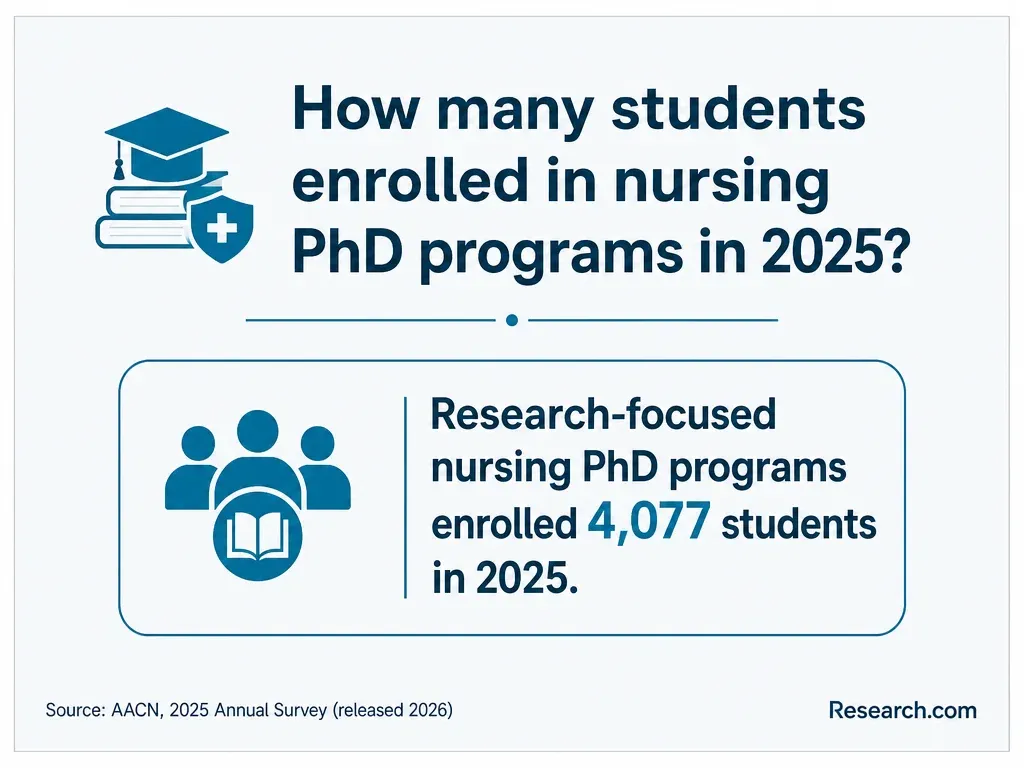
Programs commonly combine nursing science or theory with research design, quantitative and qualitative methods, statistics, ethics, and scholarly writing. Students then develop a question, defend a proposal, complete approved research, and write and defend a dissertation under the school's rules. The exact course sequence and examinations vary.
Evaluate methods training against your proposed work. A nurse studying symptom measurement may need different analytic mentorship from one studying health policy or implementation.
Discuss recruitment, clinical data access, privacy, and institutional review board requirements early; being employed at a hospital does not grant permission to use its patient records. If your goal is instead to change advanced practice populations, psychiatric NP certificate coursework options address a different educational need and require their own eligibility review.
Four to six years of full-time study is a useful budget scenario, not a verified completion time for every program or applicant. Entry route, enrollment intensity, required coursework, research access, and dissertation revisions can change the timeline. Part-time study can spread tuition charges while extending fees, travel, and time to a research-focused job.
Compare written funding offers rather than tuition alone. The following categories show why a low published tuition figure may not mean a lower total cost.
| Cost or support | What to verify |
| Tuition and required fees | Per-credit or per-term charges, dissertation enrollment, and annual increases. |
| Assistantship or fellowship | Guaranteed years, stipend, tuition coverage, workload, and renewal conditions. |
| Research and attendance | Travel, software, conference expenses, campus visits, and any unfunded research costs. |
| Opportunity cost | Reduced RN earnings or benefits if the program limits outside work. |
Request a written estimate through dissertation completion, including what happens if funding ends first. A nurse seeking a master's qualification instead can compare affordable master's progression for bachelor's-prepared RNs; lower tuition for a different credential is meaningful only if that credential meets the career goal.
Research fit is more specific than sharing a clinical specialty. Look for faculty who study a related question, use methods you need to learn, and have time to supervise a new student. A psychiatric nurse interested in testing an intervention, for example, needs a different mentor and data plan from a nurse seeking PMHNP clinical preparation through lower-tuition psychiatric nursing graduate programs.
Use conversations with faculty and current students to test whether the proposed work is achievable. The most useful questions concern:
- Mentor availability, meeting frequency, and what happens if a faculty member leaves.
- Access to collaborators, methods expertise, approved data sources, and research funding.
- Expected proposal and dissertation milestones, authorship practices, and support after setbacks.
Do not assume a prospective mentor has committed to supervise you because they replied favorably to an email. Ask the program how advisors are assigned and when research access and ethics approvals must be secured.
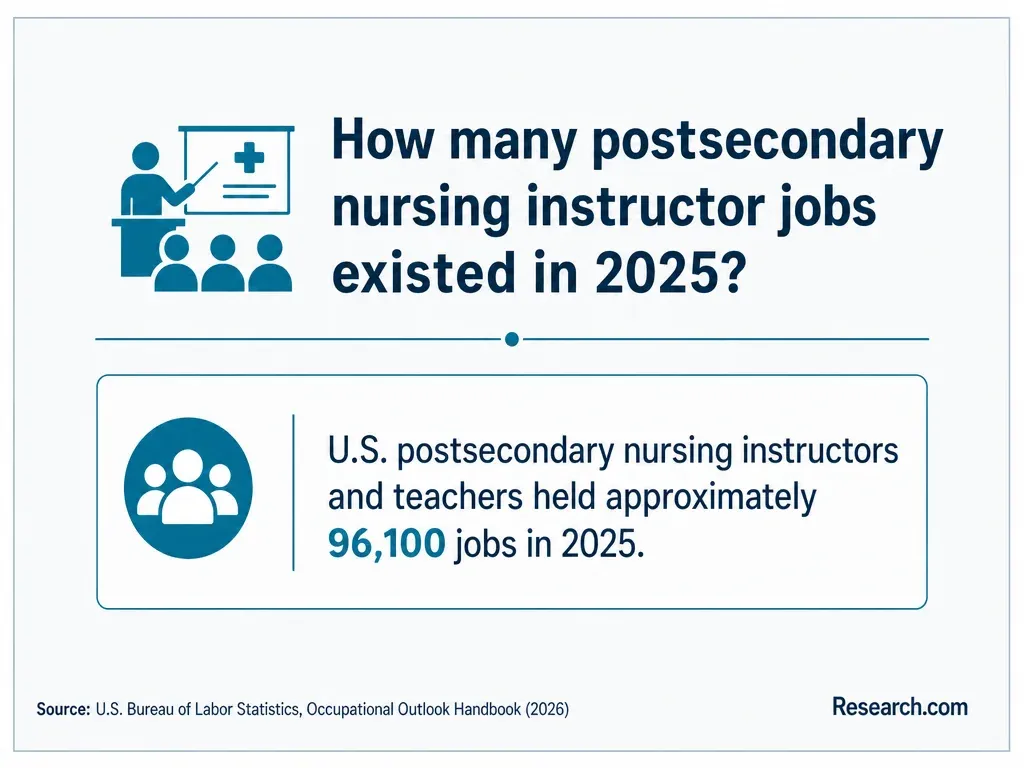
PhD graduates may pursue nursing faculty appointments, research scientist positions, health-system research roles, or policy and evaluation work. The strongest fit depends on publications, methods expertise, teaching experience, grants, and the employer's expectations - not the degree alone. Faculty openings may also require clinical teaching or an active RN license.
For pay comparisons, use the U.S. Bureau of Labor Statistics category that matches the job, such as nursing instructors and teachers, postsecondary, rather than an RN or nurse practitioner wage as a proxy for "PhD salary."
Published occupation-wide wages and employment projections are not Pennsylvania PhD placement results; compare them with actual job postings, institutional pay ranges, contract length, and benefits. If the target is clinical NP work rather than scholarship, online NP program affordability comparisons are more relevant than a PhD salary calculation.
What Licenses and Certifications Do Nursing PhD Graduates Need?
A nursing PhD does not issue or expand an RN or APRN license. Research roles may not require new clinical credentials, while clinical teaching, patient care, and advanced practice jobs can require an active license, role-specific education, certification, and employer validation. Confirm requirements with the Pennsylvania State Board of Nursing, the relevant certifying organization, and the hiring institution for the particular role.
For example, a PhD-prepared RN who wants to become an FNP needs appropriate population-focused education and supervised clinical preparation; the dissertation does not substitute for them. Review one-year FNP admission requirements only as a starting point, then verify whether a specific program and certification pathway accept the nurse's prior preparation.
Other Things You Should Know About Nursing
Usually, a topic can evolve, but major changes may require a new advisor, proposal review, or ethics approval. Ask when the program expects students to settle on a question.
Yes, if the program permits it. A brief message about your question and their work can clarify fit, but a positive response is not an admission or supervision commitment.
Possibly. Employment does not itself authorize recruitment or data use; the organization and relevant research oversight bodies must approve the work.
Not necessarily. Confirm required campus visits, assistantship duties, enrollment eligibility where you live, and whether your research can be supervised remotely before applying.
- DNP-PhD: A transformative shift - PMC - NIH https://pmc.ncbi.nlm.nih.gov/articles/PMC12998745/
- Accreditation in the U.S. | ed.gov http://www.ed.gov/laws-and-policy/higher-education-laws-and-policy/college-accreditation/accreditation-in-the-us
- Interviewing with potential Ph.D. advisors | Rice University https://graduate.rice.edu/current-news/interviewing-potential-phd-advisors
- Paying for Graduate School - The University of Alabama https://graduate.ua.edu/applicants/funding/
- Doctor of Nursing Practice (DNP) | upenn.edu https://www.nursing.upenn.edu/academics/doctor-of-nursing-practice-dnp/
- School of Nursing - University of Pittsburgh - Acalog ACMS™ https://catalog.upp.pitt.edu/content.php
- Doctor of Nursing Practice (DNP) Advanced Practice | jhu.edu https://nursing.jhu.edu/programs/doctoral/msn-dnp/
- PhD in Nursing Program | psu.edu https://www.nursing.psu.edu/ph-d-degree-program/
- How the PhD Program Works - Doctoral https://doctoral.wharton.upenn.edu/overview/degree-requirements/
- Ph.D. Funding | Brown University https://graduateschool.brown.edu/financing-support/phd-funding