2027 PhD in Nursing Programs for Nurses in New Mexico: BSN, MSN, and DNP Entry Routes and Research Fit
Audited and Verified:
Our Editorial and Data Verification Process
Research.com uses government datasets, official education statistics and primary institutional information to support its career and degree guides. Our review process checks factual accuracy, occupational definitions, source dates and the requirements associated with the credentials discussed.
How This Article Was Fact-Checked
Our editorial team verifies salary estimates, employment projections, education requirements and program information against original data providers and official organizations. Salary figures are checked against the relevant occupational definitions and reporting periods. Information about licensure, accreditation and required in-person training is reviewed separately.
Fact-checked and verified on:

Co-Founder and Chief Data Scientist
A PhD in Nursing is a research doctorate, not a faster route to advanced clinical practice. For nurses in New Mexico, the decision depends on whether a prospective advisor can support the questions they want to study - and whether doctoral research fits their work, finances, and career plans. This guide compares BSN, MSN, and DNP entry routes; identifies New Mexico universities to investigate; and explains how to assess admissions, program format, funding, and research fit before applying.
Key Things You Should Know
- The University of New Mexico and New Mexico State University are the two in-state universities to investigate for a nursing PhD; confirm the degree and admissions route offered for your intended entry term.
- BSN-, MSN-, and DNP-prepared nurses may have different routes into doctoral research, but prior graduate work does not automatically waive dissertation or methods requirements.
- A nursing PhD prepares researchers and scholars; it does not itself confer RN or APRN licensure or a clinical specialty certification.
What are the PhD in Nursing entry routes for BSN, MSN, and DNP nurses?
The appropriate entry route depends on both your existing degree and the research preparation it represents. A PhD culminates in an original dissertation, so a school may require additional methods coursework even from applicants with extensive clinical experience.
This comparison shows what each applicant should clarify with the doctoral program before assuming a particular timeline or credit award.
| Prior preparation | Potential route | Question to resolve |
| BSN and RN license | BSN-to-PhD, if offered | Whether a master's degree is earned along the way and how graduate research courses are sequenced |
| MSN and RN license | Post-master's PhD | Which prior courses satisfy doctoral requirements |
| DNP and RN license | Post-doctoral-degree entry into a PhD | Whether prior methods work transfers; a DNP project does not replace a dissertation |
An ADN-prepared RN generally needs additional degree preparation before applying to a nursing PhD. Online ADN-to-MSN program comparisons can help with that earlier decision, but applicants should ask whether a prospective PhD program accepts the resulting credential.
Which New Mexico universities offer accredited PhD in Nursing programs?
The University of New Mexico (UNM) and New Mexico State University (NMSU) are the principal in-state universities for nurses to investigate for a PhD in Nursing. Before applying, confirm each university's current catalog listing, whether it is admitting a cohort, the available entry routes, and which faculty are accepting doctoral students. A program listing alone does not establish that an advisor is available for your proposed research.
Both universities have institutional accreditation through the Higher Learning Commission. That status should not be described as PhD-specific nursing accreditation. Likewise, accreditation of a university's BSN, MSN, or DNP offering does not automatically extend to its PhD. Check the accreditor's directory for the exact degree and program, and ask the graduate school how it represents the PhD's accreditation status.
If you are not yet eligible for doctoral study, exploring nursing schools with attainable requirements addresses an earlier admissions decision; it does not identify research-doctorate options.
What are the admission requirements for a PhD in Nursing in New Mexico?
Expect a review of your nursing degree, academic record, RN license status, research interests, writing, and fit with available faculty. Programs may also request recommendations, a statement of purpose, a résumé or CV, and an interview. Minimum grades, experience expectations, tests, deadlines, and eligibility for BSN or DNP applicants are school- and cohort-specific; do not treat another university's checklist as an in-state requirement.
A persuasive application connects a feasible question to a prospective mentor's work. For example, an RN interested in rural chronic-disease care could describe the population, a possible study design, and why a faculty member's methods or partnerships are relevant - without claiming access to patient records or a clinical site that has not agreed to participate.
Entry exams for prelicensure nursing schools are a different matter. Nursing schools with no TEAS score requirement may matter to someone still pursuing initial nursing education, but they do not establish PhD admission policies.
Choose a PhD when your main goal is to generate nursing knowledge through original research, commonly for a research-intensive faculty or investigator role. Choose a DNP when you primarily want doctoral preparation for applying evidence, leading practice change, or evaluating care delivery. The distinction concerns the degree's scholarly purpose, not whether its graduates value evidence or can teach.
A DNP project typically addresses a practice or systems problem; a PhD dissertation is expected to make an original research contribution. Requirements vary by institution. Neither degree title alone establishes APRN eligibility: that depends on an appropriate population-focused educational pathway, certification, and state authorization.
If practice improvement rather than an independent research program is your goal, systems-focused DNP study options may be more relevant. Check each program's actual practice-hour and project requirements rather than interpreting "without clinicals" as no supervised or on-site obligations.
Nursing PhD study develops the ability to frame consequential questions, evaluate existing evidence, select defensible methods, analyze data, report uncertainty, and disseminate findings. Coursework may include research design, statistics or qualitative methods, theory, ethics, and scholarly writing. Faculty expertise - not a broad topic label - determines whether a particular university can support your dissertation.
New Mexico-relevant questions could concern rural access, chronic conditions, behavioral health, or care across diverse communities. These are possible research areas, not promises that either university has an available advisor, dataset, or approved study site. A proposal involving patients or protected records needs institutional permission, appropriate data safeguards, and a determination about human-subjects review before data collection.
Researching psychiatric care is also different from qualifying to provide it as a psychiatric-mental health nurse practitioner. If clinical practice is the objective, online PMHNP tuition and fee considerations belong in the comparison of population-focused clinical programs, not PhD dissertation options.
Do not infer the attendance pattern from "online" coursework. Ask UNM and NMSU for the format of your intended cohort, including live seminars, required campus visits, examinations, research meetings, and dissertation defenses. Also ask whether courses run every term and whether part-time enrollment is permitted. These details determine whether a working nurse can realistically keep a job while making research progress.
For an applicant comparing doctoral study with an earlier degree-completion step, RN-to-BSN programs without traditional clinical rotations illustrate why delivery labels need context: even flexible-looking nursing programs can have required projects, scheduled activities, or local obligations. Confirm the PhD's requirements directly rather than extrapolating from another degree.
There is no reliable single completion time or price for every BSN-, MSN-, and DNP-entry applicant. Time depends on accepted prior coursework, enrollment intensity, methods preparation, examinations, advisor availability, and dissertation research. A previous doctorate does not guarantee a short PhD: recruiting participants or obtaining approved data can take longer than completing classes.
For a usable cost comparison, request each university's current per-credit graduate tuition, mandatory fees, expected credits, and dissertation-continuation charges for your residency and enrollment status. Add travel, books or software, and reduced earnings if research responsibilities require less paid work. Ask whether an assistantship includes tuition support, a stipend, work obligations, and guaranteed or renewable funding; do not count an unoffered award as savings.
If a master's degree would meet your immediate goal without a dissertation, exploring less expensive MSN pathways after a BSN can provide a more proportionate financial comparison.
Possible paths include research-intensive nursing faculty, nurse scientist, health-services researcher, and research or evaluation leadership in a healthcare organization or public agency. Duties can include designing studies, seeking grants, mentoring trainees, analyzing findings, and publishing results. Faculty positions also involve teaching and service; requirements depend on the institution and appointment.
A PhD is most useful when those research responsibilities are the intended work. For a primarily clinical, operational, or staff-education role, an MSN, DNP, relevant experience, or employer-supported training may be more direct. A PhD does not authorize a nurse to practice in a new APRN population focus.
People entering nursing from another profession face a separate first step. A career-change nursing program guide can help them distinguish initial RN preparation from the postlicensure research route discussed here.
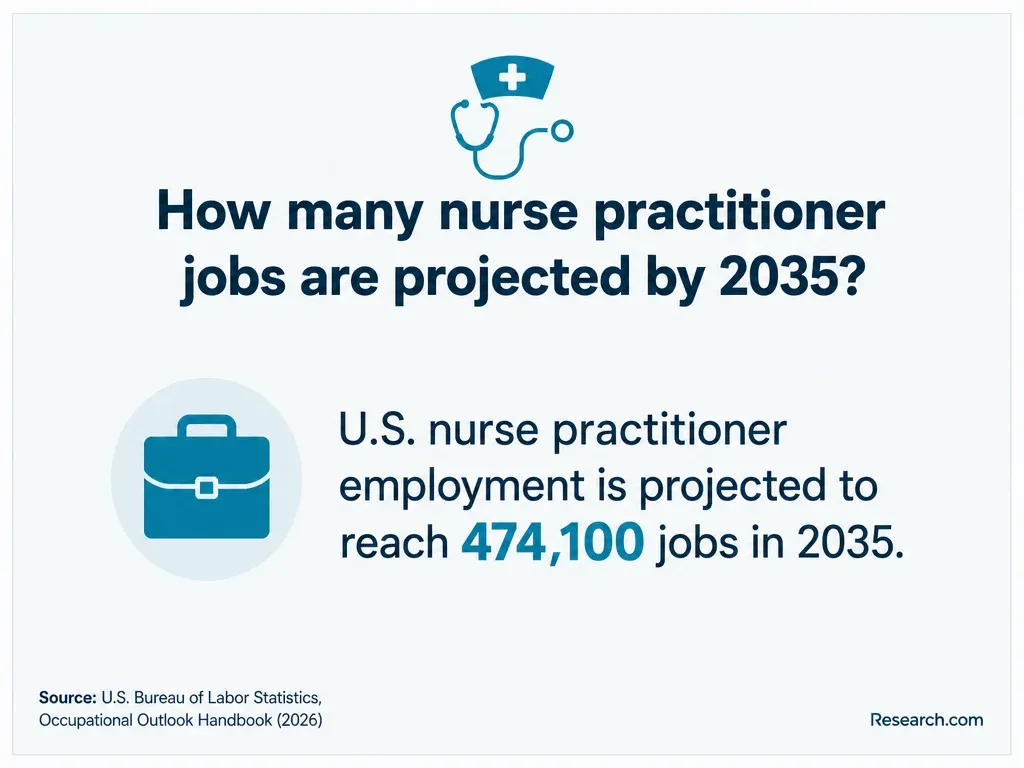
No single wage statistic describes "PhD-prepared nurses." The relevant occupation depends on the job: a nursing faculty member, registered nurse, and nurse practitioner have different duties and labor markets. The U.S. Bureau of Labor Statistics reports occupational wages, not a pay premium guaranteed by a nursing PhD. State estimates can also be less informative for specialized research posts with relatively few openings.
For an employment comparison, use the latest BLS wage estimate for the actual occupation, then examine New Mexico postings for the required degree, research record, grant expectations, and salary range. Compare likely compensation with tuition, funding, foregone earnings, and your willingness to pursue academic or research positions outside your preferred city. National occupational growth projections are context, not a forecast of local PhD vacancies.
Do not use nurse practitioner earnings as the expected return on a PhD. A guide to accelerated family nurse practitioner study concerns a distinct clinical education and certification pathway.
How should nurses evaluate PhD program accreditation and research fit?
Start with institutional accreditation and the university's published PhD requirements, then verify any claim of nursing-program accreditation against the accreditor's stated scope. State board approval of a prelicensure program serves a different purpose from review of a research doctorate. A trustworthy comparison names the exact credential and does not borrow accreditation claims from a school's other nursing degrees.
Research fit deserves at least as much attention as the university name. Before accepting an offer, identify potential advisors, read their recent work, and ask whether they expect to take a student in your entry term. Discuss the methods you need to learn, access to appropriate data or collaborators, dissertation milestones, funding, and what happens if an advisor becomes unavailable. No faculty conversation guarantees supervision or study approval until the university confirms its arrangements.
Applicants also weighing practice-focused study can use DNP programs organized by completion time as an alternative-pathway reference. A shorter advertised duration should not outweigh fit with the research career a PhD is meant to support.
Other Things You Should Know About Nursing
Not without the required organizational permissions, privacy safeguards, and research-oversight determinations. Employment access to a record does not authorize its use for doctoral research.
Not automatically. Its design, oversight, findings, and publication status must be evaluated separately; calling it a project or dissertation does not establish that it was peer-reviewed.
Yes, if the nurse maintains the applicable license, certification, and employer credentials. PhD enrollment neither replaces those obligations nor expands clinical scope.
It is usually worthwhile. A concise message about your research question and methods interests can help establish whether a potential advisor's work aligns with yours, but admissions staff should confirm the program's contact expectations.
- Approval & Accreditation - NM Board of Nursing https://www.bon.nm.gov/approval-accreditation/
- PhD in Nursing vs DNP: What's the Difference? | ucsf.edu https://nursing.ucsf.edu/phd-nursing-vs-dnp-whats-difference
- Funding FAQs for Current Students - The Graduate School https://graduateschool.charlotte.edu/funding/funding-faq/
- MSN in Nursing Leadership & Administration | nmsu.edu https://schoolofnursing.nmsu.edu/nursing/son-pages/MSN-Program.html
- Information and FAQs on Graduate Aid | virginia.edu https://gradstudies.virginia.edu/funding-and-aid-faqs-graduate-students
- Doctor of Nursing Practice (DNP) to Doctor of Philosophy in Nursing (PhD) - Johns Hopkins School of Nursing https://nursing.jhu.edu/faculty-research/research/centers/r3/r3-tools-and-modules/r3-e-pause-values/doctor-of-nursing-practice-dnp-to-doctor-of-philosophy-in-nursing-phd/
- Apply | College of Nursing | The University of New Mexico https://hsc.unm.edu/nursing/admissions/apply/
- Cost & Funding - Graduate School - University of Arkansas https://graduate-students.uark.edu/cost-and-funding/
- Graduate Program:: | The University of New Mexico https://catalog.unm.edu/catalogs/2013-2014/colleges/nursing/graduate-program/index.html
- BSN to PhD Curriculum - Pitt School of Nursing https://www.nursing.pitt.edu/academics/phd-in-nursing/bsn-phd-curriculum/