2027 PhD in Nursing Programs for Nurses in Arizona: BSN, MSN, and DNP Entry Routes and Research Fit
Audited and Verified:
Our Editorial and Data Verification Process
Research.com uses government datasets, official education statistics and primary institutional information to support its career and degree guides. Our review process checks factual accuracy, occupational definitions, source dates and the requirements associated with the credentials discussed.
How This Article Was Fact-Checked
Our editorial team verifies salary estimates, employment projections, education requirements and program information against original data providers and official organizations. Salary figures are checked against the relevant occupational definitions and reporting periods. Information about licensure, accreditation and required in-person training is reviewed separately.
Fact-checked and verified on:

Co-Founder and Chief Data Scientist
An Arizona nurse choosing a PhD needs more than a program name: the right decision depends on entry eligibility, a faculty mentor who can support the proposed research, and enough time and funding to finish a dissertation.
This guide compares Arizona's nursing-research doctorate options for BSN-, MSN-, and DNP-prepared nurses. It explains how to evaluate research fit, distinguish a PhD from a practice doctorate, and check the admissions, delivery, cost, and career details that can change an otherwise promising choice.
Key Things You Should Know
- Arizona applicants should compare the University of Arizona's Nursing Science PhD and Arizona State University's Nursing and Healthcare Innovation PhD by faculty research fit, not by a generic "best" ranking.
- BSN-to-PhD and graduate-entry routes may be available, but a prior MSN or DNP does not automatically shorten dissertation research or satisfy a particular program's requirements.
- Before applying, confirm the entry route, mentor availability, required campus attendance, written funding offer, and total cost; a PhD does not confer RN or APRN licensure.
What are the best PhD in nursing programs in Arizona?
The strongest Arizona options to investigate are the University of Arizona PhD in Nursing Science and Arizona State University PhD in Nursing and Healthcare Innovation. Neither is universally best. A program is a strong choice only if its faculty can supervise your question, its research resources match your methods, and its attendance and funding terms are workable.
Confirm each university's degree title and whether it is accepting students into your intended entry route for your application term.
This comparison identifies the decision each program is most likely to reward; it is not a ranking or a promise that a particular mentor has an opening.
| Program to investigate | Research-fit question | What to verify directly |
| University of Arizona, PhD in Nursing Science | Can nursing-science faculty supervise the population, phenomenon, and methods in your proposed dissertation? | Potential advisors, current research groups, entry routes, attendance requirements, and funding |
| Arizona State University, PhD in Nursing and Healthcare Innovation | Would the proposed work benefit from nursing and interdisciplinary health-innovation mentorship? | Faculty capacity, methodological support, entry routes, required in-person work, and funding |
Start with recent faculty scholarship and a one-page description of your question, potential data source, and preferred methods. Ask a potential advisor whether the question fits their active work and whether they expect to supervise new doctoral students.
A nurse whose real goal is a new advanced-practice population focus should instead examine the relevant clinical education route; for example, post-master's FNP certificate completion timelines address a different decision from choosing a research doctorate.
What PhD in nursing entry routes are available for BSN, MSN, and DNP nurses?
BSN-to-PhD entry lets an eligible nurse move into research-doctoral training without first earning an MSN. Graduate entry lets a nurse with an eligible master's degree apply with prior graduate preparation.
A DNP-prepared applicant may also be considered under a school's graduate-entry rules, but DNP coursework or a practice project does not automatically replace PhD methods courses, research milestones, or a dissertation. Check each program's current route-specific policy rather than assuming every route is offered every term.
The routes differ chiefly in what applicants bring to doctoral research and what the university may still require.
| Applicant background | Potential advantage | Question to resolve before applying |
| BSN-prepared RN | Direct progression toward a research career | How much graduate coursework precedes independent research, and is an MSN awarded along the way? |
| MSN-prepared RN | Prior graduate study and possibly a developed research interest | Which prior courses, if any, meet doctoral requirements? |
| DNP-prepared nurse | Experience evaluating practice problems and leading projects | What additional research-methods preparation and dissertation work are required? |
If you hold an RN license but still need the bachelor's credential required by a particular route, comparing no-traditional-clinical RN-to-BSN options may help with degree-completion planning. The PhD program - not the RN-to-BSN school - decides whether the resulting degree meets its admission rules.
What accreditation and licensing requirements apply to Arizona PhD nursing programs?
Separate institutional accreditation, nursing-program accreditation, and professional licensure. Verify the university's institutional accreditation and ask whether the specific research PhD falls within any claimed nursing-program accreditation scope. Do not assume accreditation of a school's BSN or DNP also describes its PhD. The Arizona State Board of Nursing regulates nursing practice; admission to or graduation from a research PhD is not authorization to practice as an RN or APRN.
Applicants should check whether the program requires an active, unencumbered RN license, which jurisdictions' licenses it accepts, and whether any teaching, clinical, or research assignment creates additional requirements.
An out-of-state nurse should separately verify authority to practice wherever patient care would occur. Earlier steps toward initial licensure are different: short-format LPN-to-RN pathway planning concerns becoming eligible for RN education and licensure, not admission to a postlicensure nursing PhD.
A PhD primarily prepares nurses to design and conduct research that produces new knowledge. A DNP primarily develops advanced nursing practice and the application of evidence to practice or system problems. A dissertation and a DNP scholarly project can both demand rigorous analysis, but they serve different degree purposes and follow the university's distinct requirements.
Choose a PhD if you want sustained training in research design, measurement, analysis, scholarly writing, and an original dissertation.
Choose a DNP if your central aim is practice leadership or implementation - and verify separately whether its track provides the specific APRN preparation you need. Neither degree title alone qualifies a nurse as a nurse practitioner. For a nurse whose immediate goal is psychiatric advanced practice rather than research, accelerated mental health NP master's coursework is a more relevant comparison, subject to clinical, certification, and licensure requirements.
Expect doctoral work in research questions and theory, quantitative or qualitative methods, statistics or other analysis, research ethics, scholarly communication, and dissertation development. Exact courses and qualifying milestones vary. The most important curriculum question is whether you can acquire the methods needed for your proposed study - not simply whether a catalog names your clinical specialty.
Arizona-relevant questions could concern chronic illness, behavioral health, rural access, aging, family caregiving, or how care systems affect outcomes. These are examples of possible research problems, not assurances that either university currently has an available advisor or dataset for them. Before committing to a topic, establish who owns the data, whether access is realistic, what privacy protections apply, and whether institutional review board or other oversight is required.
A nurse primarily seeking psychiatric clinical preparation should compare that objective with lower-tuition psychiatric nursing graduate programs rather than treating a research PhD as an NP pathway.
Applicants should expect review of their prior nursing degree, academic record, RN-license status where required, research interests, writing ability, recommendations, and fit with available faculty. A school may also request a statement of purpose, résumé or CV, interview, and evidence of research preparation.
Minimum GPA, statistics prerequisites, tests, deadlines, and international credential or English-language requirements must be checked for the exact program and entry term; none should be assumed universal.
A strong application explains a feasible research direction rather than merely naming a broad specialty. Briefly identify the population or setting, the unanswered question, a plausible approach, and faculty whose published work connects to it. Show what you learned from a thesis, evidence review, DNP project, quality-improvement work, or research assistance without presenting practice improvement as equivalent to independent research.
These are postlicensure research routes, not a way for a person without nursing preparation to become an RN. Someone entering nursing from another field needs to resolve initial nursing education and licensure first; less competitive accelerated nursing programs address that separate entry decision.
Time to completion depends on entry route, full- or part-time enrollment, required coursework, qualifying milestones, dissertation scope, data access, and the time available to write. A prior DNP or MSN does not guarantee a shorter dissertation. Request each program's degree plan and recent completion-time information for students entering through your route; a catalog's minimum sequence is not a completion guarantee.
For cost, calculate tuition by the university's actual charge unit and your expected enrollment, then add mandatory fees, books or software, travel for required visits, and dissertation-stage enrollment.
Compare a written assistantship or fellowship offer against the full plan: check stipend, tuition coverage, health benefits, work obligations, renewal conditions, and what happens if the dissertation extends beyond the award. Part-time study can preserve earnings but may reduce aid eligibility or lengthen continuing costs.
An MSN is not necessarily a required purchase before a BSN-to-PhD route. If you want a master's credential for its own career value, comparing online BSN-to-MSN program costs can clarify the alternative - but compare its total cost and opportunity cost with direct PhD entry rather than assuming the extra degree saves money.
Do not infer a doctoral program's attendance rules from a university-wide "online" label. Coursework, seminars, research meetings, examinations, teaching assignments, and dissertation work may have different location requirements. Ask each Arizona program which activities are synchronous, which require travel, how often students must attend in person, and whether remote students can access the same supervision and research resources.
For a working nurse, the decisive issue is protected research time. An online seminar schedule does not remove the need for advisor meetings, analysis, writing, and potentially site-based data collection. If you are comparing online doctoral study with an online clinical NP route, remember that family NP programs that help arrange clinical placements address supervised patient-care logistics; a research PhD instead requires a viable research setting and approved data access.
Research-doctorate graduates may seek nursing-faculty, investigator, research-team leadership, health-services research, or research-administration roles. Duties vary: faculty may teach and mentor while conducting scholarship; investigators develop studies, obtain approvals, analyze findings, and seek funding.
Employers also assess publications, methods expertise, grants experience, teaching record, and clinical background. A PhD alone does not guarantee a faculty appointment or an independent research position.
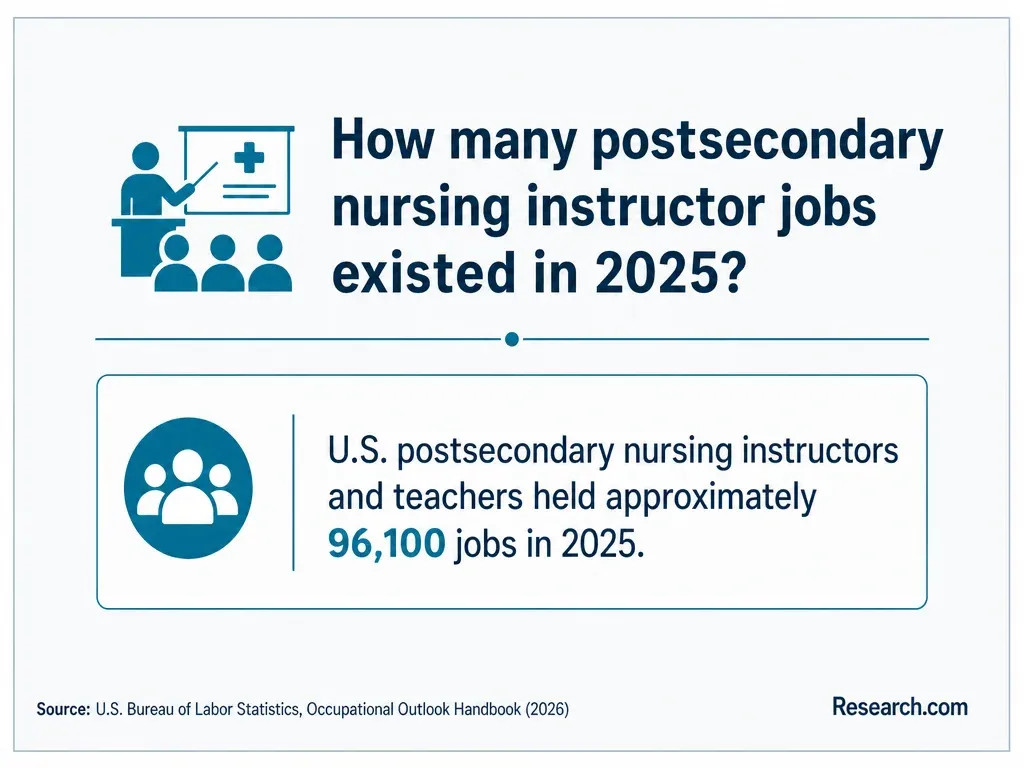
For salary comparisons, use the U.S. Bureau of Labor Statistics occupation closest to the job, such as postsecondary nursing teachers for many faculty posts. There is no single BLS salary for "PhD-prepared nurse researchers," and an occupation-wide median is neither an Arizona offer nor a graduate starting salary.
Compare actual job postings by rank, contract length, research expectations, and benefits. If your target job is clinical psychiatric NP practice instead, PMHNP certificate completion timelines are more pertinent than PhD faculty salary comparisons; eligibility depends on the certificate and your prior preparation.
What is the job outlook for nurse researchers, educators, and scientists?
Demand for nursing faculty can create opportunities, but a national occupation projection cannot tell an applicant whether a particular Arizona department has a funded position in their research area. Research jobs are also spread across universities, health systems, government, and other organizations; "nurse scientist" is not one uniform BLS occupation.
Use the latest BLS projections for postsecondary nursing teachers as context for faculty hiring, then examine current openings, grant activity, and required methods or teaching experience for the roles you actually want.
Keep clinical workforce projections separate from research-career projections. Interest in faster NP preparation - for example, planning a one-year FNP pathway - may reflect a different labor market and credentialing decision. It does not establish demand for PhD-trained investigators. A practical final check is to ask each potential advisor where recent graduates work and what research, teaching, and funding experience helped them compete for those positions.
Other Things You Should Know About Nursing
Possibly, but employment does not grant research access. Obtain the employer's permission and required university, site, privacy, and ethics reviews before recruiting participants or using records.
Do not assume so. Published work can demonstrate readiness, but programs may also value a strong writing sample, sound research reasoning, and relevant project experience. Check the current application criteria.
It can help you develop a question or identify a gap, but a completed practice project does not automatically satisfy dissertation requirements. Faculty must approve the new research plan and its oversight.
Yes, if the program permits it. A concise message describing your question and why it connects to the faculty member's work can reveal fit and supervisory availability; it is not an admission commitment.
- 32-1644 - Approval of nursing schools and nursing programs https://www.azleg.gov/ars/32/01644.htm
- Doctoral programmes in the nursing discipline: a scoping review | nih.gov https://pmc.ncbi.nlm.nih.gov/articles/PMC8591938/
- DAPIP | Homepage - Office of Postsecondary Education (OPE) https://ope.ed.gov/dapip/
- How to Apply | Edson College of Nursing and Health Innovation https://nursingandhealth.asu.edu/programs/phd/nursing-and-health-care-innovation-phd/how-to-apply
- PhD Financial Support | Duke University School of Nursing https://nursing.duke.edu/academic-programs/phd-program-nursing/phd-financial-support
- Nursing and Healthcare Innovation Degree, PhD | ASU https://degrees.asu.edu/masters-phd/major/ASU00/NUNHIPHD/nursing-and-healthcare-innovation-phd
- Clinical Translational Sciences Funding and Financial Aid | The University of Arizona Health Sciences https://healthsciences.arizona.edu/academics/clinical-translational-sciences/funding-and-financial-aid
- PhD in Nursing vs DNP: What's the Difference? | ucsf.edu https://nursing.ucsf.edu/phd-nursing-vs-dnp-whats-difference
- Doctor of Nursing Practice (DNP) - Admissions | University of Arizona College of Nursing https://nursing.arizona.edu/academics/doctor-nursing-practice-dnp/admissions