2027 Paying for an Online BS in Business Administration: An Employer That Pays Only Approved Universities
Audited and Verified:
Our Editorial and Data Verification Process
Research.com uses government datasets, official education statistics and primary institutional information to support its career and degree guides. Our review process checks factual accuracy, occupational definitions, source dates and the requirements associated with the credentials discussed.
How This Article Was Fact-Checked
Our editorial team verifies salary estimates, employment projections, education requirements and program information against original data providers and official organizations. Salary figures are checked against the relevant occupational definitions and reporting periods. Information about licensure, accreditation and required in-person training is reviewed separately.
Fact-checked and verified on:

Co-Founder and Chief Data Scientist
An employer education benefit can make an online BS in Business Administration affordable - but only if the university, degree, and courses qualify under your employer's rules. That distinction matters before you apply, transfer credits, or commit to a payment plan. This guide is for employees weighing approved universities against potentially better-fitting programs elsewhere. You'll learn what to verify with your benefits administrator and each school, how to compare the amount you would actually pay, and when an approved program may still be the wrong choice.
Key Things You Should Know
- Get written confirmation that your employer approves the specific university, online BS in Business Administration, and enrollment term; institutional accreditation alone does not establish benefit eligibility.
- Compare your remaining degree requirements and out-of-pocket costs, not advertised tuition. An approved school can cost you more if fewer transfer credits apply or required courses delay graduation.
- Determine whether the employer pays the school directly or reimburses you later, and check caps, grades, fees, employment conditions, and repayment rules before registering.
What is an online BS in Business Administration?
An online BS in Business Administration is an undergraduate degree covering several business functions rather than training for just one occupation. Depending on the school, it combines general education with subjects such as accounting, finance, marketing, management, operations, and quantitative analysis. "Online" describes delivery, not a uniform schedule: classes may have fixed deadlines, live meetings, or group assignments.
The exact degree title matters when an employer approves only certain programs. A BS in Business Administration is not automatically interchangeable with a BBA, BA in Business, or BS in Management for benefit purposes. Ask the university for the official degree name and ask your benefits administrator to confirm that name against the employer's approved-program list. If continuing to work is essential, compare work-compatible business administration education options on actual attendance requirements, not the online label alone.
How does employer tuition assistance for approved universities work?
An approved-university benefit is an employer policy, not a general promise to pay for any accredited degree. Some employers contract with particular schools; others maintain a list of eligible institutions and programs. Approval may also depend on your employment status, length of service, course relevance, grades, and when you request authorization. The written policy and benefits administrator - not a university recruiter - control what the employer will pay.
Follow the benefit's approval sequence before committing to a class. These checks separate permission to enroll from a commitment to pay:
- Ask for the current policy and approved-school list, including rules for online study, the specific degree, and any concentration.
- Request written authorization for your intended term and courses; confirm whether approval must be renewed each term.
- Confirm who receives the bill, when payment occurs, which charges are excluded, and what happens after a withdrawal or an insufficient grade.
- Check whether leaving the job, changing employment status, or receiving other aid changes your eligibility or creates a repayment obligation.
Direct billing can reduce the cash you need upfront. Reimbursement may require you to pay first and wait until grades are posted, even when the course is eligible. If you are comparing benefits with aid available for a different field, such as financial assistance for aspiring project management graduates, keep the degree-specific employer approval separate from general financial-aid eligibility.
How can you verify an online business degree's accreditation?
Check institutional accreditation first. Search the institution by its legal name in the U.S. Department of Education's accreditation database, then confirm its status and accreditor with the institution. This helps establish the school's recognized accreditation status; it does not establish that your employer has approved it or that every program qualifies for the same benefit.
Business-school accreditation is a separate question. If a university advertises AACSB, ACBSP, or IACBE accreditation, check the accreditor's directory for the institution and the scope of its accreditation. Do not assume a named online BS is covered solely because another business program holds accreditation. Send the school's legal name, degree title, and relevant accreditation details to your benefits administrator for an eligibility determination.
A waived application fee does not substitute for either check. If you consider online schools with free applications, verify accreditation and employer approval before treating the low application cost as a reason to apply.
Most programs provide a broad business core, but the course mix and required depth vary. Review the catalog for accounting, finance, economics, marketing, management, operations, business law, statistics or analytics, and a capstone. A concentration, if offered, is a defined set of requirements; taking a few electives in one subject does not necessarily earn a concentration.
For employer-funded study, curriculum fit is also a cost question. An operations employee might benefit from process analysis and project work, while someone moving toward HR may need employment-law and HR-specific coursework. If your goal is a specialized HR role, compare the business degree with a dedicated HR pathway - and ask whether prior college coursework toward an HR bachelor's would shorten that alternative. Neither coursework nor a concentration automatically confers a professional certification.
Your completion time depends chiefly on credits that apply to the degree, the number of courses you can take while working, prerequisite sequences, and when required classes are offered. A school may accept prior coursework as elective credit without using it to satisfy the business core. Ask each approved university for a program-specific transfer evaluation and degree audit before relying on its estimated finish date.
Shorter terms can help only if the courses you need are available and the pace fits your job. Compare fastest bachelor's-level business study options against your employer's annual benefit limit: taking more courses in one benefit year may increase what you must pay yourself. An adviser should also identify any residency requirement, capstone sequence, or course offered infrequently.
There is no reliable single price for an employer-funded degree. Build a completion estimate for each school using the courses still required after its official credit evaluation. Then apply the employer's benefit rules to those charges. The table separates costs that can otherwise be hidden by an attractive tuition quote.
| Cost or funding item | What to obtain | Why it affects your decision |
| Remaining tuition | A degree audit and the school's rate for your enrollment term | Accepted credits may not satisfy required courses. |
| Fees and materials | Required technology, software, books, proctoring, and any travel charges | The employer may cover tuition but exclude other expenses. |
| Employer payment | The written cap, eligible charges, payment method, and approval conditions | Approved study can still leave an upfront bill or unpaid balance. |
| Other aid and borrowing | A school-specific aid offer and loan terms, if applicable | Grants and loans have different effects on net cost and future payments. |
| Time-related costs | The course schedule and your realistic work availability | Extra terms or reduced work hours can change the overall financial picture. |
Compare total remaining charges, expected employer payment, upfront cash required, and any borrowing separately. Do not subtract the full advertised benefit unless your planned courses and charges qualify. Use the same credit-audit assumptions when you compare the least expensive business administration schools; a lower per-credit rate may not produce the lowest completion cost. Ask a qualified tax adviser about your particular benefit's tax treatment rather than assuming all employer payments are tax-free.
Requirements vary by university and by whether you apply as a first-year, transfer, or returning student. Schools commonly request prior academic transcripts and may set GPA or prerequisite requirements; admission to the university does not necessarily mean admission to the business major. Ask admissions which documents and courses apply to your situation, then ask the registrar or transfer office how prior credits will count toward graduation.
Employer authorization is a separate process. Being admitted does not obligate your employer to pay, and employer approval does not guarantee admission. Financial-aid eligibility is separate again: if you need funding beyond the employer benefit, check FAFSA eligibility at online business administration schools and request a school-specific aid offer before accepting a payment plan.
Online study may be the better fit if an approved university lets you keep your work schedule and avoid commuting. Campus study may be preferable if you learn better through in-person classes or need local recruiting and networking access. Neither format is inherently cheaper or more flexible; compare the actual sections you must take, not the university's general description of its programs.
Ask about live attendance, exam proctoring, group presentations, campus visits, internship requirements, and deadline policies. Also check whether the employer approves the online version of the program at the same rate as its campus version. Online degrees with accelerated terms may offer a useful scheduling alternative, but compressed deadlines can be difficult alongside full-time work. Choose the format in which you can realistically complete approved courses and meet any grade condition.
The degree can support applications for roles in operations, sales support, marketing coordination, HR support, procurement, and project coordination. Your prior work and the evidence you can show - such as budgeting, spreadsheet analysis, process documentation, or stakeholder communication - will affect which roles are realistic. A business bachelor's does not automatically qualify a graduate to manage staff or enter a regulated profession.
If you already work for the employer funding your degree, start with its internal job descriptions. Identify the degree requirement, the experience expected, and the business tasks you could demonstrate through approved coursework or work. For a supply chain target, for example, compare broad business study with supply chain degree cost and duration comparisons; a specialized program may be more direct, but only if it fits your employer's approval rules and your career goal.
What salary and job outlook can business administration graduates expect?
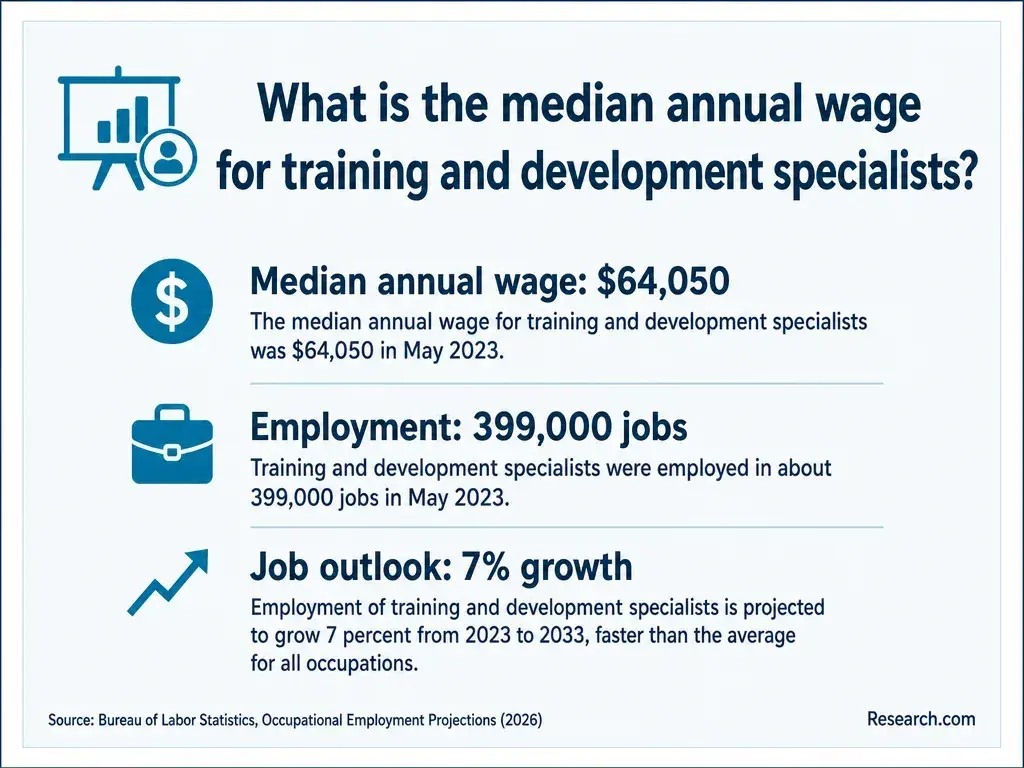
There is no single salary or growth rate for BS in Business Administration graduates. U.S. Bureau of Labor Statistics figures describe occupations, not the earnings attributable to a particular degree or employer benefit. For example, the BLS reports a May 2025 median annual wage of $75,940 for human resources specialists and projects 6% employment growth from 2025 to 2035. That occupation-wide median includes experienced workers; it is not an expected starting salary for a new graduate.
Use an occupation's pay and outlook only after checking whether its duties, entry requirements, and local opportunities match your goal. If HR is your target, weigh the broad degree against HR education costs and career planning. For the funding decision, a more immediate measure of value is whether the approved program helps you meet a documented job requirement without taking on costs or coursework that an alternative would avoid.
Other Things You Should Know About Business Administration
Possibly, but do not assume both schools qualify. Ask whether the policy permits concurrent enrollment, how its payment limit applies, and whether either university will accept the other's courses toward your degree before registering.
Policies differ. Check the rules for repeated or failed courses and whether you would owe repayment for an earlier employer-funded attempt. The university's academic repeat policy is a separate requirement.
Ask for renewed employer authorization before changing your plan. A new concentration may alter eligible courses or the approved program name, and your university should confirm whether it adds credits or time.
Do not rely on the old listing without confirmation. Give your benefits administrator the institution's updated legal name and your program details, and request written confirmation that your enrollment remains eligible.
- Cost of Attendance (Budget) | 2025-2026 Federal Student Aid Handbook https://fsapartners.ed.gov/knowledge-center/fsa-handbook/2025-2026/vol3/ch2-cost-attendance-budget
- Qualified Ed expenses | Internal Revenue Service https://www.irs.gov/credits-deductions/individuals/qualified-ed-expenses
- DAPIP | Homepage - Office of Postsecondary Education (OPE) https://ope.ed.gov/dapip/
- Employer Tuition Reimbursement: How It Works and How to Pay for College | Winston-Salem State University https://ramsonline.wssu.edu/blog/employer-education-benefits/
- Earn a CSUF BA in Business Administration Online | fullerton.edu https://extension.fullerton.edu/onlinedegrees/baba/
- Transfer Credit Policies and Processes - The College | UVA College of Arts & Sciences https://college.as.virginia.edu/transfer-credit-policies-and-processes
- Tuition Assistance for Employees - Human Resources | The University of Kansas https://humanresources.ku.edu/tuition-assistance
- How Do Transfer Credits Work When You Go Back to School? | Whitworth Online https://online.whitworth.edu/news-articles/how-do-transfer-credits-work-when-you-go-back-to-school/