2027 Online Respiratory Care Therapy Degree Programs With No Letters of Recommendation Required

Co-Founder and Chief Data Scientist
Applicants who lack recent professors or supervisors to recommend them may prefer Respiratory Care Therapy programs with streamlined admissions. "No letters required" means recommendations are not part of the standard application; it does not mean transcripts, prerequisites, clinical eligibility, or licensure requirements disappear.
This guide helps prospective respiratory therapists and licensed RRTs compare online degree-completion options, verify accreditation, estimate costs, and avoid programs that cannot support their career goals. The U.S. Bureau of Labor Statistics projects 13% employment growth for respiratory therapists through 2033, making program quality and eligibility especially important.
Key Things You Should Know
- No-recommendation admissions usually replace letters with official transcripts, prerequisite grades, a personal statement, a resume, or proof of an active respiratory credential; always confirm the requirement for the exact degree and term.
- For entry-level respiratory therapist licensure, prioritize a program accredited by the Commission on Accreditation for Respiratory Care (CoARC) and confirm that its clinical structure meets the rules where you plan to practice.
- Cost and format vary substantially: College Board reported average 2024-25 published tuition and fees of $11,610 at public four-year in-state institutions, but respiratory programs may add clinical, lab, background-check, immunization, and exam expenses.
Which Online Respiratory Care Therapy Degree Programs Require No Letters of Recommendation?
Online Respiratory Care Therapy programs without recommendation letters are most often degree-completion bachelor's programs for already credentialed respiratory therapists. These programs commonly deliver leadership, research, education, management, and advanced clinical coursework online while expecting students to hold an associate degree and an active Registered Respiratory Therapist (RRT) credential.
Fully online entry-level programs are less common because initial professional preparation requires supervised clinical experiences with patients. A school may advertise an online or hybrid respiratory care degree while requiring campus labs, clinical rotations, or skills checkoffs near the student's location. That distinction matters more than whether letters are required.
The following comparison shows where a no-letter policy is most plausible and what applicants should verify directly with admissions. Program catalogs can change by term, so a school's current application checklist - not a general admissions page - is the controlling source.
| Program type | Typical applicant | Online delivery reality | Recommendation-letter pattern to verify |
| Associate degree in respiratory care | Future entry-level respiratory therapist | May include online lectures, but labs and clinical rotations are normally in person | May not require letters, but usually has substantial prerequisite and clinical-clearance requirements |
| RN-to-BS-style respiratory care completion bachelor's | Licensed or credentialed RRT seeking a bachelor's degree | Often fully online after credential verification | Frequently streamlined; letters may be absent from the standard checklist |
| Respiratory care leadership or education bachelor's track | Working respiratory professional | Usually online, sometimes with a practicum | May use a resume and professional history instead of letters |
| Graduate respiratory care, health sciences, or leadership program | Bachelor's-prepared clinician | Often online or hybrid | More likely than undergraduate completion programs to request professional references |
Students exploring adjacent diagnostic careers can also compare training models in ultrasound tech programs; like respiratory care, these pathways may involve clinical education that cannot be completed solely through asynchronous coursework.
What Are the Admission Requirements for Online Respiratory Care Therapy Degree Programs With No Recommendation Letters?
Admissions without recommendations are streamlined, not automatic. Schools still need evidence that an applicant can complete upper-division coursework or safely enter clinical education. Requirements differ sharply between entry-level and degree-completion tracks.
For an entry-level program, applicants commonly submit a high school diploma or GED, college transcripts, prerequisite science coursework, placement or readiness materials, and health-and-safety documentation before clinical placement. Anatomy and physiology, microbiology, mathematics, and English composition are common prerequisites, although required courses and minimum grades vary.
Degree-completion applicants generally need an associate degree, official transcripts, an active RRT or state respiratory care license where applicable, and evidence of prior professional preparation. Some programs request a brief goal statement or resume even when they do not request references.
The table separates truly waived recommendations from common look-alike policies. It can prevent an applicant from assuming that "optional" and "not required" mean the same thing.
| Application language | What it means | What to do |
| "No letters of recommendation required" | Letters are not a standard application item | Save a copy of the program-specific checklist and ask whether any later review can request references |
| "Letters optional" | You may apply without them, but letters can be considered | Decide whether a strong recent reference would add useful context |
| "Letters waived for qualified applicants" | The waiver may depend on GPA, prior enrollment, credential, or application pathway | Get written confirmation that you qualify before submitting |
| "References required for clinical placement" | The academic application may omit letters, but the clinical partner may still screen applicants | Ask about clinical onboarding separately from admissions |
Applicants considering eventual advanced nursing practice should understand that graduate expectations can differ substantially; admissions criteria for easiest DNP programs are not a substitute for the credential and licensure requirements of respiratory care education.
Are Online Respiratory Care Therapy Programs With No Letters of Recommendation Easier to Get Into?
Not necessarily. Removing recommendation letters reduces administrative friction for applicants, particularly working adults and people who have been out of school for years. It does not lower the academic, technical, clinical, or professional standards needed to prepare respiratory care practitioners.
Entry-level programs may remain capacity constrained because clinical sites, faculty supervision, simulation resources, and patient-safety requirements limit available seats. A school can have an uncomplicated application while still selectively reviewing science grades, completed prerequisites, entrance assessments, and readiness for clinical schedules.
For degree-completion programs, admission may be more accessible when applicants already possess an RRT credential and an associate degree. In that setting, the program is evaluating readiness for bachelor's-level coursework rather than deciding whether an applicant can begin clinical respiratory therapy education from scratch.
A better way to judge fit is to compare the full admissions picture:
- Check whether the stated GPA is a minimum for application or a realistic threshold for competitive review.
- Confirm whether prerequisite courses expire after a stated number of years or must be retaken.
- Ask whether clinical placement is guaranteed, student-arranged, or limited by geography.
- Review whether the school requires an interview, writing sample, criminal-background check, drug screen, immunizations, or CPR certification.
A common mistake is treating "no letters required" as a signal of lower quality or guaranteed admission. Instead, assess the curriculum, clinical access, credential eligibility, completion support, and total cost.
What Do Online Respiratory Care Therapy Programs Evaluate Instead of Letters of Recommendation?
When a program does not use recommendation letters, admissions staff typically rely more heavily on objective academic records and direct evidence of preparation. This can be helpful for applicants who can document their skills and progress but do not have convenient access to academic references.
The most common replacement materials are shown below. Their importance depends on whether the program prepares first-time respiratory therapists or serves licensed professionals completing a bachelor's degree.
| Alternative material | What it can show | How an applicant can strengthen it |
| Official transcripts | Academic preparation, prerequisite completion, and cumulative performance | Resolve missing transcripts early and explain a clear upward academic trend when appropriate |
| Prerequisite grades | Readiness for science-heavy respiratory care content | Complete required sciences before applying and verify course equivalencies |
| Personal statement | Career purpose, communication skills, and understanding of the profession | Connect prior experiences to the program's stated outcomes without making unsupported claims |
| Resume or employment history | Relevant clinical exposure, work reliability, and leadership experience | Use concise descriptions of duties, credentials, and measurable responsibilities |
| RRT credential or license verification | Existing professional eligibility for degree-completion applicants | Ensure the credential is active and that the name matches application records |
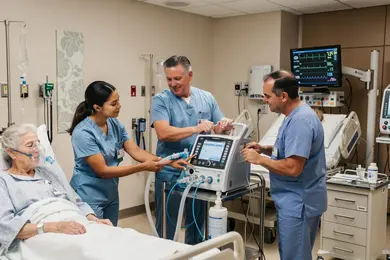
Respiratory therapists assess and treat patients with breathing disorders, operate ventilators and other respiratory equipment, educate patients, and collaborate with physicians and nurses. Applicants should demonstrate familiarity with the profession's patient-facing, shift-based, and safety-critical nature rather than focusing only on the convenience of online classes.
Artificial intelligence and remote-monitoring tools may affect documentation and workflow, but they do not replace the clinical judgment, equipment management, infection-control practices, and direct patient assessment required in respiratory care. A strong application shows readiness to learn those responsibilities.
How Can You Tell if an Online Respiratory Care Therapy Degree With No Recommendation Requirement Is Accredited and Legitimate?
Legitimacy begins with two separate checks: institutional accreditation and, for an entry-level respiratory care program, programmatic accreditation. Institutional accreditation supports academic quality and access to federal aid. Programmatic accreditation is particularly important when a degree is intended to lead to respiratory therapy credentialing or licensure.
For prospective entry-level respiratory therapists, verify that the exact program is accredited by the Commission on Accreditation for Respiratory Care (CoARC), not merely that the college is accredited. Then confirm with the appropriate state licensing board whether the program meets state requirements. State rules can differ, and a school's ability to enroll online students in a state does not by itself establish licensure eligibility there.
Use these steps before paying an application or enrollment deposit:
- Locate the exact degree, campus or online track, and accreditation status in the school's current catalog and the accreditor's directory.
- Ask whether the curriculum is designed for initial RRT credential eligibility, degree completion for existing RRTs, or another professional purpose.
- Request written confirmation of clinical requirements, including site availability, travel expectations, supervision, and who secures placement.
- Check the state where you expect to work for education, examination, and licensing requirements.
- Review required disclosures on tuition, fees, refund policies, transfer-credit rules, and student complaint procedures.
Red flags include vague claims that a program is "accredited" without naming the accreditor, promises of licensure without state-specific disclosures, pressure to enroll before reviewing clinical arrangements, and an online "respiratory therapy" degree that does not explain whether it is entry-level or designed for already credentialed therapists.
How Much Do Online Respiratory Care Therapy Degree Programs With No Letters of Recommendation Cost?
The total price of an online respiratory care degree is more than tuition. A degree-completion student may avoid some campus-based expenses, but an entry-level student can still face lab, clinical, equipment, background-check, immunization, liability-insurance, and graduation or examination-related costs.
As a broad comparison point, College Board's 2024-25 figures place average published tuition and fees at $11,610 for public four-year in-state students and $43,350 for private nonprofit four-year students. These are not respiratory care program prices or net-price estimates. Use them only as a reminder to compare each school's published tuition model and aid-adjusted cost rather than assuming online study is inexpensive.
This cost framework helps applicants ask for the information that changes affordability most.
| Cost category | Why it varies | Question to ask |
| Tuition | Per-credit, flat-rate, resident, nonresident, and completion-program pricing differ | What is the current tuition for all required credits, not only the next term? |
| Mandatory fees | Technology, distance-learning, lab, clinical, and student-service fees may apply | Which fees are charged to online or clinical students? |
| Clinical expenses | Travel, parking, uniforms, screening, and health requirements depend on placement | What expenses have recent students typically paid before clinicals? |
| Transfer credit | Accepted credits can reduce required coursework and time | How many credits are likely to apply after an official evaluation? |
| Lost work time | Clinical shifts and synchronous sessions may conflict with employment | Can clinical schedules be completed while maintaining my current work hours? |
If your long-term goal is health administration rather than direct respiratory therapy practice, compare the curriculum and return on investment with a healthcare management certificate. It serves a different career purpose and does not qualify a student for respiratory therapist licensure.
Can You Get Financial Aid for an Online Respiratory Care Therapy Degree With Streamlined Admissions?
Yes. Streamlined admissions and financial-aid eligibility are separate issues. Students at eligible institutions can generally be considered for federal student aid by submitting the Free Application for Federal Student Aid (FAFSA), provided they meet federal eligibility rules and are enrolled in an eligible program.
Start financial planning early because aid offers may arrive after admission and because clinical requirements can create upfront costs that are not fully covered by standard tuition estimates. Compare grants, scholarships, employer tuition assistance, work schedules, federal loans, and any institutional payment plan before accepting loans.
Ask the financial-aid office whether the program is eligible for aid, whether enrollment intensity affects the award, and whether repeated or prerequisite coursework has special funding limits. Also ask whether clinical terms use a different credit load than online lecture terms.
Students considering another administrative healthcare pathway can review medical billing and coding online schools that accept financial aid. Those programs are distinct from respiratory care, but the same practice of confirming institutional eligibility, program eligibility, and full charges is useful.
Avoid relying on an advertised monthly payment alone. A lower payment can result from a longer repayment period or a smaller initial course load, neither of which necessarily lowers the total educational cost.
How Long Does an Online Respiratory Care Therapy Degree With No Letters of Recommendation Take to Complete?
Completion time depends primarily on the degree type, transfer credit, clinical sequencing, and whether students enroll full time. No-recommendation admissions do not shorten the academic program; they simply remove one application document.
An associate-level entry-to-practice respiratory care program commonly takes about two years of full-time study after admission, though prerequisite completion can extend the timeline. Bachelor's degree-completion programs for credentialed RRTs may take roughly one to two years, depending on how many credits transfer and whether a student studies part time.
The table highlights the planning differences that matter most for working adults.
| Pathway | Typical timeline driver | Online flexibility limit |
| Entry-level associate degree | Prerequisites, cohort progression, labs, and clinical rotations | Clinical shifts and skills assessments are usually scheduled and in person |
| RRT-to-bachelor's completion degree | Transfer evaluation and chosen course load | Lecture work may be asynchronous, but practicums can have deadlines or site requirements |
| Graduate or leadership degree | Prior degree, professional prerequisites, and capstone expectations | Online coursework can be flexible, but group work and experiential components may be scheduled |
Before enrolling, ask for a term-by-term plan that identifies prerequisites, fixed clinical blocks, maximum transfer credits, and the latest possible completion date if a course must be repeated. This is more reliable than a marketing claim about accelerated study.
Can You Transfer Credits Into an Online Respiratory Care Therapy Degree Program With No Recommendation Letters?
Many online respiratory care programs accept transfer credits, especially bachelor's completion programs built for associate-prepared RRTs. However, transfer policies vary by institution, course age, grade earned, accreditation of the prior school, and alignment with the receiving program's learning outcomes.
General education courses are often easier to transfer than respiratory-specific clinical courses. Entry-level programs may accept anatomy, physiology, mathematics, or English coursework but still require students to complete their professional respiratory care sequence, labs, and clinical rotations through the program.
To avoid a costly enrollment mistake, follow a documented transfer process:
- Request official transcripts from every prior college, technical school, and relevant credentialing program.
- Ask for a written preliminary or official credit evaluation before committing to a start date.
- Compare accepted credits with the degree audit, not just with a general transfer-policy page.
- Confirm whether transferred science courses meet grade and recency requirements for respiratory care prerequisites.
- Keep copies of course descriptions and syllabi in case the evaluator requests additional evidence.
Do not assume that holding an RRT credential automatically awards a fixed number of credits. Some programs grant credit for prior learning or professional credentials, while others evaluate coursework individually.
How Should You Compare Online Respiratory Care Therapy Degree Programs That Do Not Require Letters of Recommendation?
Compare programs using career fit first and admissions convenience second. The right choice depends on whether you need initial eligibility for respiratory therapist credentialing, a bachelor's degree after becoming an RRT, or education for leadership, teaching, or health-system roles.
The comparison below identifies the decisions that most directly affect professional value, affordability, and completion risk.
| Comparison factor | Why it matters | Strong evidence to seek |
| Program purpose | Entry-level preparation and RRT degree completion lead to different outcomes | Clear statement of who may enroll and what the degree does not qualify graduates to do |
| Accreditation and licensure alignment | These affect credential eligibility and employer confidence | Named institutional accreditor, CoARC status where applicable, and state-specific disclosures |
| Clinical model | Clinical access can determine whether an online format is practical | Written explanation of placement responsibility, travel, schedule, and required in-person work |
| Admissions requirements | "No letters" may coexist with other selective requirements | Program-specific checklist showing GPA, prerequisites, credential, essay, and deadline requirements |
| Total cost and aid | Tuition alone misses required educational expenses | Itemized estimate, transfer evaluation, net-price information, and aid counseling |
| Student support | Online learners may need advising, tutoring, technical help, and career guidance | Named contacts, orientation details, retention support, and clear response expectations |
It can also help to compare your interests with related movement-science study through best kinesiology programs. Kinesiology can support careers in exercise, rehabilitation, and wellness, but it is not an alternative route to respiratory therapist licensure.
Before applying, contact each admissions office with a short written list: "Are recommendation letters required for this exact online program and start term? Is this an entry-level or degree-completion program? Does it meet educational requirements in my state? What in-person clinical, lab, or practicum work is required? What is my estimated total cost after transfer credit?" Save the responses with your application records.
Other Things You Should Know About Respiratory Care Therapy
Possibly. Programs that explicitly state that recommendation letters are not required allow applicants to proceed without them. You may still need transcripts, prerequisite coursework, a resume, a goal statement, credential verification, or clinical-clearance documents.
Only some do. An entry-level program must include the required professional and clinical preparation, while many online bachelor's programs are intended for people who already hold the RRT credential. Confirm the program's purpose and CoARC accreditation status before applying.
Use the program-specific application portal or current graduate/undergraduate catalog, then email admissions for written confirmation. Ask about the exact degree, delivery format, applicant category, and intended start term because requirements can vary.
Employers generally focus on whether you hold the required credential or license, completed an appropriate accredited program when required, and can demonstrate relevant skills. The absence of recommendation letters in admissions is usually far less important than program accreditation, clinical preparation, and professional eligibility.
References
- Admission https://www.pima.edu/academics-programs/degrees-certificates/health-sciences/respiratory-care/aas/admission.html
- Respiratory Care Admission Packet https://www.coahomacc.edu/programs/health-sciences/respiratory-care/admission-guidelines.html
- RESPIRATORY CARE (AAS) - Academics https://www.ncmissouri.edu/academics/respiratory-care-aas/
- Respiratory Therapy Personal Statement Examples and Tutoring | Vince Kotchian Test Prep https://vincekotchian.com/personal-statements/respiratory-therapy-personal-statements/
- Respiratory Therapy https://www.ntc.edu/academics-training/programs/all/associate-degree/respiratory-therapy