2027 Online Pediatric Primary Care NP Programs for Nurses in Tennessee: MSN Routes and Clinical Requirements
Audited and Verified:
Our Editorial and Data Verification Process
Research.com uses government datasets, official education statistics and primary institutional information to support its career and degree guides. Our review process checks factual accuracy, occupational definitions, source dates and the requirements associated with the credentials discussed.
How This Article Was Fact-Checked
Our editorial team verifies salary estimates, employment projections, education requirements and program information against original data providers and official organizations. Salary figures are checked against the relevant occupational definitions and reporting periods. Information about licensure, accreditation and required in-person training is reviewed separately.
Fact-checked and verified on:

Co-Founder and Chief Data Scientist
For a Tennessee nurse pursuing pediatric primary care, an "online MSN" can mean remote coursework paired with local clinical rotations, scheduled live classes, and campus visits. Those differences can determine whether a program is workable alongside an RN job - and whether it prepares you for the certification you need.
This guide explains the available pathways, identifies a Tennessee program to investigate, and shows how to check placement support, certification eligibility, time, and total cost before committing.
Key Things You Should Know
- A pediatric primary care NP program must prepare graduates for the pediatric primary care population focus; an FNP, pediatric acute care, or non-APRN MSN is not the same pathway.
- The Pediatric Nursing Certification Board requires at least 500 supervised, pediatric-focused direct-care clinical hours for its primary care NP certification; a school may require more.
- Vanderbilt University offers a pediatric primary care NP MSN pathway, but nurses should confirm its current distance-learning format, Tennessee clinical-placement arrangements, and full attendance requirements before applying.
What are online pediatric primary care NP programs in Tennessee?
These are graduate nursing pathways that prepare licensed RNs to assess, diagnose, treat, and coordinate care for children and adolescents in primary care, subject to certification and state practice requirements. Online usually describes the academic coursework - not the entire program. Supervised patient care takes place in person, and schools may require live online sessions or campus intensives.
The critical label is pediatric nurse practitioner-primary care (PNP-PC). Pediatric acute care NP preparation addresses a different practice focus. An FNP program spans patients across the lifespan but does not award PNP-PC preparation. A BSN-prepared RN commonly considers an MSN or BSN-to-DNP PNP-PC track; an already-prepared APRN may ask about a post-graduate certificate and a school's formal review of prior coursework and clinical hours.
A DNP is another possible degree route, not an automatic substitute for the right specialty track. Nurses comparing shortest online nursing practice doctorates should confirm that the particular doctorate includes PNP-PC preparation and a feasible Tennessee clinical plan.
What education and licensing do Tennessee pediatric primary care NPs need?
The usual progression is an active RN license, completion of a graduate PNP-PC educational pathway with supervised clinical preparation, national certification in that population focus, and Tennessee advanced practice authorization. Graduation, passing a certification exam, and receiving state authorization are separate steps. Prescriptive authority and controlled-substance requirements warrant a separate check with the Tennessee Board of Nursing and applicable state law.
An RN whose bachelor's degree is in another field should ask each school whether its PNP-PC route accepts that academic background and what additional nursing coursework applies. A person without RN licensure needs an initial nursing pathway first; direct-entry MSN coursework and clinical requirements address a different starting point and should not be mistaken for immediate admission to an NP specialty.
Before paying a deposit, obtain written confirmation that the program's curriculum and clinical experiences support its intended certification exam and Tennessee APRN application. Also check institutional accreditation, the nursing program's applicable accreditation, and authorization to enroll and place students where you live; these are distinct checks.
Which Tennessee schools offer online pediatric primary care MSN pathways?
Vanderbilt University School of Nursing is a Tennessee institution with a pediatric nurse practitioner-primary care MSN specialty to investigate. Its distance-learning arrangements should be confirmed for the intended entry term: "distance" does not establish that every class is asynchronous or that campus travel is unnecessary.
This is not a claim that Vanderbilt is the only Tennessee option. Specialty menus, degree awards, and delivery formats change, and a school listing "pediatric NP" may offer a DNP, a certificate, an acute care focus, or an on-campus route rather than the online primary care MSN you need. The comparison below separates what a prospective applicant can identify from what requires direct confirmation.
| Pathway to investigate | Relevant distinction | What to confirm before applying |
| Vanderbilt PNP-PC MSN | Tennessee-based MSN specialty in the intended population focus | Current distance format, required visits, total clinical hours, placement process, tuition, and Tennessee eligibility |
| Other Tennessee pediatric NP listings | The listed award or focus may differ from a PNP-PC MSN | Exact credential, primary versus acute care focus, current enrollment, and online availability |
| Out-of-state distance PNP-PC programs | Potential option for a Tennessee resident | Permission to enroll a Tennessee student, approved local clinical sites, campus travel, and certification preparation |
An ADN-prepared RN should not assume every MSN track admits applicants without a BSN. If that is your starting credential, compare MSN pathways that accept ADN-prepared nurses, then ask specifically whether any bridge leads into PNP-PC rather than a different MSN specialty.
Students complete supervised, school-approved clinical experiences with pediatric patients at eligible sites, potentially near home if the program permits. The school determines its curriculum, site agreements, preceptor qualifications, faculty oversight, evaluations, and accepted hours. PNCB certification eligibility includes at least 500 supervised, pediatric-focused direct-care hours; meeting that floor alone does not establish that a particular student has met a school's requirements.
Ask who identifies potential preceptors, who secures affiliation agreements, how far in advance a site must be approved, and what happens if a planned placement falls through. A pediatric RN job, prior employment hours, simulation, or a personally arranged clinic does not automatically count toward graduate NP clinical requirements. For working nurses and caregivers, the decisive scheduling question is often whether approved pediatric clinics can provide the required weekday patient encounters - not whether lectures can be watched after work.
Nurses who have not yet obtained RN licensure face a different clinical sequence. LPN-to-RN clinical training requirements concern preparation for RN practice; those hours do not automatically replace graduate pediatric NP rotations.
Expect advanced pathophysiology, advanced pharmacology, and advanced health assessment alongside pediatric-specific diagnosis and management. PNP-PC study typically emphasizes growth and development, preventive visits, immunization counseling, common childhood conditions, chronic illness follow-up, adolescent care, family education, and recognizing when a child needs urgent referral. Coursework is paired with supervised assessment and clinical decision-making; passing a class does not independently validate readiness for practice.
Review the actual course sequence rather than a general MSN description. A course labeled "pediatric" may serve acute care or another track, while a program's live case discussions, skills assessments, and intensive sessions can affect an employed RN's weekly schedule. Nurses whose intended practice is primarily psychiatric care should compare the different population focus and preparation described in accelerated PMHNP master's admissions and requirements, rather than expecting a PNP-PC curriculum to confer PMHNP eligibility.
Expect schools to review RN licensure, prior nursing education, transcripts, academic performance, and readiness for graduate-level study. Schools may also request references, a statement of purpose, a résumé, and an interview; pediatric nursing experience may strengthen an application or be required by a particular track. A clinical site can impose additional background-check, immunization, or onboarding conditions even after the university admits you.
Ask admissions to evaluate your specific entry status: BSN-prepared RN, ADN-prepared RN, RN with a non-nursing bachelor's degree, or existing APRN. For an APRN entering a new population focus, request a documented review of prior graduate courses and supervised hours. FNP certification or pediatric RN experience may inform that review but does not itself award PNP-PC preparation. If you are already an FNP, comparing post-master's FNP study options is useful only for understanding how certificate pathways can differ; another FNP certificate is not a pediatric primary care NP credential.
There is no dependable Tennessee-wide price or completion time: schools set different credit loads, clinical sequences, tuition rates, fees, and part-time options. An applicant with transferable graduate work may receive a different plan from a BSN-to-MSN entrant, but only the receiving school can approve substitutions. Published tuition also may not capture the cost of keeping a clinical weekday free from paid work.
For an accurate comparison, request a term-by-term degree plan and a written estimate using your residency status and intended course load. Include tuition and mandatory fees, travel for any campus sessions, clinical-site travel, compliance requirements, books or technology, certification and licensing expenses, and earnings you might forgo. BSN-to-MSN tuition comparisons can provide a starting framework, but a lower advertised rate for another specialty does not establish a cheaper PNP-PC qualification.
Compare total cost to completion, not just cost per credit. A lower-priced program may become less practical if it requires more travel, offers limited placement support, or delays clinical courses that must be taken in sequence.
The population-specific national credential is the Pediatric Nursing Certification Board's Certified Pediatric Nurse Practitioner-Primary Care (CPNP-PC). PNCB evaluates educational and clinical eligibility and administers the certification exam; the Tennessee Board of Nursing makes the separate state authorization decision. Check both organizations' requirements when planning your application, especially if your education spans multiple programs.
Do not confuse CPNP-PC with pediatric acute care NP certification or with a general pediatric RN specialty credential. Likewise, a faster certificate in another NP specialty is not a shortcut to pediatric primary care certification: shorter online PMHNP certificate programs prepare for a different population focus. Ask the PNP-PC program to identify its intended certification exam and explain how its documented clinical experiences support eligibility.
With appropriate certification, Tennessee authorization, and employer credentialing, PNP-PC graduates may seek roles in pediatric primary care practices, community clinics, and other ambulatory services serving children and adolescents. Depending on the position, work can include preventive care, assessment of common conditions, chronic disease follow-up, family education, and coordination with specialists. Job descriptions still matter: a hospital-based acute care role may call for different preparation.
Graduation is not a job offer or proof of independent competence in every setting. Compare employers' expected patient ages, visit mix, orientation, mentoring, scheduling, and scope of duties. An RN aiming instead for operations or executive leadership should examine online DNP executive and organizational pathways; a non-APRN leadership program is not a substitute for PNP-PC preparation.
What are pediatric primary care NP salaries and job prospects in Tennessee?
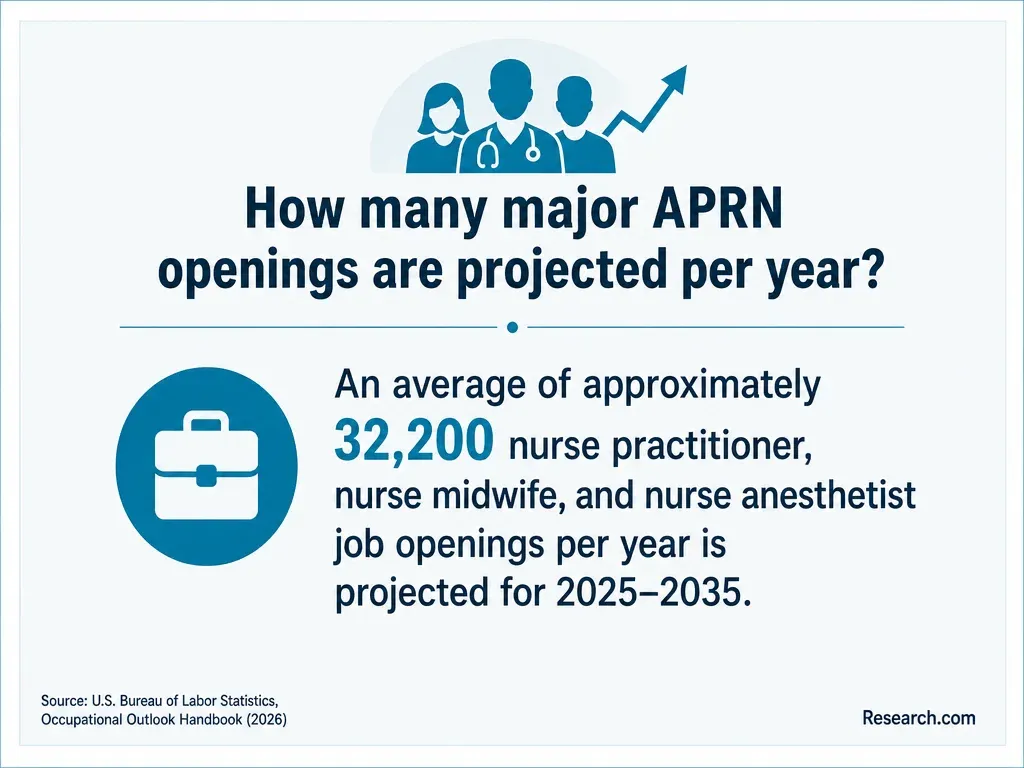
Public workforce statistics generally report nurse practitioners as an occupation, not Tennessee pediatric primary care NPs as a separate wage group. Consequently, an NP median cannot be presented as a new PNP-PC graduate's likely offer. The U.S. Bureau of Labor Statistics publishes national NP wages and occupational projections, but those figures include multiple NP specialties and practice settings; Tennessee-specific occupational wage data likewise need to be read as NP-wide estimates.
For a usable local comparison, review current Tennessee pediatric primary care postings and ask employers about base pay, productivity expectations, benefits, call, orientation, and the experience assumed in an advertised range. Geography and the number of pediatric-specific openings may matter more to your search than broad NP growth projections. If mental health practice is your actual goal, affordable online psychiatric nurse practitioner programs are a separate specialty decision - not evidence of what Tennessee PNP-PC roles pay.
Other Things You Should Know About Nursing
Do not assume Tennessee authorization is sufficient. Confirm the rules where the patient is located, along with employer credentialing and applicable telehealth requirements, before providing care.
No. School nursing positions can have different RN, education, and employer requirements. PNP-PC certification should not be assumed necessary - or sufficient - for a particular school job.
Usually not by itself. The graduate program must approve and evaluate qualifying supervised NP experiences; document prior work for an individualized review rather than assuming it transfers.
Yes. Plan for the certifier's renewal requirements and any separate Tennessee license-renewal obligations. Check the applicable deadlines and continuing-competence rules directly with each authority.
- Tennessee Department of Health Board of Nursing | tn.gov https://www.tn.gov/health/licensure/nurs.html
- Online MSN - Pediatric Primary Care Nurse Practitioner - UTA https://academicpartnerships.uta.edu/healthcare-nursing-online-programs/msn-pediatric-care/pcnp/
- Graduate Preceptor Policy - College of Nursing https://nursing.utk.edu/about/employment-opportunities/graduate-preceptor-policy/
- Nursing Field Experience: Find a Preceptor and Site | Academics at Walden University https://academicguides.waldenu.edu/nursing-field/find-preceptor
- Tenn. Comp. R. & Regs. 1000-01-.11 | State Regulations | LII / Legal Information Institute https://www.law.cornell.edu/regulations/tennessee/Tenn-Comp-R-Regs-1000-01-.11
- Tuition in Detail - One Stop Student Services https://onestop.utk.edu/billing-payments/tuition-detail/
- Prepping for PNCB Nursing Certification | Regis College Online https://online.regiscollege.edu/blog/pncb-nursing
- Clinical Placement | Vanderbilt University School of Nursing https://nursing.vanderbilt.edu/current-students/clinical-placement/
- Pediatric Nurse Practitioner Graduate Certificate - UTK Catalog https://catalog.utk.edu/preview_program.php
- Pediatric Primary Care Nurse Practitioner | DNP | UTHSC https://uthsc.edu/nursing/dnp/pediatric-primary-np.php