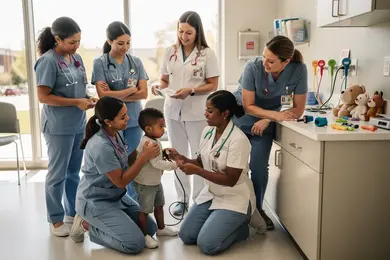
2027 Online Pediatric Care Nurse Practitioner Degree Programs With No Personal Statement or Admissions Essay Required

Co-Founder and Chief Data Scientist
Key Things You Should Know
- A true no-essay PNP application omits a required personal statement, but schools commonly still review RN licensure, nursing transcripts, GPA, prerequisite courses, professional experience, references, and background-clearance eligibility.
- No-essay does not mean open or automatic admission: PNP programs are graduate clinical programs, and the BLS projects 46% growth in nurse practitioner employment from 2023 to 2033, which can sustain competition for qualified applicants and clinical placements.
- "Essay-optional" lets applicants submit writing to add context, while "essay-waived" usually means a school removed an essay for a particular term or applicant group; scholarship, honors, and conditional-admission applications may still require written materials.
What Does No Personal Statement or Admissions Essay Required Mean for Online Pediatric Care Nurse Practitioner Degree Programs?
For an online PNP program, "no personal statement required" generally means the standard admissions application does not ask for a narrative explaining your career goals, pediatric experience, or reasons for pursuing advanced practice. "No admissions essay required" means much the same thing when the school uses the terms interchangeably. It does not mean the program has eliminated its professional or academic screening process.
A school can accurately market a no-essay policy while requiring substantial documentation. The distinction matters because clinical graduate programs must assess whether applicants can complete advanced coursework, meet placement requirements, and eventually satisfy certification and state licensure standards.
| Application term | What it usually means | What a student should confirm |
| No essay required | No narrative essay is part of the standard application. | Whether a goals statement, supplemental form, or interview replaces it. |
| No personal statement | The school does not require a personal narrative about motivation or background. | Whether written explanations are needed for low GPA, gaps, or disciplinary history. |
| Essay-optional | An essay is not mandatory but may be considered if submitted. | Whether submitting one can strengthen borderline, transfer, or scholarship applications. |
| Essay-waived | An essay requirement has been removed for a defined applicant type, intake, or campaign. | The waiver's dates, eligible program, and whether it applies to all applicants. |
Read the program-specific admissions checklist rather than relying on an advertising headline. A university-wide graduate application policy may differ from the policy for a nursing school, post-master's certificate, or PNP concentration.
What Admissions Requirements Do Online Pediatric Care Nurse Practitioner Degree Programs Use Instead of an Essay?
When an essay is not required, admissions committees generally place more weight on objective evidence of nursing preparation and readiness for graduate clinical work. Requirements vary, but most applicants should expect an active, unencumbered RN license and a qualifying nursing degree.
The following items are commonly used to evaluate applicants and should be gathered before applying.
- Official transcripts showing a BSN or, for some pathways, another qualifying nursing degree and completion of required prerequisite courses.
- A minimum cumulative and nursing GPA, with some schools separately reviewing science or upper-division nursing coursework.
- An active RN license in the state where the applicant will complete clinical experiences, plus authorization to participate in required clinical training.
- Professional résumé documenting RN employment, pediatric or relevant clinical experience when required, and current certifications such as BLS.
- Recommendation letters, an interview, a recorded response, or a faculty review when the program uses these instead of a formal essay.
- Health, immunization, drug-screening, criminal-background, and clinical-site compliance documents after admission or before clinical placement.
Standardized test policies vary. Many nursing graduate programs do not require the GRE, but a no-GRE policy is separate from a no-essay policy. Likewise, a school may accept a lower GPA with conditions, such as probationary enrollment or successful completion of initial courses, without making admission automatic.
Applicants entering nursing through an associate-degree route should first verify the education sequence needed for graduate PNP study. An ASN nursing online program can be an entry point toward RN licensure, but it is not itself preparation for immediate PNP certification; most graduate PNP tracks require additional BSN-level preparation or an RN-to-MSN pathway.
Who Is a Good Fit for Online Pediatric Care Nurse Practitioner Degree Programs With No Admissions Essay?
A no-essay pathway can fit licensed RNs with solid academic records and clear documentation who want to reduce application time without compromising program quality. It is often practical for nurses applying to several programs while managing shifts, family responsibilities, or employer scheduling constraints.
It may be a particularly good fit for applicants whose transcripts, license status, prerequisite completion, and recent clinical employment already show strong readiness. A streamlined application can also help experienced pediatric, family, emergency, neonatal, or community-health nurses who do not need an essay to explain a conventional career progression.
Applicants with less straightforward records may benefit from an essay-required or essay-optional program. A well-written statement can provide useful context for a prior low GPA, a leave from school, a specialty change, limited pediatric experience, or a compelling service commitment. In those cases, removing the essay may remove an opportunity to explain strengths that grades alone do not show.
Online delivery also requires more than comfort with virtual classes. Students should be prepared for synchronous sessions if scheduled, intensive advanced-pathophysiology and pharmacology coursework, local clinical placement requirements, and time away from paid work during practicum periods. No-essay admissions is a good fit only if the program's population focus, clinical support, state authorization, and certification alignment fit the nurse's intended practice.
What Is the Difference Between No-Essay, Essay-Optional, and Essay-Waived Pediatric Care Nurse Practitioner Degree Admissions?
These labels can sound similar, yet they create different application strategies. The important question is not whether a school uses the word "essay," but whether any written narrative, supplemental prompt, explanation, or scholarship statement remains mandatory.
This comparison shows how each policy affects the information an admissions committee receives.
| Policy | Required applicant writing | Best use case | Potential limitation |
| True no-essay | No personal statement or admissions essay in the standard application. | Applicants with a strong, straightforward academic and licensure record. | Less space to contextualize academic or professional circumstances. |
| Essay-optional | Writing is voluntary, but it may be reviewed if submitted. | Applicants who have meaningful context or a strong pediatric-care rationale to share. | Submitting a generic essay can add little value. |
| Essay-waived | An otherwise required essay is temporarily or selectively removed. | Eligible applicants who confirm the waiver in writing before applying. | The policy may not apply to every term, track, or applicant category. |
| Essay-required | A statement or response is part of the admissions file. | Applicants needing to explain fit, goals, or nontraditional preparation. | Requires additional time and careful tailoring. |
Do not assume a waiver applies to scholarship applications, graduate assistantships, clinical partnership cohorts, or special honors opportunities. Those processes may use separate applications and separate written prompts, even when the degree application has no essay.
Are Online Pediatric Care Nurse Practitioner Degree Programs With No Admissions Essay Easier to Get Into?
Not necessarily. A shorter application reduces one administrative step; it does not lower the clinical, academic, or regulatory standards needed for advanced-practice nursing education. Programs may remain selective because they must evaluate nursing preparation, faculty capacity, clinical placement resources, and an applicant's likelihood of meeting progression standards.
The most useful measure of fit is whether you meet the published requirements, not whether an essay is absent. Compare minimum GPA with the GPA of admitted students if the school publishes it, ask whether prerequisites must be completed before submission, and determine whether recent RN experience is preferred or required. A stated minimum is an eligibility threshold, not a promise of acceptance.
Be especially cautious of claims that an online PNP program has "no clinical hours." A PNP certification pathway requires supervised clinical education. A DNP program without clinical hours may refer to a nonclinical or post-licensure doctoral curriculum, not a route that replaces the clinical preparation required for initial PNP practice.
Common mistakes include equating no essay with no standards, overlooking clinical-state authorization, and selecting a program solely because the application is fast. A better approach is to treat admissions simplicity as a convenience factor after confirming nursing accreditation, PNP curriculum, certification eligibility, and realistic clinical-placement support.
How Can You Verify Accreditation and Quality in No-Essay Online Pediatric Care Nurse Practitioner Degree Programs?
Accreditation and certification alignment matter more than whether an application requires an essay. Start by confirming that the institution holds recognized institutional accreditation and that the nursing program holds nursing accreditation appropriate to its degree level, commonly through the Commission on Collegiate Nursing Education (CCNE) or the Accreditation Commission for Education in Nursing (ACEN).
Then verify that the curriculum is designed for the PNP population focus you want to pursue. Primary care and acute care pediatric roles are not interchangeable. Ask the school which certification examination its graduates are eligible to pursue, how it documents clinical experiences, and whether its curriculum meets requirements in the state where you plan to seek APRN licensure.
A quality review should include evidence beyond a school's marketing language. Ask for written answers to the following questions before paying an application deposit or committing to enrollment.
- Is the specific MSN, post-master's certificate, or DNP nursing track accredited, and through what dates?
- Does the program prepare graduates for the intended pediatric certification pathway and for licensure in my state?
- How are clinical sites, preceptors, faculty supervision, and remediation handled if a placement falls through?
- What are the typical course sequence, campus-visit expectations, clinical-hour requirements, and maximum time allowed for completion?
- What outcome information does the school publish, such as certification examination performance, completion data, or employment-related disclosures?
- Are there state restrictions, additional fees, or clinical-placement limitations for students living outside the school's home state?
Red flags include vague answers about accreditation, no clear explanation of certification eligibility, promises that clinical requirements can be bypassed, and pressure to enroll before you can review the student handbook or total-cost information. Confirm important answers by email so you have a record of what was represented.
How Does the Application Process Work for Online Pediatric Care Nurse Practitioner Degree Programs With No Personal Statement?
A no-personal-statement application is usually faster, but it still requires planning because nursing documents, transcript processing, licensure checks, and references can take time. Programs with rolling admissions may fill cohorts before their final deadline, while cohort-based programs may have a single annual or term-specific deadline.
Use this sequence to avoid discovering a missing requirement after the deadline.
- Open the admissions page for the exact PNP track and term, then save or print the current requirements and deadline.
- Confirm that "no essay" applies to your degree level, campus status, state of residence, transfer category, and admission term.
- Request official transcripts early and review them against prerequisite requirements, including statistics and advanced nursing courses where applicable.
- Verify RN license status and identify any clinical compliance documents that will be required after admission.
- Prepare a current résumé and contact references if the program requests recommendations or an employment verification.
- Submit the application and fee, then monitor the applicant portal for supplemental requests, transcript receipt, interview invitations, or admission conditions.
- Before accepting an offer, review the financial-aid package, tuition schedule, clinical-placement responsibilities, state authorization, and progression rules.
A school can request additional information if your file raises an eligibility question. For example, an admissions office may ask for a short explanation of a transcript discrepancy, a licensing matter, or a prerequisite-course plan. That request does not necessarily mean the advertised policy was inaccurate; it means the standard no-essay policy does not eliminate case-specific documentation.
Can Transfer and Adult Students Apply to Online Pediatric Care Nurse Practitioner Degree Programs Without an Essay?
Yes, provided the school accepts their prior education and they meet the program's nursing and licensure requirements. Adult learners are common in online graduate nursing programs, but work experience does not automatically substitute for required coursework, an active RN license, or eligibility for clinical placement.
Transfer rules are especially important in PNP education because schools may limit the age of transferred courses, require a minimum grade, or accept only a defined number of graduate credits. Clinical courses are often harder to transfer because faculty must confirm equivalency, supervised practice documentation, and alignment with the receiving program's certification preparation.
Applicants considering an accelerated route should distinguish a faster academic calendar from reduced clinical expectations. A fast track program may shorten scheduling through year-round terms or transfer credit, but it should still clearly disclose required clinical practice, faculty oversight, and certification alignment.
Transfer and adult applicants should ask whether the no-essay policy applies to change-of-program students, readmission applicants, international transcript evaluations, and students returning after a prior dismissal. These categories can have separate review procedures, including written explanations or interviews.
Do No-Essay Online Pediatric Care Nurse Practitioner Degree Programs Affect Tuition, Financial Aid, or Scholarships?
No-essay admissions usually does not change tuition, federal aid eligibility, or the underlying price of a PNP degree. Costs are determined by factors such as per-credit tuition, required credits, distance-learning charges, campus intensives, clinical expenses, health requirements, books, certification preparation, and travel to clinical sites.
For labor-market context, the U.S. Bureau of Labor Statistics reported a $129,210 median annual wage for nurse practitioners in May 2024. That national occupation-wide figure is not a starting-salary guarantee for PNP graduates and does not account for specialty, location, employer, experience, or state practice rules. Use it only as one broad input when weighing total educational cost against your likely local opportunities.
Financial aid can still require more paperwork than admission. Completing the FAFSA is generally necessary for federal student-aid consideration, and scholarships frequently have separate deadlines, eligibility criteria, and personal-essay prompts. A no-essay degree application should not lead you to skip scholarship applications that could reduce borrowing.
Compare published tuition with net cost rather than choosing the shortest application. The cost-comparison habits used for a cheapest online master's in nutrition search are also useful here: compare required credits, mandatory fees, travel, and clinical-related expenses instead of focusing only on the advertised per-credit rate.
| Cost or aid item | Why it matters for PNP students | Question to ask |
| Tuition and required credits | They establish the base program cost. | What is the total estimated tuition for my entry pathway? |
| Fees and residencies | Technology, clinical, simulation, and travel costs can materially affect the budget. | Which mandatory fees are excluded from advertised tuition? |
| Clinical placement expenses | Preceptor, background-check, compliance, and travel costs may fall to the student. | What clinical expenses should I budget for each term? |
| Scholarships | They may reduce borrowing but often use a separate application. | Does this scholarship require an essay, recommendation, or service commitment? |
Review loan terms carefully and avoid treating projected earnings as a repayment promise. A financial-aid counselor can help distinguish institutional scholarships, employer tuition assistance, federal loans, and private borrowing options.
How Should You Compare Online Pediatric Care Nurse Practitioner Degree Programs With No Admissions Essay?
Compare programs in the order that protects your professional goal: certification and licensure fit first, then accreditation and clinical quality, then cost and application convenience. A no-essay policy is valuable when it saves time, but it should not outweigh a mismatch in population focus or state eligibility.
The table below identifies the factors that most directly affect whether an online PNP option can support your intended practice path.
| Comparison factor | Why it matters | Strong sign |
| Population focus | Primary care and acute care PNP roles prepare students for different practice settings. | The track clearly states its pediatric focus and certification pathway. |
| Accreditation | Programmatic nursing accreditation supports quality review and may affect eligibility expectations. | Current accreditation status is plainly published and independently verifiable. |
| Clinical support | Online learners still need supervised pediatric clinical practice. | Written policies explain placement, preceptor approval, faculty supervision, and contingency support. |
| State authorization | Distance education and APRN licensure requirements vary by state. | The school confirms eligibility for students in your state in writing. |
| Total cost | Tuition alone may omit mandatory program and clinical expenses. | A complete estimate covers credits, fees, travel, and required compliance costs. |
| Admissions policy | No essay may streamline the process without indicating selectivity or quality. | The school clearly separates standard admission, scholarship, and conditional-admission requirements. |
Also compare adjacent NP pathways if your career goal is broader than pediatric-only practice. Prospective students weighing family practice against pediatric specialization can review online DNP FNP programs, then verify which patient populations, certification routes, and state-practice requirements align with their intended role.
Create a short list of two to four accredited programs and request written confirmation of your eligibility before applying. The best choice is the program that fits your pediatric career target, finances, timeline, and clinical circumstances - not simply the one that asks for the least application writing.
Other Things You Should Know About Pediatric Care Nurse Practitioner
Not always. A policy may apply only to a particular term, degree track, domestic applicants, or standard admission. Transfer, readmission, conditional-admission, and international credential-review applicants may have additional requirements. Confirm your category with the admissions office.
Yes. Schools may request a brief explanation for a GPA issue, disciplinary disclosure, missing prerequisite, license matter, or unusual transcript record. This is different from requiring every applicant to submit a standard personal statement.
Often, yes. Scholarships, employer-partnership awards, and service-based funding commonly use separate applications that may request essays, recommendations, or statements of financial need. Review funding requirements separately from degree admission requirements.
Coursework may be delivered online, but initial PNP preparation includes supervised clinical experiences that must occur in approved real-world settings. Confirm how the program supports clinical placement and whether it is authorized to enroll and prepare students in your state.
References
- Most Affordable Online NP Programs (2026): Comprehensive https://www.npschools.com/rankings/all-affordable-online-np-programs
- Admission Essay vs Personal Statement | What's the Difference? https://www.proof-reading.com/resources/admission-essay-vs-personal-statement
- Online Pediatric Nurse Practitioner (PNP) Programs https://nursinglicensemap.com/nursing-degrees/online-nurse-practitioner-programs/pediatric-nurse-practioner-pnp-programs/
- Guide to the Most Affordable Online Nurse Practitioner Programs https://www.edumed.org/online-schools/nurse-practitioner-programs/most-affordable/
- 9 Personality and Character Traits Colleges Look for in Applicants https://www.collegedata.com/resources/getting-in/9-personal-qualities-colleges-look-for-in-applicants
- 2025 Most Affordable Online Nurse Practitioner Programs https://www.onlineu.com/most-affordable-colleges/nurse-practitioner-masters-degrees
- Nurse Practitioner Personal Statement Examples and Tutoring https://vincekotchian.com/personal-statements/nurse-practitioner-personal-statements/
- College Personal Statement Examples and Writing Tips - Wordvice https://wordvice.com/blog/examples-of-successful-college-personal-statements/
- College Applications Without Essays: Do They Exist? https://collegewise.com/blog/college-application-without-essay