2027 Online MS in Psychology - Forensic Psychology Admissions with College Coursework Completed While Incarcerated: What to Ask Before Applying
Audited and Verified:
Our Editorial and Data Verification Process
Research.com uses government datasets, official education statistics and primary institutional information to support its career and degree guides. Our review process checks factual accuracy, occupational definitions, source dates and the requirements associated with the credentials discussed.
How This Article Was Fact-Checked
Our editorial team verifies salary estimates, employment projections, education requirements and program information against original data providers and official organizations. Salary figures are checked against the relevant occupational definitions and reporting periods. Information about licensure, accreditation and required in-person training is reviewed separately.
Fact-checked and verified on:

Co-Founder and Chief Data Scientist
College coursework completed while incarcerated may strengthen an application to an online forensic psychology master's program, but its value depends on the issuing college's records, the bachelor's degree awarded, and each graduate school's policies. If you are returning to school, the most useful first step is not another application fee - it is a clear answer about eligibility. This guide explains what to ask about transcripts, prerequisites, online access, costs, and career outcomes so you can identify programs that will evaluate your preparation fairly and support your actual goal.
Key Things You Should Know
- Coursework completed while incarcerated can be considered for admission when the issuing college documents it; a completed bachelor's degree is generally a separate master's-entry requirement.
- Ask for two reviews: whether your degree meets admission rules and whether specific psychology, statistics, or research-methods courses meet prerequisites.
- A forensic psychology MS is generally a nonclinical degree; coursework in legal settings does not itself qualify you for psychologist licensure or forensic evaluation.
What is an online MS in psychology with a forensic psychology concentration?
It is a graduate psychology degree focused on psychological science in legal and justice-system contexts. The forensic concentration may be a formally designated set of courses within an MS in psychology, rather than a separately awarded degree. Program titles and requirements vary, so confirm what the transcript and diploma will actually say.
Typical topics include behavior in courts or corrections, research on eyewitness memory, victimization, and ethical questions at the intersection of psychology and law. The emphasis may be research, policy, or nonclinical applied work - not training to diagnose people or conduct court-ordered evaluations. If you are still completing a bachelor's degree, compare online psychology study and degree choices separately from graduate options: admission to an MS usually depends on finishing the undergraduate credential first.
Can college coursework completed while incarcerated count toward graduate admission?
Yes, potentially. The setting where a course was taken does not, by itself, determine its academic value. What matters to admissions is usually the college that awarded credit, its transcript, the course content and grade, and how the coursework fits the program's requirements. Graduate schools make their own admission decisions; none should be assumed to accept a course solely because another school previously accepted it as transfer credit.
Keep three decisions separate: whether an undergraduate college accepted the coursework, whether it applied those credits toward a completed bachelor's degree, and whether a graduate program recognizes particular courses as prerequisites. If you have not yet earned a bachelor's degree, forensic psychology undergraduate graduation timelines may help you frame questions about a degree audit, but only your undergraduate institution can confirm remaining requirements.
Request official transcripts from every college that awarded credit, including courses taken through a prison education partnership. If an official transcript uses an unfamiliar campus, program, or pass/fail designation, ask the graduate admissions office whether it needs a course description or syllabus. Ask the academic department - not just a general enrollment adviser - to confirm any prerequisite equivalency in writing before you pay an application fee.
What are the admission requirements for an online forensic psychology master's program?
Requirements differ by school. A completed bachelor's degree is commonly central; a psychology major is not always required. Applicants from criminal justice, social work, education, or other fields may bring relevant experience but still need particular psychology or quantitative courses. For example, addiction psychology BA and BS degree options can provide relevant behavioral-science preparation, but the graduate school - not the undergraduate degree title - decides whether coursework satisfies its prerequisites.
The following distinctions help you ask for a usable eligibility decision rather than a general assurance that you are welcome to apply.
| Admission issue | What to verify with the program |
| Degree and institution | Accepted bachelor's credentials and how the school checks the awarding institution's accreditation |
| Academic record | Minimum GPA, treatment of repeated or pass/fail courses, and whether recent coursework can demonstrate readiness |
| Prerequisites | Required versus recommended psychology, statistics, and research-methods courses; acceptable substitutions |
| Application evidence | Official transcripts, recommendations, statement, résumé, and any test or interview requirement |
| Outstanding coursework | Whether conditional admission or completion of prerequisites before enrollment is possible |
Send admissions a brief record of your degree, institutions attended, relevant courses, and expected graduation date. Then ask: "Can you evaluate these courses for your stated prerequisites, and who makes that decision?" If an academic gap affects your application, use the statement to show your current research, writing, or quantitative readiness without assuming that incarceration requires a particular explanation. Review each school's actual disclosure questions and answer them accurately.
First, identify the university awarding the MS. Check its current institutional accreditation in the U.S. Department of Education's accreditation database or the accreditor's directory, then confirm that the online program is offered by that institution. Ask the school which accreditation status applies to your intended entry term if a website's wording is unclear.
Next, check accreditation against your goal. APA accreditation does not generally apply to a nonclinical psychology MS merely because it has forensic courses. Institutional accreditation also does not establish eligibility for a professional license. If your goal is substance use treatment rather than justice-system research or support, compare the credential requirements for degree pathways for substance use counseling work with your state's rules; a school's forensic concentration is not a substitute for a qualifying counseling pathway.
Look beyond the concentration label. A useful curriculum for nonclinical forensic work pairs psychology research methods and statistics with focused study of legal settings, ethics, and evidence interpretation. Possible subjects include psychology and law, victimization, corrections, violence research, or substance use in justice settings. A course about psychological assessment teaches concepts; it does not authorize graduates to administer restricted tests independently.
Ask whether the program requires a thesis, research project, capstone, or placement, and who supervises it. For a project involving justice-involved people or agency data, access and confidentiality rules may sharply limit what a student can do. Also check when prerequisite and methods courses run: psychology degrees with condensed course schedules illustrate a pacing option, but shorter terms can make statistics and research writing harder to combine with work or reentry obligations. A realistic sequence matters more than a fast advertised finish.
Completion time depends on required credits, course availability, enrollment pace, and any thesis, capstone, or placement. Ask for a term-by-term plan based on your starting prerequisites - not the fastest schedule advertised to a fully prepared, full-time student.
For cost, request an itemized estimate covering tuition, mandatory fees, books or software, technology, possible travel, and charges if a project extends into another term. Clarify whether the quote assumes a particular number of courses per term and whether that enrollment meets financial-aid rules. If you previously used aid for undergraduate study, financial aid planning for a substance use counseling bachelor's concerns a different degree level: do not assume the same grants or borrowing terms will apply to a master's.
A lower tuition quote may cease to be the cheaper choice if required courses are offered infrequently or an unpaid placement disrupts earnings. Ask the financial-aid office for your graduate-level options and the academic department for a realistic completion plan before comparing offers.
Online delivery can remove a commute without removing scheduled obligations. Ask about live classes, exams, group meetings, campus visits, and whether research supervision or a placement can be arranged where you live. If you are currently subject to facility technology restrictions, confirm access to the required learning platform and communications before applying; an online designation alone does not establish that participation is feasible.
Campus-based programs may offer easier access to faculty projects or local agencies, while an online program may be more workable alongside employment or family responsibilities. Neither format guarantees a placement or professional network. When considering faster forensic psychology master's study for working professionals, compare the actual weekly workload and course sequence with a campus option, not just the advertised end date.
The strongest fit is often a role that uses research, communication, or service-system knowledge without requiring clinical authority. Possibilities to investigate include victim-services coordination, justice-program support, corrections-related research, and program evaluation. Hiring may depend more on agency experience, clearance or screening requirements, data skills, and local job specifications than on the concentration name.
If you already have community-service or justice-system experience, compare the MS against advancement requirements at your target employer. Someone seeking direct nonclinical support work might instead explore working in substance use recovery support and its applicable training or credential rules before committing to a forensic graduate degree. Conversely, a research-focused applicant should seek opportunities to produce a supervised, ethically sourced analysis or writing sample. Neither route grants investigative authority, legal-practice privileges, or permission to provide therapy.
Not by itself in the usual US psychologist-licensure pathway. Licensed psychologist roles generally involve qualifying doctoral education, supervised experience, examinations, and state-board approval. Requirements vary by jurisdiction, and a forensic MS should not be treated as a qualifying clinical degree without explicit confirmation from the relevant board.
If you want to conduct forensic evaluations or offer expert clinical opinions, ask a state psychology board what training and licensure the work requires, then check whether a prospective doctorate accepts this MS coursework or research preparation. If your aim is psychotherapy, a qualifying counseling or social-work program may be a more direct comparison. Evaluate its own educational and supervised-practice requirements - and the mental health counseling graduate study costs versus earnings - rather than assuming that changing the concentration within a psychology MS changes its licensing status.
What are the salary and job outlook for forensic psychology careers?
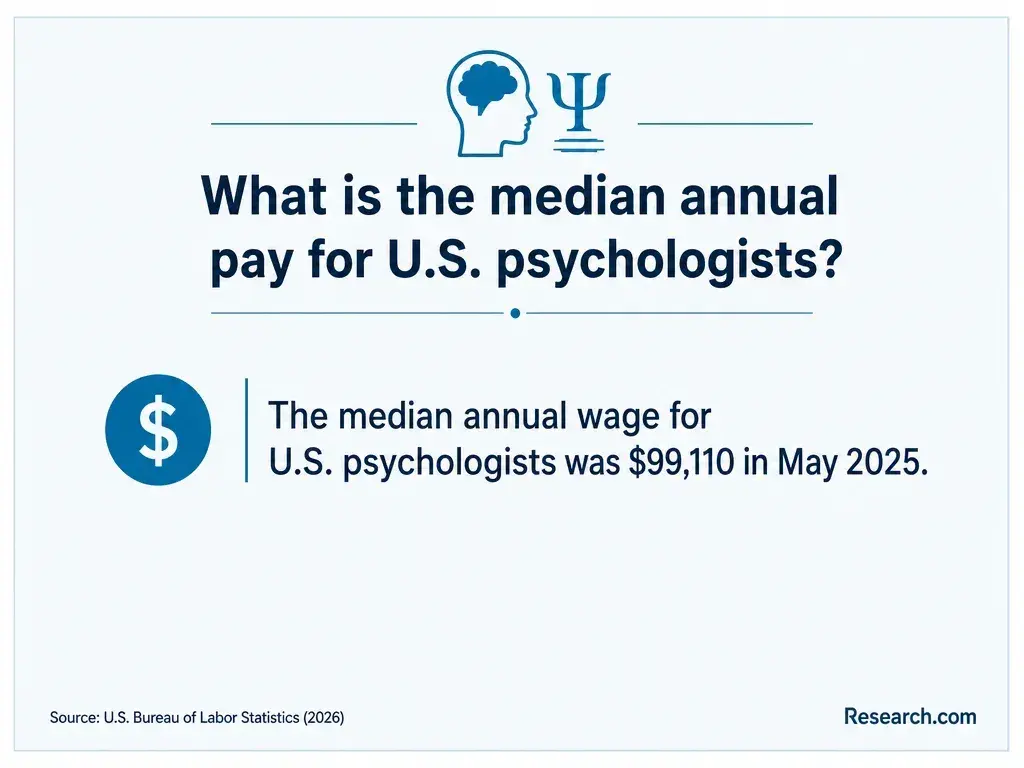
There is no single reliable "forensic psychology MS salary." The degree can support applications to occupations with different pay scales and entry rules; published wages for licensed psychologists describe a profession that an MS graduate does not automatically enter. For a defensible comparison, choose a specific target job title and location, then check its current postings, employer pay schedule, and the matching U.S. Bureau of Labor Statistics occupation where one exists.
Compare likely pay against the full degree cost, time away from paid work, and any credentials still needed. psychology master's programs with intensive pacing may reduce time enrolled, but only if their workload lets you maintain the employment or responsibilities your financial plan assumes. A program's occupational outlook claims are most useful when it names the occupation, its duties, and its required qualifications - not just a broad psychology-related growth figure.
Other Things You Should Know About Psychology
Submit all transcripts the application requires and answer its questions truthfully. A transcript may identify a program or campus, but disclosure rules differ by school; ask admissions if a question's scope is unclear.
Ask whether a recent professor, research supervisor, or work supervisor can address your writing, analytical skills, and reliability. The program decides which recommenders it accepts.
Only if the institution permits enrollment and your facility permits the required internet access, meetings, assessments, and communications. Get answers from both before paying an application fee.
No. Funding attached to an eligible prison education program does not automatically carry over to graduate study. Ask the graduate financial-aid office to assess your current eligibility and options.
- Prison Education Programs Questions and Answers | ed.gov http://www.ed.gov/laws-and-policy/higher-education-laws-and-policy/prison-education-programs-questions-and-answers
- License Requirements for Psychology - Office of the Professions https://www.op.nysed.gov/professions/psychology/license-requirements
- Online Forensic Psychology Master's Degree | ASU Online https://asuonline.asu.edu/online-degree-programs/graduate/master-science-forensic-psychology/
- Admission Policy Procedures | College of Liberal Arts and Social Sciences | Texas A&M University-Victoria https://www.tamuv.edu/liberal-arts-social-sciences/graduate-degrees/forensic-psychology/admission-policy-procedures/
- Carolina Prison Education Program - Friday Center https://fridaycenter.unc.edu/students/carolina-prison-education-program/
- Transfer Credit Evaluation - Transfer Student Resources https://transfer.ncsu.edu/transfer-credit-evaluation/
- MA in Forensic Psychology - The George Washington University https://forensicpsychology.columbian.gwu.edu/ma-forensic-psychology
- Identity Verification of Students Enrolled in Online Courses | Information Technology Services https://louisville.edu/policies/identity-verification-students-enrolled-online-courses
- Professional Licensure Disclosures | rutgers.edu https://gsapp.rutgers.edu/professional-licensure-disclosures
- Supporting Justice-Impacted Students Through Re-Entry and Post-Release | NCAN https://www.ncan.org/Web/Web/Resource-Library/Justice-Impacted-Students/Supporting-Justice-Impacted-Students-Through-Re-Entry-and-Post-Release.aspx