
Online MBA in Marketing: Curriculum and Workload for Small Business Owners

Co-Founder and Chief Data Scientist
Running a business leaves little room for coursework that does not solve a real problem. An online MBA in marketing may help you make better decisions about customers, growth, and cash flow, but its management core demands time beyond marketing classes. This guide explains what you are likely to study, how to assess the weekly workload, and when the investment makes sense for a small business owner. You can use it to compare programs against the work your company needs you to do.
Key Things You Should Know
- An online marketing MBA usually combines accounting, finance, operations, and leadership courses with marketing electives; verify that marketing is a formal concentration, not just an available class.
- Weekly workload depends on course design and enrollment pace. Before enrolling, check live meetings, group deadlines, and peak demands during your busiest business season.
- Judge value against total program cost and time away from the business, not a projected salary increase. A targeted course may be a better purchase if you need only one marketing skill.
What is an online MBA in marketing, and is it useful for small business owners?
An online MBA in marketing is a graduate management degree with additional study in marketing. The MBA core addresses decisions across the business; a marketing concentration, when formally offered, adds focused courses in areas such as customer research, brand strategy, or marketing analytics. Online describes delivery, not a uniform schedule or curriculum.
For an owner, the broad core can be as valuable as the concentration. More effective customer acquisition will not necessarily improve the company if pricing fails to cover costs, inventory cannot meet demand, or cash runs short.
An MBA is most useful when you want to improve several connected parts of the business and can apply lessons as you learn. If your immediate need is to set up search advertising or improve a website, a focused course, mentor, or consultant may produce a faster, less costly result.
Career stage also changes the calculation. An established owner considering MBA program choices: online MBA programs after 50 may value succession planning, leadership, or a future career transition more than a conventional post-graduation salary increase.
What courses are included in an online MBA in marketing curriculum?
There is no universal marketing MBA curriculum. Schools determine their own core, concentration requirements, electives, and applied work. This comparison shows what common course areas could contribute to an owner's decisions; it is not a course list for every program.
| Course area | Typical subject matter | Potential business application |
| MBA core | Managerial accounting, finance, operations, strategy, and leadership | Connect marketing plans to margins, capacity, staffing, and cash flow |
| Marketing-focused courses | Customer behavior, market research, segmentation, pricing, brand strategy, or digital marketing | Choose customers, offers, and channels using evidence rather than guesswork |
| Analytics electives | Measurement, forecasting, and interpretation of business data | Assess acquisition costs and repeat purchases without mistaking clicks for profit |
| Applied project or capstone, if offered | A business plan, consulting assignment, or integrated strategy project | Test a decision relevant to the company, subject to project rules and data permissions |
Expect management-level use of research and analytics, not necessarily advanced training in statistical modeling or advertising-platform implementation. Compare actual syllabi and required courses: a program with one digital marketing elective may not provide the depth you want, while a broader core may be exactly what a growing company needs.
How much time does an online MBA in marketing require each week?
No reliable weekly-hour figure applies to every online marketing MBA. Reading, assignments, group work, and exam preparation vary by course, term length, and your familiarity with accounting or quantitative work. A compressed course can be especially demanding even when you take only one class at a time.
For an owner, the problem is often when work is due, not just how much work exists. Asynchronous lectures may fit around customer appointments, but a team presentation or live discussion may not. Use this scheduling check before choosing a pace:
- Ask for sample syllabi showing weekly assignments, meeting times, exam windows, and group-project deadlines.
- Mark your company's seasonal peaks and recurring obligations, then identify uninterrupted study periods and backup coverage for the business.
- Ask whether you can reduce your course load, pause enrollment, or change cohorts without losing progress, and get the policy in writing.
If schoolwork would regularly displace sales, payroll oversight, or essential customer service, a slower pace - or a shorter course outside an MBA - may be the more responsible choice.
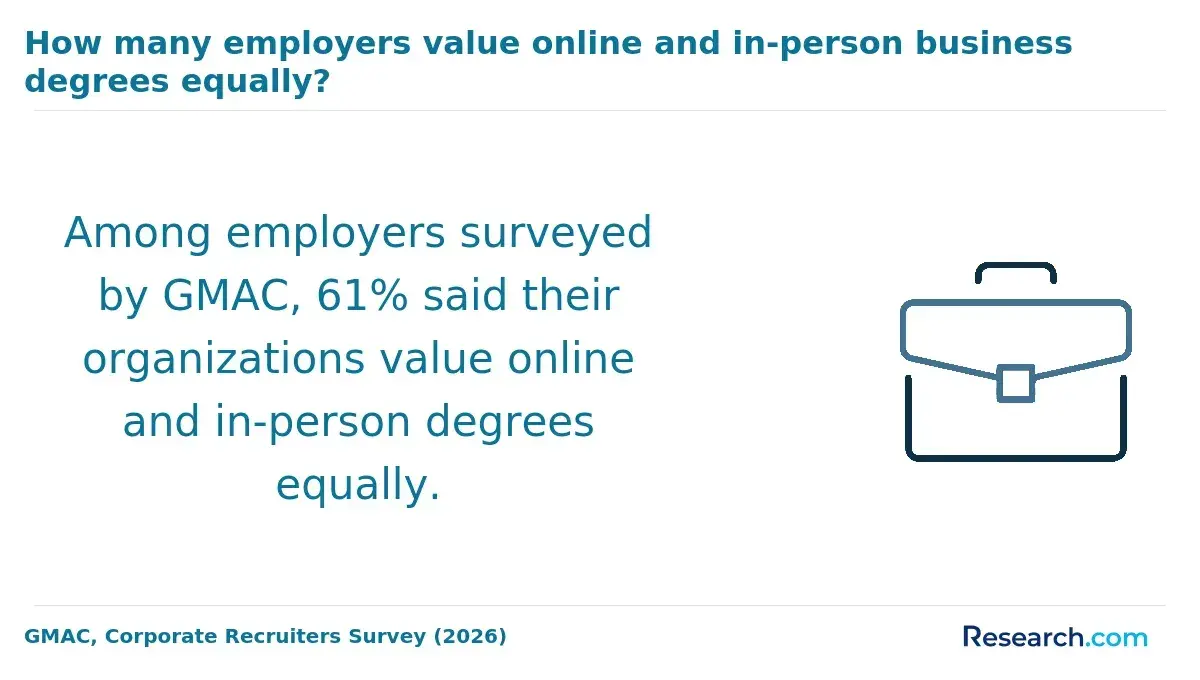
Neither format is automatically more rigorous or more flexible. Compare specific programs' academic requirements and access to people, not the delivery label. The differences below matter most when leaving the business has a direct operating cost.
| Consideration | Online MBA | Campus-based MBA |
| Time away from the business | May reduce commuting, but live sessions or residencies can still require scheduled absence | Regular travel to campus and fixed class times may require more coverage |
| Collaboration | Often relies on remote teams and scheduled virtual meetings | May offer more routine face-to-face interaction |
| Networking and recruiting | Access varies; confirm which events and career services online students can use | On-campus events may be easier to attend, depending on program and schedule |
| Practical fit | May suit an owner who must remain near the business | May suit an owner who can delegate operations and wants in-person engagement |
Ask whether the online and campus options share faculty, degree requirements, and career resources. Do not assume that an online student has access to every recruiting opportunity offered to a full-time campus cohort.
Requirements vary by school. Applicants commonly submit evidence of an undergraduate degree, transcripts, a résumé, and written statements; some programs request recommendations, an interview, or GMAT or GRE scores.
Professional-experience expectations, test waivers, and deadlines are program-specific. A business bachelor's degree is not universally required, though an owner without recent accounting or quantitative coursework may benefit from preparation or foundation classes.
Ownership experience can strengthen an application when you describe decisions you made, their results, and what you want to learn - not merely the fact that you founded a company.
If earlier grades concern you, examine each school's stated policy rather than assuming you are ineligible; research into online MBA programs for low-GPA applicants can help you frame questions for admissions staff. Such a list does not replace checking current requirements directly with the program.
Completion time depends on required credits, term length, course availability, and how many courses you take at once. A faster schedule shortens the calendar but can increase the hours you must take away from operations. Ask for a course sequence at the pace you can sustain, including when marketing electives are offered.
To estimate cost, multiply required credits by the published per-credit tuition if that is how the school charges, then add mandatory fees, books or software, and any required travel.
If tuition is charged by term or as a program total, use that pricing structure instead. Include financing costs and the value of work you would have to delegate or decline; a tuition figure alone is not the full cost of attendance.
Previous graduate coursework might reduce the required credits, but transfer limits and concentration rules differ. When you compare MBA transfer policies, request a written evaluation showing which credits satisfy core or marketing requirements before relying on a shorter timeline or lower cost.
The strongest application connects a marketing decision to an operating result. An owner might use customer research to identify a profitable segment, test a revised offer, and then use managerial accounting to check whether its margin supports the acquisition cost. A strategy course could help determine whether expanding into another market is sensible before committing staff and inventory.
Choose one business question to carry across courses where instructors permit it. Keep a baseline, document the decision, and track outcomes such as contribution margin or repeat purchases - not just impressions or sales volume.
If a class project involves customer records or confidential financials, confirm data-use rules and substitute anonymized information when necessary. Coursework can improve the quality of a decision; it cannot guarantee that a campaign or expansion will succeed.
For many owners, the immediate career outcome is running their company more effectively. Those considering a move into employment may find their experience relevant to marketing management, product or growth strategy, or general management - especially if they can demonstrate budgets managed, teams led, and measurable customer results.
Employers will still assess industry knowledge, role-specific skills, and the scale of prior responsibility; the degree alone does not qualify someone for a senior post.
A different professional goal may call for a different degree combination. For example, a licensed nurse aiming at healthcare administration might investigate MBA program choices: online MSN and MBA dual-degree programs. That route addresses a distinct background and is not a necessary addition for a typical small business owner seeking marketing skills.
There is no single salary or job-growth rate for "marketing MBA graduates." The U.S. Bureau of Labor Statistics reports that management occupations had a median annual wage of $126,520 in May 2025. That figure describes workers across management occupations - not MBA graduates, marketing specialists, or small business owners - and should not be used to forecast your return on tuition.
The BLS projects management employment to grow faster than the average for all occupations from 2025 to 2035.
For an owner, the more useful financial test is whether better decisions could improve business cash flow enough to justify tuition and time away. For a career transition, compare the responsibilities and experience requirements of the specific role you want with your own record before estimating potential pay.
How can you choose an accredited online MBA in marketing?
First, verify the institution's accreditation through its accreditor and the U.S. Department of Education's recognition information. Then check whether the business school or program holds separate business accreditation, if that distinction matters to you. Institutional and business-school accreditation are not interchangeable, and accreditation does not establish that a marketing concentration is offered online.
Request the current degree plan and confirm the formal concentration name, required marketing courses, delivery format, total charges, and policies for interruptions. Ask to speak with staff about a realistic course sequence for your busiest season.
Compare those answers with the narrower problem you could solve through a short course or advisor. If admissions accessibility is a concern, a review of online MBA programs with accessible admissions education pathways can help identify programs to investigate, but verify each school's current standards and academic fit yourself.
The best choice is the program whose coursework you can use, schedule you can sustain, and total cost your business can absorb. If a full MBA fails any of those tests, postponing it - or choosing targeted education - is a sound decision.
Other Things You Should Know About MBA
Possibly. Eligibility depends on the student and the school's program, enrollment, and aid rules. Submit the FAFSA and ask the financial aid office what, if any, federal aid is available at your planned course load.
Not necessarily. Ask instructors about project requirements before enrolling and whether you can use anonymized, aggregated, or hypothetical data. Avoid sharing customer or employee information without appropriate permission.
Some schools permit nondegree or certificate enrollment, but later application of that course toward an MBA is not assured. Get written confirmation of credit eligibility and any limits before registering.
Policies differ. Ask about withdrawal deadlines, leaves of absence, course availability on return, and any financial-aid consequences before you need a break.
- Plan your business - Small Business Administration https://www.sba.gov/counseling/plan-your-business/
- Semester Course Load and Student Performance - PMC - NIH https://pmc.ncbi.nlm.nih.gov/articles/PMC7568764/
- MBA with a concentration in Marketing Online - St. Cloud State https://degree.stcloudstate.edu/online-programs/business/mba/marketing/
- Credit hours is not enough: Explaining undergraduate perceptions of course workload using LMS records - ScienceDirect https://www.sciencedirect.com/science/article/pii/S1096751622000380
- Online MBA in Marketing Program | LSU Online https://online.lsu.edu/online-degree-programs/graduate/mba-marketing/
- Online | MBA | Howard University School of Business https://business.howard.edu/graduate/online-mba
- Student perspective: The credit hours to workload relationship is more art than science | Michigan State University https://undergrad.msu.edu/news/2022/01-student-perspective-credit-hours
- Core MBA Subjects Explained From Analytics to Strategy | University of New Haven https://business.online.newhaven.edu/blog/core-mba-subjects
- MBA Marketing Online Degree at Fitchburg State University https://online.fitchburgstate.edu/degrees/business/mba/marketing/
- What to Consider When Evaluating Online MBA Programs | Northeastern Online https://online.northeastern.edu/resources/what-to-look-for-when-choosing-an-online-mba-program/


