2027 Online Ed.D. in Leadership and Learning in Organizations Admissions: Presenting Evidence of Leadership Impact
Audited and Verified:
Our Editorial and Data Verification Process
Research.com uses government datasets, official education statistics and primary institutional information to support its career and degree guides. Our review process checks factual accuracy, occupational definitions, source dates and the requirements associated with the credentials discussed.
How This Article Was Fact-Checked
Our editorial team verifies salary estimates, employment projections, education requirements and program information against original data providers and official organizations. Salary figures are checked against the relevant occupational definitions and reporting periods. Information about licensure, accreditation and required in-person training is reviewed separately.
Fact-checked and verified on:

Co-Founder and Chief Data Scientist
An online Ed.D. application may ask you to show leadership impact, but a senior title or a successful project does not explain what you personally changed. This matters for experienced leaders, learning and development professionals, and applicants whose strongest work happened outside formal management roles.
This guide shows how to select credible evidence, describe your contribution without overstating results, and connect a real organizational challenge to doctoral study. It also identifies the admissions rules and program features to check before you invest in an application.
Key Things You Should Know
- Show impact as a chain: the organizational problem, your decision-making role, the action taken, the evidence available, and what you learned.
- Separate verified outcomes from estimates or observations; a credible account of an incomplete or mixed-result initiative can be stronger than an unsupported success claim.
- Check each program's stated degree, experience, writing, recommendation, and project requirements; there is no universal Ed.D. admissions checklist.
What is an online Ed.D. in leadership and learning in organizations?
An online Doctor of Education in this area is generally a practice-oriented doctorate focused on how people learn, lead, and improve organizations. Depending on the program, students may study adult learning, organizational change, leadership, and applied inquiry. "Online" describes where much instruction occurs; it does not establish that attendance is self-paced or that campus visits are unnecessary.
Program titles can conceal meaningful differences. Some emphasize workplace learning across sectors, while others focus on school or higher education leadership. Applicants comparing understanding different Ed.D. degree formats and focuses should inspect the actual curriculum and final project, not infer a specialization from the degree title. For an applicant whose goal is original academic research rather than improvement in practice, a research-oriented PhD may fit better.
What are the admission requirements for an online Ed.D. in leadership?
Requirements vary by institution and entry term. A program may specify a completed graduate degree, a grade threshold, relevant professional experience, recommendations, a statement, writing samples, or an interview. Other programs evaluate some of those factors without setting a fixed minimum. Prior graduate credits that establish eligibility do not necessarily transfer into the doctorate.
Read the current application instructions alongside the program's degree and experience definitions. Ask admissions whether leadership of projects, staff learning, volunteer teams, or cross-functional initiatives qualifies if you have not held a managerial title. If your degree is in another field, confirm formal prerequisites rather than assuming an education master's is required. An academic gap or limited research coursework is best addressed with evidence of recent analytical work and a specific preparation plan, not an unsupported claim of research expertise.
How can applicants demonstrate leadership impact in an Ed.D. application?
The strongest evidence makes your contribution and its limits visible. Select one or two initiatives relevant to organizational learning or change, then use the same factual account across your statement, résumé, and recommender briefing. A useful sequence is:
- Define the problem: Identify the performance or learning need, who was affected, and what was known before the initiative.
- Specify your authority: Distinguish decisions you made from recommendations, team contributions, and actions approved by someone else.
- Describe the response: Explain how you engaged stakeholders, chose an approach, and handled constraints such as budget, access, or resistance.
- Present evidence and limits: Name the records or feedback that support an outcome; distinguish participation, learning, behavior change, and organizational results.
- Reflect forward: Explain what remains uncertain and how doctoral study could improve your ability to investigate or address it.
For example, an applicant who coordinated manager training could explain the needs assessment, their role in redesigning the sessions, and what attendance records or approved evaluation summaries can establish. Attendance alone would not prove improved management performance. A recommender who observed the work can corroborate your judgment and collaboration, but should not be asked to certify results they cannot verify.
Protect employer and participant information. Use approved, aggregated descriptions where possible; obtain permission before sharing internal documents or identifiable data. If the initiative produced mixed results, describe the adjustment you made. That demonstrates evidence-based leadership more convincingly than assigning yourself credit for every later improvement.
Confirm that the institution holds recognized institutional accreditation by checking its current status with the accreditor and the U.S. Department of Education's accreditation database. Then confirm that the advertised Ed.D. is an awarded degree at that institution, rather than a certificate or an unapproved use of a similar program name. Institutional accreditation does not, by itself, establish a particular programmatic accreditation or licensure outcome.
Accreditation matters when comparing value as well as legitimacy. Before using a list of low-cost Doctor of Education programs online, verify each school's status, the exact degree, and any requirements that would add travel or time to the advertised price.
Relevant coursework may cover leadership theory, adult learning, organizational diagnosis, change implementation, research methods, and program evaluation. For an applicant presenting a training initiative, the important question is whether the curriculum will help them test learning transfer and organizational effects - not merely design another workshop. Compare required courses with electives and ask how faculty supervise applied inquiry.
Final requirements differ. Programs may require a dissertation, dissertation in practice, capstone, or another approved project, and the labels do not guarantee equivalent work. If a conventional dissertation is a poor fit, examine Ed.D. study without a conventional research dissertation, then confirm the actual research, approval, and completion requirements with the program.
Both formats can require substantial discussion, collaborative work, faculty feedback, and an applied project. Delivery format alone does not establish academic rigor or scheduling flexibility. The comparison below identifies the commitments most likely to affect a working applicant.
| Feature | Online program | Campus-based program |
| Class attendance | May combine live meetings with independent work | Typically requires travel to scheduled on-site classes |
| Peer collaboration | Often coordinated remotely across work schedules | Can include on-site meetings alongside classes |
| Travel | May still require campus convenings | Regular commuting or relocation may be necessary |
Request the live-session schedule, attendance policy, convening calendar, and group-project expectations before applying. A shorter advertised pathway is useful only if its required course sequence and project pace are feasible; accelerated education doctorate completion planning should account for workload as well as elapsed time.
Time to completion depends on required credits, course sequencing, enrollment pace, and the final project. A published minimum is not a completion promise: securing project access, obtaining approvals, or revising an analysis can extend study. Ask for the program's normal course plan and policies on leaves, missed cohorts, and continued enrollment during the final project.
Compare the full financial commitment rather than tuition alone: required credits or terms, mandatory fees, technology, travel and lodging, and possible tuition increases. Employer assistance may depend on continued employment or satisfactory progress. Use written program charges and your employer's actual policy when estimating costs; organizational leadership doctorate tuition comparisons are a starting point, not a substitute for an individualized cost estimate. If your main need is one leadership skill, employer development or a targeted course may cost less and serve you sooner.
Graduates may use the degree in learning and development, organizational development, talent management, consulting, nonprofit leadership, public administration, or education-adjacent roles. The credible next step depends on prior responsibility. A training specialist who has led evaluations might pursue broader learning-program leadership; an experienced manager might apply stronger inquiry and change skills within their existing sector.
Employers still assess sector knowledge, budgets managed, people leadership, and demonstrated results. An Ed.D. does not automatically qualify someone for a director role or make a transition into consulting viable without clients and relevant experience. In an application, describe a professional goal that follows from work you have actually done and identify the capability the doctorate would add.
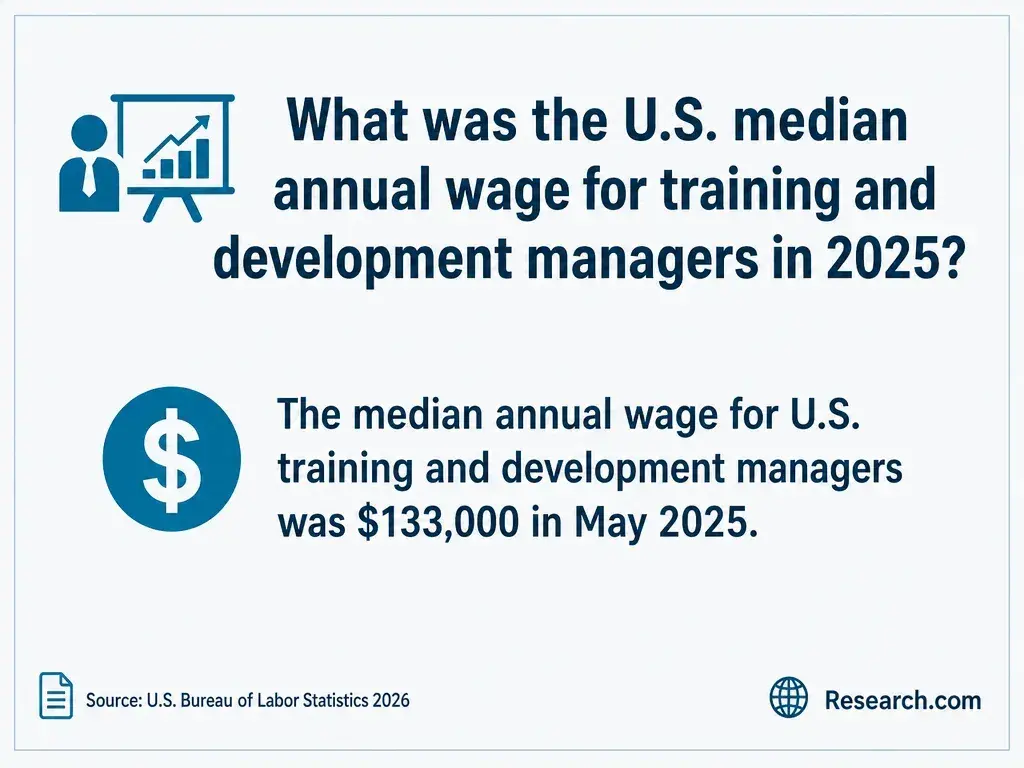
U.S. Bureau of Labor Statistics figures describe occupations, not Ed.D. graduates or the financial return from enrolling. These two roles illustrate why applicants should connect career expectations to a specific job rather than the degree title.
| Occupation | Median annual pay, May 2025 | Projected employment change, 2025-2035 |
| Training and development managers | $133,000 | +6.4% |
| Training and development specialists | $69,280 | +10.8% |
The manager role has the higher occupational median, but its responsibilities generally require substantial relevant experience. Neither figure predicts an individual applicant's pay, promotion, or ability to recover doctoral costs. Check actual postings and internal advancement rules for your target role.
Does an Ed.D. in leadership require a license or certification?
General organizational leadership and workplace learning roles do not ordinarily require a license simply because the practitioner holds an Ed.D. Regulated education positions are different: a school principal, for example, may need state-specific administrator credentials. A broadly focused leadership doctorate does not automatically meet those requirements.
If your target job is regulated, ask the program whether its exact degree and coursework are designed to meet the relevant state's requirements, and confirm the answer with that state's licensing authority. Professional certifications in learning or change management are separate credentials with their own criteria.
Other Things You Should Know About EdD Leadership
It can demonstrate real responsibility and impact, but whether it satisfies a program's professional-experience requirement is a separate admissions decision. Describe your authority and evidence as precisely as you would for paid work.
Credit the team's work and identify the decisions, analysis, or coordination you personally contributed. Avoid presenting a collective result as your individual achievement.
Use a nonconfidential description of the problem, your process, and the kinds of evidence considered. Ask your employer before sharing internal figures, documents, or participant information.
No. A well-scoped problem, plausible evidence sources, and an explanation of what you still need to learn can show stronger readiness than claiming to know the answer before investigating it.
- Ten simple rules for writing compelling recommendation letters | nih.gov https://pmc.ncbi.nlm.nih.gov/articles/PMC7906297/
- Online Doctorate in Education Leadership and Innovation | NYU https://leadershipinnovation.steinhardt.nyu.edu/
- Application Components | Yale Law School https://law.yale.edu/admissions/jd-admissions/apply-yale-law-school/application-components
- Doctoral Application Requirements | Crown Family School of Social Work, Policy, and Practice https://crownschool.uchicago.edu/admissions/doctoral-admissions/application-procedures
- Leadership and Learning in Organizations Online Ed.D. | Peabody College of Education and Human Development https://peabody.vanderbilt.edu/academics/edd-programs/online-leadership-learning-organizations/
- UNC EdD Online: Organizational Learning and Leadership https://online.unc.edu/online-doctoral-programs/online-edd-organizational-learning-and-leadership/
- Advance Your Leadership Career with an Online Ed.D. | UMass Global https://www.umassglobal.edu/blog-news/advance-your-leadership-career-online-edd
- Letters of Recommendation Guide | uoregon.edu https://urds.uoregon.edu/letters-recommendation-guide
- Common graduate application mistakes (and how to avoid them) | UVA Batten https://batten.virginia.edu/admissions-blog/common-graduate-application-mistakes/
- How to Measure the Impact of Your Leadership Development Programs - UPCEA https://upcea.edu/how-to-measure-the-impact-of-your-leadership-development-programs/