2027 Online BA in Psychology - General Psychology: Understanding the Difference Between a Track and a Transcripted Concentration
Audited and Verified:
Our Editorial and Data Verification Process
Research.com uses government datasets, official education statistics and primary institutional information to support its career and degree guides. Our review process checks factual accuracy, occupational definitions, source dates and the requirements associated with the credentials discussed.
How This Article Was Fact-Checked
Our editorial team verifies salary estimates, employment projections, education requirements and program information against original data providers and official organizations. Salary figures are checked against the relevant occupational definitions and reporting periods. Information about licensure, accreditation and required in-person training is reviewed separately.
Fact-checked and verified on:

Co-Founder and Chief Data Scientist
An online BA in psychology may advertise a "general psychology track" or a "general psychology concentration," but those labels do not necessarily produce the same academic record. That difference matters when you apply to graduate school, explain your coursework to an employer, or transfer credits. If you are choosing a program or planning your remaining courses, this guide explains what each designation usually means, how to confirm what will appear on your transcript, and when a formal concentration is worth choosing over flexible electives and stronger research preparation.
Key Things You Should Know
- A track may guide course selection without appearing on the official transcript; a transcripted concentration is a formally recorded component of the degree. Confirm each school's policy rather than relying on its website terminology.
- For graduate applications, relevant courses, grades, research experience, and prerequisites usually provide more useful evidence than the designation alone.
- Neither designation changes a general psychology BA into a clinical qualification. Compare the remaining courses, total cost, and opportunities to demonstrate skills before choosing.
What is the difference between a psychology track and a transcripted concentration?
A track is often an advising pathway: a suggested or prescribed set of courses within the psychology major. A transcripted concentration is an officially approved specialization that the institution records on the student's academic transcript after its requirements are met. Schools do not use these terms consistently, so the decisive question is not what the website calls the option. It is what the registrar records and what requirements govern completion.
This comparison shows why the distinction matters when you need to document your preparation. It describes common arrangements, not a rule that applies to every university.
| Question | General psychology track | Transcripted concentration |
| Where is it defined? | Possibly in an advising plan or program description | In formally approved degree requirements |
| Does its name appear on the transcript? | Not necessarily | Yes, if the institution awards and records it |
| What proves the coursework? | Individual courses and grades | Individual courses and grades, plus the recorded designation |
| Does it confer a professional credential? | No | No |
Ask the registrar for an example of how the completed designation appears on an official transcript, and ask an academic advisor for the applicable catalog requirements. Also check whether it appears on the diploma; transcript notation and diploma wording are separate policies. A concentration can make a coherent course sequence easier to identify, but it does not replace the courses themselves or certify a professional skill.
The distinction becomes more consequential when comparing a broad general psychology pathway with a named specialty. For example, someone comparing online forensic psychology programs should check whether "forensic" names a transcripted concentration, a track, or simply a group of electives. None of those labels grants investigative or clinical authority.
Is a general psychology track or concentration better for graduate school?
Neither designation is inherently better for graduate admission. The stronger choice is the one that lets you meet your intended program's prerequisites and show readiness for its work. A transcripted concentration can make an academic interest visible, but an admissions committee can also read the courses, grades, research work, and recommendations behind a nontranscripted track.
For a research-oriented psychology master's or doctorate, prioritize statistics, research methods, substantive courses related to your interests, and opportunities to work with faculty.
For counseling, social work, school psychology, or other professional study, compare the target program's actual admission requirements instead of assuming a general psychology concentration satisfies them. Some doctoral programs admit applicants directly from a bachelor's degree; a psychology master's is not universally required.
Before committing to either option, identify a few plausible graduate programs and compare their prerequisites with your proposed degree audit. If a formal concentration consumes electives you need for statistics or laboratory experience, its transcript notation may be a poor trade.
If its required courses match your goals and leave room for research, it may provide a useful structure. The same principle applies when comparing the fastest psychology master's formats: speed and a specialization label should not displace the methods preparation or faculty access you need.
Can an online BA in general psychology lead to a psychology career?
Yes, a general psychology BA can support entry into nonclinical, psychology-related work, especially when paired with relevant experience. It does not, by itself, qualify someone to practice as a psychologist, provide psychotherapy, diagnose conditions, or independently administer restricted psychological assessments. The track-versus-concentration label rarely changes those boundaries.
For an early-career student, the useful question is what evidence an employer will see beyond the degree: research assistance, careful data handling, supervised service work, communication with diverse communities, or a relevant internship. Someone already working in a nonprofit or service agency may be able to build on existing coordination and outreach experience; they should not assume their current duties automatically satisfy a university placement requirement.
For example, working in substance use recovery support may involve outreach, referrals, documentation, or peer support. Specific jobs may require training, certification, lived-experience criteria, or supervision under state and employer rules. Studying addiction in a general psychology track does not itself authorize substance-use counseling.
General psychology BA programs commonly combine general education with an introduction to psychology, research methods, statistics, and coursework across areas such as development, social behavior, cognition, biological psychology, and psychological disorders. The exact core, elective choices, and course order depend on the university. A course about disorders teaches academic subject matter; it is not clinical training.
Look beyond course titles when comparing a track with a transcripted concentration. Check whether each requires the same methods sequence, whether advanced electives have prerequisites, and whether you can complete a supervised research project or nonclinical internship online. "Online" may still involve scheduled meetings, group work, an approved local site, or a campus visit; verify those obligations before enrolling.
A general track may leave more room to combine methods, development, and organizational courses. A formal concentration may reserve those electives for a defined subject. If addiction is your intended area, evaluating online bachelor's study in addiction psychology can help you compare actual course depth with the appeal of a specialty name. In either case, ask for a term-by-term degree plan showing when required courses are offered.
An online psychology BA can be a recognized undergraduate degree when it is awarded by an institution with appropriate institutional accreditation. Verify the institution and its current accreditation status with the accreditor or the U.S. Department of Education's recognized accreditation information, then confirm that the online BA is offered by that institution. Accreditation does not establish that a particular track is transcripted, guarantee employer acceptance, or make the BA a license-qualifying clinical program.
Do not look for APA accreditation of a general psychology bachelor's degree: APA accreditation applies to specified professional psychology training programs, not general BA programs. An employer may instead examine the degree, individual courses, experience, and any job-specific credential. A graduate professional program may have its own applicable accreditation and state-licensure considerations.
If your actual goal is licensed counseling rather than a broad psychology education, compare the requirements of a qualifying graduate counseling pathway separately, including its accreditation relevance and full cost. A resource on paying for an online mental health counseling degree addresses a different credential decision; neither a BA concentration nor an inexpensive graduate option should be treated as proof of licensure eligibility without checking the state board's rules.
Requirements vary by institution and by whether you apply as a first-year or transfer student. Schools generally review prior secondary or college study and require an application and official academic records; additional requirements depend on the program. Admission to the university, admission to the psychology major, and approval of a particular concentration may be separate decisions.
If you have college credit, request a written degree audit before treating a general track as the quicker option. A school may accept a course for transfer without applying it to statistics, research methods, the major, or a concentration.
Ask which catalog applies to you, whether prerequisites or residency rules affect the plan, and who approves substitutions. Psychology transfer eligibility and degree planning is especially relevant when an apparent credit savings could disappear after courses are placed against actual requirements.
Keep copies of transcripts and course descriptions for any disputed equivalency. The receiving institution - not a prior advisor or a general transfer estimate - has final authority over how its degree requirements are satisfied.
Completion time depends on accepted credits that apply to the degree, remaining course requirements, course availability, and enrollment pace. Starting without prior college credit generally means a multiyear bachelor's pathway; an approved transfer plan may shorten it. A concentration can extend the plan if its required electives are offered infrequently or replace courses you have already completed.
For cost, compare the price of the remaining degree, not an advertised per-credit rate alone. Request an estimate that includes remaining credits, mandatory fees, materials, any travel or placement expenses, and the financial-aid implications of your intended enrollment pace.
Then compare that estimate with an alternative plan that uses flexible general psychology electives. Do not assume transfer acceptance, aid eligibility, or a graduation date until the relevant offices confirm them.
Intensive online psychology program formats may reduce elapsed time for some students, but faster terms can make research projects, work, and caregiving harder to balance. Ask how often required courses run and whether accelerated enrollment changes tuition, aid, or scheduling obligations.
Potential applications include research-support positions, human-services or program coordination, community outreach, and entry-level roles in organizations that value behavioral research and communication. These are possible directions, not jobs awarded by the degree. Employers may require particular software skills, service experience, a background check, additional training, or a credential specific to the position.
Read postings by duties rather than by a "psychology" keyword. A research assistant may help recruit participants under an approved protocol and manage data; a service coordinator may document contacts and arrange referrals. Neither role is equivalent to independently assessing or treating clients. Use relevant coursework and supervised work to show that you can perform the actual tasks while respecting confidentiality and role boundaries.
Forensic interests illustrate why titles matter. A bachelor's graduate might seek appropriately qualified victim-services or justice-program support work, but not licensed forensic assessment. Even faster online forensic psychology master's completion does not, by itself, confer the education, supervised practice, and license needed to work as a psychologist.
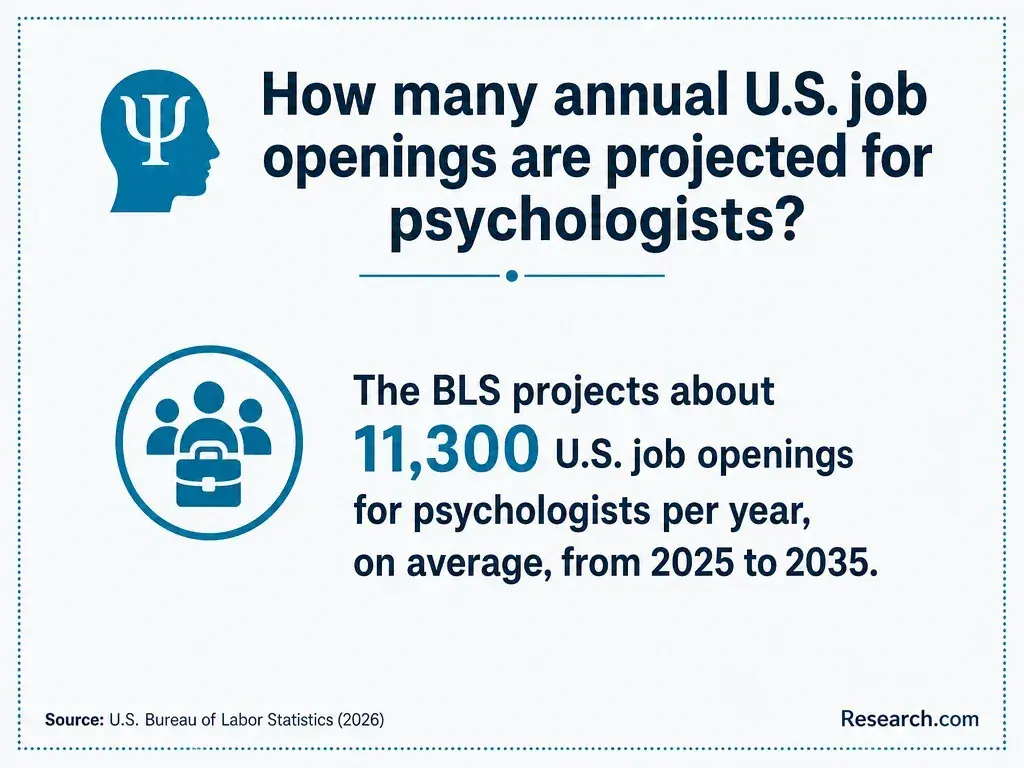
There is no single salary or job-growth figure for graduates of a general psychology BA, and a transcripted concentration does not create one. Pay depends on the specific occupation, location, employer, experience, and any required credential. U.S. Bureau of Labor Statistics Occupational Outlook Handbook figures are occupation-wide measures, not predictions for graduates of a particular online program.
For a realistic comparison, first select jobs whose stated entry requirements you can meet. Then consult the latest BLS wage reference year and employment-projection period for each matching occupation, and compare local postings with the actual cost of completing your degree.
Do not use the occupational median for psychologists to estimate the earnings of a new BA graduate: psychologist roles require substantially more education and, for regulated practice, licensure.
If cost is central to the decision, online psychology education on a budget is worth comparing against each program's completed-degree estimate. The best financial choice may be the track that accepts more applicable credits or permits needed electives without extra terms - not the one with the lowest advertised tuition or the most distinctive label.
What education and licensing are required to become a psychologist?
A general psychology BA - whether it has a track or a transcripted concentration - is undergraduate preparation, not a psychologist license. In the United States, licensed psychologist pathways generally involve an appropriate doctoral psychology degree, supervised experience, required examinations, and approval by the state licensing board.
Requirements and permitted titles vary by jurisdiction and area of practice; check the board where you intend to work before selecting further education. Decide which profession you mean before using graduate-school plans to choose a BA designation. A licensed professional counselor, clinical social worker, school psychologist, and licensed psychologist follow distinct educational and regulatory routes.
If counseling is the goal, fast-track online clinical counseling master's options belong in a comparison of counseling pathways, not a comparison of ways to become a psychologist. Verify the proposed graduate program's recognition, supervised-training requirements, and fit with the intended state's rules.
For now, choose the undergraduate option that supplies the prerequisites and experiences your intended next step actually requires. A transcript notation is useful evidence of a completed specialization, but it cannot substitute for qualifying graduate training or a professional license.
Other Things You Should Know About Psychology
Yes, if you completed it and describe it accurately. Identify it as a track or course emphasis rather than an officially awarded concentration, and list relevant courses when that gives an employer clearer evidence.
Not automatically. Ask the registrar whether the institution permits a post-graduation change to the awarded academic record and what approvals would be required. Completing additional courses elsewhere does not necessarily change an existing transcript.
It depends on who awards it and the institution's records policy. A university certificate, a noncredit badge, and a degree concentration are different credentials; request a sample record for the specific option.
Ask the academic department and registrar to resolve the discrepancy in writing for your entry catalog. Keep the response with your degree plan before enrolling in courses intended to satisfy the disputed requirement.
- Degree Name on Diploma | wisc.edu https://kb.wisc.edu/registrar/34658
- Program: Psychology B.A., with Diversity Concentration | usf.edu https://catalog.usf.edu/preview_program.php
- Transfer Toolkit - Tuition, Financial Aid, and Scholarships | NCCCS https://www.nccommunitycolleges.edu/transfer-advising-toolkit/draft-transfer-toolkit-tuition-financial-aid-and-scholarships/
- What is a Major, Minor, or Concentration? | SUL ROSS https://www.sulross.edu/about/what-is-a-major-minor-or-concentration/
- Understanding Your Degree Audit | University College Online Degree Programs https://basbls.uc.uiowa.edu/advising/degree-planning/understanding-your-degree-audit
- Do Transfer Credits Affect GPA? | The University of Olivet https://www.uolivet.edu/how-do-transfer-credits-affect-gpa/
- Psychology (BS) - Clinical Psychology Track Degree | UCF Online https://www.ucf.edu/degree/psychology-bs/clinical-psychology-track/
- Major in Psychology | towson.edu https://catalog.towson.edu/undergraduate/liberal-arts/psychology/psychology/
- BA in Psychology | Cal State LA https://www.calstatela.edu/nss/psychology/ba-psychology