2027 Online BA in Psychology - General Psychology for Work in College Student Services Offices: Compare Degree Fit and Hiring Requirements
Audited and Verified:
Our Editorial and Data Verification Process
Research.com uses government datasets, official education statistics and primary institutional information to support its career and degree guides. Our review process checks factual accuracy, occupational definitions, source dates and the requirements associated with the credentials discussed.
How This Article Was Fact-Checked
Our editorial team verifies salary estimates, employment projections, education requirements and program information against original data providers and official organizations. Salary figures are checked against the relevant occupational definitions and reporting periods. Information about licensure, accreditation and required in-person training is reviewed separately.
Fact-checked and verified on:

Co-Founder and Chief Data Scientist
An online BA in general psychology can prepare you for some college student services jobs, but it is not a universal qualification for advising, counseling, or student affairs leadership. If you want to support students through orientation, access programs, or referrals, the deciding factors are often the job's duties and your relevant experience, not the degree title alone.
This guide compares realistic roles, hiring expectations, online study, and costs so you can decide whether a psychology BA is the right next step or whether a more direct route would serve you better.
Key Things You Should Know
- A general psychology BA can fit entry-level student support and program coordination jobs; advising and counseling requirements vary substantially by employer and duties.
- For context, the U.S. Bureau of Labor Statistics reported a $65,140 median annual wage in May 2024 for school and career counselors and advisors, a broad occupation that is not an entry-level psychology BA salary.
- Choose an online program only after checking institutional accreditation, total remaining credits, scheduling, and access to supervised student-facing experience.
What is an online bachelor's degree in general psychology for college student services?
It is a broad undergraduate psychology degree completed primarily online and applied to nonclinical work with college students. General psychology usually covers human development, learning, social behavior, research methods, and statistics.
Those subjects can help a staff member communicate with students, interpret program evidence, and understand when to refer someone to a qualified professional.
The degree is not a student affairs credential or a license to provide therapy. Its fit improves when you pair electives and assignments with practical experience in orientation, accessibility support, first-year programs, or student success offices.
If your intended work is specifically in substance-use services rather than a campus student services office, distance learning degrees in addiction counseling represent a different, more specialized educational comparison; their titles alone do not establish counseling eligibility.
What college student services jobs can you get with a psychology bachelor's degree?
Look first at the work described in each posting, not just its title. The table separates plausible bachelor's-entry work from positions that commonly demand further preparation; none is guaranteed by completing the degree.
| Office or role | Typical work | What may matter beyond the BA |
| Orientation or student engagement coordinator | Plan events, communicate with students, track participation | Event coordination and campus employment |
| Student success or retention assistant | Schedule outreach, maintain records, connect students with resources | Student information systems, documentation, and referral judgment |
| Accessibility services assistant | Coordinate appointments and approved accommodation processes | Confidentiality training and knowledge of office procedures |
| Academic or career advisor | Guide academic or career decisions under institutional policy | Requirements vary; some employers seek a master's or advising experience |
Experience as a resident assistant, peer mentor, tutor, or campus office employee can provide more persuasive evidence of job readiness than a psychology elective by itself. Student support may overlap with community referrals, but career choices across recovery service settings have different responsibilities and, in some roles, state-specific credentials.
Do college student services jobs require a bachelor's or master's degree?
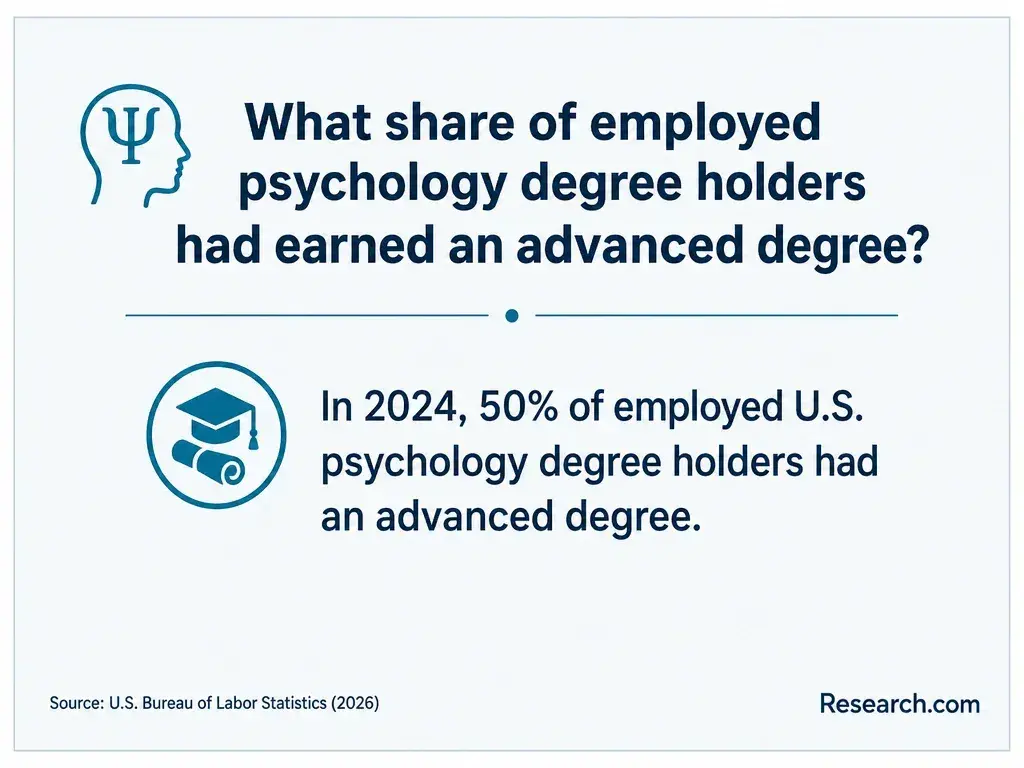
Some support and coordination jobs accept a bachelor's degree; many counseling and senior student affairs jobs expect a master's degree or substantial experience. There is no single education rule for every college office. An employer may accept several majors while prioritizing advising experience, knowledge of student records, or experience serving a particular student population.
Read the posting for whether a master's is required or preferred, then compare the listed tasks with your evidence of doing them. Mental health counseling is a separate, regulated path: a general psychology BA does not qualify its holder to diagnose or provide psychotherapy.
If that is the actual goal, compare qualifying graduate education rather than assuming that shorter graduate counseling programs by cost and duration can be substituted for a student affairs master's; the programs serve different roles and must be checked against state requirements.
Both formats can teach the same psychology concepts, but they may offer different access to campus employers. An on-campus student can often meet student services staff through campus jobs and events.
An online student may need to arrange comparable experience locally or ask whether the university permits remote mentoring, approved fieldwork, or participation in its own student-facing programs.
Online does not necessarily mean self-paced. Check live-session times, group-work expectations, exam arrangements, and any required visits before enrolling. These checks matter across specialties.
Forensic psychology degree accreditation comparisons, for example, address a different career interest, but illustrate why delivery format and institutional recognition must be assessed separately.
Common components include introductory psychology, developmental and social psychology, statistics, research methods, and a capstone or advanced seminar. For student services work, developmental psychology can inform how students navigate transitions.
Social psychology can sharpen thinking about belonging; and methods courses can help staff evaluate outreach surveys without mistaking correlation for proof that a program worked.
Prioritize electives in education, multicultural psychology, communication, disability studies, or organizational behavior when available, then seek a student-facing project or job. Verify the actual catalog: electives are not necessarily offered every term, and an elective is not a formal concentration.
Someone considering a later specialty should compare its prerequisites separately; twelve-month forensic psychology graduate study pathways, for instance, should not be treated as equivalent to taking a forensic elective during a general BA.
First-year applicants generally submit secondary-school records or an accepted equivalent; transfer applicants usually submit transcripts from prior colleges. Schools set their own GPA, documentation, and application rules. Admission to the university, admission to the major, and application of transfer credits toward graduation are distinct decisions.
If you have college credit, request a written degree audit showing which courses satisfy general education, psychology methods and statistics, electives, and residency requirements.
Ask about financial aid deadlines while applying: a related guide to comparing grants for undergraduate addiction counseling study may help frame aid questions, but its program-specific opportunities should not be assumed to apply to a general psychology BA.
Time and cost depend on the credits you still need, the pace you can sustain, course availability, and the school's charges. A transfer student may finish sooner than a first-time undergraduate, but accepted credits do not always satisfy major requirements. Required statistics or research-methods sequences can also delay graduation if courses are offered infrequently.
Compare a school-issued estimate covering remaining tuition, mandatory online fees, books or software, and any travel or unpaid experiential work. Use the same remaining-credit assumptions for every school; an apparently low per-credit price can lose its advantage if fewer prior courses apply. Inexpensive undergraduate substance use counseling degree choices offer a different specialization and should be compared only if that curriculum also fits your intended job.
Confirm the university's current institutional accreditation with the accreditor and the U.S. Department of Education's accreditation records, then confirm that the online BA is offered by that institution. Check the status for your intended enrollment period and ask the school about any restrictions affecting your location.
Do not look for APA accreditation of a general psychology bachelor's degree: APA's professional accreditation does not cover general BA programs. Program-specific recognition matters when comparing a different professional credential.
For example, accreditation checks for accelerated counseling programs address considerations that should not be incorrectly applied to an undergraduate psychology major.
There is no reliable single salary for "psychology graduates in student services": campus assistant, advisor, counselor, and administrator positions have different qualifications and pay structures.
The U.S. Bureau of Labor Statistics reports a $65,140 median annual wage in May 2024 for school and career counselors and advisors. That occupation spans settings and qualifications, so its median is not a starting offer for a BA holder seeking an entry-level college office job.
BLS projects employment in that broad counseling-and-advising occupation to grow 4% from 2024 to 2034. Use that projection for context, not as a forecast for one college's hiring. Compare pay ranges in actual local postings, including benefits and advancement requirements.
Likewise, exploring better-paid roles related to forensic psychology will not establish the earnings available in student services: the occupations and required preparation differ.
How do you choose a reputable online psychology degree program?
Start with three actual student services postings you would consider. Identify their required degree, preferred experience, software, and student-facing duties; then assess programs against those requirements rather than against a general promise of career versatility.
Before committing, ask admissions and the psychology department for a degree audit, a course schedule, the full cost estimate, and examples of accessible internships, campus employment, or supervised projects. Ask career services whether online students can use its employer connections.
If you already hold a bachelor's degree and mainly need advising experience, another BA may be a poor investment; targeted training or entry-level campus work may be more direct. Consider finding a lower-cost psychology master's degree only when specific job postings or your longer-term academic goal justify graduate study, not because a master's automatically qualifies you for counseling or promotion.
Other Things You Should Know About Psychology Programs
Possibly, but obtain approval from your academic program before counting it. The work must meet its learning, supervision, and documentation requirements; employment alone does not establish internship credit.
Follow institutional privacy policies and applicable law, including FERPA where relevant. Share information only through authorized channels, and seek guidance rather than making independent promises of confidentiality.
Not necessarily. Employers often train staff on their systems. Campus employment or approved administrative experience can help you demonstrate accurate recordkeeping and appropriate data handling.
If you meet its required qualifications, consider applying and explain relevant mentoring, tutoring, service, or administrative work. Do not treat a stated degree or credential requirement as optional.
- Students & Recent Graduates | U.S. Office of Personnel Management https://www.opm.gov/policy-data-oversight/hiring-information/students-recent-graduates/
- Requirements Related to the Practice of Counseling - NCBI https://www.ncbi.nlm.nih.gov/books/NBK259170/
- Accreditation in the U.S. | ed.gov http://www.ed.gov/laws-and-policy/higher-education-laws-and-policy/college-accreditation/accreditation-in-the-us
- Skills of a Psychology Major | Evelyn L. Spiro School of Nursing https://wagner.edu/psychology/skills/
- Area Coordinator - Residential Life - 994559 - NSU Careers https://nsucareers.nova.edu/jobs/area-coordinator-residential-life-994559-fort-lauderdale-davie-florida-united-states
- Do Employers Accept Online Degrees? What Matters Most to Hiring Managers | University of the People | https://www.uopeople.edu/blog/do-employers-accept-online-degrees/
- Internship Opportunities for Psychology Students | Husson University https://www.husson.edu/college-of-science-and-humanities/blog/2026/06/internships-for-psychology-students
- Psychology careers guide | apa.org https://www.apa.org/education-career/guide/careers
- BA vs. BS in psychology: key differences explained | Capella University https://www.capella.edu/blog/psychology/ba-vs-bs-in-psychology-key-differences-explained/
- Careers in Psychology: High-Demand Jobs for Graduates | CSP Global Concordia University, ST. Paul https://online.csp.edu/resources/article/psychology-degree-jobs-career-paths/