2027 Online BA in Psychology - General Psychology for Psychology of Civic Participation: Which Courses Should You Look For?
Audited and Verified:
Our Editorial and Data Verification Process
Research.com uses government datasets, official education statistics and primary institutional information to support its career and degree guides. Our review process checks factual accuracy, occupational definitions, source dates and the requirements associated with the credentials discussed.
How This Article Was Fact-Checked
Our editorial team verifies salary estimates, employment projections, education requirements and program information against original data providers and official organizations. Salary figures are checked against the relevant occupational definitions and reporting periods. Information about licensure, accreditation and required in-person training is reviewed separately.
Fact-checked and verified on:

Co-Founder and Chief Data Scientist
If you want to understand why people vote, volunteer, organize, or disengage, an online BA in general psychology can provide useful tools, but only if its courses connect behavior to communities and teach you how to evaluate evidence.
This guide is for prospective and returning students interested in civic research, outreach, or nonprofit and public-sector work. It identifies the most valuable courses, explains what an online program must offer beyond a course catalog, and helps you decide whether a psychology BA or a more targeted route fits your goal.
Key Things You Should Know
- Prioritize social psychology, research methods, statistics, cultural psychology, and community-based learning; a course labeled "civic participation" is not necessary.
- Check whether relevant electives run online, whether a methods course precedes the capstone, and whether supervised community work can be arranged where you live.
- A psychology BA can prepare you for nonclinical outreach and research-support roles, but it does not confer clinical licensure or guarantee a civic-sector job.
What Is an Online BA in General Psychology and Civic Participation?
An online BA in general psychology is a broad undergraduate degree in psychological science, delivered partly or entirely online. Psychology of civic participation is the study of how people's beliefs, identities, relationships, environments, and institutions relate to activities such as voting, volunteering, public meetings, and collective action. It is usually a topic assembled through electives and projects, not the name of a formal psychology concentration.
That distinction matters when comparing degrees. Psychology is particularly useful for questions about motivation, social influence, trust, and behavior. Political science may offer deeper preparation in elections and government; sociology may better cover institutions and inequality.
If your goal is a specialized justice-system career rather than civic participation broadly, compare the intended job's requirements before considering forensic psychology master's completion time comparisons. A faster graduate degree is not automatically a better foundation for community research or public engagement.
Which Courses Should You Look For in Psychology of Civic Participation?
The strongest course combination is social psychology plus research methods and statistics, supported by coursework on culture, development, and community contexts. A compelling elective title cannot make up for weak methods training: civic organizations need people who can distinguish a promising outreach idea from evidence that it worked.
The table separates essential foundations from useful additions. Course titles vary, so compare catalog descriptions, prerequisites, and the work students actually produce.
| Course area | Why it matters for civic participation | What to look for |
| Social psychology | Examines attitudes, identity, group norms, persuasion, and collective behavior. | Application to real social settings, not persuasion techniques alone. |
| Research methods and statistics | Supports credible surveys, comparisons, and interpretation of participation data. | Study design, sampling, uncertainty, and explicit attention to correlation versus causation. |
| Cultural or cross-cultural psychology | Helps students examine whose experiences a theory or measure may overlook. | Context, accessibility, representation, and measurement across groups. |
| Developmental psychology | Adds a lifespan perspective on civic learning and participation. | Attention to age and setting without stereotyping communities. |
| Community psychology or program evaluation | Connects individual behavior with organizations, resources, and local conditions. | Partnership ethics and evaluation of a feasible community question. |
A workable sequence is introductory psychology, then statistics and research methods, followed by social or community psychology and an applied project. Ask whether you can use an approved, accessible dataset or partner-defined question to create a research brief.
Recruitment, surveys, and access to organization records require the appropriate permissions; a class assignment does not itself authorize them. If your intended work is specifically substance-use prevention, compare addiction psychology bachelor's curriculum options rather than assuming a general civic-focused elective supplies that subject knowledge.
Is an Online Psychology Bachelor's Degree Accredited and Career-Ready?
Check institutional accreditation for the university awarding the BA through the institution and its recognized accreditor. Do not expect APA accreditation of a general undergraduate psychology major; APA accreditation applies to specified professional psychology training programs, not every degree that teaches psychology.
Career readiness requires a separate check. Request the degree plan and confirm that the courses you need are offered online often enough to finish your sequence. Ask who supervises undergraduate projects, whether local internships are optional or required, and what career support is available to online students.
A program may be institutionally accredited yet offer limited access to community-based work. If your intended role is substance-use counseling rather than civic outreach, compare online substance use counseling degrees against your state's credential rules; neither a program name nor institutional accreditation alone establishes eligibility.
Online and campus-based programs can teach the same psychological concepts, but access to people and projects may differ. Online study can make it easier to work with a local community organization; campus study may make it easier to join a faculty research team or attend events. Neither advantage is automatic.
For an online BA, ask whether classes are asynchronous, whether group research meetings occur at set times, and whether any internship, residency, or exam requires travel. For a campus program, ask whether relevant courses and placements fit your schedule.
Delivery format also matters if you later pursue specialized graduate work: forensic psychology graduate study in an intensive format illustrates why a short advertised timeline must be weighed against live sessions, workload, and applied requirements. For the BA, choose the format that lets you complete the methods sequence and obtain meaningful feedback.
Admissions requirements depend on the university and on whether you apply as a first-year or transfer student. Schools commonly request prior academic records; some have separate rules for entry to the psychology major or upper-level courses. Do not assume that admission to the university means every course needed for a civic-focused plan is immediately available.
If you have college credit, request a written degree audit showing which courses satisfy general education, psychology major, statistics, methods, elective, and residency requirements. An accepted course may count only as a general elective. This is especially important when planning a psychology degree with previous college study: ask the receiving institution about course equivalencies and appeals before choosing a completion timeline.
Many US bachelor's degrees are built around 120 semester credits, but your remaining time depends on accepted credits, required prerequisites, course availability, and enrollment pace. A civic-participation project may also require advance approval from a faculty member or organization. Ask for a term-by-term plan rather than relying on an advertised completion time.
Compare the full cost of that plan: tuition, required fees, materials, technology, possible travel, and any unpaid project or internship time. Then check aid eligibility at your expected enrollment level and compare low-cost online psychology degrees using the credits you would actually need at each school. The lowest published tuition rate may not produce the lowest remaining cost if credits fail to apply or a needed course is offered infrequently.
A well-chosen general psychology curriculum can help you turn a broad claim, such as "residents are disengaged," into a question that can be examined respectfully. Useful skills include defining participation clearly, reading research critically, designing accessible questions, interpreting basic data, and communicating limitations to a nonacademic audience.
Social and cultural psychology can also help you consider whether an apparent lack of interest reflects barriers such as timing, language, transportation, or distrust.
Employers will still want evidence that you can use those skills. An approved, nonclinical project might result in a literature review, survey proposal, or evaluation brief that states its data source and limitations.
Do not present a proposal as completed research or share identifiable participant information in a portfolio. If your work centers on recovery services, low-cost substance use counseling undergraduate degree pathways may be more targeted; compare their coursework and applicable credential requirements before trading broad research preparation for specialization.
Potential entry-level directions include community outreach assistant, volunteer coordinator, program assistant, and research-support roles. Day-to-day duties may involve arranging events, communicating with participants, maintaining records, coordinating volunteers, or helping collect and summarize data. Hiring requirements depend on the employer; experience, writing ability, language skills, and familiarity with a community may matter as much as the major.
Read job postings by tasks, not just titles. A research role may require stronger statistics or software skills, while a public-agency role may require specific eligibility or experience. If a justice-system setting interests you, online forensic psychology bachelor's programs in three years or less offer a different curricular emphasis to compare. Neither that label nor a general psychology BA grants investigative, clinical, or legal authority.
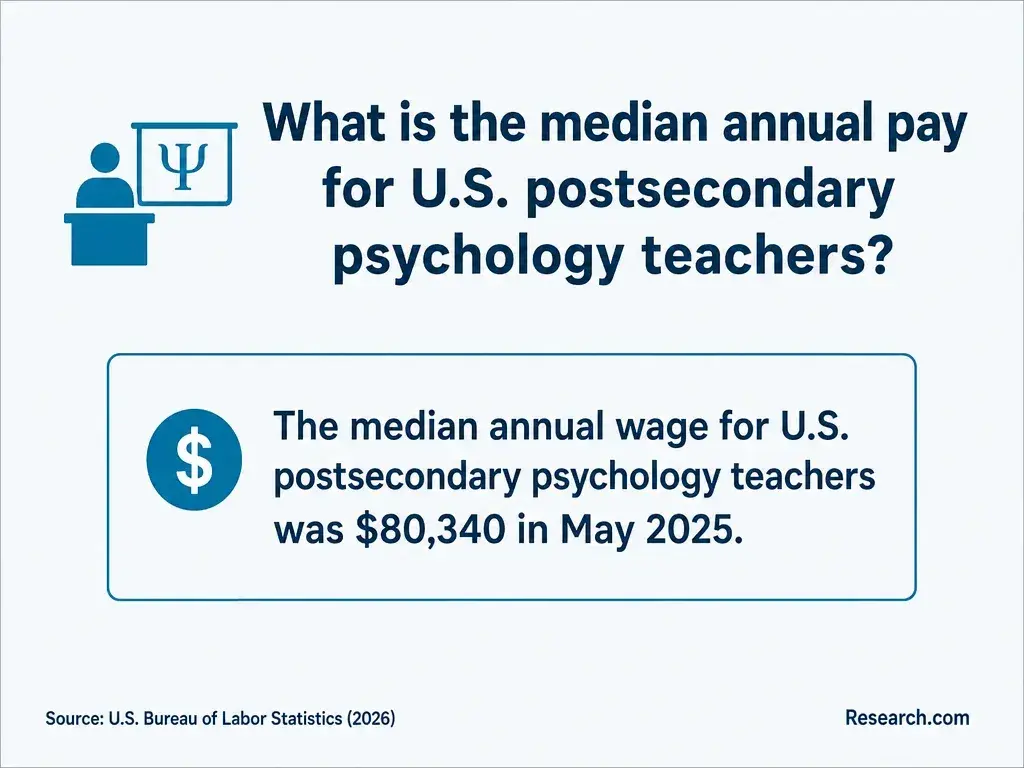
There is no single salary or growth rate for "psychology BA graduates." The US Bureau of Labor Statistics reports wages and projections by occupation, while civic-oriented graduates may work across nonprofit, government, education, and research settings. An occupation-wide median is not an entry-level offer or an outcome measure for a particular degree.
For a useful comparison, identify job titles in your target location, check their current Bureau of Labor Statistics occupation descriptions and wage reference periods, then compare local postings' pay and requirements. Include the cost of any additional education in the decision.
If a proposed role requires graduate training, compare tuition-focused psychology master's program choices only after confirming that the degree teaches the needed skills and meets any applicable credential rules. A lower graduate tuition bill does not establish a salary return.
Does a Psychology BA Lead to Licensure or Graduate Study?
A general psychology BA does not by itself qualify someone to practice as a licensed psychologist, diagnose conditions, or provide psychotherapy. Those activities require additional, jurisdiction-specific professional education and other requirements. An undergraduate internship involving outreach, referrals, or program support is not a clinical practicum.
For graduate study in psychological research, prioritize statistics, methods, strong writing, and opportunities for faculty feedback. Check each target program's prerequisites rather than assuming a psychology master's is required before doctoral admission.
If speed is important, evaluate faster pathways through graduate psychology coursework against research access and the qualifications your intended next program or occupation actually requires. Counseling, social work, and other professional degrees follow distinct training and credential pathways.
Other Things You Should Know About Psychology Programs
No. Compare course descriptions and assignments in social psychology, methods, cultural psychology, and community-focused electives.
It can if you want stronger grounding in elections, policy, or institutions. Check whether the minor fits your available electives without delaying graduation.
Possibly, but your instructor and organization must approve the scope, supervision, and any data use. Volunteering alone does not satisfy an academic project requirement.
Ask for the current degree plan, projected online course schedule, project or internship rules, and, if you have prior credits, a written degree audit.
- Exploring key service-learning experiences that promote students' learning in higher education - PMC https://pmc.ncbi.nlm.nih.gov/articles/PMC9972304/
- Service-Learning | Youth.gov https://youth.gov/youth-topics/civic-engagement-and-volunteering/service-learning
- Accreditation in the U.S. | ed.gov http://www.ed.gov/laws-and-policy/higher-education-laws-and-policy/college-accreditation/accreditation-in-the-us
- Program: Community Psychology, B.S. - PBA catalog https://catalog.pba.edu/preview_program.php
- Criteria for Applied Civic Engagement Course Designation | skidmore.edu https://www.skidmore.edu/civic-engagement/criteria.php
- Online Psychology B.A. or B.S. Degree Completion Program | gsu.edu https://online.gsu.edu/program/psychology-ba-or-bs-completion-program/
- B.A. in Psychology for Online Degree Completion Program | gallaudet.edu https://gallaudet.edu/psychology/b-a-in-psychology-for-online-degree-completion-program/
- APA Accreditation - Home https://accreditation.apa.org/
- Bachelor of Arts in Psychology - Texas State's online programs https://online.txst.edu/degrees/undergraduate/ba-psychology/
- Civic Engagement | apa.org https://www.apa.org/education-career/undergrad/civic-engagement